
Customers keep asking for apple pomelo tea by name, and your team keeps improvising it. Apple pomelo tea is a fruit-forward iced tea that pairs a jasmine-style green tea base with apple and pomelo, usually finished with one topping and a clear cup. The problem is that no public standard recipe exists for it, so every shift builds a different drink: one barista pours heavy syrup, another drops in fresh pomelo segments, and the cup your regular loved on Tuesday tastes thin by Friday. Guessing costs you fresh fruit that browns before it sells, inconsistent cups that customers notice, and a menu slot that never earns its place. The US bubble tea market reached about USD 1.08 billion in 2025 (Future Market Insights, 2025), so the demand is real, but demand alone does not protect a margin. This guide builds the spec from verified building blocks: a tested 16 oz recipe, a costed price, a prep workflow your team can repeat, and a sell-through check that tells you whether to keep it.
Step 1: Decide whether apple pomelo tea earns a menu slot
Before you build a single test batch, answer one question with numbers: which item on your current menu does this drink displace or extend? Menu space is the scarcest resource a small shop has, and sales concentrate hard at the top. An analysis of 244,398 restaurant orders by Avocado POS found that the top 10% of items generated 56.4% of item sales at the median restaurant, the top 20% generated 75.3%, and the top 30% generated 85.3%, against a median menu of 51 sold items. The study draws on a single POS vendor’s order data, so treat the exact percentages as directional rather than universal.
That distribution sets your bar. A new fruit tea menu addition has to either pull volume from a slow mover you can retire, or grow the check without slowing the fruit-tea station during a rush.
Decision checklist: Does it share ingredients with SKUs you already stock? Does it fill a real gap in your boba shop menu lineup? Can your team build it at the existing fruit-tea station with no new equipment?
Step 2: Gather what you need before the first test batch
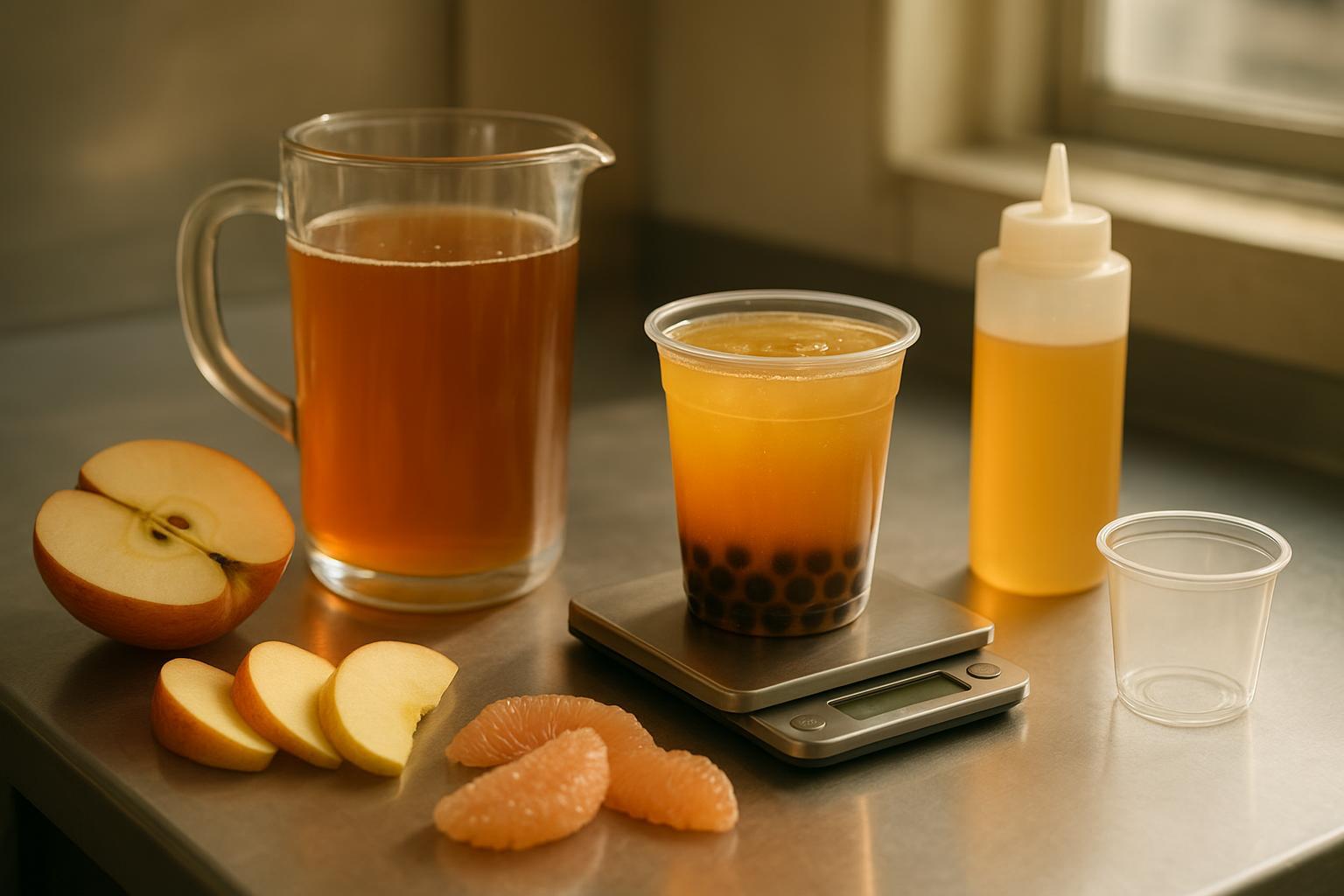
With that bar set, the next move is to get everything on one prep counter, so the first test batch is a measurement exercise rather than a shopping trip.
What you’ll need:
- A jasmine green or light oolong base, enough for at least three test batches
- An apple component and a pomelo component (fresh, frozen, or puree, whichever your supplier already stocks)
- Your existing sweetener system: simple syrup, fructose, or a pump-based syrup you already dose
- One topping, chosen before you brew, not after
- A 16 oz cup as the reference size, since 16 oz / 500 ml is the standard unit for spec and cost math (Boba Buzz FAQ, ~2025)
- A digital scale accurate to 1 g
- A POS item you can map ingredients to, so the test has somewhere to land
Assumed skill: comfortable brewing and batching tea, and dosing syrup by weight or pump.
Time: about 90 minutes for a first test batch, including cleanup and note-taking. Difficulty: intermediate.
Sourcing reality: there is no verified US price band for apple or pomelo inputs. Price this drink from your own supplier quotes, not from any figure in this article.
Step 3: Build the tea base and lock the batch parameters
By the end of this step you have a repeatable base batch with a known yield and a hold time you can defend.
Jasmine green is the most common base for fruit-forward drinks, with oolong or light black as workable alternatives, according to a fruit tea production guide from Youyi101. The choice matters to the pairing: a light jasmine lets the citrus lift of pomelo read clearly, while a heavy roast flattens it and pushes the apple into the background.
- Brew to a fixed ratio and temperature, then write both on the batch card. Keep the same numbers every time so a bitter batch is traceable to a cause rather than a guess.
- Size the batch to expected daily volume, not to the largest pot you own. A smaller batch brewed twice beats a large one held too long.
- Set a hold time and discard the base when it passes. Aroma clarity fades before the tea tastes obviously stale, and that fade is what makes apple pomelo tea read as flat.
Verify: taste the base alone at serving temperature. It should be clean and not bitter before any fruit goes in.
Step 4: Set the apple-to-pomelo ratio and sweetness dosing
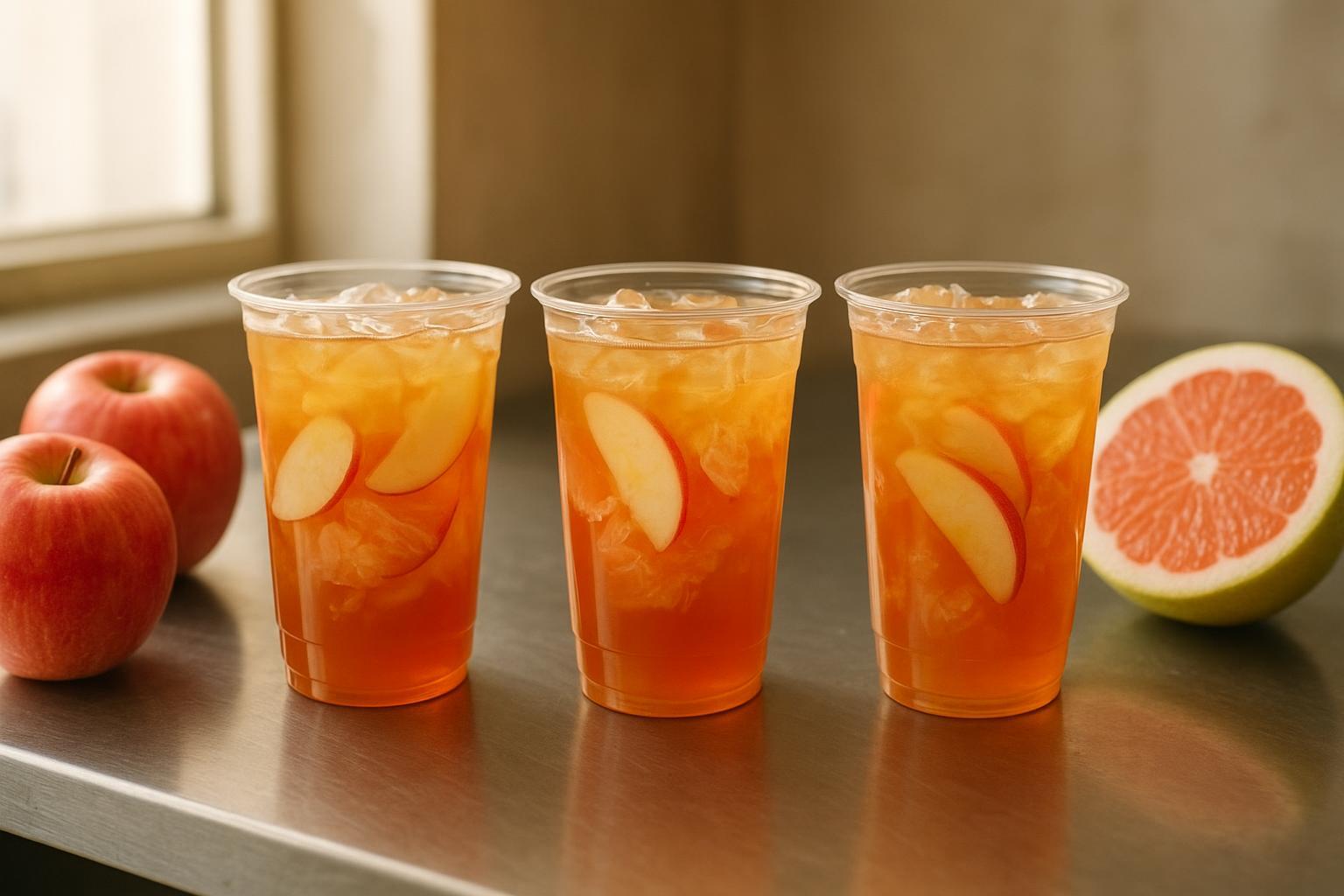
With the base locked, the next variable is the fruit itself. By the end of this step you’ll have a written ratio and a sweetness ladder you can hand to a new hire on their first shift.
Start from the fruit-tea build convention: a 16 oz cup takes roughly a quarter to a half cup of fruit component (youyi101, retrieved 2026-06-11). Split that component between apple and pomelo, and the trade-off is the whole decision. More pomelo gives citrus lift and a bitterness risk if you push past the top of the range. More apple gives body and sweetness, and can mute the pomelo’s top note. A workable starting point for an apple pomelo tea recipe is 60/40 apple to pomelo by weight, then adjust in 10% increments.
Dose sweetness as discrete levels, not “less sugar”: 100%, 70%, 50%, 30%. Weigh it. A scale gives the same cup on every shift; a pump gives you whatever the last person left in the line.
Step 5: Choose the topping and finish the cup
By the end of this step you have one topping, a weight per cup, and a cost line you can carry into pricing. Fruit tea usually works best with a single topping, because a second one muddies the aroma you just built and adds a second cost you have to track.
Choose by texture job, not by trend. Popping boba adds a burst that cuts through the apple and pomelo acidity, while coconut jelly adds a soft chew that keeps the drink light. Nata de coco sits between the two. Whichever you pick, hold it to a fixed weight so the cup tastes the same on every shift.
The add-on is where the topping pays for itself. One operator estimate puts popping boba at roughly $0.25 per serving against a $1.00 add-on charge (Fruit Tea vs Milk Tea Profit Margin, 2026-07-26). Treat that as an operator planning figure rather than audited data, and confirm it against your own supplier invoice before you build it into a fruit tea menu price.
Verification: finish a test cup and let it stand for the drink time you expect at your counter. The topping should still hold its texture and the drink should not separate.
Step 6: Cost the cup and set the menu price
By the end of this step you have a cost per cup and a price you chose on purpose. Fruit tea runs about $1.00 in ingredients and packaging per 16 oz cup against roughly $0.60 for milk tea, at about 84% versus 86% gross margin, per an operator bill-of-materials breakdown (youyi101, 2026). Convert your own containers with the yield figures: a 2.5 kg syrup bottle pours about 83 drinks at 30 ml, and a 1 kg powder scoops about 33 drinks at 30 g (Boba Buzz, 2026).
Then price against the observed US band, where fruit teas at Sharetea in Houston start at $6.25 against $5.45 for milk tea (Menupedia, 2026 Houston menu). Your apple pomelo tea sits in the fruit-tea line, so it carries the higher cost and the higher price.
Treat every figure here as an operator planning number. Vendor and operator cost content is written by parties selling into the category, so it is a starting point for your own spreadsheet, not an audited benchmark (youyi101, 2026).
Step 7: Position it as a seasonal special or a permanent item
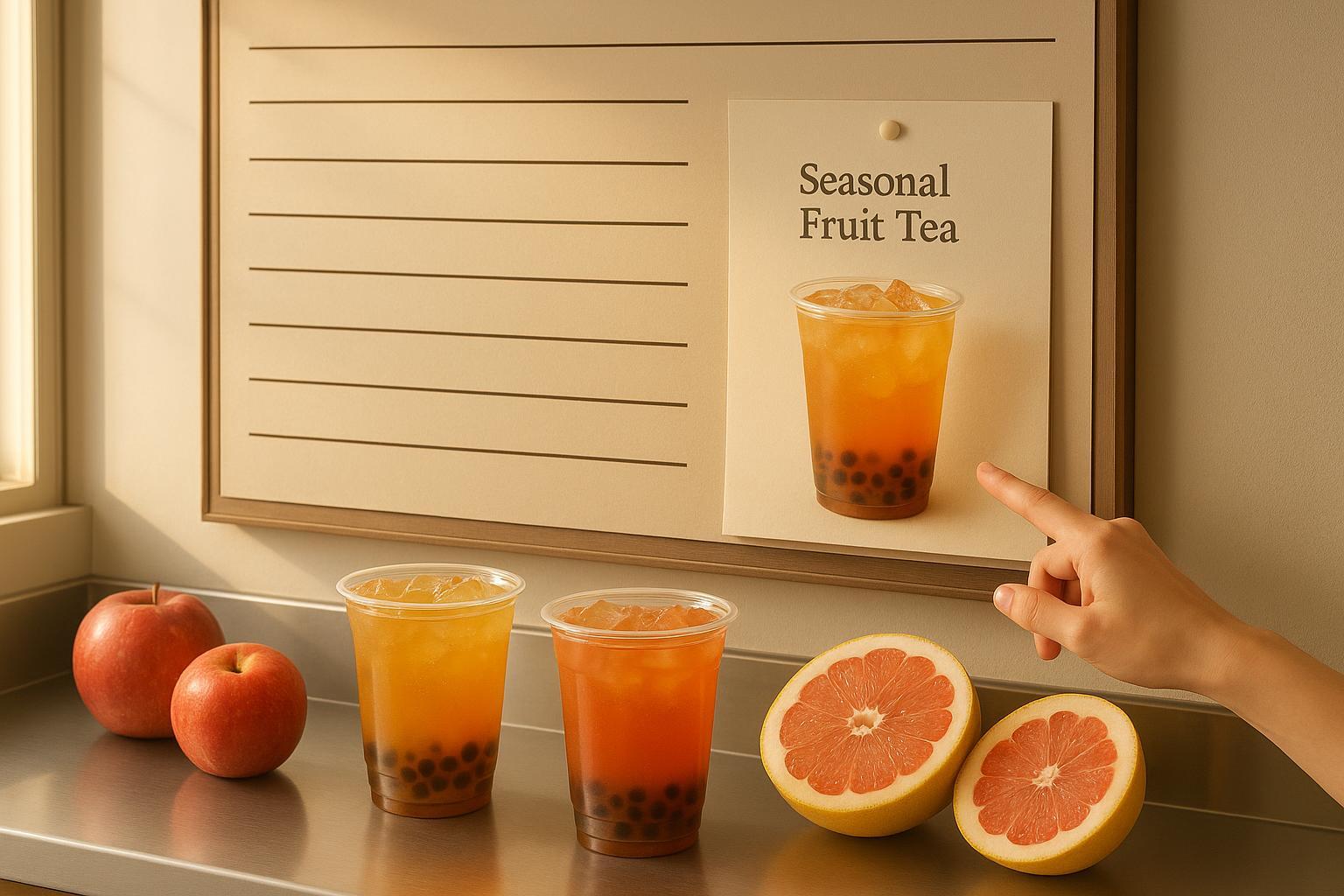
By the end of this step you have picked a launch mode and you know what it costs you. A seasonal run caps your waste exposure: if the drink stalls, you are out one fruit order, not a permanent line on the board. It also gives you a real demand window, because apple and pomelo both peak in the cooler months and customers already expect citrus drinks then. A permanent slot earns its shelf space only when repeat volume covers the ingredients you have to keep in stock year-round.
If you want a lift figure, one supplier claims seasonal beverage offers can lift traffic by up to 25%. That is undated vendor content, not a finding, so treat it as a pitch rather than a benchmark.
Note: Older NPD seasonal-beverage check data circulates in menu-planning posts. It is historical and should not be used as current evidence for a 2026 launch decision.
Step 8: Track sell-through and control waste
By the end of this step you have a two-week loop that tells you whether apple pomelo tea stays on the boba shop menu. Map every menu item to the same ingredient pool in your POS so theoretical usage can be compared against actual counts, and count perishables separately from sealed stock (KitchenInvy, retrieved 2026-05-17). Set par for the apple and pomelo components at daily usage times days between deliveries, plus a safety buffer; a weekly delivery schedule means covering roughly seven days (BobaSync, retrieved 2026-06-18). Those two are short-shelf-life items, unlike dry tapioca, powders, cups and sealing film, which hold far longer (BobaSync, retrieved 2026-06-18).
Waste stays defensible through cross-use: three to four tea bases, a small sweetener system and a core topping set, with fruit components as reusable modules, so one ingredient supports several drinks (fokusinc, retrieved 2026-08-12). After two weeks, compare the SKU’s sales share against the Pareto bands you set in Step 1.
Common mistakes to avoid
The most consequential mistake is treating a consumer recipe as an operator spec. A home formula written in cups and spoons does not tell you yield per batch, cost per cup, or how the drink behaves when a shift worker makes it forty times in a row. The fix is to convert every ingredient to grams and build a batch sheet before the first paid cup.
Copying a home recipe without converting to batch yields. Home recipes are written for one glass, so scaling them by feel produces inconsistent volume and cost. Convert each ingredient to weight, set a fixed batch size, and record the yield in cups per batch.
Dosing sweetness by pump instead of weight. Pumps vary by syrup viscosity and by who is holding them, so the same drink drifts across shifts. Weigh the syrup for the test batch, then calibrate your pumps against that weight.
Buying fresh apple and pomelo without a par level. Fresh fruit has a short window, and over-ordering turns directly into spoilage cost. Set a par level from your expected weekly covers and reorder against it.
Pricing from a competitor’s menu instead of a costed BOM. A competitor’s price tells you nothing about your cup size, your syrup cost, or your labor. Build a bill of materials per cup and price from that number.
Launching permanently before any sell-through data exists. A permanent menu slot is hard to remove once regulars expect it. Run the drink as a limited item first and let the numbers decide.
What success looks like
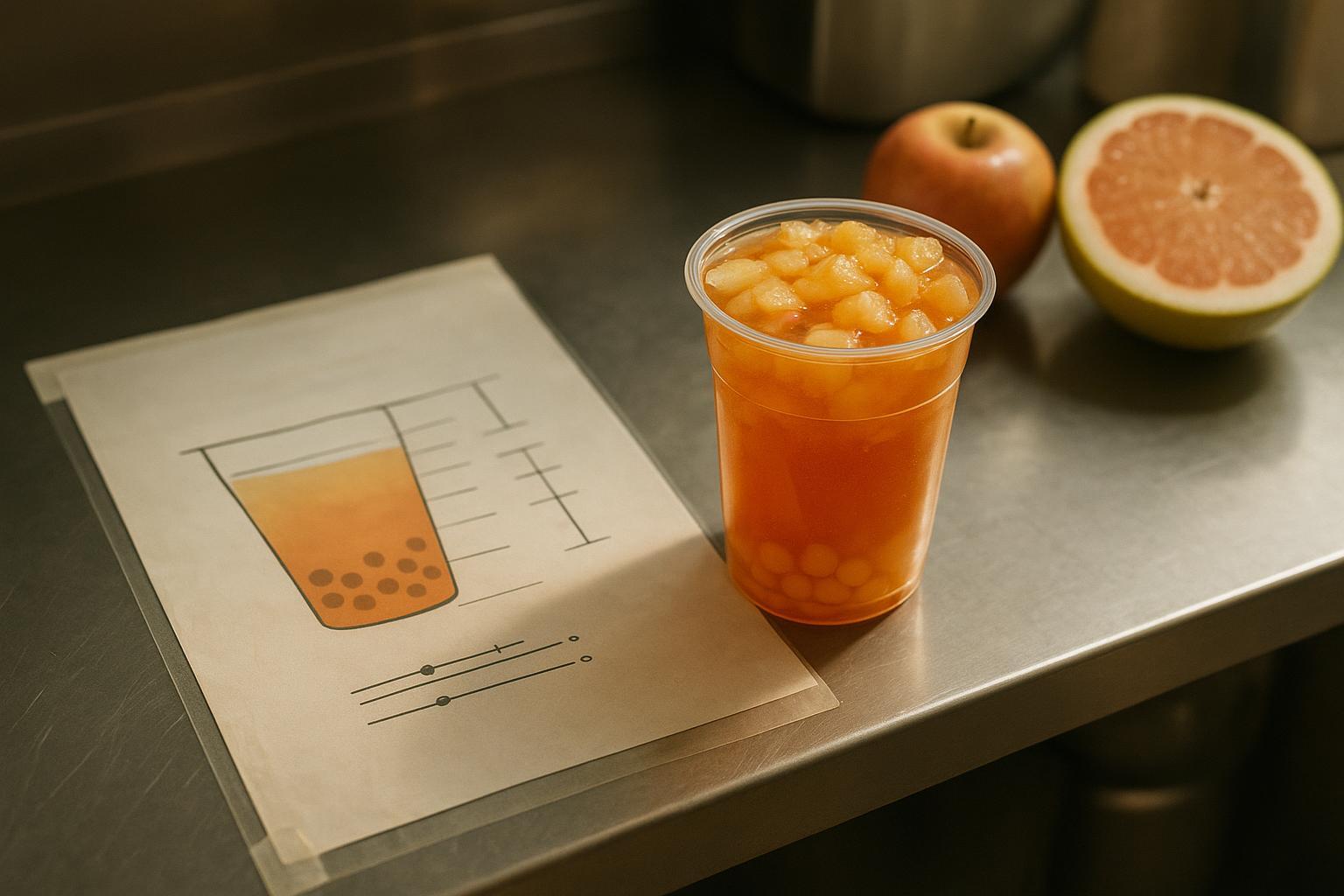
Success is a 16 oz cup your team builds identically on every shift, at a known cost per cup, at a price you chose, with a two-week sell-through number you can actually read. If you can hand a new hire the spec sheet and get the same drink back, the launch worked.
Use this checklist to confirm each checkpoint before you call the item live:
| Checkpoint | Done when |
|---|---|
| Spec sheet posted | One laminated page at the prep station lists base, ratio, sweetness, ice, and topping |
| Three blind builds taste the same | Three staff members build the apple pomelo tea without coaching and the cups match |
| POS maps the item to ingredients | Ringing the item deducts tea base, apple, pomelo, syrup, and topping |
| Par level set | A written minimum on hand covers your Step 1 Pareto band without a mid-week order |
One stretch goal: cross-use the apple or pomelo component in a second SKU so the ingredient cost spreads across two drinks instead of one.
Frequently asked questions
How long do the fruit components keep once opened?
No readable primary source on opened-fruit shelf life was found for this run, so treat your supplier’s label as the authority. In practice that means writing the open date on every tub and bottle the day it is opened, and pulling anything past its stated window rather than judging by smell. If your distributor publishes a use-by period for the opened container, that number beats any general rule you find online.
Is a powder or a syrup base better for this drink?
It depends on how fast you turn the SKU. A 2.5 kg syrup bottle yields roughly 83 drinks at a 30 ml pour (Boba Buzz), which suits a shop selling a steady volume of apple pomelo tea; powder wins when you want a longer unopened shelf life or a smaller opening order. Run the yield math against your projected weekly cups before you commit to either format.
Can I build the drink without fresh fruit?
Yes, and many shops do. A syrup or powder base plus a fruit-flavored topping gets you a consistent cup with no produce prep, no spoilage clock, and no knife work during a rush. Fresh apple and pomelo are what separate the drink from a standard fruit tea, so if you skip them, say so on the menu rather than implying fresh fruit.
How should I price it against an existing $5.45 milk-tea line?
Anchor above the milk tea, not level with it. Fruit teas at Sharetea start at $6.25 (Menupedia), which gives you a defensible range roughly $0.80 to $1.00 higher than your milk-tea price. Cost the cup first, then set the price so the fruit components and any fresh-fruit prep are covered at your target margin.
Next steps
You now have a costed, repeatable fruit-tea SKU instead of a guess: a locked tea base, a tested apple-to-pomelo ratio, a sweetness spec your staff can follow, a topping decision, a price that covers the cup, and a sell-through number that tells you when to reorder.
Before you commit to a full case of any base or purée, order sample packs from two or three suppliers and run the same test batch on each. It costs a few dollars per cup and a single afternoon, and it tells you which apple pomelo tea actually holds its flavor over ice before you tie up cash in inventory you cannot move.
Pick your two candidates this week, then run the batch again side by side.