
You’ve built a strawberry guava lemon tea that tastes perfect on Tuesday and thin by Friday. The fruit settles, the tea turns bitter in the holding container, and someone on the closing shift adds a little more syrup to compensate, so the drink your regulars loved on Monday is now a different drink. Multiply that drift across a week and you’re pouring purée down the drain, guessing at sweetness, and holding a menu slot that never quite earns its place.
This guide fixes that with a repeatable, spec-level build: exact ratios for 16 oz and 22 oz, a sweetness ladder you can train in one shift, holding and date-marking rules, and a cost-per-cup method. It draws on supplier standard operating procedures as of 2026, formulation guidance on °Brix (the percentage of dissolved solids in a liquid, read on a refractometer) and Brix-to-acid balance, FDA Food Code holding rules, and consumer data on guava. Purée is strained whole fruit with body and fiber; nectar is a thinner, pre-sweetened drink base. Dilution ratio is simply how much water, tea or ice you add to a concentrate.
Guava is already familiar ground for your guests: Datassential found 76% of U.S. consumers know guava and 48% have tried it, with the fruit showing up most often in beverages.
Prerequisites: What Your Shop Needs Before You Start
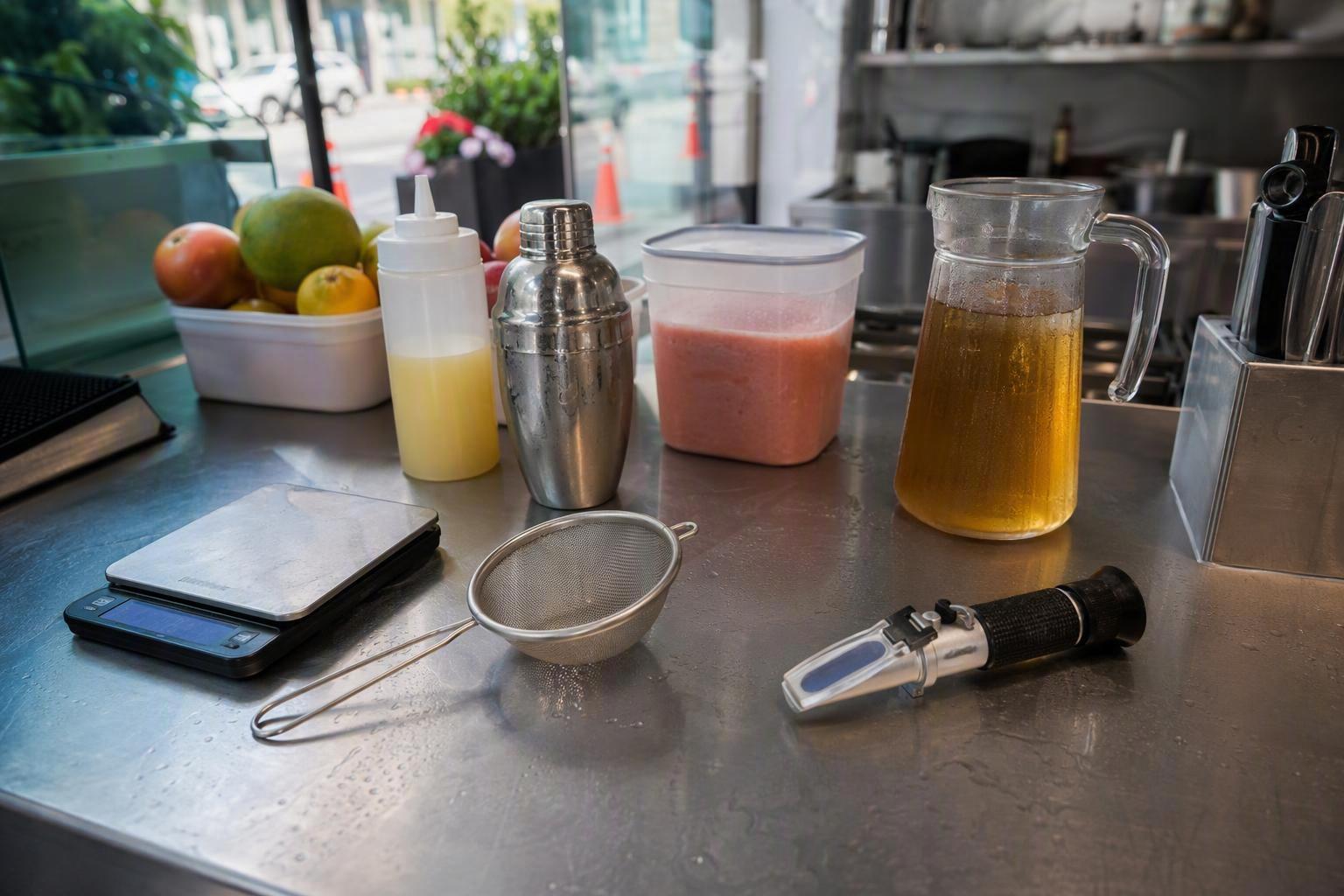
A workable fruit tea for boba shops is built from five standardised blocks, not from a single recipe card: a brewed base, a fruit element, sweetness and acid, inclusions, and ice or garnish (bubbleteasuppliers.com, retrieved 2026-05-21). Get all five on the counter before you start.
What you’ll need:
- Jasmine green tea base
- Guava fruit element in your chosen format
- Liquid fructose or simple syrup
- Fresh lemon
- Crystal boba or another inclusion
- Digital scale, shaker, strainer, refractometer
- Airtight food-grade holding containers
Skill: comfortable weighing rather than scooping. Time: about 45 minutes to first build, tea chilling included. Difficulty: intermediate.
The base is weighed, not spooned. A supplier-published batch brew runs 90 g of loose-leaf jasmine green tea at a strict 1:33 leaf-to-water ratio (bubbleteasuppliers.com, undated).
⚠️ Warning: everything downstream assumes a scale and a chilled, ice-shocked tea base.
Step 1: Brew and Ice-Shock the Jasmine Tea Base
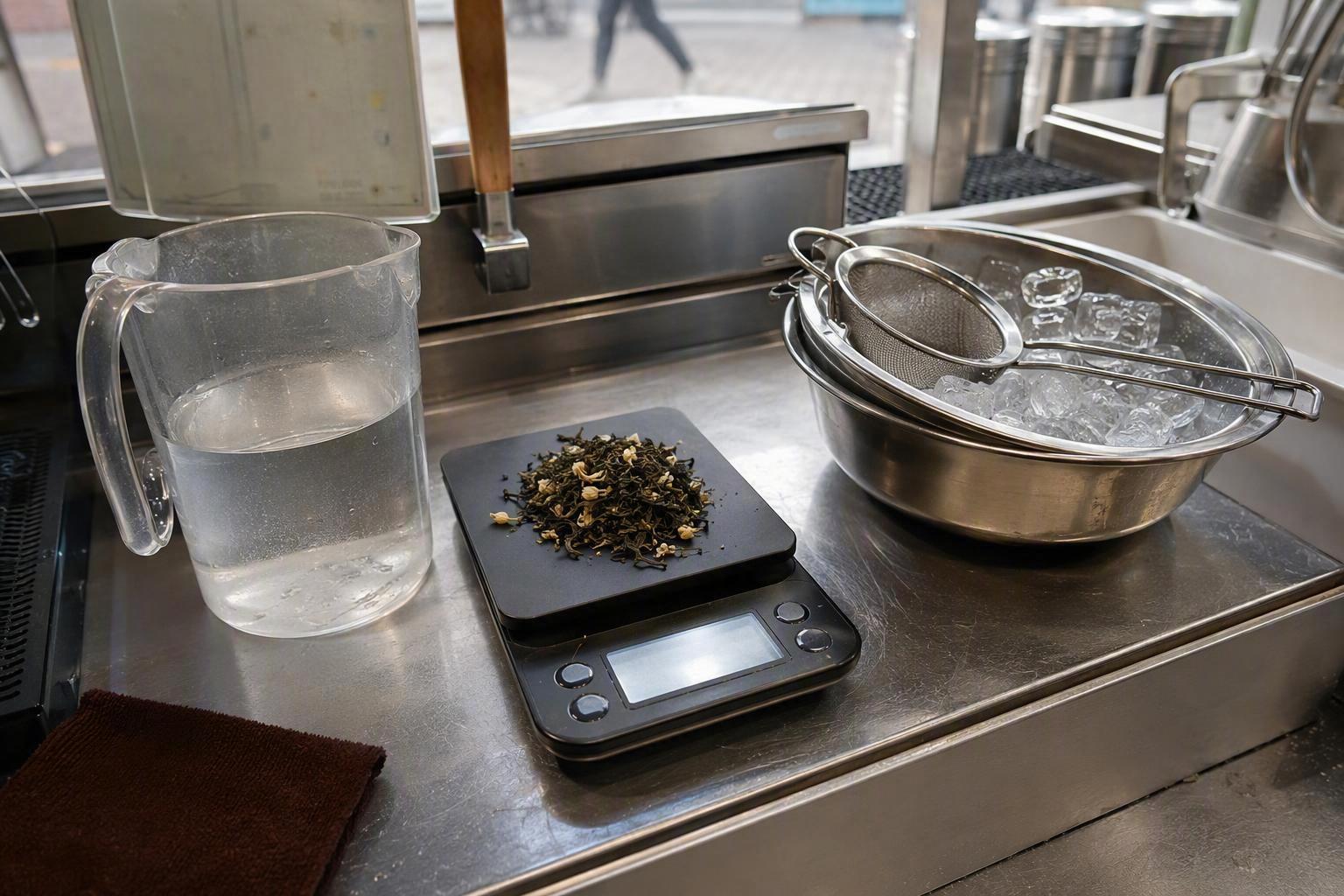
That base is the floor everything else stands on: if it is bitter, no amount of fruit or sweetener rescues the cup. By the end of this step you will have a batch of jasmine green tea brewed at a strict 1:33 leaf-to-water ratio, strained the moment it comes off the heat, ice-shocked, and held cold.
- Weigh the leaf, don’t spoon it. Tea strength at shop scale is best specified as a leaf-to-water ratio rather than a spoon measure, because a spoon of jasmine leaf varies with how tightly it’s packed and how much stem is in the tin (boba.guide, 2026). A published supplier batch runs 90 g of loose-leaf jasmine green tea to 1,000 g of ice stirred in immediately after brewing.
- Brew hot, then chill hard. Batch tea is commonly brewed hot and chilled before service (boba.guide, 2026). Strain straight into the ice vessel and stir. Hot tea keeps pulling tannins out of the leaf after it’s strained, which is where that drying, “tanic” bitterness comes from; rapid ice-shocking drops the temperature and stops the extraction while the floral top notes stay in the cup.
- Verify before you hold it. The finished base should be clear, floral on the nose, and free of the drying astringency you get from tea left to cool on its own. If it tastes flat and grippy, your ratio or your chill time is off, and every guava lemon iced tea built on it will taste thin by Friday.
Step 2: Build the Strawberry Guava Lemon Tea Spec for 16 oz and 22 oz
By the end of this step you will have a written card for both cup sizes. The strawberry guava lemon tea spec below comes from one supplier-published SOP, so treat it as a worked example, not an industry standard.
| Component | 16 oz | 22 oz | Guava variant (16 oz) |
|---|---|---|---|
| Crystal boba | 50 g | 70 g | 50 g |
| Fresh fruit slices | 30 g | 50 g | 30 g |
| Chilled jasmine tea | 200 ml | 280 ml | 150 ml |
| Fruit purée or syrup | 35 ml | 50 ml | 35 ml guava base, or 20 ml syrup + 15 ml purée |
| Liquid fructose (55%) | 10 ml | 15 ml | 10 ml |
| Fresh lemon or lime | 5 ml | 8 ml | 5 ml |
| Ice | 180 g | 250 g | to 450 ml shaker mark |
The guava variant scales to 50 ml base at 22 oz (BubbleTeaSuppliers guava SOP, 2026).
Purée is strained fruit with pulp; nectar is thinner and pre-sweetened; syrup is sugar-based and shelf-stable; powder reconstitutes. For volume, syrup and purée hold consistency better than fresh fruit, which varies by batch and labor. A supplier such as BubbleTeaSuppliers can be used to source these formats.
Step 3: Set the Sweetness Ladder and Acid Balance
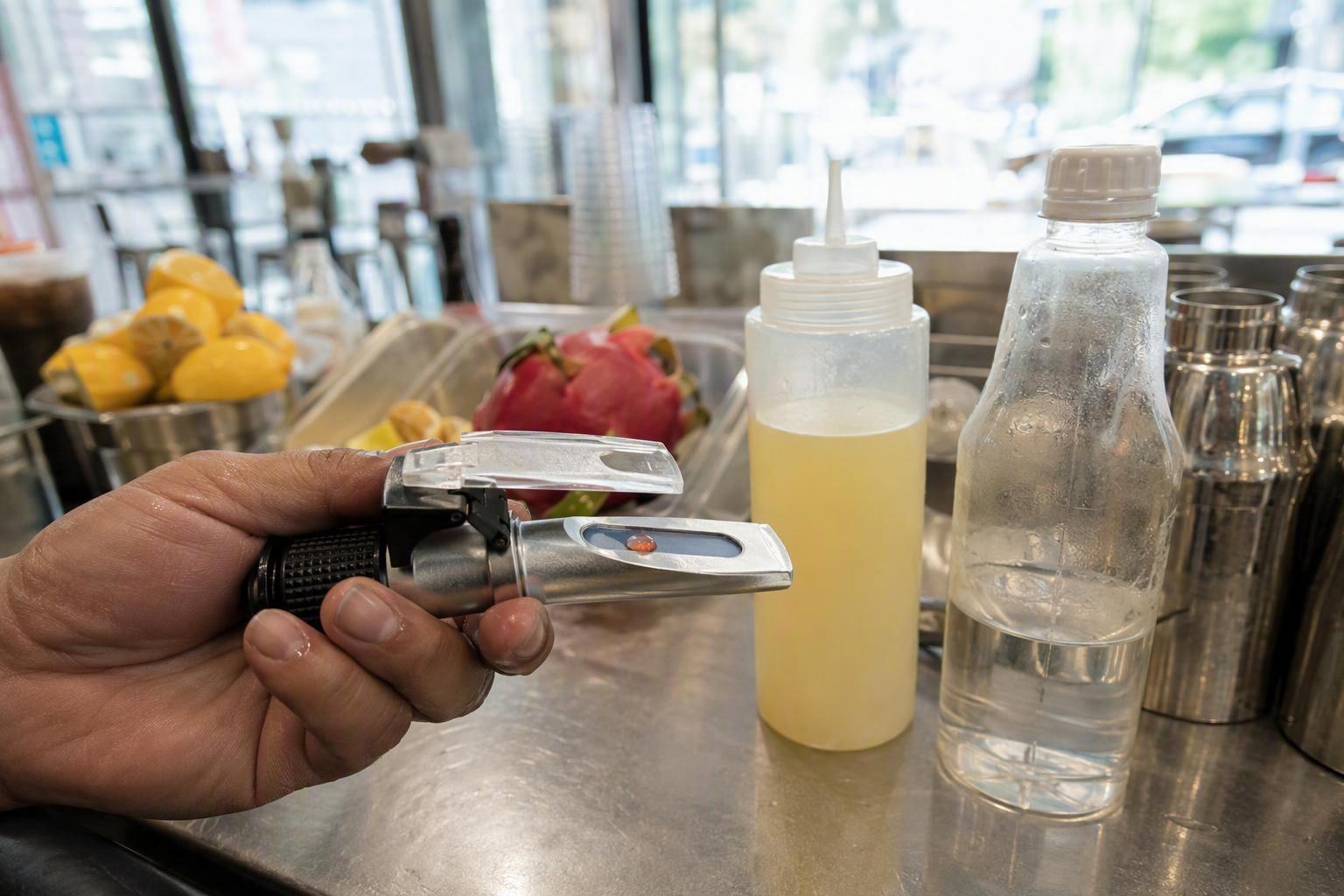
By the end of this step you will have a sweetness ladder where 0, 30, 50, 70 and 100% sweet each produce the same cup, whoever is on bar. A published guava fruit tea SOP sets the rungs at 15 ml fructose for 100%, 10 ml for 70%, 5 ml for 50% and 0 ml for 30%, and cuts the guava base from 50 ml to 40 ml while raising tea from 200 ml to 210 ml so the drink does not thin out as sugar drops (bubbleteasuppliers.com guava fruit tea SOP, 2026). That is your strawberry guava lemon tea ratio, written on one card.
Sweetness alone is not the target. °Brix measures dissolved solids with a refractometer, and the same supplier’s formulation guide gives shop bands of 10–12 °Bx at pH 2.6–3.4 for a citrus refresher, 11–13 °Bx at pH 3.2–3.8 for a fruit purée cooler, and 8–10 °Bx at pH 3.8–4.4 for a tea-based tonic (small cafe natural beverage formulation guide). A strawberry guava lemon tea sits between the last two, so pick a band and hold it.
Balance is the second number. Formulation practice pairs Brix with titratable acidity in a Brix:acid ratio, and citrus-forward profiles such as lemon sit at 5–10:1 (Understanding Brix). Specify Brix as a range, not a single number, because fruit varies by season and origin (Brix, acid and pH specification guide). A range of 10–12 °Bx survives a new guava delivery; a spec of 11.0 °Bx does not.
When the cup tastes cloying, the cause is high °Bx with low acid: dilute 10–20 g/L and add 2–5 g/L citrus. When it tastes dull, add 2–5 g/L citrus juice or acidulated water (small cafe natural beverage formulation guide).
Verify your result: take a refractometer reading after mixing, never before. If it lands inside your chosen band, the ladder is working.
Step 4: Assemble, Shake and Control Ice Dilution
By the end of this step you can build a consistent strawberry guava lemon tea at speed, and you will know why the same spec tastes sweet in one cup and thin in the next.
Assemble to the standard beverage prep flow: keep fruit components refrigerated and portioned by measured pump or weight, stir or shake them if separation occurs, and build the drink just before service rather than ahead of it (Super Fruit Tea SOP and fruit-drinks operations guide). Tea first, then fruit, then acid, then ice, then a hard shake of 8 to 10 seconds, or 15 seconds on an automated shaker.
Dilution is the variable most shops never measure. Shaking melts roughly 15 to 25 percent of the ice into the drink, and iced-coffee service guidance assumes 20 to 30 percent ice melt (Perlage Systems; CocktailFYI). Because measured Brix falls roughly in proportion to added water, a 12 °Bx base reads about 10.0 at 20 percent dilution and about 9.6 at 25 percent. Those figures come from cocktail and iced-coffee measurement, which is analogous to boba shaking rather than measured on fruit tea, so treat them as a planning range. Ice level moves the number too: a less-ice build adds about 120 ml of cold water, and a no-ice build about 180 ml.
Taste the finished cup against the Step 3 band, then check the color gradient holds from top to bottom before it leaves the bar.
Step 5: Hold, Date-Mark and Prep Ahead Without Losing Quality
By the end of this step you will know exactly how long each component can sit and what to throw out.
Two clocks govern the bar, and they are not the same clock. The first is a quality window: a supplier-published commercial SOP for fruit tea holds the chilled tea base at 35–38°F (2–3°C) in airtight food-grade containers, keeps dispensing containers below 40°F (4.5°C), and discards the tea after 4 hours of holding even refrigerated (Super Fruit Tea commercial menu SOP). That 4-hour rule is a quality standard dressed as a safety rule. It sits well inside the regulatory bound, so you can choose which one governs your bar: hold to 4 hours and the cup tastes the same at hour four as at hour one.
The second clock is the legal floor. Under the FDA Food Code, ready-to-eat TCS fruit held at 41°F (5°C) or below and kept more than 24 hours must be date-marked for a maximum of 7 days, with the day of prep counted as Day 1. Frozen purée stays at 0°F (−18°C) or lower. The 4-hour mark applies only to time-as-a-public-health-control holding without temperature control, which is not what a refrigerated back-bar is doing.
Key Takeaway: two clocks govern the bar, the 4-hour quality window and the 7-day date-marking maximum.
For a Friday rush, batch the tea base in the morning and the fruit mix in two smaller containers rather than one large one, so a single opened batch is never sitting past hour four while the rest stays sealed. Over-batching is the quiet waste line in a fruit tea for boba shops: every extra litre you pour on Thursday is a litre you dump on Saturday.
Step 6: Cost the Cup and Place It on the Menu
By the end of this step you will have a cost-per-cup figure you calculated yourself and a price band to test it against.
The method is the one foodservice operators use when no published COGS exists for a drink: write a standard recipe or portion spec, convert as-purchased cost to edible-portion cost using a yield percentage, multiply that EP unit cost by the portion quantity, add packaging and an explicit waste allowance, then divide by your target food-cost percentage to set the price. Brewed liquids scale the same way, by cost per litre (Provincial foodservice waste-prevention toolkit; Culinary recipe-costing workbook).
For the price band, live US boba menus put fruit teas in the mid-single-digit dollar range. One Chicago-area shop lists a Guava Lemon Fruit Boba Tea, described as “pink guava with the crisp, tart bite of fresh lemon,” at $4.95 (Agape Sweet Heaven menu). Treat that as market context, not a study.
| Costing worksheet | Your figure |
|---|---|
| Batch yield (cups) | |
| Tea base cost per litre | |
| Fruit component cost per litre | |
| Lemon/acid cost per litre | |
| Sweetener cost per litre | |
| Packaging per cup | |
| Waste allowance (%) | |
| Cost per cup | |
| Target food-cost (%) | |
| Suggested menu price |
Verify your result: your cost per cup sits at or under your target food-cost percentage, and your price lands inside the local band. This strawberry guava lemon tea is the build that carries a shop through summer patio traffic, so price it to hold the slot all season, not just opening week.
Common Mistakes to Avoid
The most common failure in strawberry guava lemon tea is treating sweetness as a pour rather than a measurement. Each mistake below breaks a different part of the spec, and most of them show up as inconsistency across shifts rather than as an obvious error.
Scooping tea instead of weighing it. A tablespoon of jasmine leaf varies with leaf size, moisture and how the scoop is packed, so the 1:33 tea-to-water ratio drifts without anyone changing the recipe. Weigh the leaf on a scale accurate to 0.1 g and the bitterness problem disappears before sweetener is involved.
Letting brewed tea cool on its own. Tannin extraction keeps running while the liquid sits warm, so a batch that tasted clean at 4 minutes turns astringent by the time it reaches the shaker. Ice-shock the concentrate immediately after straining to stop extraction.
Setting one Brix number instead of a range. Fruit purée shifts with season and origin, so a fixed target fails the moment the supplier changes. Hold a range and adjust within it.
Ignoring ice dilution. The same spec reads sweet in a light-ice cup and thin in a regular one. Build the recipe around the ice level you actually serve.
Over-batching ahead of a slow shift. Purée and brewed tea both degrade on hold, so prepping for peak volume that never arrives means pouring the difference into the drain. Batch to your real hourly rate.
Frequently Asked Questions
How long does it take to build the drink from scratch?
The first build runs about 45 minutes, and most of it is waiting rather than working. Brewing the jasmine base takes 8 to 10 minutes, ice-shocking it another 5, and chilling the finished tea to serving temperature is the longest stretch. Once the base is cold and the spec card is written, each cup assembles in under 90 seconds. Time drivers are batch size, how many sizes you pour, and whether fruit components are already portioned.
Can we use fresh guava instead of purée, nectar or syrup?
Yes, and fresh guava makes a vivid drink, but it stops making sense past roughly 30 to 40 cups a day. Fresh fruit means seeding, blending, straining, a same-day shelf life and inconsistent Brix from batch to batch. A prepared fruit format buys you a repeatable number on the spec card. Below 30 cups, fresh is a menu story worth telling; above it, labor and waste usually cost more than the format saves.
Why does the drink taste thin even though we followed the spec?
Thin almost always traces to dilution, not to the fruit. Check three things: ice melting before service, a tea base that was not fully chilled before assembly, and under-measured fruit because someone eyeballed the scoop. Weigh the fruit for one shift and compare. If the fruit weight is right and the drink is still thin, tighten the brew water ratio before you touch the fruit.
How do we scale this for a second location or a bigger team?
Scale the base, not the cup. Brew larger tea batches on the same ratio, portion fruit and sweetener into labeled cups during prep, and keep one laminated spec card per station. The cup-level recipe never changes; only batch size and prep frequency do. Train new staff on the spec card and a verification taste, not a verbal walkthrough.
Does the 4-hour holding rule or the 7-day date-marking rule govern?
Both, and they cover different things. The 4-hour rule governs the assembled, ice-shocked tea base once it is in service. The 7-day rule governs sealed, refrigerated components like portioned fruit and simple syrup. When the two overlap, the shorter window wins. Date-mark everything at prep, and treat the 4-hour mark as the hard stop for anything already holding at the station.
Conclusion
You now have a strawberry guava lemon tea that holds its spec: a weighed jasmine tea base, a written build for both 16 oz and 22 oz cups, a sweetness ladder tied to a Brix range, a shake that accounts for ice dilution, holding and date-mark rules, and a cost-per-cup method you can update when prices move. The payoff is the one you were after on the first day: the same drink on Friday that you served on Tuesday, whether you or a new hire is on bar.
Write the spec on one card, tape it where the shaker lives, and train it in a single shift. If you want to compare fruit formats before you lock the recipe, take a look at the fruit tea ingredient range or request a sample and build a test batch against your current purée.