
Black sesame mochi for boba tea fails on the cold bar for one reason: the batch was never controlled after it left the pot. It cuts clean at 9 a.m., then goes hard, sticky or gritty by the afternoon rush, and the closing shift throws away product it cannot explain. Gelatinization is the point where waxy rice starch absorbs water and swells into a cohesive gel; it is what makes mochi chewy, and retrogradation is what takes the chew back. Cooked mochi is a TCS food, meaning it needs time and temperature control to limit pathogen growth, and cooked rice, potatoes and pasta are the standard examples of cooked plant foods that need time and temperature control (Minnesota Department of Health, retrieved 2026-05-01). This SOP gives you a formula in baker’s percentage (every ingredient as a share of the flour weight), a cook and knead process, portioning by cup size, and a cooling, labeling and discard protocol. The FDA Food Code is a model code that states adopt, not federal law, so confirm your state’s adopted edition before you print anything (FDA, retrieved 2026-05-01).
Why Make Black Sesame Mochi for Boba Tea In-House Instead of Buying It
Buying is the cheaper decision until you count the days the bag sits open. Commercial mini mochi for drinks runs about 14 mm per piece, and the supplier’s own directions say to refrigerate it airtight after opening and consume it within 3 to 5 days (Bossen, WebstaurantStore, listing dated 2023-03-14). That is a real constraint for a shop that sells mochi on two drinks a shift: you either move the bag or you throw part of it away.
Making it in-house trades that waste for labor, and the labor is not exotic. The four-hour ambient hold is the same discipline shops already run for tapioca pearls, where cooked pearls held at room temperature are served or discarded within four hours and are never refrigerated for reuse (BubblePhil, 2026-08-13). If your closing shift already logs a pearl discard time, it can log a mochi one.
The deciding question is whether the shop already runs a same-day cooked-topping cycle. If it does, adding mochi is one more batch card on the same clock. If it does not, you are building a new habit, and the supplier bag is the honest answer until you are ready to build it.
Seasonally, this is a summer cold-bar decision. The US bubble tea shop industry is a $3.3bn market in 2026 across 7,114 businesses (IBISWorld, 2026). More shops competing on the same drinks means texture is one of the few things a customer notices without being told.
The Shop Formula and Batch Ratio for Black Sesame Mochi
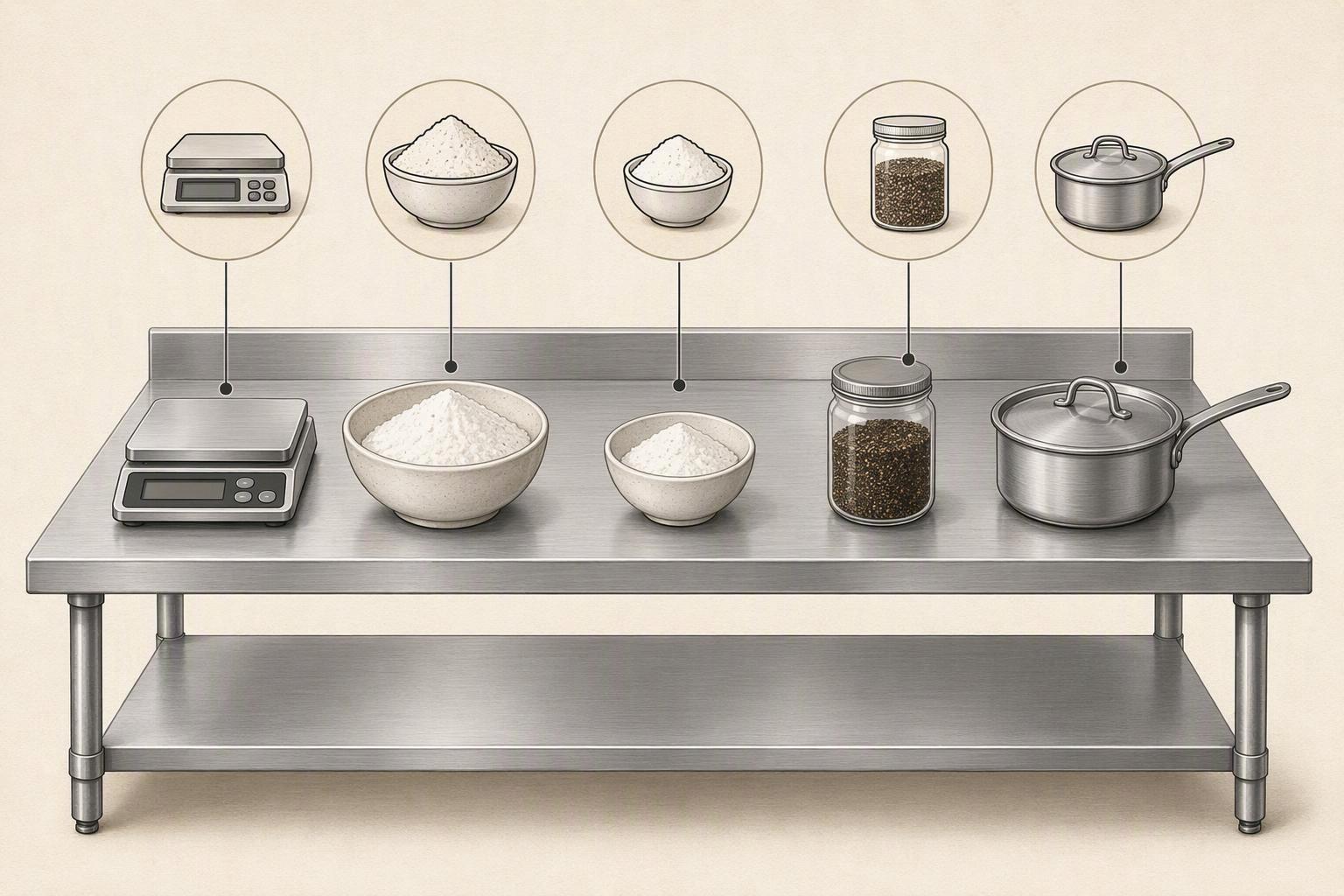
No published commercial standard exists for black sesame mochi topping, so treat this as a starting formula you calibrate, not a specification you copy. Weigh everything; baker’s percentage means the glutinous rice flour is always 100%, and every other ingredient is expressed against it.
| Ingredient | Baker’s % | Low end | High end | What the ends produce |
|---|---|---|---|---|
| Glutinous rice flour | 100% | 100% | 100% | Base starch; sets the chew ceiling |
| Water | 85–95% | 85% | 95% | Low: stiff, hard to knead. High: slack, sticky sheet |
| Tapioca starch | 10–25% | 10% | 25% | Low: softer, more tender chew. High: firmer bite, less sticky |
| Toasted ground black sesame | 12–18% | 12% | 18% | Low: faint nuttiness. High: coarse, dry, gritty crumb |
| Sugar | 8–12% | 8% | 12% | Low: savory. High: masks sesame, speeds surface weeping |
| Neutral oil | 2–3% | 2% | 3% | Kneading aid and anti-stick |
The texture ceiling comes from the flour, not the process. Waxy rice starch gelatinizes between roughly 57°C and 79°C and is almost pure amylopectin, with measured amylose of 1.67% and 2.55% in the two waxy varieties tested (PMC10743165, 2023-12-15). Glutinous rice amylose content is low and varies by variety, measured between 0.90% and 3.71% with a mean of 2.54% across 22 cultivars (Lyu et al., PMC, 2024). Because there is almost no amylose to work with, you cannot knead your way to a firmer mochi; you change flour or you change the tapioca starch share.
Sesame is the ingredient that fails first. Above roughly 20% of flour weight, the powder stops hydrating into the dough and starts interrupting the starch network, and the piece reads gritty rather than nutty. That threshold is shop-calibrated, not published: no source measured a maximum sesame inclusion before texture degrades.
How to Cook, Knead, and Portion a Batch Consistently
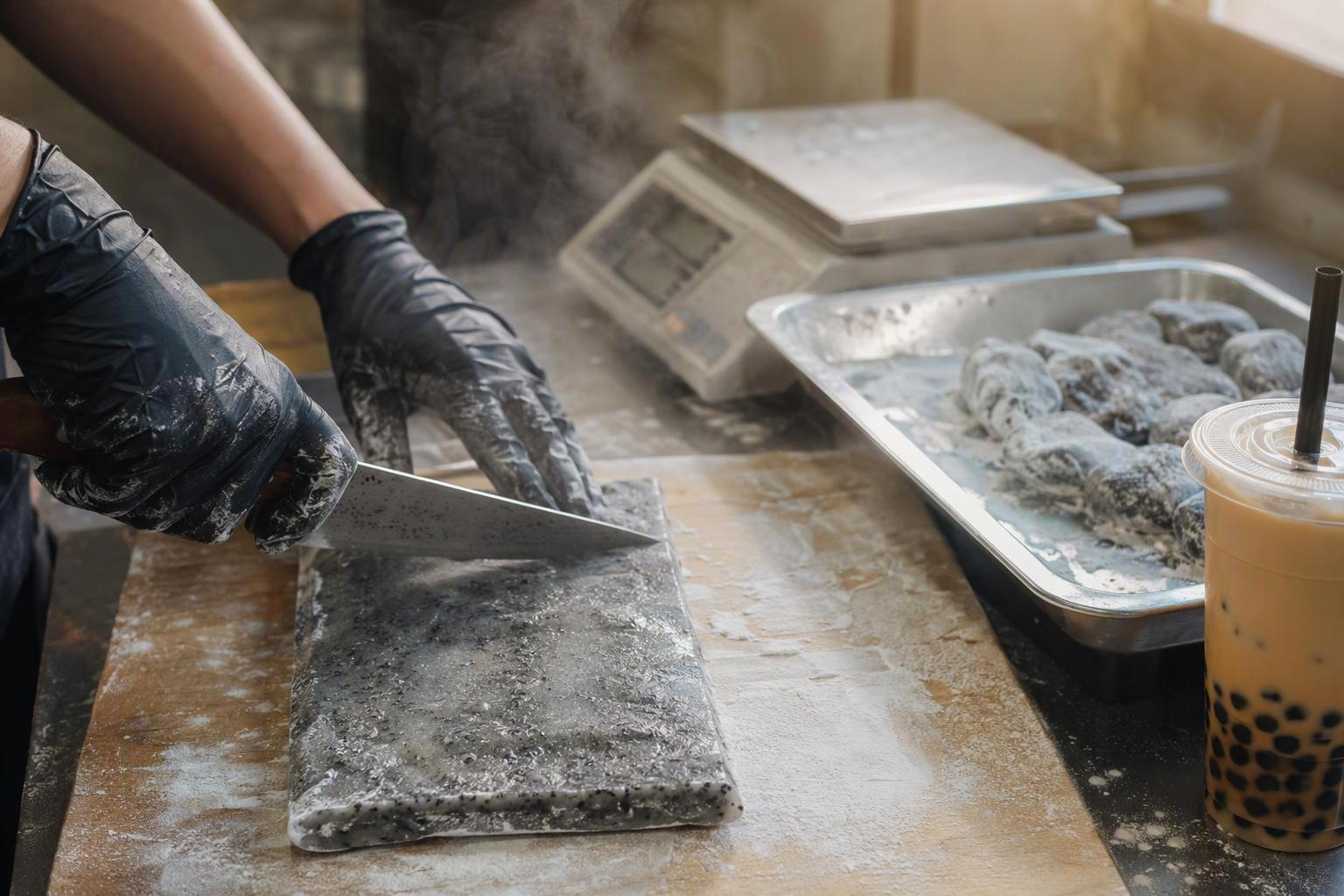
Work in this order, and log each checkpoint. The whole batch is roughly 45 minutes of hands-on time for a 500 g flour batch, plus cooling.
- Weigh. Scale flour, tapioca starch, sesame, sugar and water separately. Do not scoop by volume; a 10% water error is the difference between a kneadable dough and a sticky sheet.
- Whisk. Combine the dry ingredients until the sesame is evenly distributed. Lumps of sesame powder become dry pockets in the finished piece.
- Steam. Steam the mixture in a covered saucepan or steam oven until the center is uniformly translucent and no opaque white core remains. The gelatinization window is wide, so judge by appearance, not by a timer alone.
- Knead. Turn the hot dough onto a lightly oiled surface and knead while it is still hot enough to be pliable. This is the window that home batches miss: cold dough tears instead of stretching.
- Cut. Rest the sheet until it holds its shape, then cut uniform pieces on a starch-dusted board.
- Dust. Toss the cut pieces in tapioca starch to stop them fusing in the tray.
The cooling clock starts the moment the batch leaves the heat, not when you finish portioning. FDA Food Code § 3-501.14 requires a two-stage cool: 135°F to 70°F within two hours, and to 41°F within six hours total (FDA Food Code, Chapter 3, 2022 edition). The Code lists shallow pans, thinner portions and ice-water baths as approved cooling methods, and containers must be arranged for maximum heat transfer and loosely covered or uncovered while cooling (FDA Food Code, Chapter 3, 2022 edition). A deep, lidded container on the cold bar is how a batch misses the first leg.
No supplier publishes a batch yield or a per-piece gram weight for this product, so yield and piece weight are shop-measured and logged. Weigh the finished dough, weigh ten pieces, and write both numbers on the batch card.
How Much Mochi Goes in a 16 oz vs. 22 oz Drink
Portion by piece count, then verify by pulling a test drink through the actual straw you serve. The defensible band for boba straws is 8 to 13 mm inner diameter, and the rule of thumb is to keep the piece comfortably under the straw’s inner diameter. Measure your own lid opening before you set the standard; no manufacturer datasheet in this research published a straw-hole dimension.
| Cup size | Target piece count | Target portion weight | Straw check |
|---|---|---|---|
| 16 oz | 8–12 pieces | 30–40 g | Piece passes the straw with light resistance |
| 22 oz | 12–16 pieces | 40–55 g | Same piece, more of them; do not enlarge the piece |
Those gram ranges are a starting band, not a published spec. The fill arithmetic is what makes them defensible: a 16 oz cup leaves roughly 75 to 100 ml of pearls and 125 to 175 ml of ice after the tea fill, so topping volume has to be budgeted before the liquid pour (Outstanding Packaging, undated). Pull one 16 oz and one 22 oz drink at the start of every batch and check the chew, the graininess and the sweetness. Customer-noticed texture is the trust signal, and it is cheaper to catch at the counter than in a review.
How Long You Can Hold Black Sesame Mochi, and How to Cool, Label, and Discard It
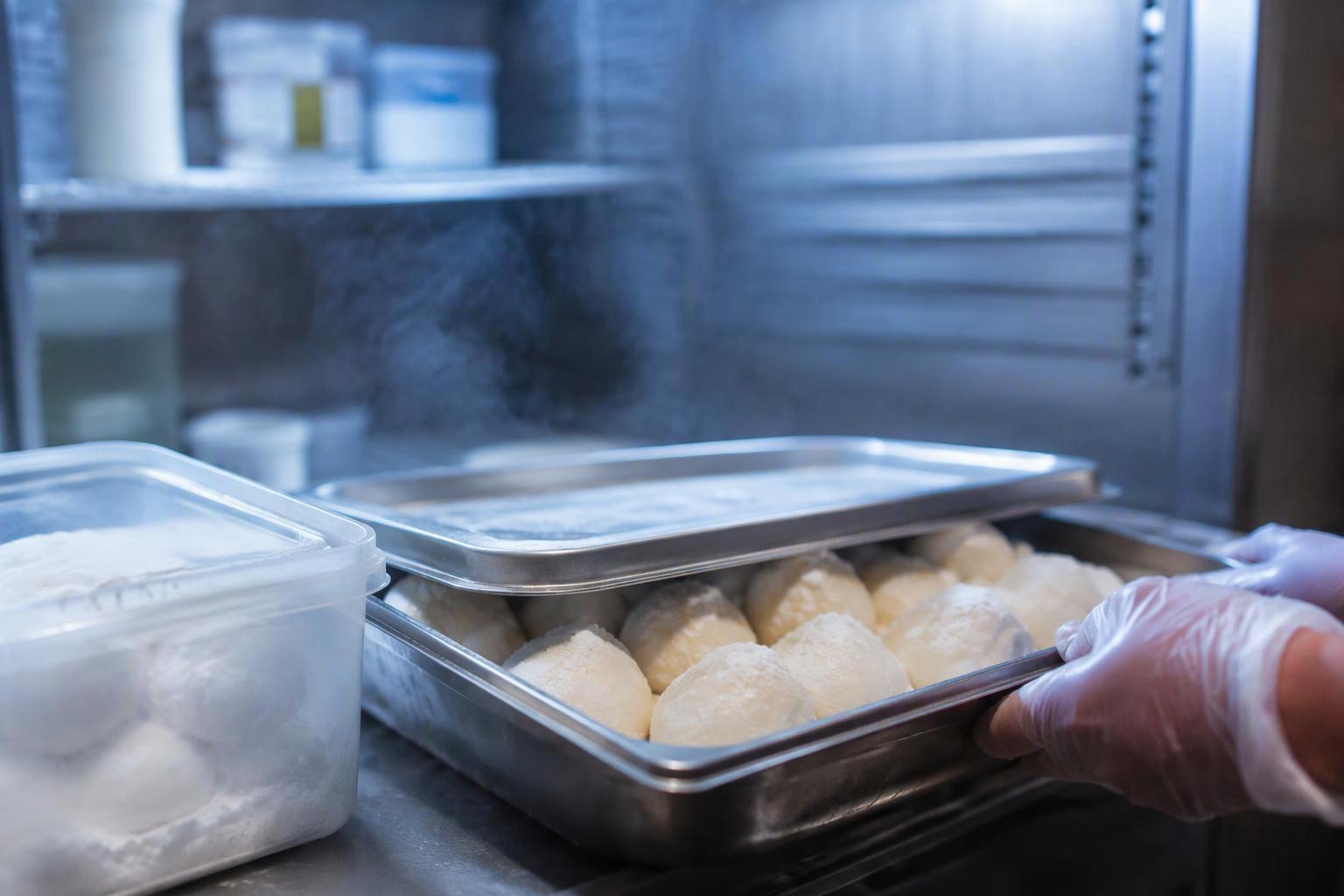
You have two defensible holding models, and a small shop should pick one and write it down. The short ambient service hold mirrors the pearl cycle: TCS food made from ambient ingredients must reach 41°F within four hours (FDA Food Code, Chapter 3, 2022 edition). The chilled model uses date marking: refrigerated ready-to-eat TCS food held more than 24 hours must be date marked and used within seven days at 41°F or less, counting the prep day as Day 1 (FDA Food Code, Chapter 3, 2022 edition).
| Model | Hold window | Label required | Best fit |
|---|---|---|---|
| Ambient service hold | 4 hours, then discard | Batch time, discard time | High-volume cold bar, same-day sell-through |
| Chilled, date marked | 7 days max at 41°F or less | Prep date, discard date | Low-volume shops, batch twice a week |
Time as a public health control is available but only with written procedures prepared in advance and kept available to the regulatory authority, and the food must be marked with its discard time (FDA Food Code, Chapter 3, 2022 edition). If you run the ambient model without the written procedure and the marked time, you are running an unlogged hold.
The 2026 Food Code, issued 17 September 2026, amended § 3-501.15 to add an alternative cooling method that requires regulatory-authority approval, and added a reference that cooling uncovered food at a depth of about 5.1 cm (2 in) or less poses little risk of pathogen growth (FDA, content current 2026-09-17). The 135/70/41 limits did not change. Most shops are not on the newest edition: only 11 state agencies in 7 states, 16.06% of the US population, had adopted the 2022 version as of the 2024 adoption report (FDA, 2024 report). Confirm your holding limit and labeling format with your local health department before the first batch.
How to Label and Protect Against Sesame Cross-Contact at the Topping Station
Sesame has been the ninth major food allergen since January 2023, and packaged foods must declare it by common name in the ingredient list, in parentheses after the ingredient, or in a “Contains” statement (FDA, 2025-02-25). Your in-house mochi is an unpackaged food served from your counter, so the packaged-label rules are not the ones that bind you.
Cross-contact is a residue or trace amount of an allergenic food becoming incorporated into another food not intended to contain it, and “may contain” advisory statements are not a substitute for current good manufacturing practices (USDA FSIS, undated). That distinction matters at a topping station where the same scoop, the same tongs and the same gloved hand touch three toppings in a row.
Write the station rules down and train them:
- One dedicated scoop or tong per topping, stored in the topping, never swapped.
- Sesame mochi gets its own labeled insert, not a shared tray.
- Change gloves between sesame and non-sesame builds.
- Wipe the counter and the scoop rest at every batch change, not every shift.
- Keep the allergen notification visible where the customer orders, not behind the counter.
What Goes Wrong with Mochi Topping in a Shop, and How to Fix It
Most failures trace to one of five causes, and each has a process fix rather than a recipe fix.
| Symptom | Likely cause | Fix |
|---|---|---|
| Hard, chalky by hour four | Retrogradation, often accelerated by refrigeration | Hold in the ambient model, or date mark and accept the shorter chilled window |
| Sticky, fused block | Pieces dusted too lightly, or stored warm and stacked | Dust in tapioca starch, single-layer the tray, cool before stacking |
| Gritty, dry crumb | Sesame above roughly 20% of flour weight | Drop sesame to 12–15% and re-test |
| Hard center, translucent outside | Under-steamed, or kneaded cold | Steam until no opaque core; knead while hot |
| Clogged straw | Piece sized above the straw’s inner diameter | Cut smaller; do not add more pieces to compensate |
The mechanism behind the first row is worth understanding because it explains why refrigeration is not a fix. Starch retrogradation is the progressive association of gelatinized starch segments into a more ordered structure, and it is the dominant mechanism behind texture loss and hardening in glutinous rice cake (Lyu et al., PMC, 2024). Because waxy rice starch has almost no amylose, the hardening you see is largely amylopectin retrogradation, and cold storage is the condition that drives it fastest.
Frequently Asked Questions
Can I freeze a batch of black sesame mochi?
Freeze it only if your supplier’s package directions say the product tolerates it. Commercial mini mochi for drinks runs about 14 mm per piece, and those listings typically carry their own storage guidance rather than a universal freeze-thaw rule (WebstaurantStore, retrieved 2026-05-01). No published freeze-thaw window exists for this topping, so treat the label as the authority and test one thawed portion before you commit a tray.
Can I swap tapioca starch for another starch?
You can, but expect a different texture. Waxy rice starch is almost pure amylopectin, which is what produces the soft, stretchy chew (PMC10743165, 2023-12-15). Starches with more amylose set firmer and grainier, so a substitution changes mouthfeel even when the cook step looks identical.
What if I miss the first cooling leg?
Reheat the batch above 135°F and start the two-stage cool again, or discard it. FDA Food Code § 3-501.14 requires a two-stage cool: 135°F to 70°F within two hours, and to 41°F within six hours total (FDA Food Code, Chapter 3, 2022 edition). A batch that sat too long in the first window has no compliant path forward except reheating or disposal.
Can I make mochi ahead for a seasonal menu reset?
Yes, within the same seven-day refrigerated window you use for daily prep, and only if the batch is labeled and held at 41°F or less. Seasonal resets are a good time to run a pilot batch and log the yield, texture at hour six, and piece weight so the next menu cycle starts from a known baseline rather than a guess.
The batch that survives the afternoon rush is the one you controlled after it left the heat. Weigh in baker’s percentage, steam to a translucent core, knead hot, cut uniform, and start the cooling clock immediately: 135°F to 70°F within two hours and to 41°F within six hours total (FDA Food Code, Chapter 3, 2022 edition). Pick one holding model, label it, and write the discard time where the closing shift can see it.
Run one pilot batch this week. Log the water you added, the cooked yield, the piece count and the piece weight. Hold samples and check texture at hour 0, 2, 4 and 6. Then take your holding limit and your labeling format to your local health department and confirm them against the edition your state has actually adopted, because the Food Code is a model that states adopt with local variation (FDA, retrieved 2026-05-01). One batch, one log sheet, one week tells you whether in-house mochi belongs on your cold bar.