
A pineapple lemon tea that tastes different depending on who is on bar is not a recipe problem. It is a documentation problem. Over a week of shifts, that drift shows up as remade drinks, comped cups, and customers who order the same thing twice and get two different beverages.
This is a commercial shop spec for a 16 oz build, not a home-brew recipe. The numbers below are a starting build your shop tunes to its own tea, fruit format, and ice.
Two terms matter before you start. Brix is the soluble solids content of a liquid, measured with a refractometer, and it is the number that tells you how much fruit body a pineapple format actually carries. The federal standard of identity for pineapple juice sets a floor of 10.5 °Brix for juice without added water and 12.8 °Brix for juice reconstituted from concentrate (21 CFR 146.185, current eCFR text). TCS stands for time/temperature control for safety food, and brewed tea and cut fruit become TCS items, which is why a batched fruit tea carries holding and discard clocks that a shelf-stable syrup does not (FDA Food Code 2022, Chapter 3, 2022 edition).
Consumer demand is moving toward lighter builds: 66% of US consumers say they have already shifted toward lower-sugar or lower-calorie beverages (EY Consumer Beverage Survey, 2026-03-06).
What follows is how to make pineapple lemon tea to a written, repeatable spec, with a batch method and a hold clock your team can run this week.
Prerequisites: What You Need Before You Build the Drink
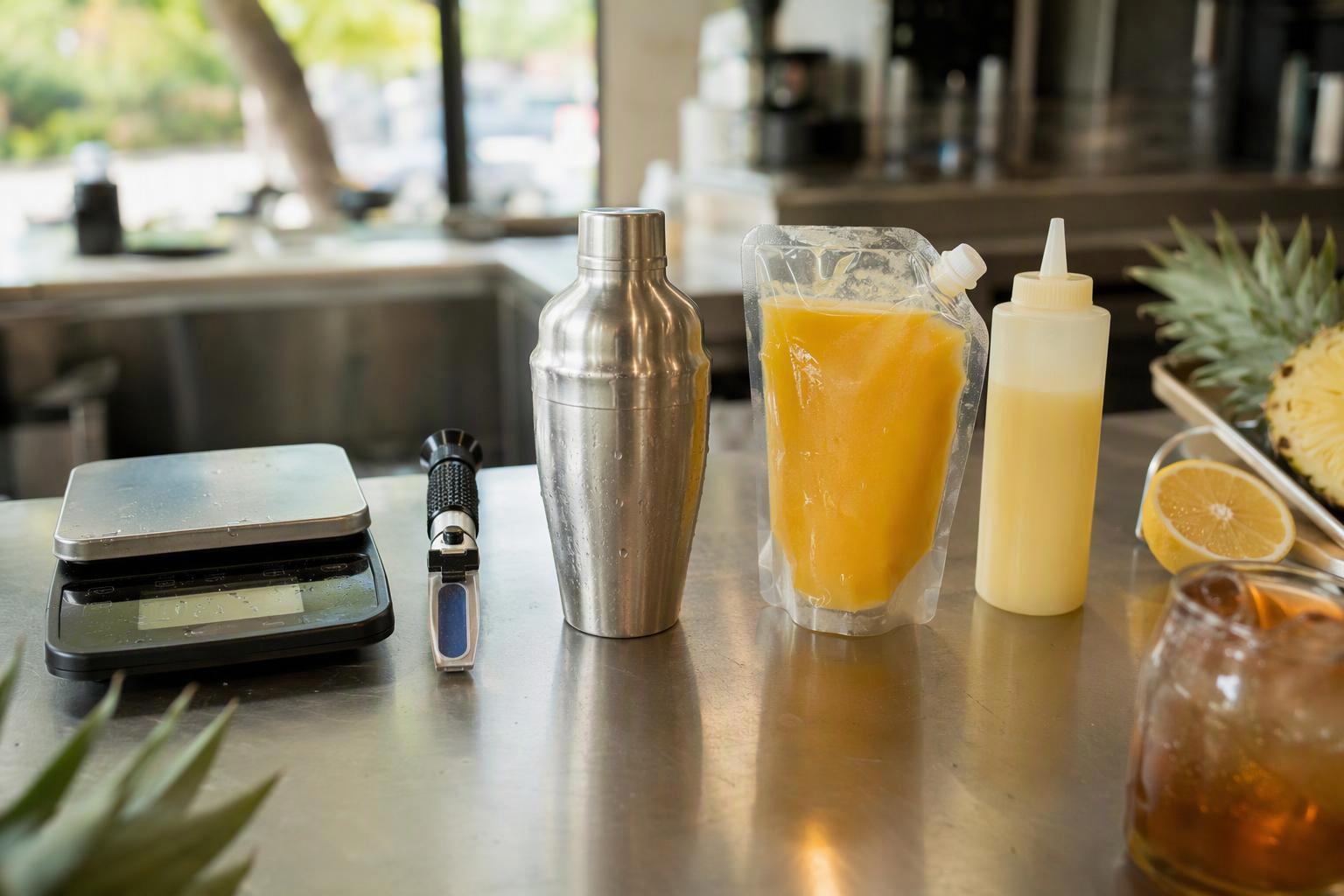
Get the station and the format decisions settled before anyone builds a drink, because the pineapple lemon tea recipe only repeats if the inputs repeat. A commercial boba setup needs 15 to 30 minutes to prepare all elements for a day’s service, with 5 to 10 minutes of that in tea steeping, according to a beverage-equipment vendor’s prep-time estimate (SPM Drink Systems, undated page). That is the whole time budget for batching, and it is why the format and base choices below are the two decisions worth making deliberately.
Pick your pineapple format first
Choose the format before the sweetener line, because the format sets the sugar spec. Fresh and puree formats land in the 10 to 16 °Brix band, while jam and syrup run near 65 to 68 °Brix, so syrup is a sweetener plus flavor and puree is fruit body; swapping one for the other changes the sugar spec, not just the fruit spec (21 CFR 146.185, current eCFR text; a second supplier’s puree spec, undated sheet). The widest practical difference between formats is opened-format shelf life: puree runs 10 to 14 days refrigerated after opening across two independent suppliers, and both say refrigerate or freeze immediately once opened, while unopened aseptic puree holds 18 months ambient (a second supplier’s puree spec, undated sheet; a puree spec sheet, 2020 posting). If freezer space is the constraint, an aseptic pineapple puree spec sheet confirms the product is shelf-stable unopened at room temperature, below 75 °F recommended, which makes it workable for a shop without a walk-in freezer (Scotzin Bros. technical data sheet, 2020). Fresh fruit also carries a seasonal window and a labor load that puree does not, so decide the format for the quarter, not the shift.
Pick your tea base
Pick the base by the temperature and time you can hold, not by the flavor name on the bag. The standard foodservice brewing chart gives green tea 175 °F for 2 to 3 minutes and black tea 212 °F for 3 to 5 minutes, with iced tea brewed at water of at least 195 °F and 1 oz of tea per gallon (US Foods, “Know Your Tea”, undated distributor technical sheet). A tea blender’s brew guide agrees on the shape of it, dosing 2 g of leaf per 8 to 12 oz cup, with black tea at a boil for 3 to 5 minutes and green tea off the boil for 2 to 3 minutes (Teatulia, “Brewing It Right”, undated). Green tea bitterness is a temperature and time problem, not a quality problem, and the operator route for pineapple lemon green tea is a concentrate-strength brew: 172 to 176 °F for 7 minutes at a 1:33 leaf-to-water ratio, because that base is later diluted by ice and fruit (the standard foodservice brewing chart, undated). The two sets of numbers are consistent once you see that the shop is brewing a concentrate, not a cup.
| Tea type | Water temperature | Steep time |
|---|---|---|
| Green | 175 °F | 2–3 min |
| Oolong | 195 °F | 2–4 min |
| Darjeeling | 195 °F | 3–4 min |
| Black | 212 °F | 3–5 min |
| Herbal | 212 °F | 6–7 min |
| Shop fruit-tea concentrate (jasmine green) | 172–176 °F | 7 min at 1:33 leaf:water |
Step 1: Build the 16 oz Spec on a Scale
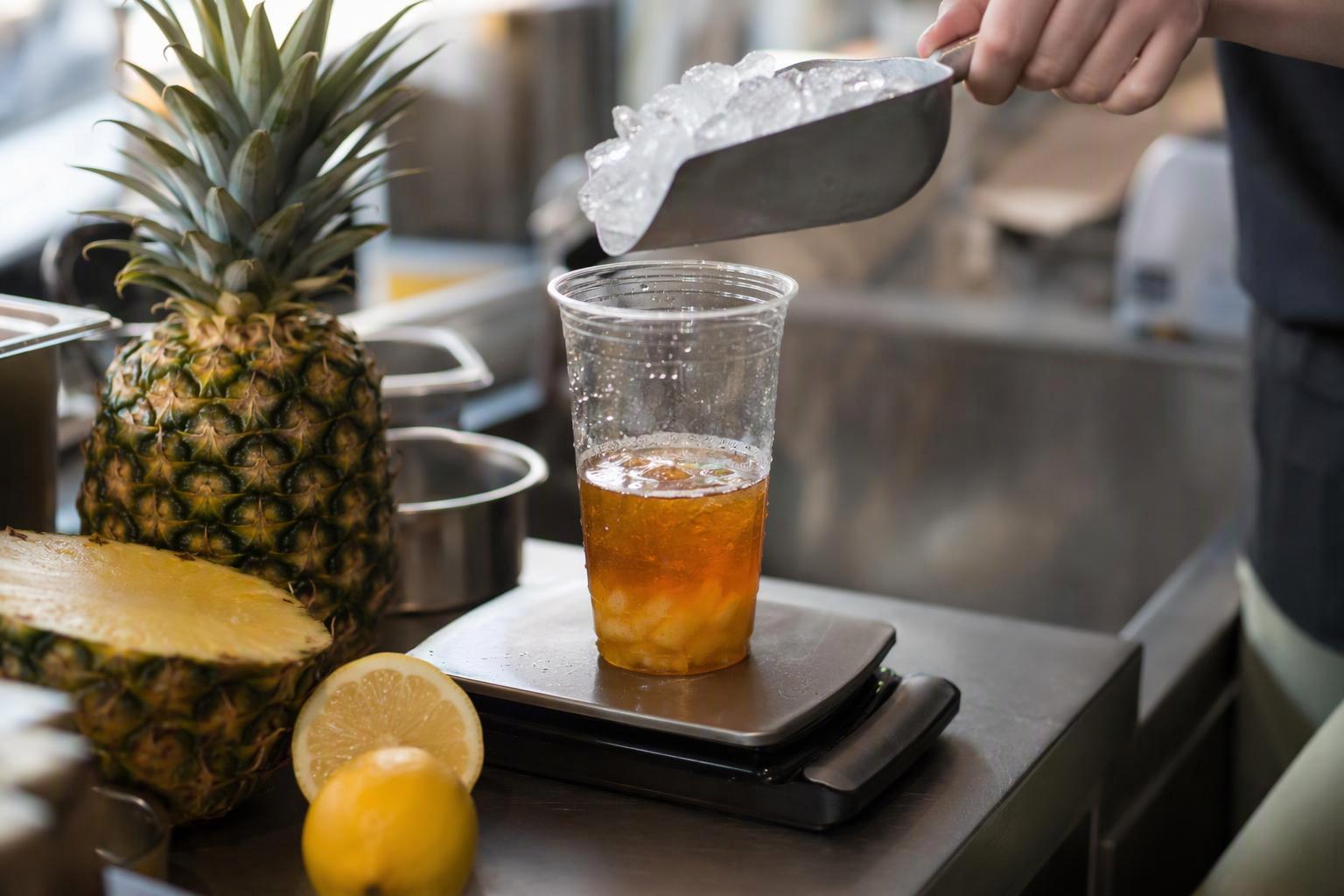
The build is a weighed formula, not a pour count, and that is the single change that makes how to make pineapple lemon tea repeatable across baristas. One published example SOP runs a 16 oz build as 200 ml tea base, 35 ml fruit, 10 ml fructose, 5 ml lemon, and 180 g ice, shaken hard for 10 to 12 seconds (a pineapple fruit tea shop SOP, 2026-08-19). Treat that as one supplier’s example formula, not an industry standard, and set your own numbers against your tea and fruit.
- Put the empty 16 oz cup on the scale and tare it.
- Add 200 ml tea base.
- Add 35 ml pineapple fruit.
- Add 10 ml fructose.
- Add 180 g ice, filling the shaker to the 80 to 85% line.
- Shake hard for 10 to 12 seconds, then top and seal.
Verification: the finished iced pineapple lemon tea should weigh within a few grams of the same total on every build. If two baristas weigh the same drink and get totals more than about 10 g apart, the spec is not being followed.
Step 2: Brew and Shock-Chill the Tea Base in Batch
Batch the base once and chill it fast, because a slow chill is where a good brew turns dull. One supplier’s costed spec sheet brews at concentrate strength and drops 1,000 g of ice into 3,000 ml of brew, then holds the finished base at 35 to 40 °F (one supplier’s costed spec sheet, 2026-09-23). The brew itself runs at the concentrate-strength ratio and temperature above (the standard foodservice brewing chart, undated). If you would rather not run a hot brew at all, a cold-brew tea concentrate method steeps 8 oz (230 g) of leaf in 9 cups (2.13 L) of water for 6 to 12 hours, holds the concentrate up to 2 weeks refrigerated, and serves at 1 part concentrate to 7 parts water or milk (Toddy cold-brew manual, undated).
Verification: the base should read 35 to 40 °F on a probe thermometer immediately after the ice dissolves. If it is warmer, add ice and stir before it goes into the cooler.
Step 3: Add the Lemon So It Does Not Turn Bitter
Add the lemon after the tea is off the heat and strained, because prolonged heat is what pulls bitterness out of the peel and pith. The brewing-mistakes guidance is explicit that lemon goes in near the end or after straining for a brighter flavor and to avoid unnecessary bitterness from heat exposure (the standard foodservice brewing chart, undated). In the build itself, the lemon is a 5 ml acid adjustment rather than a top note, and it has to be re-tasted whenever the pineapple format changes (a pineapple fruit tea shop SOP, 2026-08-19). A puree at 11 to 16 °Brix and a syrup do not need the same acid correction (a second supplier’s puree spec, undated sheet).
Verification: the finished drink should taste bright at the front and clean at the finish. If it reads flat, add 1 ml of lemon and re-taste; if it reads sharp or pithy, you added it hot or added too much.
Step 4: Set the Hold and Discard Clock for the Batch
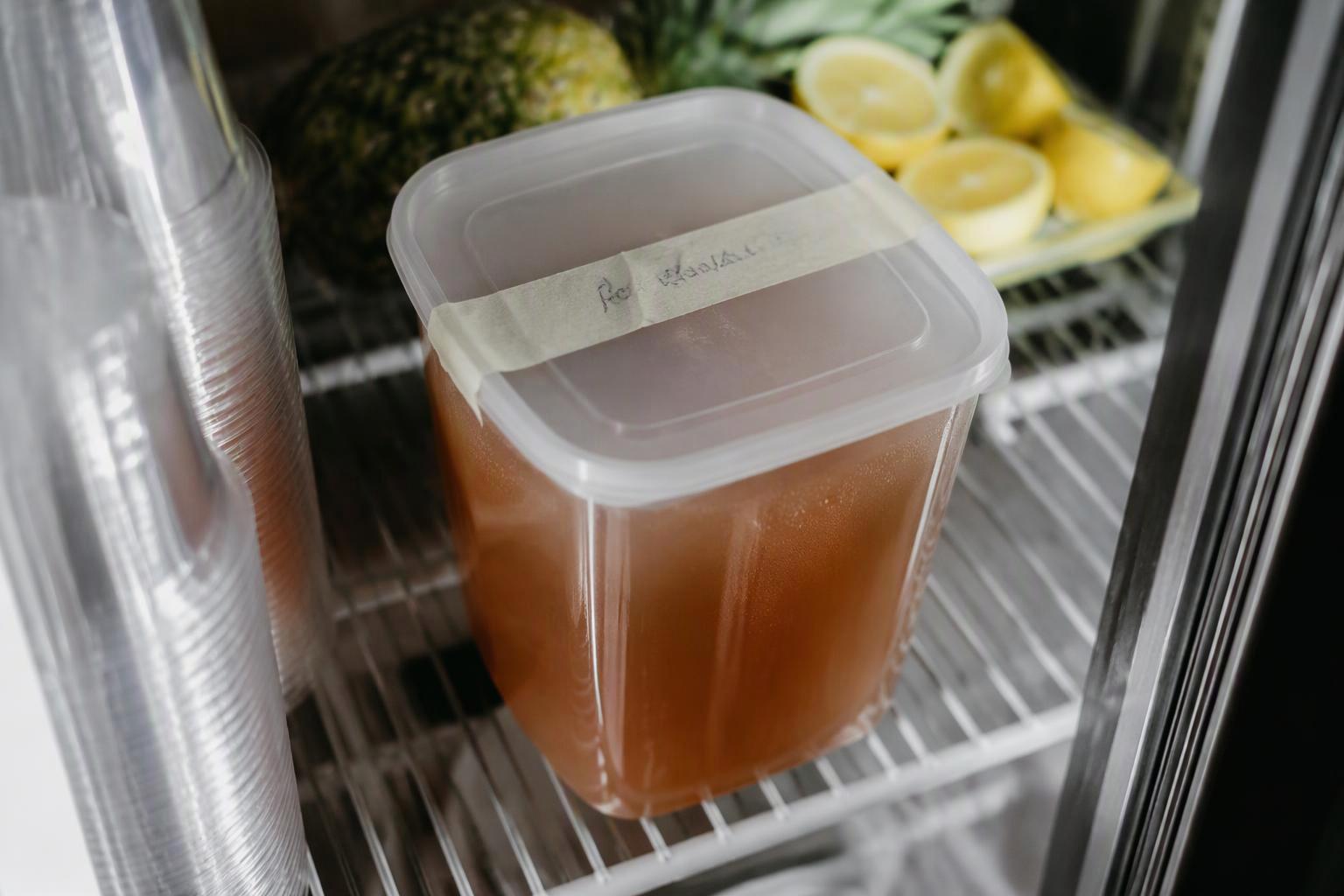
Write the clock down before the first batch goes in the cooler, because the 4-hour rule is conditional on a written procedure. Refrigerated ready-to-eat TCS food held more than 24 hours must be marked and discarded after a maximum of 7 days at 41 °F or less, with the day of preparation counted as Day 1 (Chapter 3 of the Food Code, 2022 edition). Cold holding of TCS food is 41 °F or less (Chapter 3 of the Food Code, 2022 edition). If you hold food without temperature control, it must be served or discarded within 4 hours of leaving temperature control, and the FDA’s cut-produce guidance applies the same cut-produce holding logic to fruit that becomes TCS when cut (Chapter 3 of the Food Code, 2022 edition; FDA guidance on cut produce, current as of 2022-03-07). The 4-hour route is not self-executing: it requires written procedures prepared in advance, maintained on site, and available to the regulatory authority on request (FDA guidance on cut produce, current as of 2022-03-07). On top of the code, the operator practice in the published SOP is stricter for quality: discard the refrigerated tea base at 4 hours regardless (one supplier’s costed spec sheet, 2026-09-23). That is a quality rule with a named source, not a legal limit.
Verification: every batch container leaving the prep station carries a prep time and a discard time in marker. A container without both gets dumped, no discussion.
Step 5: Cost the Cup and Set the Menu Price
Run the cost math on your own invoices, because the published figures come from three different upstreams and describe three different builds. Inside one 16 oz build, the same SOP prices pineapple syrup at $0.12 to $0.18 per cup, puree or jam at $0.25 to $0.35, and fresh pineapple chunks at $0.45 to $0.65 (a pineapple fruit tea shop SOP, 2026-08-19). A separate supplier’s cost breakdown puts fruit tea at $1.00 COGS against a $6.50 menu, versus $0.60 and $4.50 for milk tea, and suggests COGS at 20 to 30% of revenue (a supplier’s cost breakdown, 2026). A third, larger build prices direct COGS at $1.09 against a suggested retail of $6.95 (one supplier’s costed spec sheet, 2026-09-23). The range, not any single figure, is the claim.
- List every input in the 16 oz build with its invoice cost per unit.
- Convert each to cost per build (for example, cost per liter divided by 1,000, times milliliters used).
- Add cup, seal, straw, and sleeve.
- Divide by your target COGS percentage to get a floor price, then round to a menu number.
Verification: your costed build should land inside the $0.12 to $0.65 fruit-format band and your total COGS inside the $0.44 to $1.09 range the three sources describe. If it does not, check your unit conversions before you change the price.
Step 6: Write the Prep Card and Train the Shift
A spec that lives in a manager’s head is not a spec, and the code agrees: the 4-hour route requires written procedures prepared in advance and kept on site (FDA guidance on cut produce, current as of 2022-03-07). The staff-facing version of the same rules, from ServSafe time-and-temperature rules, gives you the plain-language lines to put on the card: cold TCS food ready to eat held at 41 °F or less, ready-to-eat fruit that becomes TCS when cut starting at 70 °F or less but discarded within 4 hours, and cold ready-to-eat TCS food held without temperature control up to 6 hours if it starts at 41 °F or less (ServSafe Food Code supplement, 2017 supplement).
- One page, laminated, at the bar: grams and milliliters for the 16 oz build, in order.
- Batch card: brew ratio, shock-chill ice weight, hold temperature, discard time.
- Clock card: 41 °F cold hold, 7-day date mark, 4-hour discard, and the shop’s stricter 4-hour tea-base rule.
- Second-barista test: have someone who did not write the card build the drink from it alone, then weigh both cups.
Verification: two baristas building from the card should land within 10 g of each other and within a few grams of the target total.
Common Mistakes That Break the Spec
Most drift traces to four habits. Pouring by eye instead of weighing is the first, and it is the one the 180 g ice figure exists to catch (a pineapple fruit tea shop SOP, 2026-08-19). Adding lemon into hot tea is the second, and it is a bitterness problem rather than a flavor preference (the standard foodservice brewing chart, undated). Swapping pineapple formats without re-tasting the sweetener line is the third, because the Brix gap between puree and syrup is roughly 50 points (a second supplier’s puree spec, undated sheet). Letting a batch sit unmarked is the fourth, and it is the one that turns a quality problem into a compliance one (Chapter 3 of the Food Code, 2022 edition). Note also that the two puree suppliers disagree on post-opening limits, 14 days versus 10, so pick one supplier’s sheet and hold your team to that sheet rather than a blended rule (a second supplier’s puree spec, undated sheet; a puree spec sheet, 2020 posting).
What Success Looks Like
Success is two cups built by two baristas that a customer cannot tell apart. Weigh both: they should land within 10 g of each other and within a few grams of the target total, with the same color, the same pineapple aroma, and the same clean finish. The batch log should show a prep time and a discard time on every container, and no container should ever be dumped for an unmarked clock (Chapter 3 of the Food Code, 2022 edition). Your costed build should sit inside the published range for your chosen format (a pineapple fruit tea shop SOP, 2026-08-19). One caution on the evidence: the 16 oz formula and the 4-hour tea-base hold both trace to a single vendor’s pages, so treat them as one shop’s working numbers and let your own second-barista test be the real proof.
Frequently Asked Questions
Can I hold the batched tea base overnight?
Only under refrigeration at 41 °F or below, and only with a date mark. Ready-to-eat TCS food kept past the 24-hour mark must be labeled and used within 7 days, counting the prep day as Day 1 (Chapter 3 of the Food Code, 2022 edition). For quality rather than safety, the published operator practice is tighter: discard at 4 hours even when chilled (one supplier’s costed spec sheet, 2026-09-23).
Do I need a written procedure to use the 4-hour rule?
Yes, and it has to exist before the shift starts. The 4-hour route depends on procedures prepared in advance, kept on site, and handed to the inspector on request (FDA guidance on cut produce, current as of 2022-03-07). Telling staff verbally does not satisfy that condition, and the ServSafe time-and-temperature material repeats the same requirement for training purposes (ServSafe Food Code supplement, 2017 supplement).
I already use a concentrate. Do I need any of this?
Partly. A bag-in-box concentrate takes the brewed-tea hold clock off your board: the standard foodservice brewing chart lists “no holding time in dispenser” for iced tea concentrates, with printed dilution ratios of 11+1 sweetened and 15+1 unsweetened (US Foods, “Know Your Tea”, undated distributor technical sheet). What a concentrate does not remove is the pineapple side of the drink, which carries its own clock, or the weighed build that keeps a pineapple lemon tea consistent from shift to shift.
How long does an opened puree pouch keep?
Plan on 10 to 14 days refrigerated, and treat the split as real rather than rounding it. One opened-format shelf life figure runs to 14 days (a second supplier’s puree spec, undated sheet), while another supplier’s puree spec sheet caps it at 10 (a puree spec sheet, 2020 posting). Unopened aseptic puree is a different case: shelf-stable at room temperature below 75 °F recommended, for 18 months (Scotzin Bros. technical data sheet, 2020). Date the pouch the day it opens and use the shorter limit when your supplier does not state one.
Does the spec work at a different cup size?
Yes, because the spec is a ratio, not a fixed recipe. Build the 16 oz version on the scale first, then scale every component by the same factor for a 12 oz or 20 oz cup: if the 16 oz build uses 4 oz of pineapple, a 12 oz cup takes 3 oz and a 20 oz takes 5 oz. Keep the ice-to-liquid proportion unchanged, since ice is what sets the final dilution and the perceived sweetness. Weigh the first few cups at the new size to confirm the numbers land where you expect, then write the scaled column onto the prep card alongside the original.
The drink does not have to taste different every shift. Weigh the 16 oz build, batch and shock-chill the base, add lemon after straining, write the hold clock on the container, cost the cup from your own invoices, and put the whole thing on a laminated card at the bar. The numbers in this spec are a starting build: the 200 ml, 35 ml, 180 g formula is one supplier’s published example, and the 4-hour tea-base hold is that shop’s quality rule rather than a legal limit (a pineapple fruit tea shop SOP, 2026-08-19; one supplier’s costed spec sheet, 2026-09-23). The regulatory floor underneath it is the FDA code: 41 °F cold hold, a 7-day date mark with prep day as Day 1, and a 4-hour discard if the food is held without temperature control (Chapter 3 of the Food Code, 2022 edition). Run the spec for one week and weigh the shift-to-shift cups. If two baristas land within 10 g of each other, you have a menu item instead of a guess.