
If you’re deciding between matcha and hojicha for your bubble tea menu, you’re really deciding between two different “moods”:
Matcha is bold, grassy, and energizing—perfect for a classic matcha latte build.
Hojicha is toasty, mellow, and often positioned as a gentler option.
Both can work. But they don’t behave the same in milk tea, they don’t speak to the same customer cravings, and they won’t create the same operational headaches.
Below is a shop-owner-friendly comparison you can actually use to choose what to launch first.
Matcha vs hojicha (quick comparison)
Decision factor Matcha Hojicha
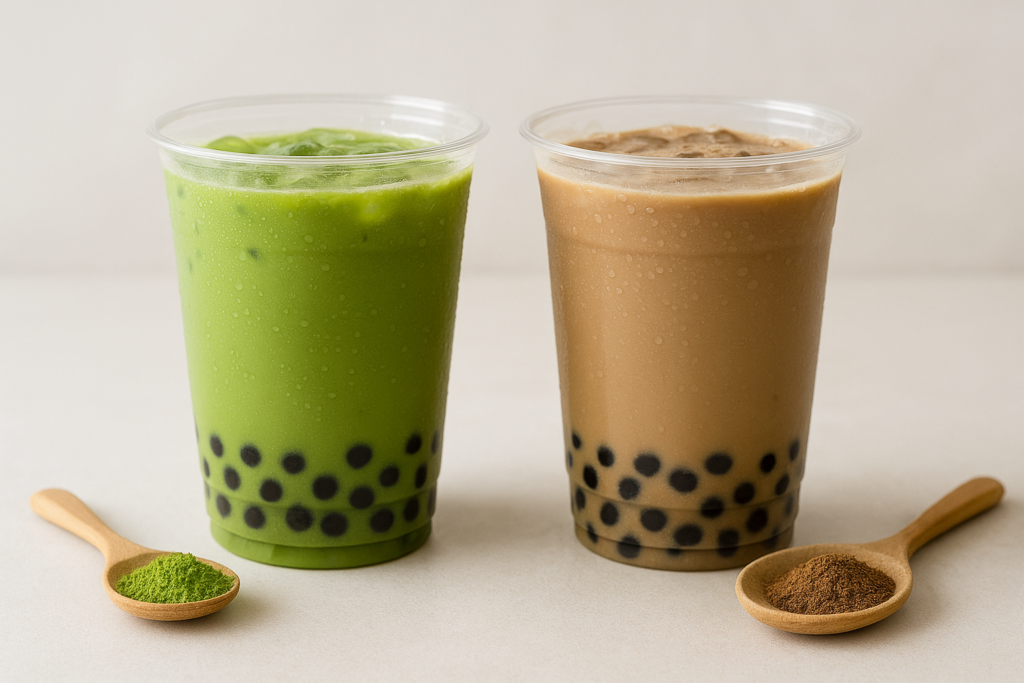
Flavor in milk Grassy/umami, “green” and bold Roasty, nutty, cocoa/caramel-leaning
Color/visual impact Bright green (high “wow” factor) Warm brown (cozy, coffee-adjacent)
Caffeine positioning Typically higher Typically lower
Customer familiarity Very high (social + café trend) Growing (coffee-shop adoption)
Prep difficulty Medium (clumps + temp sensitivity) Medium (clumps, but more forgiving flavor)
Best menu role Signature “green” latte, premium add-on Seasonal special, coffee-alternative latte
Pro Tip: If you can only launch one, matcha wins on visual marketing. If your customers ask for “something less caffeinated,” hojicha wins on positioning.
1) Flavor: what customers will actually taste
Your customers won’t describe these teas by how they’re processed. They’ll describe them by what they taste like in a creamy drink.
Matcha flavor profile
Matcha in milk tea tends to read as:
grassy/vegetal
slightly sweet
umami (savory depth)
a clean, lingering “green” finish
That intensity is why matcha can support stronger toppings (think brown sugar pearls, red bean, or a lightly salted foam) without disappearing.
Hojicha flavor profile
Hojicha is roasted Japanese green tea. In milk, it usually tastes:
toasty
nutty
cocoa/caramel-like
smooth and cozy
Taste of Home summarizes the contrast well: hojicha leans “caramel and campfire,” while matcha is “earthy and grassy” in comparison (see Taste of Home’s matcha vs hojicha comparison (2025)).
2) Caffeine: how to position “energy” on your menu
Caffeine is where shop owners get into trouble—because customers ask for numbers, but the number changes with dose, powder type, and serving style.
Matcha caffeine (typical ranges)
Matcha is often higher in caffeine than most brewed green teas because it’s powdered—you’re consuming the whole leaf.
Harvard Health reports matcha at 38–89 mg caffeine per 8 oz, compared with green tea at 23–49 mg (and coffee at 100–120 mg) in its 2024 overview (see Harvard Health’s matcha caffeine range (2024)).
A peer-reviewed review of matcha chemistry reports matcha caffeine at 18.9–44.4 mg per gram (helpful for operators who portion by grams) (see a 2020 review on matcha’s caffeine content (18.9–44.4 mg/g)).
How to translate that into a menu talking point:
If you serve a “matcha latte” style drink, expect customers to experience it as noticeably more stimulating than most brewed teas.
Hojicha caffeine (what you can say without overpromising)
Hojicha is commonly described as lower caffeine because it’s typically made from more mature leaves and then roasted.
Bon Appétit notes hojicha is roasted and is a popular “low-caffeine” café drink option compared with matcha in its 2026 overview.
How to translate that into a menu talking point:
Position a hojicha latte as a gentler, later-in-the-day option for customers who want something warm and roasty without coffee-level intensity.
⚠️ Warning: Don’t promise “caffeine-free” unless your specific product is verified as such. Stick to “typically lower caffeine” and train staff to say caffeine varies by serving.
3) Visual merchandising: the color sells the drink
If you run social-friendly menus (Instagram, TikTok, menu boards with photos), matcha has a built-in advantage:
Matcha: bright green reads instantly as “matcha.” It photographs well and signals premium.
Hojicha: warm brown often reads as “coffee-adjacent.” That’s not a negative—it can be a strategic bridge for customers who don’t love “green” flavors.
If your shop already sells coffee, hojicha can be a smart cross-sell: “tea latte energy, coffee-ish flavor.”
4) Prep workflow: where shops lose consistency (and margin)
The biggest operational difference isn’t the tea itself—it’s whether your team can make the drink the same way every time.
Matcha: clumps + temperature mistakes are the usual failures
Matcha can taste bitter if it’s mixed with water that’s too hot.
Naoki Matcha recommends avoiding boiling water and flags bitterness risk above about 80°C / 176°F, plus it strongly favors whisking (bamboo whisk or frother) over spoon-stirring to prevent clumps (see Naoki Matcha’s water temperature guidance (2024)).
Operator checklist for matcha consistency:
portion by grams (or a standardized scoop)
use hot-but-not-boiling water for the initial mix
whisk/froth into a smooth base before adding milk
Hojicha powder: similar mixing steps, usually more forgiving flavor
Hojicha powder can clump too, but the roasted flavor is often more forgiving if the drink sits slightly longer before serving.
Hojicha Co. suggests using about 1 tsp hojicha powder with up to ~60 ml warm water, breaking clumps first, then whisking in a zig-zag pattern (see Hojicha Co.’s hojicha powder prep method).
Operator checklist for hojicha consistency:
standardize your powder-to-water ratio
whisk/froth into a smooth base (don’t dump powder straight into cold milk)
taste-test sweetness: hojicha often pairs well with maple, brown sugar, or light caramel notes
5) Cost drivers: what changes your margin (without guessing your prices)
Even if you don’t want to publish pricing, you can still make a smart decision by thinking in cost drivers:
Matcha tends to skew “premium”
Matcha is often marketed in grades, and customers expect to pay more for it. That can be a margin opportunity if your quality is consistent.
The risk: matcha that’s clumpy, bitter, or dull green will get called out immediately.
Hojicha can be a margin-friendly specialty drink
Hojicha’s flavor is naturally roasty and dessert-friendly, which makes it easier to build a signature drink around it (think toasted notes + brown sugar + oat milk).
The risk: if customers have never heard of hojicha, you may need a one-line menu description and a sample push.
6) Menu fit: who should choose which?
This is the part most blog posts skip. Here’s the simple decision rule.
Choose matcha if…
your customers ask for matcha already (or you’re in a health/fitness-heavy area)
you rely on visuals to sell drinks (matcha is a billboard)
you want a premium anchor item that supports add-ons
Choose hojicha if…
you want a coffee-adjacent latte for non-tea customers
you get frequent “less caffeine” requests
you want a cozy seasonal special (fall/winter) that tastes like toasted dessert
Choose both if…
your shop runs seasonal menus and you want two distinct hero drinks
you can train staff on one “powder base” method and apply it to both
7) Japan-origin sourcing notes (what to say on your menu)
Both matcha and hojicha are strongly associated with Japanese tea culture.
Hojicha is a Japanese roasted green tea—Bon Appétit notes it originated in Kyoto in the 1920s (see Bon Appétit’s hojicha overview (2026)).
Matcha’s modern ceremonial style is deeply tied to Japan (see Encyclopaedia Britannica’s overview of matcha).
Menu-description starter lines you can steal:
Matcha: “Stone-ground Japanese green tea powder with a bold, earthy-sweet finish.”
Hojicha: “Japanese roasted green tea with warm, nutty, cocoa-like notes—smooth and cozy.”
FAQ
Is hojicha just “roasted matcha”?
No. Hojicha is roasted tea (often leaves/stems), while matcha is a powdered green tea made from specially grown leaves and ground into a fine powder. Some brands sell “roasted matcha,” but hojicha and matcha are still different products.
Does matcha always have more caffeine than hojicha?
Usually, yes—but portion size matters. Matcha is powdered, so caffeine can climb quickly depending on how many grams you use. Hojicha is commonly positioned as lower caffeine, but exact caffeine depends on the product and serving.
Which one tastes better in bubble tea?
Neither is “better.” Matcha is brighter and more vegetal; hojicha is roasty and dessert-like. The best choice is the one your customer base will reorder.
Next steps
If you’re building (or refreshing) your tea lineup, start by browsing the tea catalog at Bubble Tea Supplier. For matcha-specific options, you can also check Matcha and premium listings like Imperial Pure Matcha Tea or Jade Green Matcha Tea.