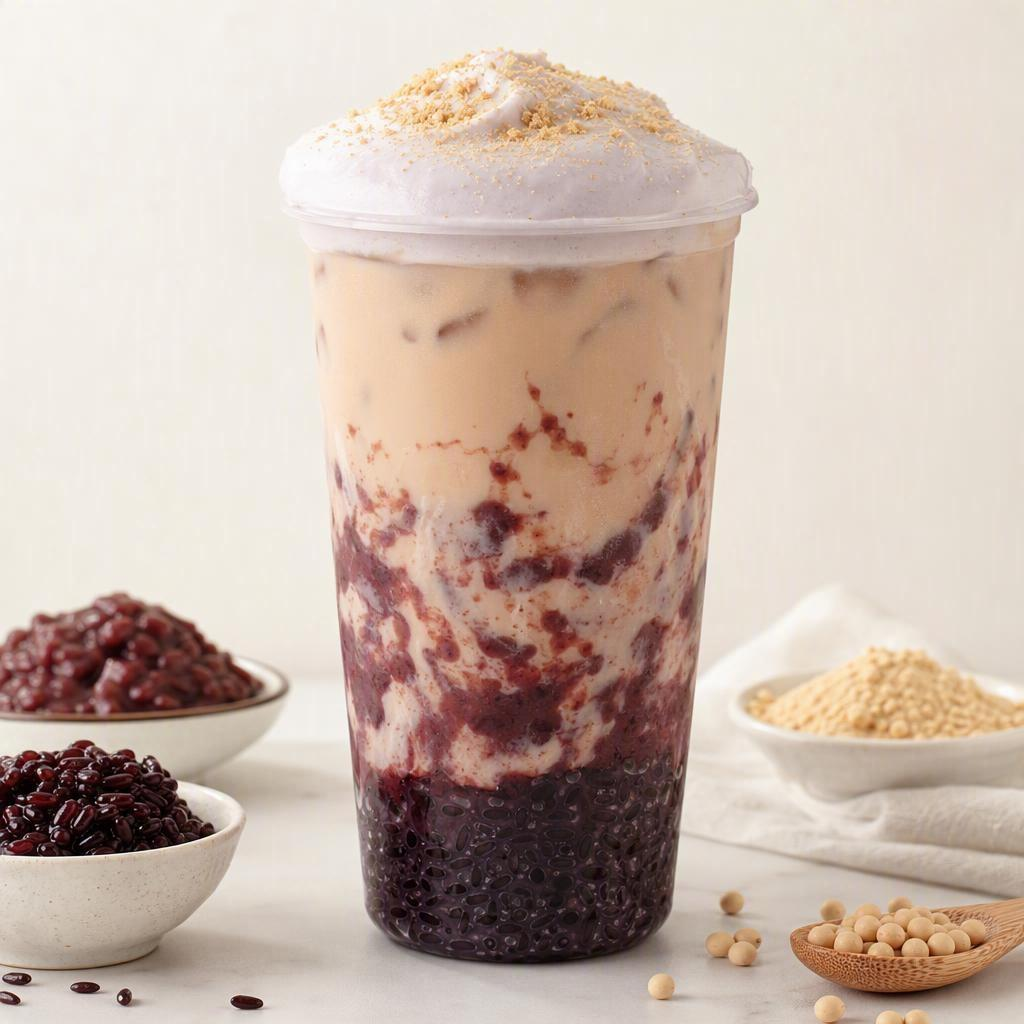
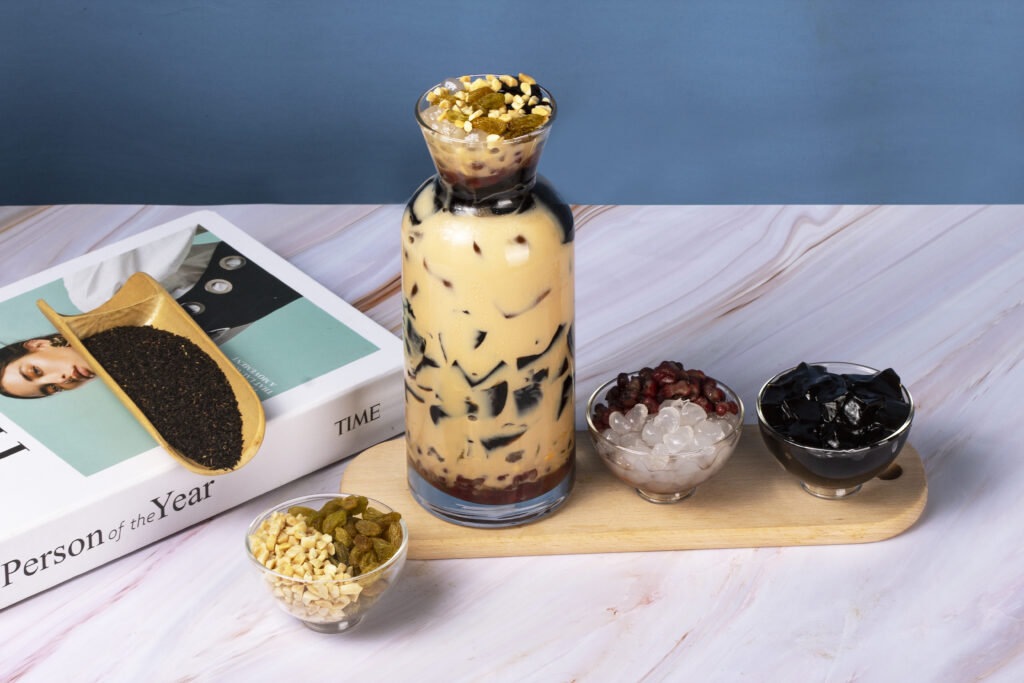
“Purple drinks sell,” is a phrase you hear a lot in US bubble tea these days — and for good reason. Consumers gravitate toward rich, dessert-like milk teas that photograph well and feel like an indulgence rather than a quick sip. Purple rice mochi milk tea is one of the cleanest ways to ride that wave without cloning yet another taro or ube drink.
Done right, it layers four distinct experiences in a single clear cup: cooked black glutinous rice at the base for a nutty chew, sweet red bean paste marbled up the walls for velvet, a creamy milk tea body for the familiar comfort, and a stretch mochi cream top for that soft, dessert-forward finish.
For a shop owner, this drink is more than a pretty photo. It works on the numbers: modest wholesale ingredient cost, a premium retail price, and a simple speed-of-service build that a trained barista can execute in under 30 seconds. The catch is prep. Rice and mochi don’t cooperate if you improvise, so this guide gives you the operator-ready standard.
Why Purple Rice Mochi Milk Tea Earns a Premium Menu Slot
Before you buy a single bag of rice, it helps to see this item the way a menu strategist does: as a high-margin, three-texture showcase item rather than a base-flavor repeat.
Texture-led toppings are the growth story in specialty drinks right now. Datassential data, highlighted by Nation’s Restaurant News, shows mochi has grown roughly 35% on American menus in four years as it moves from dessert novelty into everyday foodservice. Mochi’s natural home is the rich, sweet, dessert-positioned milk tea — which is exactly the profile of this drink.
At the same time, the broader “purple” family of drinks — led by taro and ube — stays popular in large part because it is photogenic and reads as a treat. Purple rice gives you that same social-media pull with a genuinely different story: instead of a purple-flavored base, the purple comes from chewy glutinous rice, so the drink doubles as a drinkable dessert with visible, believable texture. Most menu content covers either purple drinks or mochi toppings; few combine rice + bean + mochi into one spec-ready layered build, which is the gap this recipe fills.
Key takeaway: A single-taste drink is a commodity. A layered “drinkable dessert” with three distinct chewy/smooth textural notes gives you pricing power — which is why this item earns a $7+ slot instead of a standard milk tea price.
The Ingredient System: Buying for Texture, Not Just Flavor
The drink’s selling point is contrast, so every component must be specified for its texture role, not just its flavor.
Sweetened azuki (red bean) paste, ideally with visible whole-bean fragments
Velvety sweetness + marbled visual wall
Tea base
Roasted oolong or Assam (a robust, malty profile)
Cuts through the creamy, sweet toppings
Cream base
Non-dairy creamer or fresh milk, matched to your menu
Creamy, familiar milk tea body
Mochi top
Scratch mochiko foam OR commercial mochi-foam powder whipped with cream
Soft, stretchy dessert layer on top
Purple rice = black glutinous rice
This is the most important terminology point for your kitchen team. The ingredient that cooks to that dark purple and stays chewy in an iced drink is black glutinous rice. Regular (non-sticky) purple rice won’t give you the bouncy bite you need; it cooks soft and turns mushy in a cup. When you order in bulk, specify black glutinous rice so your baristas aren’t surprised on the first batch.
Sweet red bean paste
Buy commercial sweet azuki paste in the 45–50% sugar range and look for one that keeps some visible whole beans rather than a fully smooth puree. Those bean fragments show through a clear PET cup and that is what makes the marbled wall read on social media.
A robust tea base matters more than you’d think
Purple rice, red bean, and mochi cream are all rich and sweet. A light tea base gets buried. A charcoal-roasted oolong or an Assam black tea has the backbone to sit underneath and keep the drink balanced rather than cloying.
The mochi top: two reliable ways to run it
Drinkable mochi here means a stretchy, mochi-flavored cream/foam that floats on top — the soft pillowy cousin to cheese foam. You have two commercial routes:
Scratch mochiko foam: glutinous rice flour cooked with milk into a mochi dough, then blended with cream cheese, heavy cream, and sweetener until glossy and pourable.
Commercial mochi-foam powder: a standardized mix whipped with cold milk and cream for fast prep on high-volume shifts.
Both hold if you keep them cold and consistent, which is the whole point of your batch SOP below.
Back-of-House Batch Prep SOP
All of this belongs in the opening prep block, before the store opens, so rush-hour assembly is just scoop-and-pour.
Task
When
Key parameter
Soak black glutinous rice
2–4 hrs before or overnight
Cold water, rinsed until clear
Cook purple rice
~10:00 AM
~1:1.3 dry rice to water
Sweeten warm rice
right after cooking
Toss with liquid syrup while above ~160°F
Whip mochi cream
~11:00 AM
Whip to soft/medium peaks; hold cold
Brew concentrated tea base
~11:15 AM
~1:30 tea-to-water, steeped then chilled
Step 1 — Black glutinous rice, cooked to stay separate
The #1 quality failure is rice that clumps into a solid mass. Prevent it at the cook step.
Rinse 1,000 g raw black glutinous rice 3 times until the water runs mostly clear.
Soak in cold water at least 2 hours (overnight is better for even softening).
Drain and cook in a commercial rice cooker with about 1,300 ml purified water (the ~1:1.3 ratio).
When the cooker switches to “Warm,” let it steam untouched for about 15 minutes.
Transfer the warm rice to a stainless holding container and immediately fold in roughly 220 g liquid fructose (or a 50% cane-sugar syrup) plus a touch of honey until glossy.
Pro tip: Sweeten while the rice is hot — above about 160°F (71°C). Sugar penetrates the grain and stops the starch retrogradation that makes rice grain hard and gritty once ice hits the cup.
Quality check: A spoonful of cooled rice should pour free and separate, with single grains sliding apart — not one sticky clump.
Step 2 — Red bean paste handling
Unopened cans or bags store in dry ambient space for months. Once opened, transfer unused paste to airtight food-grade containers and refrigerate at about 39°F (4°C); use within a few days. For marbling, keep the paste thick enough to smear on the cup wall rather than pour.
Step 3 — Mochi cream foam
If you run scratch mochiko foam:
Whisk glutinous rice flour with milk into a smooth, lump-free batter.
Cook (microwave in short bursts or steam) until a translucent, sticky mochi dough forms.
In a blender, combine the warm dough with softened cream cheese, heavy cream, sweetener, and a pinch of salt.
Blend until smooth, glossy, and pourable with a stretchy-ribbon consistency (typically stop at soft to medium peaks — overwhipping makes it grainy).
Keep chilled in a squeeze bottle or pour pitcher at ~39°F (4°C).
For running a more complete mochi cream program, the shop-level prep and holding details in BubbleTeaSuppliers’ mochi foam SOP guide lay out batch sizing, “done when” checks, and the food-safety steps to train to.
Step 4 — Concentrated tea base
Steep roasted oolong or Assam at about a 1:30 tea-to-water ratio for 10 minutes at ~203°F (95°C). Strain, then stir creamer and sweetener into the hot brew, and chill quickly with ice to below ~60°F (15°C) before it goes into a refrigerated dispenser.
Cup Build Specs for 16 oz and 22 oz
Standardize the build so every shift tastes identical and your portion costs stay predictable.
Ingredient / step
16 oz build
22 oz build
Sweetened black glutinous rice
60 g (about 1.5 scoops)
80 g (about 2 scoops)
Sweet red bean paste
40 g (1 scoop)
50 g (about 1.25 scoops)
Milk tea base
180 ml
250 ml
Fructose / sweetener
15 ml (adjustable)
20 ml (adjustable)
Ice
120 g
160 g
Stretch mochi cream top
50 ml
60 ml
Garnish (optional)
Roasted soybean (kinako) dust
Roasted soybean dust
Speed-of-service assembly (< 30 seconds):
Scoop the sweetened purple rice into the bottom of a clear PET cup.
Scoop the red bean paste and smear it along the lower inner wall for a marbled look.
In a shaker, combine the milk tea base, sweetener, and ice; shake ~6 seconds; pour into the prepared cup leaving ~1 inch of headroom.
Gently pour the chilled mochi cream over the back of a spoon so it floats as a clean top layer.
Dust lightly with kinako or matcha powder, seal, and serve with a wide boba straw.
⚠️ Warning: Never shake purple rice or red bean inside the shaker cup. Shaking breaks the grains and turns the clean layered drink into murky soup. Rice and bean go in the cup; only the milk tea gets shaken.
What This Drink Costs (COGS & Margin)
This is where the pricing story lands. Using bulk wholesale pricing, a 16 oz cup’s ingredient cost stays low enough to protect a strong margin even at a premium menu price. Sourcing commercial-grade toppings in volume — the approach laid out in BubbleTeaSuppliers’ boba toppings that boost AOV strategy — is what keeps these numbers in your favor.
Component
Usage
Approx. cost
Cost contribution
Roasted oolong / Assam milk tea
180 ml
~$0.002/ml
~$0.35
Sweetened black glutinous rice
60 g
~$0.004/g
~$0.25
Sweet red bean paste
40 g
~$0.005/g
~$0.20
Mochi cream top
50 ml
~$0.007/ml
~$0.35
Cup + lid + wide straw
1 set
~$0.20
~$0.20
Total COGS
~$1.35
Suggested retail
$7.25
Gross profit
~$5.90 (≈81% margin)
Menu & upsell guidance:
Price Purple Rice Mochi Milk Tea as a Signature or seasonal Chef’s Special at roughly $7.25 (16 oz) and $8.25 (22 oz).
Let customers add extra purple rice or mochi top to other drinks for a +$1.25–$1.50 topping upsell — a fast way to lift ticket average across the whole menu.
Protect the margin by portioning with color-coded scoops so over-scooping doesn’t quietly eat into the ~81%.
Note on topping strategy: The more texture-driven toppings you offer well, the easier AOV growth becomes — which is exactly why the topping-selection logic in BubbleTeaSuppliers’ toppings menu playbook is worth reviewing before you finalize the board.
Storage, Shelf Life & Food Safety
Cooked grain, dairy cream, and bean paste each carry their own holding rules. Post these at your prep station.
Component
Hold method
Safe window
Notes
Cooked, sweetened purple rice
Room temp (~70–75°F / 21–24°C)
Up to ~6 hours
Do not refrigerate overnight — it turns gritty
Red bean paste (opened)
Refrigerate ~39°F (4°C)
Use within a few days
Airtight container
Mochi cream foam
Refrigerate ~39°F (4°C)
~24–48 hours
Keep closed; discard per policy
Brewed tea base
Refrigerate ~39°F (4°C)
End of day
Discard leftover at close
Two rules worth repeating to staff:
Don’t refrigerate cooked purple rice overnight. Refrigeration sets the starch; the rice comes back hard and gritty instead of chewy. Bake fresh batches twice a day (opening and mid-afternoon) rather than holding rice overnight.
Treat the mochi cream and milk tea like dairy (or non-dairy) toppings: keep cold, label prep/use times, and follow your local health department rules for date marking and time/temperature control.
Label any dairy in the mochi cream and milk tea on your menu for allergen transparency. Glutinous rice and black rice are naturally gluten-free, but confirm supplier certifications if you advertise a gluten-free option, since cross-contamination in the kitchen can happen.
Troubleshooting the Common Failures
Even with a clean SOP, a grab-and-go topping like this will bite back occasionally. Here’s what to check.
Problem
Likely cause
Fix
Rice clumps in the bottom of the cup
Not sweetened/coated while warm
Toss rice with syrup immediately after steaming
Mochi cream sinks or dissolves fast
Dough too dense, or milk tea too warm
Whip to soft/medium peaks; make sure the milk tea is fully chilled
Drink is too sweet after mixing
Fructose not cut for the sweet bean
Reduce syrup in the tea base by a few ml
Rice looks mushy, not chewy
Regular purple rice used
Buy black glutinous rice and soak before cooking
Full Wholesale Sourcing Next Steps
Purple Rice Mochi Milk Tea gives you a photogenic, dessert-forward signature that stands apart from the usual taro offerings, backed by a repeatable prep workflow and a margin that holds above 80%. Because the drink is only as easy as its upfront prep, standardize the batch recipes, train the cup-build sequence, and source all four texture components from one supplier you can rely on.
BubbleTeaSuppliers carries the components for this exact build — black glutinous rice, sweet red bean paste, roasted oolong and Assam tea, and commercial mochi-foam systems — along with consultation for portioning and recipe formulation. Explore the full wholesale ingredient catalog or reach out to request sample kits and a custom formulation so your first official batch comes out right.