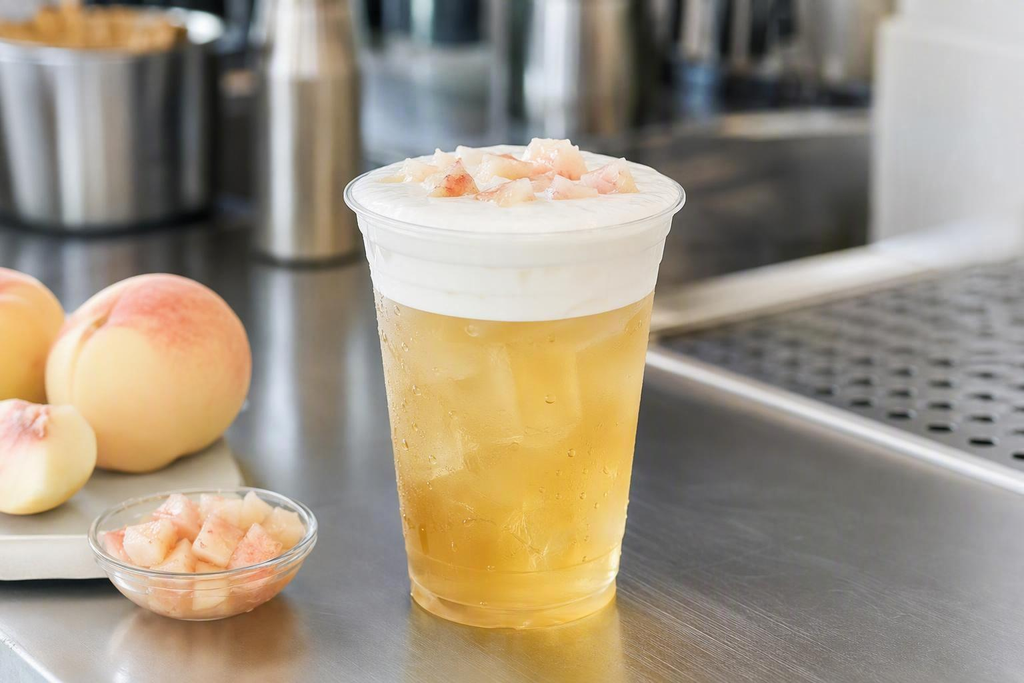
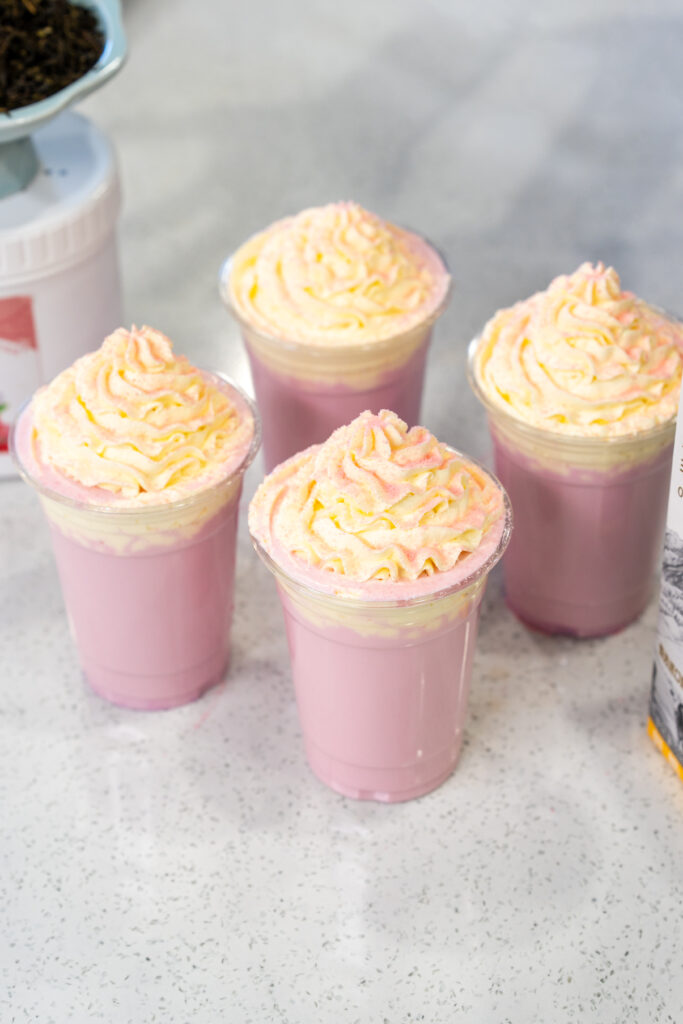
If a customer ordered a “snowy peach oolong,” would your barista know exactly what to do? For most US shops the answer is no — and that is the opportunity.
A snowy drink is simply a chilled tea base topped with a light, creamy white foam layer that floats on the surface. On major menus it has become its own named category. CHAGEE standardizes a whole Snow Cap Milk Tea
line of fresh milk tea topped with a silky fresh cream layer, and signature offerings like The Whale Tea’s Snowy Fresh Peach Oolong
prove the format sells on real menus.
What most operators lack is the playbook: how to make the cap stable, keep it floating instead of sinking, and price it so the extra step actually pays. This SOP gives you that — the cap recipe and batch, the layering technique that matters most, a 16 oz and 22 oz spec, QC checks, and a cost model.
Why “snowy” earns premium pricing
The snow cap is a low-capex premiumizer. You are not buying new equipment or launching a whole new tea base — you are adding a foam layer to a drink you already know how to build, and charging more for it.
The margin math supports the move. US milk teas average around $5.64
, and shops routinely charge about $0.50–$1.50 extra for add-on toppings, with specialty drinks priced into the $5.50–$7.50 band. A snow cap typically costs roughly $0.30–$0.60 per serving
in ingredients, yet you can price the topping at $1.25–$1.75 — a healthy spread with no equipment change.
Pro Tip: Name it like a category, not a flavor. “Snowy Peach Oolong” sets the expectation of a layered, premium drink and lets you charge accordingly. “Peach oolong with foam” reads like a modifier and invites free upgrades.
The cap: what to stock and how to batch it
You have two viable routes, and neither is wrong. Pick one for training simplicity.
Option A: Real-dairy snow cap (richer, more “fresh”)
This is the made-from-scratch route: cream cheese, heavy cream, milk, sugar, and a touch of salt, whipped to a soft ribbon.
A scaled-for-service batch (about 10–12 cap servings):
Ingredient
Amount
Cream cheese (full-fat), softened
150 g
Heavy whipping cream
180 g
Whole milk
90 g
Granulated sugar
45 g
Fine salt
1 g
Method: Beat the softened cream cheese smooth, add the sugar and salt, then pour in the heavy cream and milk. Whip on medium until the mix holds a soft to medium peak — thick and glossy, spreading slowly. Stop before stiff peaks; an overwhipped cap is hard to layer and turns frothy.
Option B: Powder-based snow cap (fastest, most consistent)
If your line is fast and your staff rotates, a foam powder gets you the same category with tight portion control: roughly 1 part powder to 4 parts cold water or milk (a common starting point is 60 g powder + 240 ml cold water), mixed about 2 minutes, then chilled before service.
The real-dairy version tastes richer; the powder version is easier to reproduce under pressure. For the operational foundation of cap batching, sizing, and portioning, the cheese foam / snow cap drink SOP
from BubbleTeaSuppliers walks through batch sizes and par levels in detail.
Done when: the cap holds a distinct layer for several minutes and doesn’t drip off a spoon instantly.
Running a snow cap milk tea across busy shifts
The single biggest risk to a snow cap milk tea isn’t the recipe — it’s the line. A cap is a perishable, texture-sensitive component, and it will fight you in a rush if you treat it like a bottle of syrup.
Three rules keep the program trainable:
Small, rotating cap batches. One big bucket that sits for an hour will deflate and sink. Whip to soft/medium peaks, hold it covered and chilled, and use it fast. Re-whip in small increments during peak hours rather than letting one batch die.
Assign the cap to a specific station task. When volume spikes, one person handles fill + layer + seal so the technique doesn’t drift between staff chasing different orders.
Build cards for both sizes. No verbal “about this much.” The 16 oz and 22 oz spec on the card (tea, peach, ice line, cap portion) is what lets a new hire hit the same drink as the morning lead.
This discipline applies whether the cap is a milk foam topped oolong tea, a cheese foam variant, or any foam-topped fruit tea on your menu. The cap consistency framework is the same; only the flavor pairings change.
Pro Tip: Keep a labeled cap container with a portion scoop at the station. When a customer asks for “a little extra foam,” sell it as a topping bump — but keep the line’s standard portion fixed so your cost model holds.
The float technique (the step most shops get wrong)
The cap only stays on top if three conditions hold. Get these right and the foam floats; miss them and it sinks, streaks, or dissolves into the drink.
Condition 1 — The tea base must be fully chilled
Warm tea destroys the cap. It melts the foam on contact and tilts the density balance so the cap sinks. Brew the oolong strong, strain it clean, and chill it completely before building.
Condition 2 — The cap must be denser than the base
This is why you don’t over-dilute the tea. A thin, watery base is closer to the foam’s density, so they merge. Keep the base robust and iced, and the cap will sit on top.
Condition 3 — Layer gently, leave headspace
Build the base to a fill line that leaves room, then set the cap on top by spooning it on or pouring slowly over the back of a spoon. Never dump it straight in from height — that drives the foam into the tea.
For a deeper look at how foam consistency and hold-time behave across a drink line, the bubble tea supplier’s milk tea foam prep, holding, and service SOP is a useful read.
16 oz snowy peach oolong spec
A single reference card your team can hit every time, iced cold.
16 oz / 473 ml iced build (syrup version)
Component
Amount
Chilled oolong tea base
165 ml (5.5 oz)
White peach syrup
30–45 ml
Ice
fill to 80–85%
Snow cap
25–35 g
How to choose the syrup dose: start at 30 ml if customers add sweet toppings; start at 45 ml if “less sugar” is common or the oolong is very aromatic.
If you use peach jam instead: keep the tea and serving the same, and whisk 20–30 g peach jam into a little chilled tea first (no clumps) before adding to the shaker. For the syrups-versus-jam-versus-puree decision behind this, the fruit milk tea ingredient formats guide
from BubbleTeaSuppliers helps you pick the format that holds up best on your line.
Step 1 — Shake the chilled tea, peach flavor, and ice for 8–10 seconds.
Step 2 — Strain into the cup, leaving headspace for the cap.
Step 3 — Spoon or slow-pour the cap on top.
Done when: two cups made by two staff look and taste the same, with the cap sitting as a clean white layer.
22 oz snowy peach oolong spec
The larger size needs proportionally more cap so the layer still reads on a taller cup.
22 oz / 650 ml iced build
Component
Amount
Chilled oolong tea base
240 ml (8 oz)
White peach syrup
45–60 ml
Ice
fill to 80–85%
Snow cap
35–45 g
Everything else — brew a strong base, chill fully, layer gently — stays the same. Don’t eyeball the scale-up; put both specs on the build card so a new hire can hit either size without guessing.
Pro Tip: Portion the cap with a fixed scoop or jigger so the layer is identical cup to cup. The visual thickness of the cap is part of what customers pay for.
QC targets and troubleshooting
Give your team a few non-negotiables to check, then handle the two most common failures inline.
QC targets
The cap sits as a distinct white layer for several minutes; it does not immediately streak into the tea.
Aroma is peach-first, with the tea finish behind it.
Mouthfeel is creamy and layered — you taste the tea base and the cap separately.
The cap sinks or dissolves Usually a warm or over-diluted tea base, an under-whipped cap, or a hard pour. Fix: chill the base fully, keep it robust, and layer with a spoon.
The cap is stiff and frothy You whipped it too far. Fix: stop at soft/medium peaks, and if it’s still too stiff, fold in a few grams of milk.
Separation on the cap Temperature shock is the usual culprit. Keep the cap itself chilled, and don’t pour warm-ish tea under a cold cap.
If you’re running other foam-topped teas, the hojicha cheese foam tea shop SOP
shows how the same cap logic transfers across a menu.
Cost model: is the snow cap worth it?
Run this quick per-serving math with your real ingredient prices.
Cost item
Typical per serving
Peach syrup
$0.15–$0.30
Chilled oolong tea base
$0.10–$0.25
Snow cap ingredients
$0.30–$0.60
Total ingredient cost
~$0.55–$1.15
Priced as a premium drink at $5.75–$6.75, that puts ingredient cost at roughly 15–18% — healthy for a specialty item. As a rough rule, a topping priced around 3–4× its own ingredient cost covers the added labor without leaking margin. The US boba tea shop cost guide
from KitchenCost is a solid reference for building accurate ounce-based cost models across your menu.
FAQ
What exactly is a “snowy” bubble tea? It’s an iced tea base topped with a light, creamy white foam layer that floats on top. The peach base matches well with oolong because the tea aromatics keep the sip clean under the rich cap.
Is a snow cap the same as cheese foam? They’re the same category — a dairy-based cap layered on top. Cheese foam leans saltier and cheesier; a snow cap is usually lighter and sweeter. For a peach oolong, the lighter cap tends to flatter the peach better.
Do I need a new tea base or equipment? No. That’s the appeal. You use the oolong base you already brew and add the cap. The milk and creamer choice still matters for mouthfeel, though — this guide on what milk to use in a bubble tea shop
covers the swap and upcharge logic.
How do I keep the cap from sinking during a rush? Chill the base fully, keep it properly strong, and have one person handle layering near the line. Small caps in rotation beat one big batch that sits too long.
Next steps
Pick one cap route (powder or real-dairy), lock a single chilled oolong base brew, and put both size specs on a build card before your next shift. Stock the oolong and peach format you actually want to run — if you’re sourcing commercial peach oolong tea and cap ingredients for a consistent menu, BubbleTeaSuppliers carries the wholesale tea powders, syrup, and topping products to get the recipe onto your line. Start with an ingredient sample or a product catalog review, then run a staffing taste test before you publish the menu price.