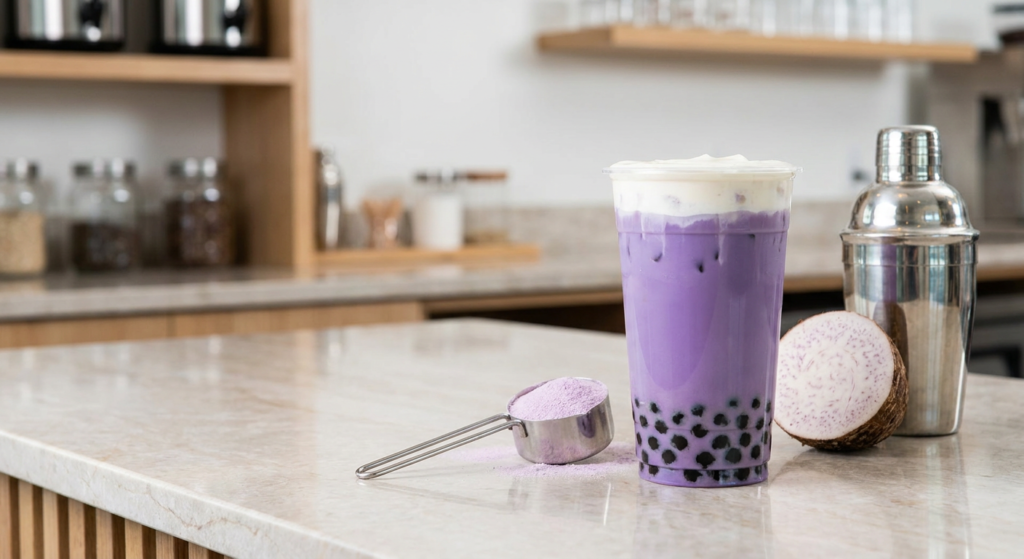
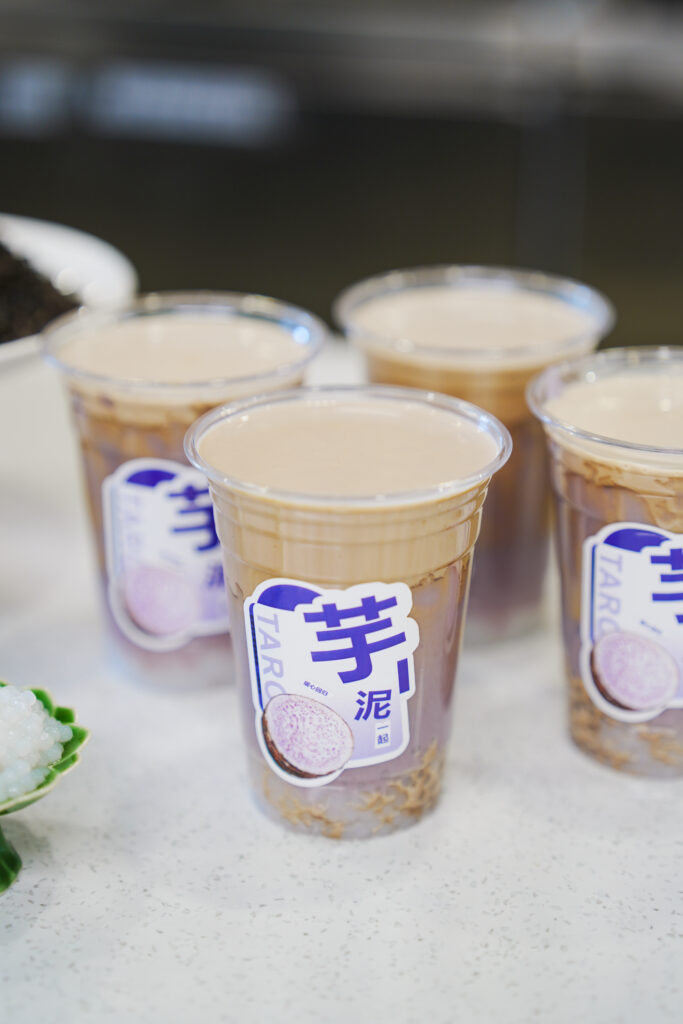
Taro milk tea is a non-negotiable core menu pillar for commercial bubble tea shops across North America. Accounting for up to 15–20% of total daily drink volume in many beverage establishments, its iconic pastel-purple hue, creamy texture, and nutty, vanilla-like flavor profile make it a reliable best-seller. However, for shop owners and beverage directors, serving a consistent taro beverage across multiple barista shifts presents distinct operational challenges.
Improper dissolution leads to chalky sedimentation at the bottom of the cup, inconsistent sweetness ruins customer retention, and unoptimized powder dosage shrinks gross profit margins. Achieving a signature, barista-grade drink requires understanding the food science behind commercial taro milk tea powder, mastering water dissolution temperatures, establishing exact gram-weight Standard Operating Procedures (SOPs), and managing inventory yield economics.
This comprehensive operational guide breaks down ingredient formulation, step-by-step 16 oz and 22 oz cup spec sheets, profit margin models, and beverage troubleshooting protocols designed specifically for commercial bubble tea shop operators.
What Is Commercial Taro Milk Tea Powder? (Formulation & Ingredient Chemistry)
Commercial taro powder is not simply dehydrated raw taro root. Raw taro root (Colocasia esculenta) is high in moisture, fibrous, and contains calcium oxalate crystals that must be cooked thoroughly to eliminate acridity. In commercial beverage manufacturing, raw taro purée is blended with functional carriers, non-dairy fats, and natural sweeteners before undergoing spray-drying to create a free-flowing, shelf-stable instant beverage powder.
Understanding the structural components of commercial wholesale taro milk tea powder
allows beverage developers to balance mouthfeel, sweetness, and solubility across hot, iced, and blended menu applications.
Key Takeaway: Commercial taro powder is an engineered food system. It combines spray-dried taro starch, non-dairy creamer fats, and anti-caking agents to deliver instant solubilization, rich mouthfeel, and consistent color stability under fast-paced shop conditions.
Raw Taro Root vs. 3-in-1 Instant Taro Beverage Powder
Boba shops generally choose between two primary operational approaches: scratch-cooked raw taro purée or commercial 3-in-1 instant powders. While fresh taro paste offers an artisanal texture, it introduces high labor costs, short refrigeration shelf life (2–3 days), and seasonal variation in starch and moisture content.
Commercial instant powders standardize sweetness, color, and texture into a single shelf-stable ingredient with an 18–24 month ambient shelf life.
Feature / Dimension
Fresh Taro Root Purée
Commercial 3-in-1 Taro Powder
Preparation Labor
High (Peeling, steaming, mashing, sweetening)
Zero (Scoop and dissolve)
Batch Consistency
Variable (Seasonal starch & water variance)
100% Standardized batch-to-batch
Speed of Service
Slow (Requires ladle & wall-coating prep)
Fast (15–20 seconds per cup)
Storage & Shelf Life
2–3 Days Refrigerated (High spoil risk)
18–24 Months Ambient Sealed
Gross Margin Impact
Higher labor & waste overhead
High gross margin (82–85%)
Key Functional Ingredients in Commercial Formulations
A high-performance commercial taro powder relies on a precise balance of functional food ingredients:
Sucrose & Dextrose Carriers: Fine-grain cane sugar or glucose syrup solids act as the primary sweetness source and carrier matrix, ensuring rapid dispersion when introduced to hot liquids.
Barista-Grade Non-Dairy Creamer: Formulated with hydrogenated vegetable oils (coconut or palm kernel) and sodium caseinate (a milk-derived protein), barista non-dairy creamer imparts a silky, dairy-like body without masking the delicate taro flavor notes.
Dehydrated Taro & Purple Sweet Potato Extract: High-quality powders incorporate real spray-dried taro root powder combined with natural purple sweet potato extract (Ipomoea batatas) or anthocyanin colorants to achieve the signature lavender shade naturally.
Hydrocolloid Thickeners & Anti-Caking Agents: Micro-doses of tapioca starch, guar gum, and silicon dioxide (E551) prevent moisture clumping in opened bulk bags while enhancing drink viscosity and suspension.
Suspension Chemistry: Water Temperature & Dissolution SOP
The most common operational failure in taro beverage prep is grittiness or rapid particle settling. This occurs when baristas attempt to mix taro powder directly into cold water, cold milk, or ice.
According to food science studies on taro starch gelatinization
, native taro starch granules require thermal energy to swell, absorb liquid, and gel. When introduced to liquids below 50°C (122°F), starch granules and non-dairy creamer fats remain suspended as insoluble solid particles rather than forming a smooth emulsion.
[Raw Taro Powder + Non-Dairy Creamer] │ ▼ [Add Hot Water @ 65°C – 80°C] ◄── Thermal Hydration & Fat Emulsification │ ▼ [Whisk / Shake Vigorously] ◄── Complete Granule Gelatinization & Smooth Base │ ▼ [Add Fructose & Ice] ◄── Rapid Thermal Chill for Iced Service
Thermal Hydration: Why Cold Water Causes Grittiness
When taro powder meets cold water, the outer starch layer hydrates partially, creating a sticky barrier around dry inner powder pockets. This results in stubborn clumps that resist shaking.
Furthermore, the vegetable fats in non-dairy creamer solidify at room temperature, leaving an unappealing oily film on the surface of cold drinks.
Pro Tip: Always maintain a dedicated counter-top hot water dispenser set between 65°C and 80°C (149°F – 176°F) at the milk tea station. Dissolving taro powder in hot water first ensures 100% starch hydration and zero customer complaints regarding chalky texture.
Whisking & Shaking Mechanics for Silky Emulsion
To achieve operational efficiency during peak rush hours, implement a two-stage dissolution protocol:
Stage 1 (Hot Concentrate Dissolution): Measure exact powder grams into a stainless steel mixing pitcher or shaker cup. Dispense 120 ml to 150 ml of hot water (65°C–80°C). Whisk vigorously with a wire mini-whisk or electrical handheld frother for 5–8 seconds until completely dissolved.
Stage 2 (Sweetener & Ice Chill): Add house liquid fructose cane syrup according to customer sweetness specifications, top with ice, seal, and shake vigorously for 10 seconds (or place in an automated commercial boba shaker machine).
Standard Operating Procedure (SOP): 16 oz & 22 oz Master Spec Sheets
Commercial drink consistency depends on gram-weight accuracy rather than volumetric scoops. A standard plastic powder scoop can vary by ±5 to 8 grams depending on how tightly the barista packs the powder, altering drink flavor and food cost per cup.
Below are the standardized master build sheets for classic Iced Taro Milk Tea across standard North American cup sizes: 16 oz (500 ml) and 22 oz (700 ml).
16 oz Cup (500 ml Total Volume) Commercial Recipe Spec Sheet
Designed for a balanced 500 ml finished drink serving over cooked chewy black tapioca boba
.
Ingredient Component
Exact Quantity (Grams / ml)
Operational Notes
Cooked Boba Pearls
50 g (approx. 1 slot spoon)
Placed at bottom of cup first
Commercial Taro Powder
35 g (approx. 2.5 level scoops)
Weighed on digital scale
Hot Water (65°C–80°C)
120 ml
Dispensed directly onto powder
Liquid Fructose (100% Sweetness)
15 ml (approx. 0.5 oz)
Adjust for custom sweetness levels
Non-Dairy Creamer (Optional)
10 g
Add only if extra rich profile is desired
Ice Cubes
180 g
Fill shaker cup to 400 ml line
Cold Water / Brewed Tea Base
Top to 500 ml fill line
Shake vigorously for 10 seconds
22 oz Cup (700 ml Total Volume) Commercial Recipe Spec Sheet
Designed for a standard large 700 ml finished drink serving.
Ingredient Component
Exact Quantity (Grams / ml)
Operational Notes
Cooked Boba Pearls
70 g (approx. 1.5 slot spoons)
Placed at bottom of cup first
Commercial Taro Powder
50 g (approx. 3.5 level scoops)
Weighed on digital scale
Hot Water (65°C–80°C)
180 ml
Dispensed directly onto powder
Liquid Fructose (100% Sweetness)
25 ml (approx. 0.8 oz)
Adjust for custom sweetness levels
Non-Dairy Creamer (Optional)
15 g
Optional for ultra-creamy signature line
Ice Cubes
250 g
Fill shaker cup to 550 ml line
Cold Water / Brewed Tea Base
Top to 700 ml fill line
Shake vigorously for 10 seconds
Customizing Sweetness, Ice Levels, and Tea Bases
While traditional taro milk tea is made using a hot water base, offering tea-infused variations adds menu depth:
Jasmine Green Tea Base: Replaces hot water with hot Jasmine Green Tea (brewed at 80°C). Adds a floral top note that cuts through the creaminess.
Assam Black Tea Base: Replaces hot water with hot Assam Black Tea (brewed at 90°C–95°C). Imparts a robust maltiness for customers who prefer a distinct tea presence.
Sweetener Customization: For 75% sweetness reduce fructose by 5 ml; for 50% sweetness reduce by 10 ml; for 25% sweetness reduce by 15 ml.
High-Margin Taro Menu Extensions & LTO Variations
Relying solely on classic taro milk tea leaves revenue on the table. By leveraging taro powder across multiple beverage categories, shops can introduce High-Margin Limited Time Offers (LTOs) without adding new SKUs to storage.
Concept: A lighter, floral evolution of classic taro.
Build: Dissolve 50g taro powder in 180 ml hot Jasmine Green Tea (80°C). Add 20 ml fructose and 250g ice. Shake and pour over crystal boba.
Menu Positioning: Positioned as a refreshing, premium green tea hybrid.
2. Ube Taro Cheese Foam Boba
Concept: A visually stunning layered drink combining rich taro with a savory-sweet cream cheese topping.
Build: Prepare standard 22 oz taro milk tea over black tapioca boba. Leave 1.5 inches of headspace at the top of the cup. Float 60 ml of fresh salted cream cheese foam on top. Dust with a pinch of dry taro powder.
Menu Positioning: High-margin specialty drink carrying a $1.00–$1.50 price premium over standard milk tea.
3. Taro Coconut Blended Slush
Concept: A rich, frozen smoothie ideal for warm summer months.
Build: Combine 60g taro powder, 30 ml coconut milk, 30 ml fructose, 100 ml cold water, and 350g ice in a commercial blender. Blend on high speed for 20 seconds. Line the inside of a clear cup with purple taro paste before pouring.
Menu Positioning: Indulgent frozen treat that commands a higher retail price point.
Profit Margin Economics & COGS Breakdown for Boba Shops
Controlling Cost of Goods Sold (COGS) is vital for long-term store profitability. Commercial taro milk tea powder represents one of the highest gross margin items on a boba shop menu, typically yielding between 82% and 85% gross margin.
According to industry benchmark data published in the Boba Shop Beverage Margin Report (2025)
, powder-based specialty beverages deliver significantly higher gross profit dollars per labor hour compared to fresh fruit teas due to lower prep time and minimal spoilage.
Per-Serving Cost Breakdown Table (22 oz Iced Taro Milk Tea)
The cost model below is calculated using standard US commercial wholesale ingredient prices and an average retail selling price of $6.25.
Cost Component
Unit Usage per 22 oz Drink
Wholesale Cost Basis
Ingredient Cost ($)
Wholesale Taro Powder
50 g
$11.00 / 1 kg bag (1,000 g)
$0.55
Liquid Fructose Syrup
25 ml
$28.00 / 25 kg tin
$0.04
Filtered Water & Ice
400 ml total
In-house filtration system
$0.02
Tapioca Boba Pearls
70 g cooked
$32.00 / 10 kg case
$0.14
22 oz PP Cup, Lid & Straw
1 Set
Custom printed wholesale
$0.22
TOTAL DRINK COGS
—
—
$0.97
RETAIL SELLING PRICE
—
US Market Average
$6.25
GROSS PROFIT PER CUP
—
Retail Price minus COGS
$5.28 (84.5% Margin)
Key Takeaway: At a raw drink COGS of under $1.00 per 22 oz cup, selling 50 taro milk teas per day generates over $260.00 in daily gross profit ($7,800+ monthly gross profit) from a single menu SKU.
Maximizing Yield & Inventory Storage Practices
To protect ingredient quality and prevent stock waste, adhere to strict inventory protocols:
Air-Tight Container Storage: Once a 1 kg foil bag is opened, transfer the powder into a food-grade, airtight container equipped with a silicone gasket seal. Exposure to ambient shop humidity causes powder caking and oxidation.
First-In, First-Out (FIFO) Rotation: Store sealed stock in a cool, dry environment below 25°C (77°F). Always rotate inventory so older production batches are used first.
Moisture Prevention: Never leave measuring scoops sitting inside opened powder tubs. Ambient moisture from steam wands or hot water dispensers transfers to the scoop, causing localized clumping inside the container.
Troubleshooting Common Taro Milk Tea Operational Failures
When drink quality drops, use this quick diagnostic troubleshooting matrix to identify and correct store-level execution issues.
Issue: Settling / Chalky Texture └─► Root Cause: Dissolved in cold water or insufficient whisking      └─► Action: Mandate 65°C–80°C hot water prep for initial powder stage
Issue: Faded / Grayish Purple Color └─► Root Cause: Excess milk/creamer added or exposure to UV light      └─► Action: Rebalance powder ratio; store powder in opaque containers
Issue: Overly Sweet / Heavy Aftertaste └─► Root Cause: Uncalibrated fructose dispenser or unweighed powder scoops      └─► Action: Calibrate syrup pumps weekly; mandate scale weighing
Resolving Clumping, Settling, and Flavor Fading
Problem 1: Powder Clumping in Shaker: Baristas are adding ice before dissolving the powder. Fix: Enforce strict 2-step SOP—hot water + powder first, whisk until smooth, then add ice.
Problem 2: Drink Separates Into Layers After 10 Minutes: Water temperature was too low during prep (<50°C), preventing starch gelatinization. Fix: Increase hot water dispenser temperature to 75°C.
Problem 3: Flavor Tastes Muted or Diluted: Excessive ice melting due to slow shaking or warm water volume being too high. Fix: Cap hot dissolution water at 180 ml for 22 oz drinks and fill shaker immediately with ice to lock in temperature.
Frequently Asked Questions (FAQ) for Boba Shop Operators
Does taro milk tea powder contain caffeine?
Standard taro milk tea powder is caffeine-free when prepared with a hot water base. However, if your shop uses a Jasmine Green Tea or Assam Black Tea base, the finished drink will contain approximately 25–40 mg of caffeine per 16 oz serving. Highlighting caffeine-free taro options on your menu is a great way to capture evening sales and family customers.
How many drinks can you make from a 1 kg bag of taro powder?
A 1 kg (1,000 g) bag yields approximately 28 servings for 22 oz cups (using 35g to 50g per serving) or 33 servings for 16 oz cups (using 30g to 35g per serving).
Can taro milk tea powder be used for hot beverage menus?
Yes. To make a Hot Taro Latte (16 oz), dissolve 45g of taro powder in 100 ml of hot water, then top with 250 ml of steamed milk or steamed non-dairy oat milk (60°C–65°C). Top with a light layer of microfoam for an indulgent winter menu item.
Next Steps for Beverage Directors & Store Owners
Standardizing your taro milk tea program is one of the highest-leverage operational improvements you can make in a commercial beverage business. By training baristas on exact gram-weight SOPs and maintaining proper dissolution temperatures, you guarantee consistent flavor, eliminate inventory waste, and protect your 84%+ gross profit margins.
Ready to upgrade your boba shop’s beverage program? Explore our premium range of commercial wholesale taro milk tea powders
, non-dairy creamers, and shop equipment at BubbleTeaSuppliers.com
, or contact our beverage specialists today to request wholesale sample kits for your store.