
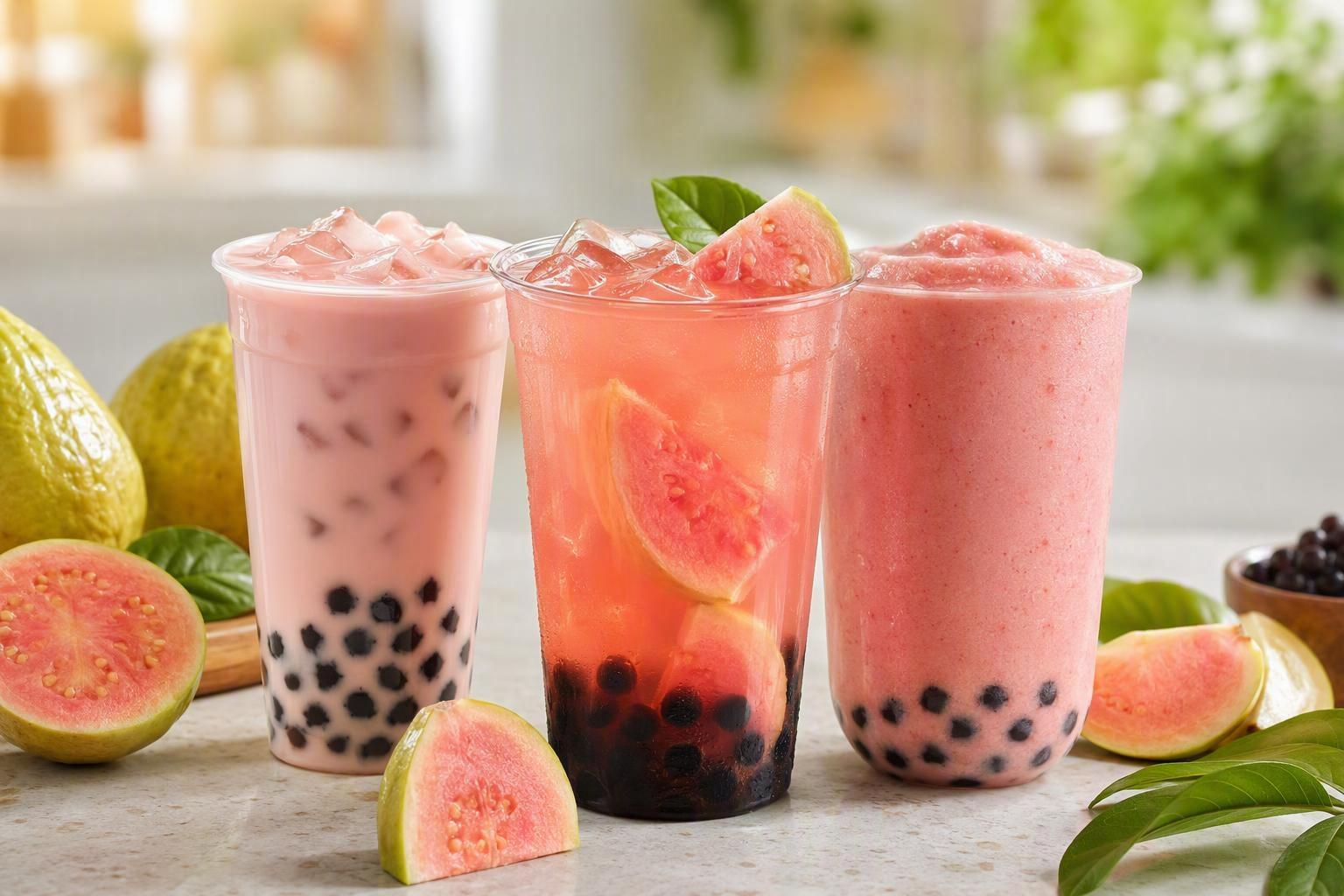
Guava is having a moment in U.S. boba shops, and it’s easy to see why. The fruit brings a pink, tropical sweetness that photographs beautifully and tastes unlike anything else on a standard tea menu. The catch? Guava can be a headache to run behind the bar — unless you pick the right ingredient platform for the drinks you actually sell.
This guide walks you through the three ways to stock guava (syrup, puree, or fresh fruit), then shows you how to turn that base into the three drinks that carry a guava series: guava milk tea, guava fruit tea, and guava smoothie. You’ll get exact specs, the COGS tradeoffs that matter to your margin, and the fixes for the failures that quietly kill guava drinks.
Syrup vs Puree vs Fresh: The Ingredient Decision
Before you build a single drink, decide which guava base fits your kitchen. The answer isn’t “the best one” — it’s “the one that matches your speed, your storage, and your menu.” Here’s how they compare across the criteria that actually matter.
| Criteria | Guava syrup | Guava puree | Fresh guava |
|---|---|---|---|
| Speed of service | Fastest | Moderate | Slowest |
| Flavor & texture | Smooth, clear, uniform | Thick, pulpy, fruit-forward | Most natural, variable |
| Sweetness control | Easiest | Must cut other sweetener | Hardest to standardize |
| Storage & handling | Ambient-stable | Refrigerated, needs agitation | Perishable, high prep |
| Best fit | Milk tea, high-volume fruit tea | Smoothies, thick drinks | Premium limited-timers |
Speed of service
If your line is busy at 6 p.m., syrup wins without debate. It dissolves instantly in cold drinks, so a milk tea or fruit tea comes together in one shake with no extra prep. Puree needs to be stored cold, stirred between uses, and often strained, which adds seconds to every cup. Fresh guava is a completely different labor story: wash, trim, blend, strain, then manage a perishable item that can’t sit on the counter safely.
Flavor and texture
Puree carries the real fruit feel. It’s made from blended whole fruit, so it brings fiber and body that syrup simply can’t. Guava syrup gives you a cleaner, brighter, more consistent profile with no sediment — which is exactly what you want in a clear fruit tea or a creamy milk tea where a cloudy, pulpy layer looks off. Save puree for the drinks where that thickness is a feature, not a bug.
Sweetness control
Syrup is the easiest to dose because its sweetness is fixed and predictable. Puree adds fruit solids and its own natural sugar, so you’ll pull back on any added simple syrup when you switch to it. Fresh fruit is the wildcard: ripeness changes sweetness cup to cup, which makes a consistent menu price hard to defend.
A quick rule of thumb
Key Takeaway: Syrup for throughput, puree for texture, fresh for a premium story. Most small boba teams get the best of both worlds with a syrup base plus a small puree line for smoothies — never more SKUs than your fridge can hold.
Guava Milk Tea: The Anchor Drink
Guava milk tea is the flagship of the series, and it’s where syrup earns its keep. Milk amplifies perceived sweetness, so the guava dose lands a touch lower than it would in a fruit tea, and the syrup keeps the cup clean and creamy with no pulp separation. A jasmine green or light oolong base gives the guava room to shine without fighting a heavy black tea.
16 oz recipe
| Component | Amount |
|---|---|
| Strong brewed jasmine green tea, chilled | 180 ml |
| Guava syrup | 50 ml |
| Fresh milk (or barista oat for vegan) | 120 ml |
| Ice | to fill |
| Optional simple syrup | 0–10 ml to taste |
Build it in the shaker: syrup and tea first, milk next so it doesn’t foam prematurely, then ice. Shake 8–10 seconds and pour over your topping. Pearls are the obvious choice, but a layer of guava jelly or coconut jelly sells the tropical angle and lets you charge a small premium.
Keep the milk volume locked even if you swap whole milk for oat or soy. A fixed line keeps labor and cost predictable, and it stops the drink drifting between staff members. If you dial this format in, the guava milk tea formulation notes
in our café series walk through dairy handling and acidity in more depth.
Guava Fruit Tea: The Bright Refresher
When the weather turns warm, the fruit tea outpaces everything else on the menu. Guava fruit tea is tea-forward, ice-heavy, and a touch sour to balance the fruit’s sweetness. Here the choice matters: syrup keeps it clear and fast, while a splash of puree gives a more artisanal, pulpy finish at the cost of a slower build.
16 oz recipe
| Component | Amount |
|---|---|
| Chilled jasmine green tea | 350 ml |
| Guava syrup | 25 ml |
| Guava puree (optional, for body) | 5–10 ml |
| Lemon or lime juice | 5 ml |
| Ice | to fill |
Total sweetener in a 16 oz fruit tea should land around 40 ml at full sweetness, so if you add puree, steady the syrup a couple of ml to hold the line. Skip the free-pour and use a jigger — fruit-tea sweetness drift is the fastest way to get a bad review, because the color stays the same even when the sugar doesn’t.
For the full build, batch times, and an assembly flow you can hand to a new hire, our commercial guava fruit tea SOP spec sheet
is a ready-made starting point. The same syrup-versus-puree tradeoffs show up in our blended lychee-guava green tea build
, which layers guava into a second fruit.
Guava Smoothie: The Premium and the Profit Question
Guava smoothie is the drink that justifies keeping puree in stock. It asks for body, fiber, and spoon-thick texture, so puree — or fresh fruit when you want a limited-run premium — is the core ingredient, not brewed tea.
16 oz recipe
| Component | Amount |
|---|---|
| Guava puree | 180 g |
| Milk or yogurt base | 150 ml |
| Ice | 100 g |
| Simple syrup (if puree is unsweetened) | 0–15 ml |
Blend 20–25 seconds until thick, not thin. If you use fresh guava, strain it first or the seeds will turn a great smoothie gritty. Keep the fruit base prepped and dated in the fridge, and shake the puree container before every use so the solids don’t settle out of spec.
Be honest about where this drink sits on the margin curve. Smoothies use more fruit and more product volume than either tea, so they carry the highest COGS of the three. That’s fine — but price them accordingly, and don’t let the smoothie line cannibalize the faster tea formats. If you’re still deciding whether the format even belongs on your menu, our guide to adding smoothies to your boba menu
breaks down the equipment and labor commitment.
Who Should Choose Which
Run through this checklist before you commit to a platform.
- You’re a high-volume tea-focused shop with a small fridge and a fast line → start with a guava syrup base and run milk tea plus fruit tea. Add smoothie puree only if you have the cold storage.
- You already batch smoothies and want a real fruit texture → carry puree and let the smoothie lead the series, with the syrup doing the tea formats.
- You run a seasonal or premium concept and want a fresh-fruit story → use fresh guava for a short, higher-priced run, and keep syrup as the everyday base so a menu gap never appears when the fresh fruit runs out.
Start syrup-heavy and puree-light, then raise the puree on premium SKUs once you’ve confirmed the sales justify it. It’s cheaper to test that way than to buy a case of puree that sits past its date.
Costing the Series
You don’t need a finance degree to cost a guava line. You need a locked spec and a simple sum.
COGS per drink = tea + guava base + milk + sweetener + ice + packaging + topping
Take each recipe above, price the exact grams and milliliters, and total them per cup. Then check the gross margin, which is (menu price − COGS) ÷ menu price. A healthy boba model keeps beverage COGS around 20–30% of the menu price — push much higher and profit turns tight fast.
Ranking from cheapest to most expensive to run: fruit tea sits lowest, milk tea sits higher because of the milk, and the smoothie sits highest because of the fruit and volume. So price your fruit tea below the milk tea, and price the smoothie at a clear premium. Nobody blinks at a two-dollar spread between a fruit tea and a smoothie on the same menu.
Nailing the Operators
Three habits keep a guava series consistent shift after shift:
- Standardize the tea base first. Brew one strong, repeatable tea with fixed grams, time, and temperature, and run it across the whole series. Per-cup tweaking is where drinks wander. Our milk tea consistency guide covers the batch method.
- Lock the doses. Weigh the ice or use a fill line, and jigger the syrup and milk. Free-pouring every ingredient is a consistency disaster waiting to happen.
- Manage the dairy. Guava is naturally acidic, and acid plus hot or old milk can split. Use cold milk, keep the drink under 60°C, and swap to a barista-grade plant milk if you see curdling in your vegan line.
Watch for two silent killers: sweetness drift on the fruit tea, and dairy splitting on the milk tea. Both are preventable with a scale and a jigger, and both are exactly the kind of inconsistency that quietly erodes your margins and your reviews.
Beyond the Three
Once the core three hold, the guava series scales easily. A matcha guava latte, a guava yakult, or a guava jasmine slush are flavor-line extensions that reuse the same base and add menu depth without many new SKUs. The platform you chose in the first section decides how painless those additions are — which is why the ingredient decision comes first.
Pro Tip: Name the series on your board (“Guava Series” with the three drinks beneath it) rather than listing guava milk tea as one isolated line. Series framing lifts trial on all three SKUs at once, and it makes the whole lineup feel intentional instead of accidental.
Frequently Asked Questions
Can I use guava puree in the milk tea instead of syrup? Yes, but drop the added sweetener and expect a thicker, pulpier cup. Operators who want a smooth, creamy milk tea usually stay on syrup and save puree for the smoothie.
Does fresh guava work for a fast-service line? Rarely. Fresh guava needs prep, varies in sweetness, and spoils quickly. Treat it as a limited-run premium, not an everyday base.
Why does my guava milk tea taste overly sweet? Milk amplifies sweetness, so the guava dose in milk tea should sit lower than in a fruit tea. Taste it cold, after shaking, with the milk fully mixed in — not hot or in the shaker.
Is the smoothie worth the higher cost? Yes, if you price it at a premium and it sells. It’s the highest-COGS format in the series, so let its price reflect the fruit and volume it uses.
Bring the Guava Series to Your Line
You now have a clear way into guava: choose syrup, puree, or fresh on the back of speed, texture, and storage; build guava milk tea as your anchor; and add fruit tea and smoothie as the refresher and the premium. The specs above get you to a consistent, profitable launch.
When you’re ready to stock the base, BubbleTeaSuppliers carries commercial-grade guava syrup and puree in wholesale volumes, so you can hold a single sourcing partner across the whole series. If you’re still tuning the formula, browse our wholesale guava ingredients
and order a sample kit to taste-test before you commit a case.