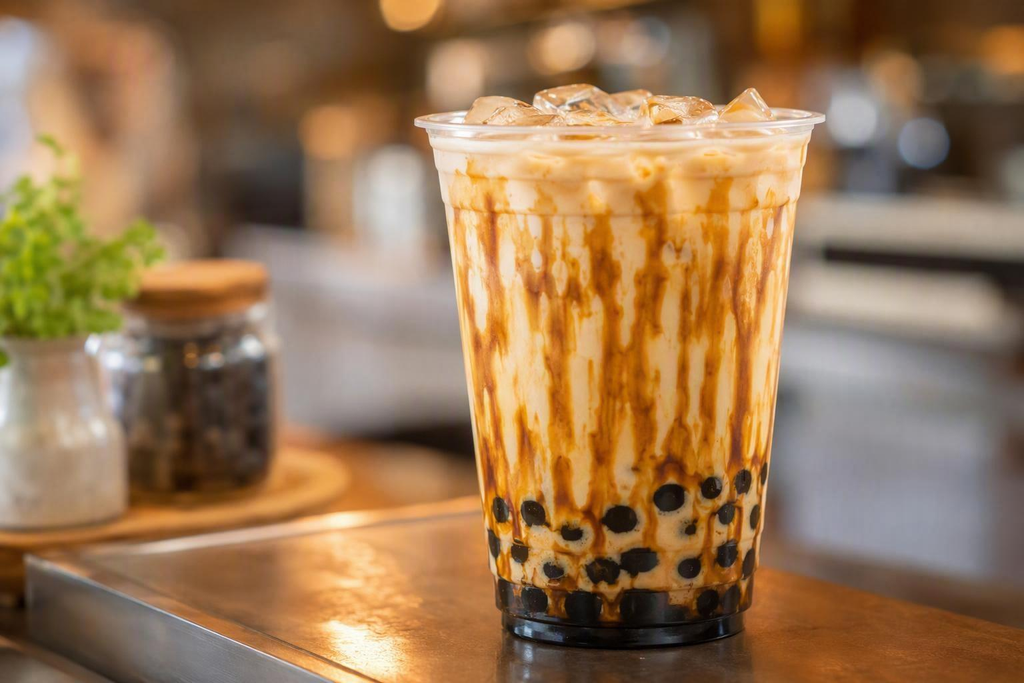
The drinks that get photographed are the ones that sell. You see it on social feeds every week: a clear cup with caramel-brown stripes running down the inside wall, dragging into the milk tea like lava. That effect has a name in the boba trade — walling powder — and it is one of the cheapest, fastest ways to turn an ordinary milk tea into a signature order.
Walling powder (also sold as cake milk tea powder, tiger powder, or ripple powder) is a dry mix you blend into a thick paste, paint onto the inside of a clear cup, then pour the drink over. The pour drags the paste into bold streaks. It adds a flavor note and an Instagram-ready visual with almost no extra equipment.
Before we get into the build, one thing needs to be clear, because it causes more ordering mistakes than anything else: walling powder is not a jelly topping powder, and it is not a milk foam powder. Here is the short version of each so you buy the right one.
Ingredient
What it’s for
Texture / behavior
Walling / cake milk tea powder
Cup-wall stripes and decoration
Thick paste you paint on the cup wall
Milk tea powder
The drink base itself
Dissolves into the tea/milk liquid
Milk foam / cheese foam powder
A creamy top layer
Whipped into a foam topping
Jelly topping powder
Chewy jelly pieces
Sets into gel cubes after cooling
A practical way to remember it: walling powder decorates the cup, milk tea powder makes the drink, foam powder tops it, and jelly powder adds chew.
How to Make the Walling Paste
The whole system hinges on one ratio. Across suppliers the working paste spec is roughly 1 part powder to 2 parts water or milk by weight. Bossen’s tiger powder directions
call for 50 g of powder to 100 ml of water or milk, and the lava-effect walling powders from Tea Planet
use 10–12 g of powder to 20–30 ml of hot water. Cup-pattern camo demos land on the same 1:2 line.
Here is the batch that works for a small shop:
Ingredient
Small batch
What it’s for
Walling powder
100 g
Paste base
Hot water (or milk)
200 ml
Dissolves and thickens
Whisk or spatula
1
Smooth, lump-free slurry
Steps:
Put the powder in a clean stainless bowl.
Add the hot water in a slow stream while whisking.
Whisk until smooth — no dry lumps, no clumps.
Let it sit 1–2 minutes so it thickens to a paste that clings to the cup wall.
Verify your result: the paste should coat a spoon and hold its shape briefly before running. Too runny means add a little powder; too thick to swirl means add a few ml of water. Adjust to the exact consistency your cup and pour require.
Pro Tip: Milks and dairy-like pastes give a creamier stripe that reads well on lighter tea bases, while water-based paste keeps the color cleaner on dark teas. Test both once before you commit one to your lineup.
How to Apply It: The Walling SOP
The application is where most shops stumble, because the paste has to be on the wall before the drink goes in, and it has to stay there long enough to be topped. Paste is best handled in small pre-made batches at the start of a shift, not per-cup during a rush.
Build order for a single cup:
Scoop the prepared paste and smear it around the inside wall of a clean, clear cup.
Rotate the cup so the paste spreads in even streaks — bold or fine, depending on how you want the pour to look.
Add ice to the cup first.
Pour the milk tea (or milk, coffee, or base mix) over the ice.
The pour drags the paste down into visible stripes; cap and serve.
The same tea’s consistency approach from BubbleTeaSuppliers
applies here: keep the sequence, the ice level, and the pour fixed, and post the spec at the station so nobody improvises during a rush.
Verify your result: pour one test cup at opening. The stripes should be visible through the clear cup and the drink should be cold throughout. If the paste bleeds and muddies the whole drink, it is too thin — add powder to the batch.
Tiger-Stripe Milk Tea Spec Sheet (16 oz and 22 oz)
Here is a commercial build a barista can execute fast and repeat. The walling dose stays small and the paste carries the visual, so the drink itself never gets over-sweetened by the decoration.
Ingredient
16 oz
22 oz
Walling paste (brown sugar or plain)
25 g
35 g
Brewed black or oolong tea base
200 ml
250 ml
Milk or creamer
60–80 ml
60–80 ml
Sugar syrup, to taste
10–15 ml
15–20 ml
Tapioca pearls
50 g
70 g
Ice
fill
fill
Build order:
Smear the walling paste around the inside wall of the cup.
Add tapioca pearls.
Add ice to fill.
Combine tea base, milk, and sugar syrup; pour over the ice and pearls.
Cap and serve without over-shaking, so the stripes stay crisp.
Done when: the stripes read clearly through the cup, the drink is cold, and the pearls are evenly distributed.
Walling also plays well beyond classic milk tea. It works on dirty coffee and mochas (chocolate or malt walling), on fruit tea (red velvet or strawberry for pale bases), and on dessert cups. The base under the paste needs enough color contrast to show the stripe — that is why clear cups and pale bases give the cleanest result.
Flavor & Pattern Directions
Walling is not one flavor. Common lines include brown sugar (the tiger-stripe bestseller), chocolate and malt chocolate, red velvet, taro and purple sweet potato, golden sweet potato, strawberry, and cheese or salted-cheese. Plain or pudding-flavored walling gives you a neutral base you can tint and flavor in-house.
Patterns go beyond stripes too. With the same paste you can create a full “messy cup” (heavy smear), a marbled swirl, or a trained camo pattern. Keep the color contrast between the paste and the drink in mind — low contrast reads as a dirty cup, which is fine if that is the look you want.
On the beverage side, a bold base helps. If you pair walling with a matcha-heavy or roasted tea drink, you want enough body to hold the layers apart. The matcha powder selection guide from BubbleTeaSuppliers
is a useful read if you are thinking about a walling drink on a green base, since the tea has to stand up to the paste’s flavor.
What Walling Costs per Drink
Because the dose is small, the presentation cost stays modest. Here is a transparent COGS model for a 16 oz tiger-stripe milk tea, built on reasonable wholesale assumptions you should replace with your own supplier numbers:
Component
Cost per drink
Walling paste (25 g prepared)
$0.08
Tea base
$0.08
Milk or creamer
$0.32
Sugar syrup
$0.06
Tapioca pearls (50 g)
$0.35
Cup, lid, straw, seal
$0.18
Total COGS
$1.07
The formula is simple: COGS per drink = sum of (ingredient used × unit cost), plus a small waste factor for batch shrink. To price the walling cost precisely, take your bag cost divided by the grams in the bag, then multiply by the prepared paste grams you use per cup. A 1 kg bag lasts a long time at 25 g per 16 oz cup, which is exactly why this visual is cheap per drink — the cost is in the labor and the training, not the powder.
⚠️ Warning: Walling is a low-ingredient-cost, high-labor ingredient. Do not treat it as a free add-on. If the paste is made fresh every shift and applied per order during a rush, the labor can eat the margin. Batch the paste and keep application to a fixed 2–3 second smear to protect speed at the line.
Batch, Storage & Shelf Life
Dry walling and cake milk tea powders keep well. Most commercial walling powders carry a 12–24 month shelf life when stored sealed, cool, and dry — Sunnysyrup lists its walling powder at 1.5 years and CTT Food lists cake walling powder at 2 years
. Rules that matter in a working kitchen:
Store sealed, in a cool, dry place, away from direct sunlight and strong odors.
Reseal tightly after every use so moisture does not bind the powder.
Make prepared paste in small shift-sized batches — prepared paste has a limited window, so do not pre-make a full day’s worth that can dry or separate.
Date the bag when it arrives so you rotate stock.
Sourcing Walling Powder: Red Flags
Because walling is a niche ingredient, a few sourcing checks keep you from buying a powder that streaks badly or looks off in the cup:
Get a spec sheet with the ratio. A supplier that cannot tell you its powder-to-water ratio cannot guarantee a repeatable stripe. Reject the mystery powder.
Request shelf-life validation. Food-safety practice expects documented evidence that the product stays safe and acceptable through its claimed life, including storage conditions and batch records. Ireland’s food-safety authority summarizes this in its Guidance Note 18 on shelf-life validation. Ask whether your supplier can provide this plus a COA per lot.
Check the facility cert. Look for HACCP, ISO 22000, or FSSC 22000 as a baseline.
Small pack first. For a low-volume presentation ingredient, oversized bags create waste until you confirm real volume. Start with the smallest wholesale unit and validate it in your cup before scaling.
Test it cold and in your base. A paste that looks great in a demo with whole milk can fail in your specific iced tea-and-creamer recipe. Always test exactly how you will serve it.
For a fuller checklist on what to ask any boba ingredient supplier — tests, certification, and documentation — the BubbleTeaSuppliers guide to sourcing a bubble tea ingredients supplier in North America walks through the whole vetting journey.
Walling Powder for Boba Tea Shop: Common Questions
Is walling powder the same as jelly powder? No. Walling powder is a paste you paint on the inside of the cup for a stripe effect, while jelly powder sets into chewy jelly topping cubes. Confusing the two is the most common mistake when ordering. For more on how toppings fit the rest of the lineup, the BubbleTeaSuppliers toppings guide is a good reference.
What is the ratio for walling powder? A practical starting point is 1 part powder to 2 parts hot water or milk by weight — for example 50 g of powder to 100 ml of liquid. Adjust the thickness to control how bold the stripes run.
Can walling powder be used hot? Yes. Many walling powders work in both hot and cold applications, but you should test the paste in your exact hot recipe to confirm it does not bleed or melt flat. Clear cups give the best visible effect either way.
How much walling powder goes in one cup? A small dose is plenty. For a 16 oz cup, about 25 g of prepared paste on the wall is a working starting point; roughly 35 g for a 22 oz cup. Adjust for how bold you want the stripe.
How long does walling powder last? Dry walling powder typically keeps 12–24 months when sealed, cool, and dry. Prepared paste should be made in small shift-sized batches and used the same day.
Do I need special equipment? No. A whisk or spatula, a bowl for the paste, and a clear cup are all you need. The effect comes from the pour, not the gear.
Next Steps
Walling powder is one of the easiest ways to add a photographable signature drink this year — the ingredient cost per cup is small, the stripe effect is instant, and the training is a two-step smear. Batch the paste, lock the build, and price it as a premium visual. Request walling and cup-decoration samples plus a wholesale bubble tea catalog to start, and build from the spec sheets in this guide.