
Short answer: milk tea isn’t technically called boba — boba is the name for the large, chewy tapioca pearls that go into it. Over time, especially in the United States, the name stuck to the whole drink.
But the longer answer is more interesting. The word “boba” comes from Taiwanese slang, traveled through Hong Kong pop culture, and landed in American cafes with a meaning that’s now distinct from how the drink is still named in Taiwan. If a customer asks “why do you call it boba?”, here’s the full story — and why it matters for how you talk about your menu.
Boba Is the Pearl — Technically
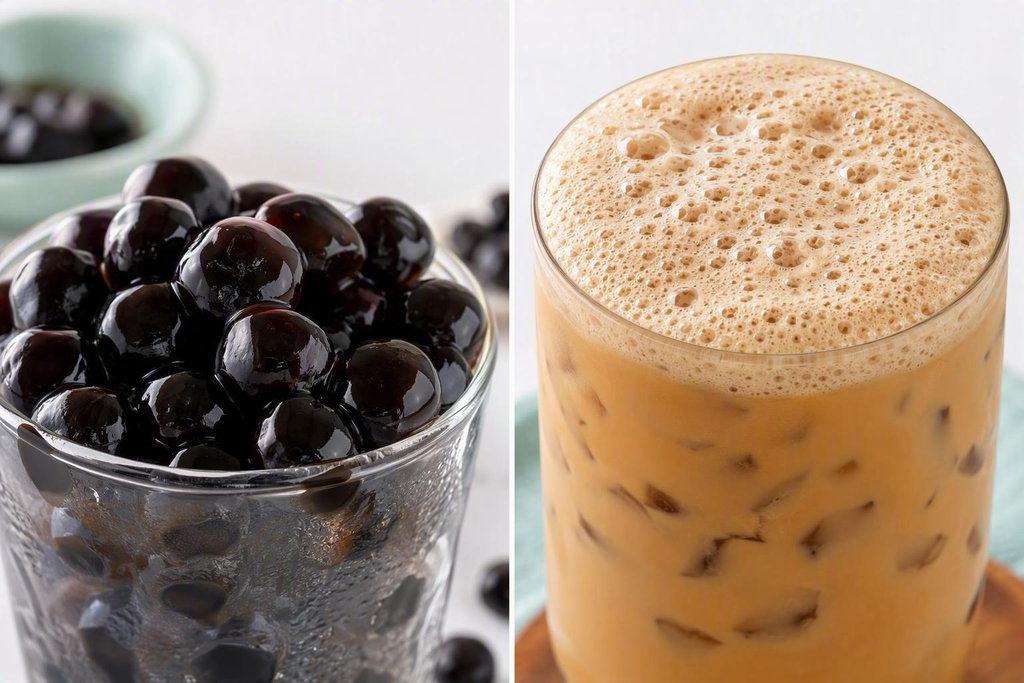
Strictly speaking, boba refers to a specific kind of topping: the large, dark tapioca balls made from cassava starch. They’re rounder, chewier, and typically larger than the smaller “tapioca pearls” (also called fen yuan) that predated them. Shops in Taiwan originally used small, white starch balls. The larger, darker version — what became known as boba — came later and quickly became the signature topping.
The difference between boba and tapioca pearls is a point of confusion even among operators. Both are made from cassava starch. The distinction comes down to size, color, and sweetening: boba are bigger, usually around 8–10mm, and cooked with brown sugar or caramel, which gives them their signature dark color and sweeter flavor.
In parts of the US, boba eventually became a shorthand for the entire drink — the tea, the milk, the sweetener, and the pearls combined. This usage is especially common on the West Coast. On the East Coast, and in most of Asia, the drink is still called bubble tea, pearl milk tea, or simply milk tea.
The Etymology of “Boba”: Where 波霸 Came From
The Mandarin characters for boba are 波霸 (bōbà). Breaking down the characters: bō (波) means “wave” or “ball-shaped,” and bà (霸) means “overlord” or “champion.” Combined, 波霸 is Taiwanese slang — roughly, “champion of big, round things.” It was already in circulation as a playful, slightly risqué expression before it ever touched a drink.
According to Dictionary.com, the word was first recorded in English usage between 1995 and 2000 and is described as borrowed from “a dialectal Chinese source akin to Cantonese bo baa or Mandarin bōbà, ‘tapioca pearl,’ colloquially ‘big-breasted woman.'” Merriam-Webster similarly defines it as “perhaps literally, ‘large breasts'” and traces it to Chinese (Beijing) bōbà.
The most widely told origin story connects the name to Amy Yip — a Hong Kong actress who was a celebrity in the late 1980s and whose nickname was boba, a reference to her figure. According to multiple food history sources, including a CNN feature on Taiwan’s bubble tea history, a vendor in Tainan started calling the large tapioca balls boba after her nickname, and the term spread from there. Other accounts suggest the slang was already applied to anything large and round, and the pearls just happened to fit.
What’s not disputed is the shape logic: the large, perfectly spherical, dark pearls look like a collection of round, full objects. The name stuck because it was memorable, playful, and a little bit subversive — which is why it caught on in marketing.
Key Takeaway: “Boba” started as Taiwanese slang for something large and round, was popularized through a connection to a Hong Kong actress, and eventually became the standard English term for both the tapioca pearls and the drink itself.
How “Bubble Tea” Got Its Name — It’s Not About the Pearls
Here’s where the terminology gets genuinely confusing: bubble tea was named before tapioca pearls were even part of the recipe.
In Taiwan in the early 1980s, Liu Han-Chieh at Chun Shui Tang (春水堂) in Taichung started serving cold, shaken black tea — inspired by Japanese iced coffee. When you shake tea vigorously with ice, it creates a thick layer of frothy foam bubbles on top. That foam is what gave the drink its original name: pào mò hóng chá (泡沫紅茶), which translates to “bubble black tea” or “foam red tea.”
The bubbles in the name referred to the foam, not to any round pearls. The pearls came later. In 1988, Lin Hsiu Hui — a product development manager at Chun Shui Tang — reportedly dropped fen yuan (sweetened tapioca balls) into her cup of iced tea during a staff meeting on a whim. The combination was immediately popular, and the shop added it to the menu.
Hanlin Tea Room (翰林茶館) in Tainan makes a competing claim: their owner, Tu Tsong-He, spotted white tapioca balls at a local market and added them to milk tea, eventually switching to the larger, dark version. A lawsuit between the two shops over the drink’s origin ran for a decade before being settled without a definitive winner.
Both shops agree on one thing: the pearls were an addition to an existing shaken-tea format. Bubble tea was already the category name before boba became the topping name.
Three Names, One Drink: What Each One Actually Means
For operators building menus, training staff, or writing product descriptions, it helps to know exactly what each term covers. The types of milk tea served around the world vary widely in base, topping, and naming convention. Here’s how the three most common names break down:
| Term | What it technically means | Where it’s most commonly used |
|---|---|---|
| Milk tea | Tea + milk + sweetener (hot or iced); may or may not include toppings | Worldwide; also used in British, Indian, and Southeast Asian contexts |
| Bubble tea | Milk tea or tea base, shaken to create froth, typically with tapioca pearls or other toppings | Taiwan, East Asia, East Coast US, UK, Australia |
| Boba | The large tapioca pearls; also shorthand for the full drink | US West Coast; increasingly standard in North American casual speech |
| Pearl milk tea | Milk tea with tapioca pearls (the most precise description) | Taiwan (珍珠奶茶, zhēnzhū nǎichá); formal menus |
The key distinction for your staff: a customer who says “do you have milk tea?” may or may not expect pearls. A customer who says “do you have boba?” almost certainly does. Knowing the naming convention your customer base uses helps avoid a mismatch at the point of order.
From Taiwan to the US: How the Naming Split Happened
Bubble tea reached the US West Coast in the early 1990s, carried by Taiwanese immigrant communities in California. The shops that opened first were mostly in areas with dense Taiwanese-American populations — Los Angeles, the San Francisco Bay Area, and later Seattle. These shops used the term boba colloquially because that’s what the pearls were called in Taiwan at the time, and the term stuck.
On the East Coast, the drink arrived slightly differently — often through Southeast Asian and Hong Kong immigrant communities, and through chains with Asian roots. Those operators used bubble tea as their primary term. That East/West split in American terminology has largely persisted.
Pro Tip: If you’re writing a menu or signage, “boba” will resonate faster with West Coast customers and younger demographics; “bubble tea” tests better on the East Coast and with customers new to the category. Many shops now use both — “boba (bubble tea)” — to cover both audiences.
For a full breakdown of what goes into the drink beyond the pearls, the bubble tea ingredients guide covers base teas, creamer types, syrups, and sweetener ratios used in commercial production.
The Naming Question Your Customers Actually Ask
Most customers who ask “why is it called boba?” are really asking one of two things: What is the pearl thing? or Why does this drink have so many different names? Both questions are easy to answer once your team knows the short version.
Staff-ready answer:
- “Boba” = the chewy pearls — named after a Taiwanese slang word for something large and round, popularized in the late 1980s when larger tapioca balls became the signature topping.
- “Bubble tea” = named after the frothy foam you get from shaking the tea, not the pearls.
- “Pearl milk tea” = the most literal name — tea + milk + pearls.
All three names refer to the same category of drink. The regional and cultural context determines which word a customer reaches for first.
Operators looking to expand topping variety beyond classic pearls can explore the boba toppings guide, which covers popping boba, jelly, pudding, and other common additions — each with its own naming conventions worth knowing.
If your shop also serves fruit-based drinks without milk, the distinction between fruit tea vs. bubble tea is another question customers frequently ask, and one that’s grown more relevant as non-dairy and fruit-forward menus expand.
For wholesale supply and ingredient sourcing, BubbleTeaSuppliers carries the tapioca pearls, teas, creamers, and syrups behind most US boba shop menus.
Frequently Asked Questions
Is milk tea the same as boba? Not exactly. Milk tea is any tea mixed with milk and sweetener — a category that includes everything from British builder’s tea to Thai iced tea. Boba (bubble tea) is a specific type of milk tea from Taiwan, typically served cold with tapioca pearls. All boba is milk tea; not all milk tea is boba.
What does 波霸 (bōbà) mean in Chinese? Literally, it means something like “large-ball overlord” or “champion of big, round things.” It’s a playful slang term — the 霸 character means “tyrant” or “champion,” and 波 refers to something round and full. It was used as a nickname for Hong Kong actress Amy Yip before being applied to the large tapioca pearls.
Is “bubble” in bubble tea about the pearls or the foam? The foam. The original shaken black tea in Taiwan was named for the frothy bubbles that formed on top when the drink was vigorously shaken with ice. The pearls were added later and became the defining feature, but the name stayed.
Why do some people call it pearl milk tea? Pearl milk tea (珍珠奶茶, zhēnzhū nǎichá) is the original Taiwanese name. Zhēnzhū means pearl, referring to the round tapioca balls. It’s still the standard name in Taiwan and among many Taiwanese-American operators, though boba and bubble tea dominate everyday conversation in the US.
Is boba more common on the West Coast than the East Coast? Generally, yes. West Coast shops — especially in California — widely adopted boba as the primary name in the 1990s when Taiwanese-owned shops first brought the drink to the US. East Coast usage has historically leaned toward bubble tea, though the two terms are increasingly interchangeable across North America.
Are the small pearls still called boba? The smaller pearls (typically 6mm or under, often white or clear) are more precisely called tapioca pearls or fen yuan (粉圓). The term boba is more commonly associated with the larger pearls (8–10mm). In practice, most US shops use boba for both sizes, and customers rarely make the distinction.