
If “mango milk tea” is on your menu (or you’re planning a seasonal mango push), you’re not just choosing a flavor.
You’re choosing an ingredient format that determines:
how consistent the drink tastes across shifts
how fast your team can build it during a rush
how much control you have over sweetness and texture
whether your dairy-free version tastes like a premium drink (or like an afterthought)
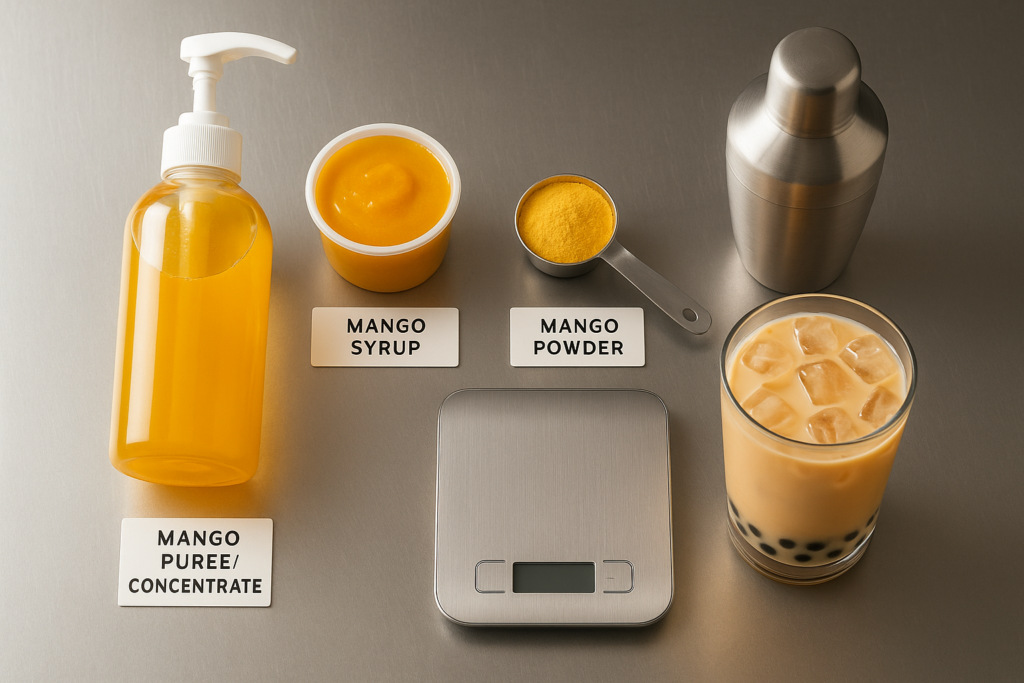
This guide breaks down the three most common options—mango puree/concentrate, mango syrup, and mango powder—with a shop-operator lens: taste, cost, workflow, and failure modes.
The fast decision framework for mango milk tea ingredients (what you’re really optimizing)
Before you pick a format, decide which of these is your non-negotiable:
1) Consistency (every cup tastes the same)
If your mango drink is a top seller or you run multiple locations, format stability matters more than the “freshest” option.
2) Speed of service (build time under pressure)
If mango milk tea is ordered often during peak hours, you want a format your staff can portion and mix quickly—without blender steps.
3) Flavor + texture (what customers feel)
Mango can read as:
bright and juicy
creamy and dessert-like
thick and smoothie-adjacent
Different formats naturally pull the drink in different directions.
4) Sugar control (especially for dairy-free)
Many mango products are pre-sweetened. If you want a clean “choose your sweetness” workflow, choose a format that lets you separate flavor from sugar.
5) Storage + waste
Fresh mango and some purees introduce short shelf life and prep waste. Powders and syrups usually simplify inventory.
Pro Tip: If you’re unsure, choose the format that fits your workflow first. You can adjust flavor with tea base, sweetness, and toppings later—but you can’t fix a slow, inconsistent build during a rush.
First, define the three formats (so your team speaks the same language)
Mango puree vs mango concentrate
In practice, shops use “puree” to mean either:
a blended fruit puree (often refrigerated)
a thicker concentrate / “fruit jam” style ingredient designed for consistent use
If you’re shopping wholesale, you’ll often see this labeled as mango puree for bubble tea—but functionally, the decision is still “fresh-ish fruit base” versus “operator-friendly concentrate.” BubbleTeaSuppliers frames this trade-off clearly in its mango concentrate vs fresh mango comparison: concentrates tend to win on operational consistency and year-round availability, while fresh fruit wins on “fresh” perception.
Mango syrup
A pourable or pumpable flavoring—often pre-sweetened. It’s fast, consistent, and easy to portion. It can also push your drink toward a “candy mango” profile if you’re not careful.
Mango powder
A dry mix (sometimes paired with a separate creamer). The upside is consistency and speed. The downside is that powders have a mixing technique—done wrong, they go chalky or flat.
Mango puree/concentrate: best for premium mango milk tea ingredients flavor and thick body
What it does best
Taste and aroma: puree/concentrate tends to taste most “mango-forward” and natural.
Body: it builds thickness and a smoothie-like mouthfeel without relying on creamer.
Premium positioning: it supports menu language like “real mango” or “mango fruit blend” (assuming your product truly contains that).
Where it can fail
Inconsistent batches if you’re using fresh mango: ripeness swings change sweetness and acidity.
Prep time and waste: peeling, slicing, blending, cleaning.
Oxidation/browning risk (especially with fresh fruit) if held too long.
BubbleTeaSuppliers notes concentrates can be stored refrigerated or frozen and references longer shelf life (up to 24 months) in its mango concentrate vs fresh mango discussion—one reason concentrates are often the “operator’s choice” for consistent mango year-round.
How to use it (starting point, then dial in)
A practical starting point is to treat concentrate like a strong flavor base and adjust to your cup size, tea strength, and target sweetness. BubbleTeaSuppliers suggests a starting point of about a tablespoon per cup in the same piece (then adjust to taste).
For shop testing, run three test cups:
baseline mango amount
-20% mango amount (to see if tea opens up)
+20% mango amount (to see if it turns candy-sweet or heavy)
Dairy-free note (puree/concentrate)
Puree works well with oat or coconut for a richer, tropical profile. But higher fruit acidity plus plant milks can increase separation risk. (We’ll cover stabilization in the dairy-free section.)
Mango syrup: best for speed, portion control, and lighter mango profiles
What it does best
Fast build: pump, shake, serve.
Portion control: easy training for new staff.
Stable inventory: less mess than puree.
Syrup also plays nicely when you want mango as a top-note rather than the whole drink—especially if you’re building fruit-forward teas.
BubbleTeaSuppliers references mango puree or syrup as a common base choice in its mango green tea example within “What is your favorite teas in boba tea shop?”, which reflects how many shops treat syrup: a reliable flavor lane for mango beverages.
Where it can fail
Dilution: too much syrup can thin your dairy-free milk tea and mute tea character.
Sweetness lock-in: many syrups come pre-sweetened.
One-note mango: if the syrup is very “bright,” it can lose depth in a creamy drink.
How to use it (starting ranges)
For a 16 oz drink, start with a conservative pump range, then adjust based on:
whether your milk base is sweetened
whether you’re adding additional sweetener
how strong your tea base is
A practical operator move: pick a target sweetness level (e.g., “50% sugar standard”), then calibrate syrup pumps to match that standard.
Dairy-free note (syrup)
Syrup is often the easiest path for dairy-free because it doesn’t add solids that need dissolving. The main risk is separation if you combine very acidic mango syrup with plant milk and hot tea.
Mango powder: best for consistent creamy milk tea—if you respect the mixing technique
What it does best
Consistency: scoop-based recipes are easy to standardize.
Creamy profile: powders often deliver the “mango milk tea” experience customers expect.
Speed: quick build with shaker workflow.
Where it can fail
Chalkiness/lumps if you add powder directly into cold liquid.
Flat mango if you under-dose or use a weak tea base.
Over-sweetness if your powder blend is already sweetened and you also add syrup.
A shop-style mixing order that prevents chalkiness
BubbleTeaExpert’s process emphasizes the key operational step: dissolve powder (and creamer) with a small amount of hot water first, then add tea, then shake with ice.
In its recipe for mango milk tea from powder, the method uses a scoop-and-pump workflow (powder + creamer + sweetener, dissolved with hot water, then combined with tea and shaken with ice).
You don’t need to copy any exact numbers to benefit from the technique: hot dissolve → add tea → ice shake is what prevents powder problems.
Dairy-free note (powder)
Powder-based mango milk tea often pairs naturally with non-dairy creamers or barista-style plant milks, because the “creamy” target is already baked into the format.
Choosing the right tea base (so mango doesn’t taste like juice with milk)
Mango is strong. If your tea base is weak, your drink becomes a sweet mango milk drink—not a mango milk tea.
A practical rule:
Choose jasmine/green if you want a fresh, fragrant mango profile.
Choose Assam/black if you want a richer “milk tea” backbone that can stand up to sweetness.
Key Takeaway: If your mango tastes great but the drink feels “hollow,” your fix is usually stronger tea, not more mango.
Dairy-free mango milk tea: how to keep it creamy (and stop separation)
A dairy-free mango milk tea has two common enemies:
temperature shock (hot tea meeting cold plant milk)
acidity (fruit ingredients pushing the mix toward curdling)
Tasting Table explains the basics of why milk can curdle in tea and how to prevent it: temperature management, avoiding extra acids, and mixing gradually in its article on the science of why milk curdles in tea and how to prevent it.
Here’s how to translate that into shop SOP.
Choose a plant milk that matches your target drink
Oat milk: best for “creamy dessert mango” positioning; adds body.
Soy milk: often the most neutral; good if you want tea and mango to lead.
Coconut milk: strong tropical synergy; best when you want the drink to taste intentionally coconut-mango.
Almond milk: lighter body; can feel thin unless you adjust with a creamer or powder format.
Use a mixing order that avoids curdling
For iced builds:
Brew tea strong, then cool it (or use chilled tea base).
Combine mango ingredient with tea first.
Add plant milk slowly while stirring (or shake immediately).
Add ice last and shake hard.
For powder builds:
Dissolve powders with hot water first.
Add tea.
Add plant milk (if used) and shake.
Avoid stacking acids
If you’re offering “mango + citrus” variants, keep them as fruit teas or use careful balancing. BubbleTeaSuppliers mentions lime/lemon as an optional accent in its mango green tea description in favorite teas in boba tea shop. That can be delicious—but in dairy-free milk tea, extra acid increases separation risk.
⚠️ Warning: If a dairy-free mango milk tea separates, don’t fix it by adding more mango. Fix the temperature and mixing order first.
Mango milk tea powder vs syrup vs puree: which format is right for your shop?
Choose mango puree/concentrate if…
you want a premium “real fruit” profile
you can support slightly slower builds (or you’ll pre-batch)
you’re okay paying a bit more for the sensory payoff
Best menu positioning:
“Mango Milk Tea (Real Fruit Blend)”
“Mango Coconut Milk Tea” (especially if you use coconut milk)
Choose mango syrup if…
speed and training simplicity are top priorities
you want a lighter mango note (or you sell more fruit teas than milk teas)
you’re okay with less sugar flexibility
Best menu positioning:
“Mango Milk Tea” (classic, consistent)
“Mango Green Tea Latte” (if your build is lighter)
Choose mango powder if…
you want the most consistent “creamy mango milk tea” profile
you need the fastest, easiest standardization across staff
you’re willing to enforce the correct mixing technique
Best menu positioning:
“Classic Mango Milk Tea” (creamy, consistent)
“Dairy-Free Mango Milk Tea” (when paired with non-dairy creamer or stable plant milk)
Common operational problems (and quick fixes)
Problem: chalky mango milk tea
Most common cause: powder not dissolved.
Fix: dissolve powder (and creamer) in a small amount of hot water first, then add tea, then shake with ice—mirroring the workflow described earlier from BubbleTeaExpert.
Problem: mango overwhelms the tea
Fix: brew stronger tea, or reduce mango by ~20% in your recipe test. Mango intensity is easy to over-correct.
Problem: dairy-free version separates
Fix: cool the tea base and add plant milk gradually; avoid stacking acids (like lemon) in the same milk tea. (This aligns with the curdling-prevention approach summarized earlier from Tasting Table.)
FAQ (shop-owner version)
Is mango puree better than mango syrup for mango milk tea?
“Better” depends on what you’re optimizing. Puree/concentrate tends to win on body and premium fruit impression, while syrup often wins on speed and portion control. If consistency is your concern, BubbleTeaSuppliers argues concentrates are designed to deliver uniform flavor in its mango concentrate vs fresh mango comparison.
What tea base works best with mango milk tea?
If you want a brighter, floral profile, green/jasmine is a strong match; if you want a richer milk-tea backbone, black tea is often better.
What’s the easiest way to make mango milk tea dairy-free?
Powder-based or concentrate-based builds are typically easiest to keep creamy. Whatever format you choose, control temperature shock and acidity, and mix gradually to prevent separation.
Next steps
If you want to standardize mango across your menu (milk tea, fruit tea, and seasonal LTOs), start by picking one “hero format” and building a tight SOP around it.
You can browse the BubbleTeaSuppliers bubble tea ingredient category to compare mango ingredient formats and decide what best fits your workflow and dairy-free positioning.