
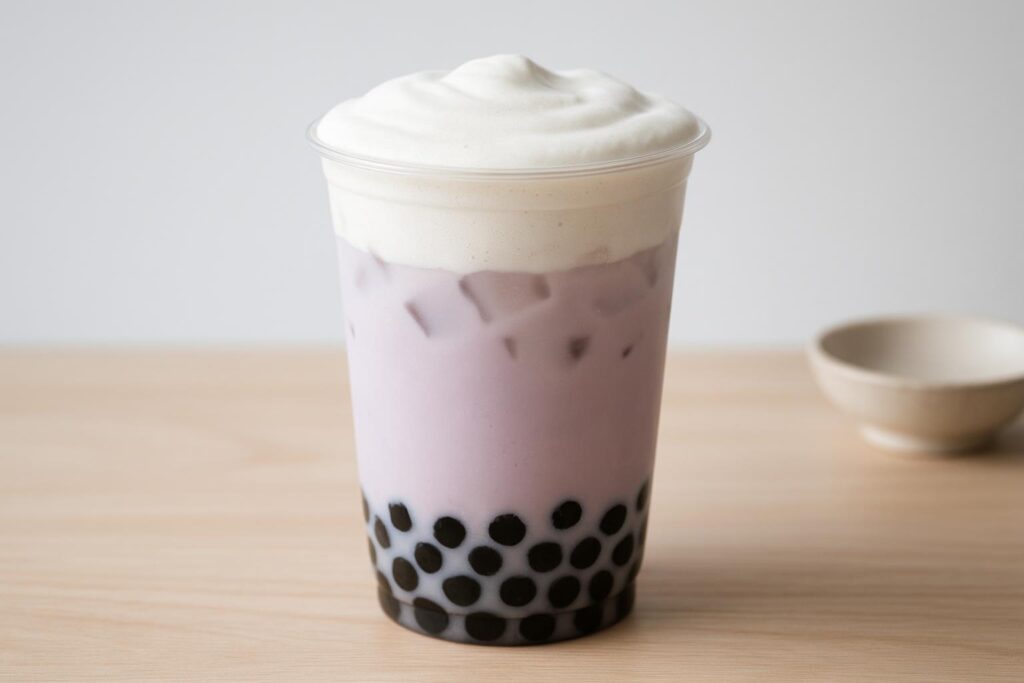
“Fluffy taro milk tea” usually isn’t one ingredient—it’s a texture promise.
In a bubble tea shop, that promise typically comes from two places:
A creamy taro milk tea base that doesn’t drink watery or chalky.
A light, airy topping (milk foam or cheese foam) that stays on top long enough for customers to enjoy it, instead of melting into the drink immediately.
This guide is written for US bubble tea shop owners/managers who want to add a fluffy taro milk tea to their menu and keep it consistent across staff, shifts, and locations. It’s a consideration-stage piece, so we’ll focus on tradeoffs and selection criteria, not a single “one true recipe.”
What “fluffy taro milk tea” should mean on your menu (so you can standardize it)
Before you buy anything, define “fluffy” in your SOP (standard operating procedure). Otherwise, two baristas will make two different drinks.
A practical definition that works in real shops:
Base fluff (mouthfeel): creamy, slightly thick, smooth, no lumps, no powdery aftertaste.
Top fluff (visual + texture): a pourable foam cap that holds shape long enough for the guest to take 5–10 sips.
Build fluff (method): the drink is shaken/poured to emulsify and lightly aerate—but not blended into a slush unless that’s your intent.
That definition helps you answer the real question: Are we selling “taro milk tea” with a foam cap, or are we selling a dessert drink with taro flavor? Both can work, but they need different ingredients and staffing assumptions.
The 4 criteria that decide your best taro setup
Most “taro debates” go nowhere because they don’t start with constraints. Use these four criteria to choose your approach.
1) Volume + speed (seconds matter)
Ask: How many of these will we sell during a rush?
If it’s a top-10 seller, you need a base that’s scoop-and-shake fast.
If it’s a limited-time premium, you can afford more prep.
2) Consistency (same drink, every time)
Customers expect the same color and flavor every visit.
If your taro varies by prep person, you’ll get “it tasted different last time” reviews—even if the drink is technically fine.
3) Storage + waste (hidden cost)
Fresh taro looks premium, but it also:
takes fridge/freezer space
has spoilage risk
creates peel/cook labor and waste
Those costs don’t show up in the ingredient invoice. They show up in overtime, thrown-away prep, and rushed baristas.
4) Positioning (value vs premium)
Decide whether this is:
a classic, purple, candy-creamy taro (what many guests expect), or
a premium “real taro” profile (earthier, less neon, more handmade)
One isn’t “better”—they’re different products. The mistake is promising one and serving the other.
Choose your taro base: powder vs paste vs fresh taro (and the hybrid option)
Here’s the honest truth: taro powder wins on operations; real taro wins on story + texture.
To make the decision easier, think in three layers:
Flavor + color layer (what guests recognize as “taro”)
Body layer (thickness/creaminess)
Texture layer (real taro cues: slight starch, tiny bits, or a richer paste feel)
You can build those layers with one ingredient—or you can mix approaches.
Option A: Taro powder (best for speed + consistency)
If your goal is reliable flavor, strong margins, and fast assembly, taro milk tea powder is the default choice for most high-volume shops.
Operational strengths (as summarized in Mustea’s operator-focused cost comparison of fresh vs powder taro milk tea):
powder is shelf-stable and extremely consistent
prep is essentially scoop → dissolve → shake
cost-per-cup is typically far lower than fresh taro due to labor and waste differences (see Mustea’s real taro vs powder cost breakdown)
How to make powder taste “premium” (not chalky):
Dissolve warm, then chill: many powders dissolve better with warm water or warm milk first, then add tea/milk and ice.
Use grams, not scoops: “2 scoops” is not an SOP. Use grams and a scale.
Know your sweetness baseline: some powders are already sweetened; your syrup spec should adapt.
Filter once if needed: a quick strain can save a whole drink remake during rushes.
Failure mode to watch: powdery grit, clumps, or separation.
Fix: pre-dissolve warm; shake aggressively (fixed time); avoid adding ice before the powder is fully dissolved.
Option B: Canned/frozen taro paste (best middle ground)
If you’ve ever argued about taro paste vs taro powder, this is usually the compromise that makes both ops and menu quality happy.
Paste gives you a “real taro” texture cue with less labor than fresh roots.
Why it’s useful:
lower waste than fresh taro
faster than peel/cook/mash
more consistent than seasonal roots
What to standardize in your SOP:
paste grams per drink
dilution ratio (paste + milk/tea)
sweetness adjustment (many pastes are sweetened)
Failure mode: too sweet, too heavy, or a paste “blob” that doesn’t integrate.
Fix: build a paste slurry first (paste + warm milk), then combine with the rest of the drink.
Option C: Fresh taro (best for premium positioning)
This is the lane for a true real taro milk tea profile: less candy-sweet, more earthy and starchy (and it won’t be neon purple unless you add color).
Fresh taro can be fantastic, but it’s the hardest to run well.
What changes operationally:
peel/cook labor
variability by batch
short refrigerated shelf life
more QC steps (texture, aroma, sweetness)
In Mustea’s comparison, fresh taro tends to raise COGS due to labor and waste factors, and it also changes the visual expectation (fresh taro isn’t neon purple).
Food safety note (important if you use fresh taro): raw/undercooked taro and taro-like plants can contain calcium oxalate crystals that cause irritation; cook thoroughly and don’t serve raw taro. The Hong Kong Centre for Food Safety note on calcium oxalate in taro-like plants (2018) explains the irritation risk.
Operational shortcuts that still taste premium:
cook taro in consistent batch sizes (smaller batches reduce variability)
puree/strain for the drink base, and reserve a controlled amount of small taro bits for “real taro” texture
Failure mode: gritty texture and “earthy/gray” guest complaints.
Fix: strain for smoothness, and make sure your menu description matches the flavor profile.
Option D: The hybrid strategy (powder + real taro cues)
For many shops, the best answer is: powder for color + consistency, plus a small real-taro element for texture.
A hybrid build can look like:
powder-based taro milk tea base
plus a measured scoop of taro paste (or small taro chunks) for “real taro” mouthfeel
This mirrors the “hybrid strategy” framing discussed in Mustea’s operator guidance.
Pro Tip: If your staff is small and rushes are real, “hybrid” is often the only way to sell something that feels premium without wrecking throughput.
Choose your creamy base: milk, oat milk, creamer, or evaporated/condensed milk
If “fluffy” is your promise, your milk component can’t be an afterthought.
The base has two jobs:
carry taro flavor
provide enough body that the topping feels intentional (not like it’s sitting on iced tea)
Whole milk / half-and-half (clean, premium)
Pros:
clean flavor
premium perception
pairs well with real taro
Cons:
higher cost than creamer
shorter shelf life
Good for: shops positioning taro as “real ingredient” and willing to price accordingly.
Oat milk (best dairy-free creaminess)
Pros:
naturally creamy mouthfeel
works well with dessert flavors
Cons:
brand-to-brand variability
can still be “thin” if you choose a low-fat option
Good for: dairy-free menus that still want a rich texture.
Non-dairy creamer (classic boba texture)
Pros:
consistent body
easy batching
cost-friendly and shelf-stable (depending on format)
Cons:
“processed” perception for some customers
Good for: high-volume, cost-sensitive operations where consistency matters more than “clean label.”
Evaporated milk / condensed milk (richness + sweetness)
These are classic in certain milk tea styles and can add a thicker feel without blending.
Operational notes:
condensed milk changes your sweetness spec—treat it as both dairy and sweetener
consistency improves when you measure it by weight
Choose your fluffy finish: cheese foam vs milk foam vs whipped cap
This is where “fluffy” becomes obvious to the guest.
The topping should be standardized like any other ingredient. If it’s free-poured, you don’t have a signature drink—you have a different drink every time.
Option 1: Cheese foam (most “cloud-like”)
Cheese foam is the most common fluffy topping for tea drinks because it’s rich and holds its shape.
A typical method uses cream cheese + whipping cream + milk + sugar + salt, whipped to a pourable consistency (see Yes Moore Tea’s cheese foam method).
What to decide before you launch it:
do you want a salty finish (more “cheese tea” vibe) or a sweet finish (dessert vibe)?
do you want the foam to be straw-friendly (thinner) or cap-like (thicker)?
Best practices for shops:
portion the foam (ladle size or grams) so every drink gets the same cap thickness
keep foam cold and use within a defined window to prevent separation
label batches with time made + discard time
Failure mode: runny foam, grainy foam, or foam that collapses.
Fix: adjust fat ratio, chill the mix, and stop whipping at “pourable mousse,” not liquid.
Option 2: Milk foam (lighter, less savory)
Milk foam (without cheese) can still read “fluffy,” especially for customers who don’t want a salty cheese note.
Best practices:
build a foam base with enough fat/protein to hold air
portion it like cheese foam
Failure mode: disappears too fast.
Fix: slightly thicken with cream or a small amount of creamer; tighten whipping time.
Option 3: Whipped cap (dessert-forward and easiest to execute)
A whipped topping cap is the most dessert-like and the easiest for staff to execute.
Operational tradeoff:
it can turn the drink into a “milkshake vibe,” which may or may not match your menu
Use this when “fluffy” is basically a dessert cue—and price it like a dessert.
A simple decision framework (use this in your menu meeting)
If you want a fast internal decision, use this rule-of-thumb grid:
High volume + tight staffing → powder base + standardized foam (cheese foam or milk foam)
Mid volume + premium positioning → paste or hybrid base + foam
Low volume / premium seasonal → fresh taro base + foam (with a tight prep schedule)
If you’re unsure, start with hybrid, then adjust based on sales and customer feedback.
Standardization: how to build it so it’s consistent
Even if you don’t publish your full SOP in the blog post, you should create one internally.
Here’s a practical build order to reduce variability:
Pre-dissolve taro base (powder or paste) in a defined warm-liquid amount.
Add tea (optional) + milk/creamer to reach your target base volume.
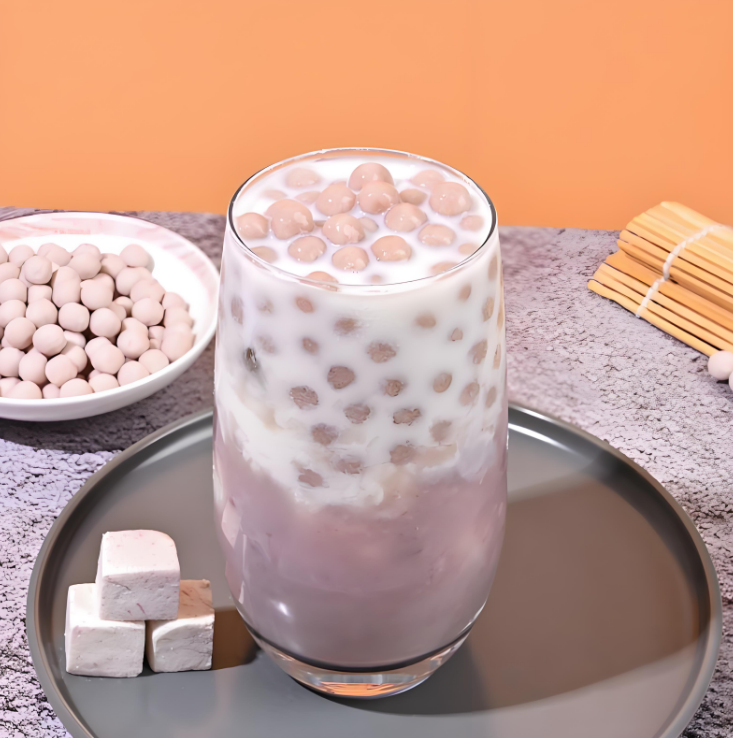
Shake with ice for a fixed time (for example, 10–15 seconds) to emulsify.
Pour into cup.
Add toppings (boba, pudding, etc.).
Top with foam (standard ladle amount).
Pro Tip: If you want “fluffy” to be consistent, make foam a measured ingredient (for example, “60 g foam cap”), not a free-pour.
QC checks (what to train staff to notice)
Train staff to check three quick signals before serving:
Color: is it your expected taro purple? (Hybrid and fresh taro will look different—standardize your “correct” target.)
Mouthfeel: does it feel creamy, or watery? If watery, your milk/creamer ratio or dilution control is off.
Foam hold: does the foam cap last long enough to be experienced, or does it disappear immediately?
If you want this drink to scale, build a 30-second “QC sip” culture for new items during the first week.
The most common “fluffy taro” problems (and how to fix them fast)
Problem: Lumps or grit
Most common cause: powder added directly into cold milk, or paste not made into a slurry.
Fix:
dissolve warm first
standardize mixing time
strain once if needed
Problem: Watery base that can’t support foam
Most common cause: weak dairy/creamer spec or too much ice dilution.
Fix:
increase solids (milk/creamer choice)
reduce initial ice if needed
standardize shake time
Problem: Foam collapses in the first minute
Most common cause: foam too warm, under-whipped, or too thin.
Fix:
chill foam
adjust fat content
stop whipping at pourable medium peaks
Problem: “This doesn’t taste like taro” complaints
Most common cause: mismatched expectation (classic powder profile vs real taro profile).
Fix:
align menu description and color with the chosen approach
consider a hybrid build if you want “premium cues” without losing the classic taro expectation
Next steps
If you want a taro drink that’s consistent shift-to-shift, start by standardizing your taro base choice (powder vs paste vs fresh) and your foam spec (cheese foam vs milk foam).
If you want additional shop-focused guidance, you may also want:
BubbleTeaSuppliers.com’s guide on how to choose quality taro milk tea products
Their walkthrough on taro bubble milk tea ingredient and prep tips
A quick QC reference on what taro milk tea is supposed to taste like