
If you’ve ever tried to add coffee boba to your menu and ended up with a drink that tastes watery, separates in 10 minutes, or gets complaints about hard pearls—this is for you.
A coffee-forward milk tea can be a high-margin, high-repeat item, but only if it’s consistent across staff and shifts and doesn’t depend on an espresso machine.
Below is a shop-ready coffee boba milk tea recipe with batching math, holding windows, and quick QC checks.
What “good” coffee boba milk tea should taste like
Before you touch ratios, set the target.
A good coffee boba milk tea should be:
Coffee-forward (not “sweet milk with a hint of coffee”)
Creamy but clean (no chalky aftertaste, no greasy finish)
Balanced sweetness (remember: boba carries syrup into the cup)
Chewy pearls (no hard center, no mush)
Pro Tip: When customers say “this tastes watered down,” it’s usually not the beans—it’s dilution from ice melt plus a coffee base that wasn’t strong enough to begin with.
Ingredients and tools (built for shops)
Core ingredients
Coffee base (choose one): cold brew concentrate or strong batch-brewed coffee (cooled)
Milk: whole milk is the easiest default for body; oat/soy also work well
Sweetener: brown sugar syrup (recommended) or simple syrup
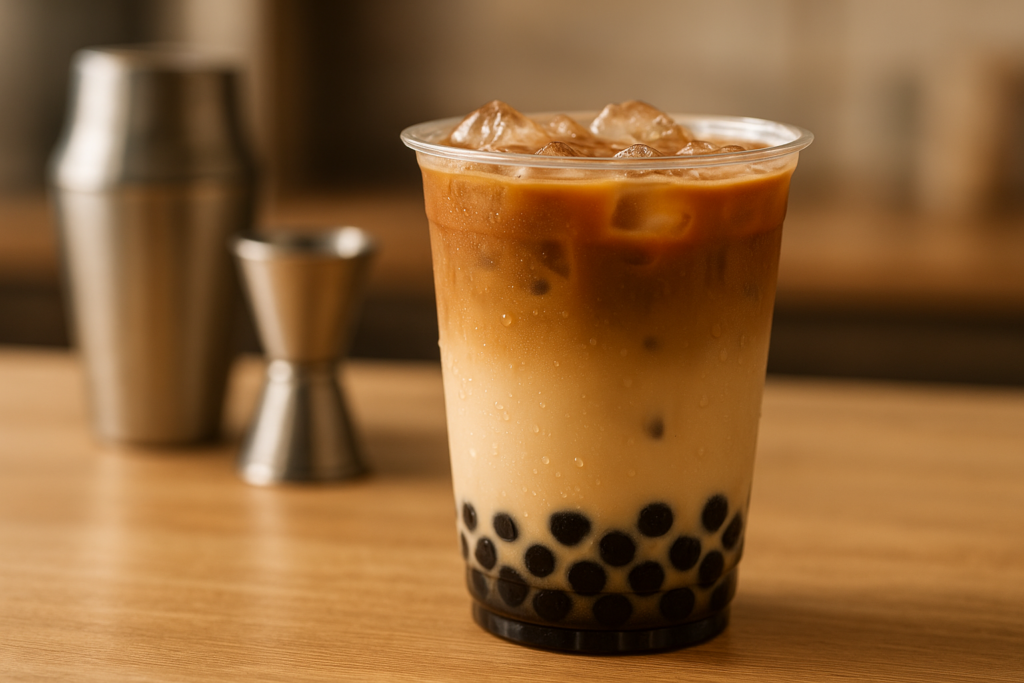
Tapioca pearls
Ice
Optional (use only if you want a slight “milk tea” backbone):
Strong black tea (small amount; this stays coffee-forward)
If you want a quick refresher for staff training, share this internal explainer on the difference between boba and tapioca pearls.
Tools (no espresso machine required)
Measuring pitcher (at least 2L)
Scale (recommended for batching)
Shaker tins or sealed mixing cups
Boba cooker/stock pot + strainer
Portion scoop or ladle for pearls
Labels + marker (for “boba cooked at” and coffee base dates)
Choose your coffee base (two shop-friendly options)
You need a coffee base strong enough that it still tastes like coffee after milk + ice + boba syrup.
Option A: Cold brew concentrate (most consistent)
Cold brew concentrate is the easiest way to make a consistent cold brew boba recipe.
Why it works:
It’s strong without harsh bitterness.
It’s already cold (less ice melt).
Your ratio stays stable all day.
Simple shop starting spec:
Use a cold brew ratio that produces a noticeably strong concentrate (not ready-to-drink iced coffee).
Strain thoroughly (fines can make the drink taste gritty and increase separation).
Store refrigerated and date-labeled.
Option B: Strong batch-brewed coffee (fastest to implement)
If you already batch brew drip coffee, you can use that—just brew it stronger than your “regular cup” target and chill it fully.
Key rule: if the coffee tastes only “medium” when it’s black, it will taste weak once milk and ice show up.
Critical: Don’t mix hot coffee into an iced milk drink on the fly. It increases melt, throws off sweetness, and makes separation more obvious.
Coffee boba milk tea recipe (shop-scale ratios + steps)
This is a coffee-forward coffee bubble tea recipe designed for speed and consistency.
Target build (16 oz / 500 ml cup)
Base ratios (starting point):
Coffee base (cold): 4 oz (120 ml)
Milk: 6–8 oz (180–240 ml)
Syrup added to drink (not counting boba syrup): 0.5–1 oz (15–30 ml)
Cooked boba: 60–90 g (about 2–4 Tbsp depending on scoop)
Ice: fill to cup line
This lines up with common coffee + milk starting points used in popular coffee milk tea recipes; for example, Thank You Berry Much’s recipe combines strong coffee and milk and then adjusts sweetness using syrup and/or condensed milk (Coffee Milk Bubble Tea with Boba Pearls, 2023).
Step-by-step (single drink)
Portion boba into the cup.
Add cooked pearls plus a small spoon of their syrup.
Fill with ice to the standard line.
Add coffee base (cold).
Add milk.
Add syrup, then mix.
Stir aggressively or shake for 5–8 seconds.
QC check (10 seconds)
Color should be even.
Smell should read “coffee” first.
One quick sip: coffee shows up before sweetness.
Optional: add a subtle tea backbone (still coffee-forward)
If you want it to drink more like “coffee milk tea” (not just coffee + milk), add:
1 oz (30 ml) strong black tea per 16 oz cup
Keep it small. Tea is supporting flavor here.
Batch recipe (1 liter base for fast service)
This is the part most home recipes don’t give you.
1 L coffee-milk base (before ice and boba):
Coffee base: 300–350 ml
Milk: 650–700 ml
Brown sugar syrup: 60–90 ml (start low; boba syrup will add more)
Optional strong black tea: 60–120 ml (only if using the tea-backbone version)
Mix, chill, and keep in a labeled pitcher.
Service:
Add boba + ice to cup
Pour 350–400 ml of the base
⚠️ Warning: If you’re holding a pre-mixed base, keep it cold and use it the same day. The longer it sits, the more likely it is to taste “flat,” especially if your coffee is under-extracted.
Tapioca pearls SOP (cook, sweeten, hold)
Boba can make or break the drink.
You don’t need a complicated method, but you do need a repeatable one and a clear holding rule.
A practical default method: cook + rest + syrup
A widely used approach is the “cook then rest” method: simmer pearls, rest them covered off-heat, rinse, and soak in syrup.
Hungry Huy outlines a classic “30 minutes simmer + 30 minutes rest” approach for many tapioca pearl brands (How to Cook Tapioca Pearls, updated 2026).
For shop operations, the exact time depends on your pearl brand. But the process is consistent:
Boil lots of water (don’t crowd the pot).
Add pearls while stirring to avoid clumps.
Cook until the center is no longer chalky.
Rest covered off heat to finish texture.
Rinse briefly to remove surface starch.
Soak in syrup so they don’t stick and they carry flavor.
Holding window (don’t fight physics)
Plan around a realistic quality window.
RestaurantSupplyDrop’s bubble tea guide recommends using cooked tapioca pearls within about 4–6 hours for best texture (How to Cook Tapioca Pearls — Professional Guide, updated 2025).
SOP habit that helps: Put a “cooked at” time on the boba container. Don’t rely on memory during a rush.
A simple syrup spec for pearls
You’re not just sweetening pearls—you’re preventing sticking and keeping them glossy.
Starting point:
1 part brown sugar
1 part hot water
Stir until fully dissolved, cool to room temp, then add cooked pearls.
Sweetness and balance (so the drink doesn’t swing wildly)
Coffee drinks have a narrower “sweet spot” than classic milk tea.
Too sweet and it tastes like dessert syrup. Too little and coffee bitterness spikes.
Standardize sweetness levels
Use syrup volume as your control knob.
Suggested starting points for a 16 oz drink (not counting boba syrup):
25% sweet: 0.5 oz (15 ml)
50% sweet: 0.75 oz (22 ml)
100% sweet: 1.0 oz (30 ml)
Then account for the syrup clinging to pearls.
Pro Tip: If customers complain the drink is inconsistent, standardize boba syrup carryover by using the same scoop + the same “drain time” before portioning.
Milk choices that work well with coffee
A coffee-forward drink needs body.
Whole milk: easiest default; round mouthfeel.
Oat milk (barista-style): stable and naturally sweet.
Soy milk: strong structure; can be very stable.
If you’re testing milk options across your menu, this internal guide breaks down shop considerations: what kind of milk do you use for your boba tea shop.
Optional toppings that pair well with coffee
Coffee boba milk tea doesn’t need ten toppings to sell, but a few options can lift average order value.
Popular pairings:
Coffee jelly (on-theme, clean finish)
Grass jelly (light bitterness, pairs with coffee)
Pudding (turns it into a dessert drink)
If you want a broader list for menu planning, start with these must-try bubble tea toppings for boba tea shops.
Training + prep timeline (so staff can execute fast)
A tight SOP beats a perfect recipe.
Suggested prep flow
Open (or pre-open)
Brew/chill coffee base (or pull from cold brew batch)
Mix syrup
Cook first batch of boba; label “cooked at” time
Mid-shift
Cook a second boba batch before the first one crosses your quality window
Taste-check coffee base strength (coffee should still read clearly when mixed 1:2 with milk)
Last 2 hours
Stop making large boba batches unless you’re certain of volume
Common mistakes (and how to fix them)
“It tastes watered down”
Likely cause: coffee base isn’t strong enough, or it wasn’t fully chilled.
Fix: switch to cold brew concentrate or strengthen batch brew; chill everything before assembly.
“The milk separates”
Likely cause: thin milk + warm coffee + long hold.
Fix: fully chill the coffee base; use whole milk or barista-style oat/soy; mix to order.
“Boba is hard in the center”
Likely cause: undercooked pearls or not enough rest time.
Fix: extend cook/rest; verify with a chew test before service.
“Boba is mushy”
Likely cause: overcooked, held too long, or left in liquid too long.
Fix: smaller batches, tighter hold-time labeling, and stick to the quality window.
Next steps: tighten consistency and sourcing
Once your recipe is dialed in, the next lever is ingredient consistency—coffee base, pearls, and syrups.
If you’re building a more reliable supply chain in the US, BubbleTeaSuppliers has a practical overview on how to source bubble tea ingredients in North America.