
Assessed as of 2026-03-05, U.S. foodservice context. Ingredient pricing is volatile by supplier, region, and season. Replace any example costs here with your local invoices before making decisions.
If you run an independent cafe or a tea/milk-tea chain, you’re likely asking a simple question with a not-so-simple answer: fruit smoothies vs milk smoothies — which sells better? The truth is, “better” depends on your concept, guests, and constraints. Operators win by matching the base to the job: units, margin, repeat/loyalty, and AOV/attach.
This guide gives you a fast verdict by scenario, a head-to-head table, and operator-safe examples (COGS, make time, waste risk) you can adapt to your stores.
TL;DR verdict (no single universal winner)
Independent cafes with wellness-led positioning and breakfast traffic usually see faster trial and wider reach with fruit smoothies (easy dairy-free defaults).
Chains centered on indulgent tea/milk formats and teen/young adult traffic often perform better with milk smoothies (inherent creaminess and familiar mouthfeel).
If throughput is your bottleneck, simple fruit-plus-water/juice SOPs tend to move lines faster; if protein-led upsells drive your AOV, milk bases make 20–30 g targets easier (fruit bases can match with plant/whey boosts but need flavor masking).
Best for scenario Typical unit price (16–24 oz) as of 2026-03-05 Gross margin note
Wellness-led independents and breakfast commuters $5.50–$8.50 (market/location sensitive) Often strong if fruit inputs are optimized and waste is low
Indulgence-forward tea/milk-tea chains $5.50–$9.00 (market/location sensitive) Solid when dairy contracts are stable and upsells attach
Throughput-constrained rush periods $5.00–$8.00 (menu breadth dependent) Margin hinges on fast SOP, low SKU touches, and add-ons
Fruit smoothies vs milk smoothies: head-to-head in 2026
Dimension Fruit smoothies Milk smoothies
Demand fit (health trends) Naturally dairy-free builds; aligns with plant-based and lactose-intolerant guests; fortified soy/plant milks keep options broad, supported by guidance in the Dietary Guidelines Requires lactose-free dairy or plant-milk swaps for intolerance; still compatible with health-forward menus
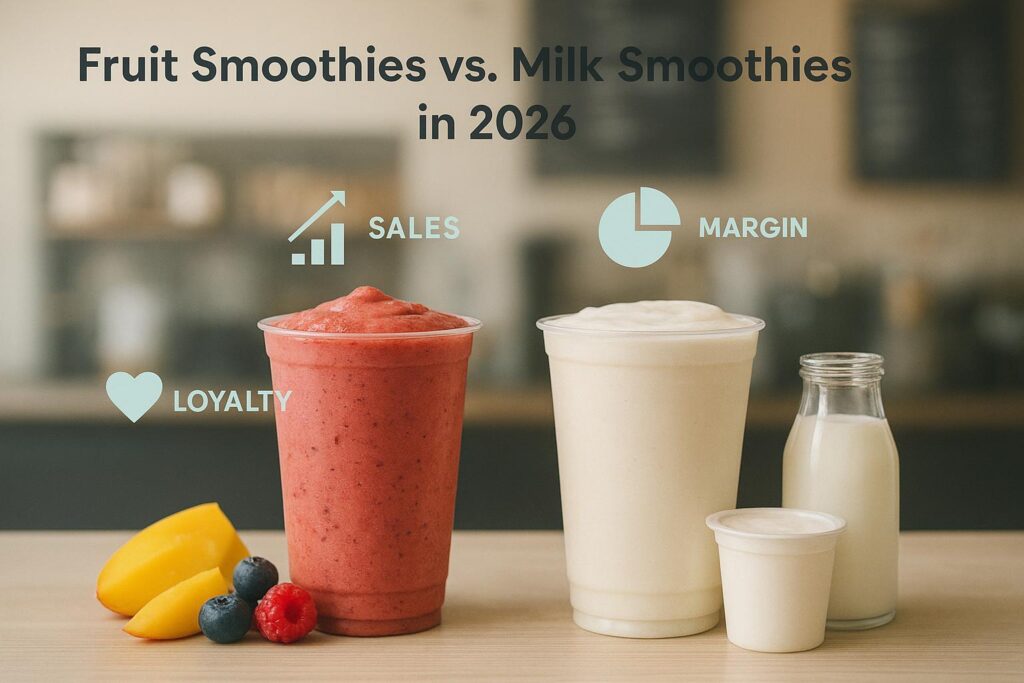
Sensory appeal & flavor delivery Bright, refreshing fruit intensity; can thin out unless banana/pectin-rich fruits or a touch of yogurt are used Inherently creamy, indulgent mouthfeel prized in milk-tea culture; carries dessert-style flavors well
COGS & gross margin Competitive when using IQF fruit or shelf-stable purees with portion control; waste risk is low if frozen Competitive with stable dairy contracts; yogurt/ice cream adds cost but supports higher price points
AOV & attach potential Easy to position protein boosts, vitamin C/fiber claims, and fruit add-ons; premium fruits can ladder pricing Pairs naturally with toppings (cheese foam, boba), protein boosts (whey/yogurt), and dessert branding
Repeat & loyalty Health perception and customization drive repeat among wellness segments Creaminess and comfort flavors can drive stickiness among teens/young adults
Prep speed & SOP Fewer refrigerated SKUs; frozen fruit + water/juice blends in tens of seconds with presets Similar blend times; dairy handling adds cleaning vigilance at rush
Supply stability & waste Frozen fruit offers long quality windows; minimal shrink if FIFO is tight Milk/yogurt have shorter opened shelf-life; higher waste risk at low turns
Nutrition & claims readiness Vitamin C and fiber-forward; protein needs add-ins to hit 20–30 g Protein-dense via yogurt/whey; easier to reach 20–30 g with taste acceptance
Brand/daypart fit Wellness, breakfast, post-workout Indulgent treats, afternoon dessert, teen/young adult
Regional cost sensitivity Seasonal fruit spikes; IQF/purees mitigate some volatility Dairy contracts can stabilize costs; plant milks vary by brand/region
Evidence notes in sections below.
Health and dietary trends: where demand flows in 2026
A significant share of guests either prefer or need dairy-free options. The NIH’s MedlinePlus explains that roughly two-thirds of the global population reduces lactose digestion after infancy, with big demographic variation by ancestry; that context helps explain why lactose-free and dairy-free options expand your addressable market in many U.S. trade areas, according to the NIH overview on lactose intolerance genetics. See the discussion in the NIH resource “Lactose intolerance — Genetics” for background on prevalence patterns and guest inclusion.
According to the Dietary Guidelines for Americans (2020–2025), fortified soy beverages can serve as dairy alternatives inside dietary patterns. That means you can keep milk smoothies on menu while ensuring parity for dairy-avoiding guests with soy or other plant milks. Practically, fruit smoothies create a simpler default path to dairy-free builds; milk smoothies need a swap (lactose-free dairy or plant milk) to accommodate intolerance.
Bottom line for fruit smoothies vs milk smoothies: fruit-led menus generally win inclusivity out of the box, but both bases can satisfy health-led demand if you plan the menu architecture and swaps.
Citations:
According to the NIH’s MedlinePlus overview, see Lactose intolerance — Genetics (accessed 2026-03-05): https://medlineplus.gov/genetics/condition/lactose-intolerance/
See the CDC-hosted PDF mirror of the Dietary Guidelines for Americans 2020–2025 for dairy alternative accommodations (accessed 2026-03-05): https://www.cdc.gov/breastfeeding-data/media/pdfs/2024/05/Dietary_Guidelines_for_Americans_2020-2025.pdf
Taste, texture, and satiety: what drives repeat
Texture sells. Milk and yogurt bases bring creaminess and a rich mouthfeel that align with milk-tea culture and dessert-centric profiles. Fruit-forward builds bring brightness and perceived freshness; when you need more body, banana or yogurt, or pectin-rich fruits (mango, peach) can add thickness while preserving fruit intensity.
From an operations standpoint, commercial blending presets keep make times short. Vitamix’s commercial manual for The Quiet One shows smoothie programs in the tens of seconds, depending on thickness and inclusions. That’s your ceiling for rush throughput, assuming tight mise en place. For teen/young adult traffic in chains, the indulgent profile of milk smoothies often boosts trial and repeat; for breakfast and wellness guests at independents, fruit smoothies typically set the tone for a “feel-good” reorder.
Cited evidence: See Vitamix’s The Quiet One preset guidance (accessed 2026-03-05): https://www.vitamix.com/media/catalog/product/file/TQO_Twist_Lock_1.pdf
COGS, margin, and pricing windows (examples dated 2026-03-05)
Ingredient prices swing with seasonality and supplier contracts. Use the math below as scaffolding and drop in your invoices for a real view.
Worked Example A — 16 oz Fruit Smoothie (Fruit + Water)
Assumptions: 5 oz IQF/puree fruit, 10 oz water, 1 oz sweetener/syrup, disposables.
Prices as of 2026-03-05 (illustrative; verify live): a 1 L Monin fruit puree bottle on WebstaurantStore lists in the mid-to-high teens per liter; at 33.8 fl oz per bottle, a 1.0–1.5 oz shot costs roughly $0.50–$0.80 depending on flavor and discount. IQF fruit case pricing varies by flavor and case size; replace with your actual cost per ounce.
Sample COGS math placeholder using puree: Fruit puree 1.5 oz at $0.55/oz = $0.83; sweetener 1 oz at $0.05; cup/lid/straw $0.20; water negligible; labor not included. Estimated COGS ≈ $1.08–$1.40 (range reflects flavor/case costs). If menu price is $6.50, gross margin ≈ 78–83% before labor/overhead.
Worked Example B — 16 oz Milk Smoothie (Milk + Yogurt)
Assumptions: 6 oz milk, 3 oz plain yogurt, 4 oz fruit (IQF or puree), 1 oz sweetener/syrup, ice, disposables.
Prices as of 2026-03-05: many foodservice dairy and barista plant milks display prices only in-cart or behind logins; insert your invoices. For illustration, keep the same fruit cost as Example A (e.g., $0.60–$0.90). Estimate milk + yogurt combined at $0.45–$0.85 based on regional contracts; sweetener $0.05; disposables $0.20.
Estimated COGS ≈ $1.30–$2.00. If menu price is $6.99–$7.99, gross margin ≈ 72–84% before labor/overhead.
Operator notes
Fruit waste vs dairy waste: frozen fruit and shelf-stable purees typically cut shrink; opened milk/yogurt has a shorter clock. Strong FIFO and right-sizing open dairy is crucial to protect margin during slower turns.
Price ladders: milk smoothies that deliver extra creaminess or protein can justify the top of your range; fruit smoothies that feature premium berries or tropicals can ladder pricing with limited-time flavors.
Linked price example: see a Monin 1 L fruit puree listing with visible price as of 2026-03-05 (verify live before use): https://www.webstaurantstore.com/monin-1-liter-blueberry-fruit-puree/544FRTRP008F.html
Prep speed, SOP complexity, and waste risk
Think of speed in two parts: station touches and blend time. Preset programs keep blend cycles in the 18–40 second band; the rest is mise en place and sanitation. Fruit smoothies that rely on frozen fruit plus water or juice minimize refrigerated dairy touches, which can shave seconds and reduce cross-contact risk during a rush. Milk smoothies can be just as quick on the blender, but dairy handling raises the sanitation bar.
For storage and shrink control, lean on federal guidance. The FDA reminds operators to hold refrigerated foods at or below 40°F and frozen items at 0°F; food kept frozen remains safe indefinitely, though quality falls over time. The USDA FoodKeeper reference is the industry-friendly guide for opened shelf-life norms on milk, yogurt, and best-quality windows for frozen fruit. Codify those durations in your SOP, log temperatures, and right-size your batch prep.
Cited evidence: see the FDA’s consumer update on safe storage temperatures (accessed 2026-03-05): https://www.fda.gov/consumers/consumer-updates/are-you-storing-food-safely; and the USDA’s FoodKeeper overview pages for shelf-life context (accessed 2026-03-05): https://www.usda.gov/about-usda/news/blog/how-reduce-food-waste-home and https://www.usda.gov/about-usda/news/blog/todays-lesson-prepare-safe-lunches
AOV lift, attach rates, and customization playbook
Raising margin per ticket often matters more than squeezing a few extra points of unit margin. Use your menu and app to nudge valuable add-ons: protein boosts (whey or plant), nut butters, boba or fruit pearls, premium fruits, and dairy/plant-milk upgrades. Be transparent on protein grams and calories; show value clearly on the board and in the app. Run short tests on default add-on prompts and bundling (e.g., smoothie + pastry breakfast combo) to measure attach and AOV.
Who wins where: scenario picks for 2026
Independents with wellness/breakfast traffic: Prioritize fruit smoothies as the everyday default; offer a dairy or plant-milk creaminess upgrade. Expect strong trial from inclusive, dairy-free positioning and speed-friendly SOPs.
Chains centered on indulgent milk-tea culture: Prioritize milk smoothies for the core lineup; keep at least two dairy-free SKUs visible. Expect better texture-driven repeat among teens/young adults and strong pairing with toppings.
Throughput-constrained formats: Start with fruit SOPs that minimize SKU touches and cleaning. Use pre-measured portions and blender presets to keep total make time under 45 seconds.
Protein-led pricing ladders: Milk bases get you to 20–30 g protein fastest via yogurt/whey. Fruit-led menus can match with plant/whey boosts; mind flavor masking and sweetness balance.
Price volatility pivots: In fresh-berry spike seasons, lean into contracted dairy stability; when frozen/puree deals are strong, spotlight fruit.
How to decide (and test) in your stores
Here’s the quick decision tree you can apply this week:
If your brand leads with wellness, lactose-free, or breakfast commuters → start with fruit smoothies as your core.
If your traffic skews to indulgent milk-tea and teens/young adults → make milk smoothies your hero SKUs.
If the line is your enemy at peak → simplify to fruit + water/juice SOPs first.
If your AOV strategy centers on protein → begin with milk bases (layer fruit SKUs with boosts over time).
If local produce prices are spiking → bias toward milk bases until seasonality eases.
Six-week A/B pilot plan (one store or matched pair)
Baseline 2 weeks: track units, gross margin per cup, attach rate (% with add-ons), and 7/30-day repeat from loyalty.
Intervention 2 weeks: swap base emphasis per decision tree (e.g., promote fruit as default in wellness-led store, or milk in indulgence-led store); keep 2–3 control SKUs unchanged.
Stabilization 2 weeks: hold changes; run a modest price or add-on prompt test if volumes allow.
Measure: change in units, margin per ticket, attach rate, and repeat. Publish a one-page readout and decide your permanent core/seasonal lineup.
FAQ
Is there enough lactose-free demand to justify a dairy-free default?
Demographics vary by trade area, but lactose intolerance and dairy avoidance are common enough to warrant visible dairy-free options. The NIH’s MedlinePlus overview on lactose intolerance genetics highlights wide global and demographic variation; building inclusive menus broadens your reach.
Can plant-based smoothies match protein targets of milk smoothies?
Yes, with fortification. Milk/yogurt or whey typically make 20–30 g easy with strong taste acceptance. Fruit-led builds can match using plant proteins (pea/rice/soy), but you may need flavor masking and sweetness adjustments.
Which is faster to make during a rush: fruit or milk?
Blend times are similar under presets, but fruit-plus-water/juice SOPs can trim station touches and cleaning during peak. Your mise en place and training determine the real answer.
Should I raise price during seasonal fruit spikes?
Price ladders work best when paired with clear value signals. If seasonal spikes hit your COGS, steer demand to contracted SKUs (e.g., dairy-forward or non-berry fruit) and use LTOs with premium pricing where guest willingness to pay is highest.
Sources and scope
Health and dietary context: see the NIH’s MedlinePlus resource Lactose intolerance — Genetics (accessed 2026-03-05): https://medlineplus.gov/genetics/condition/lactose-intolerance/
Dairy alternative accommodation: see the CDC-hosted Dietary Guidelines for Americans 2020–2025 PDF (accessed 2026-03-05): https://www.cdc.gov/breastfeeding-data/media/pdfs/2024/05/Dietary_Guidelines_for_Americans_2020-2025.pdf
Blending throughput: Vitamix The Quiet One commercial presets (accessed 2026-03-05): https://www.vitamix.com/media/catalog/product/file/TQO_Twist_Lock_1.pdf
Storage and waste risk: FDA storage temperatures guidance (accessed 2026-03-05): https://www.fda.gov/consumers/consumer-updates/are-you-storing-food-safely and USDA FoodKeeper overview pages (accessed 2026-03-05): https://www.usda.gov/about-usda/news/blog/how-reduce-food-waste-home; https://www.usda.gov/about-usda/news/blog/todays-lesson-prepare-safe-lunches
Price example for fruit puree: WebstaurantStore listing for a 1 L Monin fruit puree with visible pricing (accessed 2026-03-05): https://www.webstaurantstore.com/monin-1-liter-blueberry-fruit-puree/544FRTRP008F.html
Scope statement: Assessed as of 2026-03-05, U.S. foodservice context; ingredient specs and SOPs are representative examples from commercial operator playbooks. Pricing and availability are subject to change by supplier, region, and season. Replace all cost assumptions with local invoices for decisions.