
Hojicha cheese foam tea is one of those drinks that sounds niche, but sells fast when it’s executed well: a smooth, roasted-tea milk base with a salty-sweet “cheese cap” on top. It hits the same comfort notes as coffee and brown sugar drinks—without tasting like dessert-in-a-cup.
If you’re a bubble tea shop owner or manager exploring new menu ideas, this guide gives you a practical SOP: batch specs (grams/mL), a repeatable service workflow, conservative holding guidance, and the failure modes that usually ruin a first test.
What hojicha cheese foam tea is (in plain English)
Hojicha is Japanese green tea that’s been roasted. Roasting changes the flavor from “green” and grassy to toasty, nutty, and caramel-like, with much less bitterness and astringency. Tea writers at byFood describe hojicha as having mellow roasted undertones that can remind people of chocolate or caramel (see byFood’s overview of hojicha).
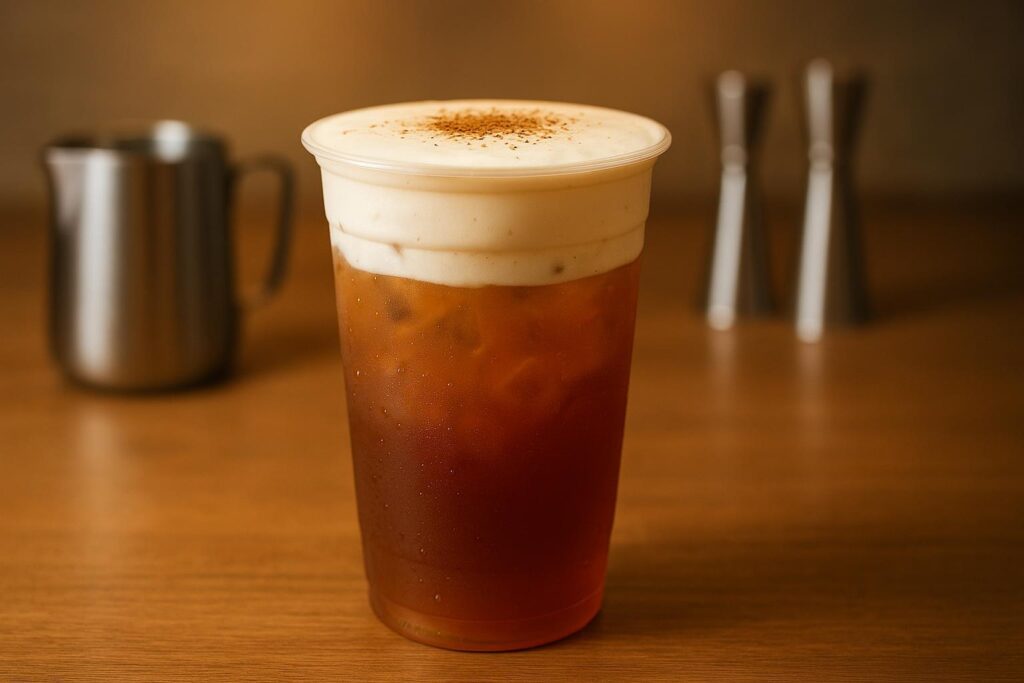
Cheese foam (also called cheese cap or “cheese cap boba” on some menus) is a whipped dairy topping—typically cream cheese, cream, milk, a sweetener, and a pinch of salt—beaten into a thick-but-pourable foam. It’s not “cheesy” like pizza. Think: lightly tangy, creamy, and salted like a good cheesecake bite—made to sit on top of tea.
Why this drink works on a bubble tea menu
Hojicha brings something many menus lack: roasted depth. Nio Teas describes hojicha’s “rich, nutty, slightly smoky” character (see Nio Teas on hojicha flavor). That roast note pairs naturally with dairy foam.
From an ops standpoint, it can be a smart test drink because:
The flavor is distinctive without being polarizing.
You can position it as “coffee-adjacent” (roasted, cozy) for customers who don’t want fruity.
It supports upsell: boba, coffee jelly, or pudding work with the profile.
The workflow is teachable: a consistent tea base + a consistent foam portion.
Pro Tip: When customers ask “What does hojicha taste like?”, don’t over-explain. Try: “Toasty roasted-tea flavor—like nutty cocoa notes, not grassy green tea.” Then offer a sample.
Menu positioning: flavor + caffeine expectations
Flavor notes you can use on menus
Hojicha is often described as toasty, warm, and mellow because roasting reduces many of the bitter/astringent compounds present in unroasted green tea. Naoki Matcha’s guide explains how roasting creates the characteristic aroma and brown color (see Naoki Matcha’s hojicha tea guide).
Menu copy that tends to convert:
“Roasted hojicha milk tea with a lightly salted cheese cap.”
“Toasty, nutty hojicha with a creamy cheese foam top.”
Caffeine: keep the claim conservative
Hojicha is typically lower caffeine than matcha and many black teas. Some tea references cite hojicha at roughly 7–20 mg per 8 oz (varies by leaf/stem and brewing). If you want a menu-friendly source, see Hojicha Lab’s caffeine comparison chart.
Operational takeaway: Position hojicha as “lower caffeine” or “gentler” instead of guaranteeing an exact mg number.
Build decisions before you run your first test batch
You’ll get a cleaner launch if you decide these upfront—before you spend an afternoon “tuning” a recipe that was never going to be stable.
1) Tea base: hojicha powder vs brewed hojicha
Many shops use powders for speed and consistency; others prefer brewing for clarity. If your staff is already trained on powders and you want a reliable build, start there.
If you’re evaluating powders in general, the best ops question is: “Will it dissolve smoothly and stay smooth?” Bubble Tea Supplier’s guide on choosing tea powders without chalky texture is a helpful read before you commit.
2) Sweetness target
Cheese foam reads sweeter than it is because it’s aromatic and creamy. For first tests, aim your hojicha base slightly less sweet than your standard milk tea, then adjust based on tasting.
3) Salt level in foam
Salt is what makes cheese foam “work.” Too little and it’s just whipped dairy. Too much and it tastes like a mistake.
4) Portioning: decide the foam dose early
If you don’t standardize the foam portion, you’ll get inconsistent reviews (and inconsistent costs).
A practical starting point:
16 oz (500 mL) cup: 25–35 g foam
24 oz (700 mL) cup: 35–45 g foam
Pick one portion size per cup size, then train it.
SOP Part 1: Hojicha milk tea base (batch)
This SOP is designed for a 1,000 mL batch of hojicha milk tea base (before ice). Scale up with the same ratios.
Ingredients (1,000 mL batch)
Hojicha tea base (brewed or powder slurry) — as specified below
Whole milk — 700 mL
Simple syrup (1:1) — 80–120 mL (start at 100 mL; adjust)
Optional: pinch of salt — 0.5–1 g (rounds roast notes)
Option A: Powder-based hojicha slurry
Hojicha powder — 30–45 g
Hot water (80–90°C / 176–194°F) — 200 mL
Step 1 — Make the slurry
Add hojicha powder to a heat-safe container.
Add hot water.
Whisk until fully smooth (no dry pockets).
Done when: slurry is glossy and uniform, with no visible specks clinging to the sides.
Step 2 — Build the base
Add whole milk to a clean batch pitcher.
Add simple syrup.
Add the hojicha slurry.
Stir for 20–30 seconds.
Done when: color is even from top to bottom (no streaking).
Option B: Brewed hojicha (if you prefer brew clarity)
If you brew, your main risk is weak tea that disappears under dairy and foam. Many milk tea SOPs recommend brewing stronger than “home tea.” If you want a broader foundation for shop tea strength, Bubble Tea Supplier’s shop-ready milk tea ingredients SOP is a good reference point.
Conservative approach: brew strong, chill quickly, then cut with milk to taste.
SOP Part 2: Cheese foam for milk tea (dairy cheese cap) — batch recipe
This recipe targets a foam that is thick, airy, and pourable—not stiff frosting.
Ingredients (about ~620 g foam; typically 18–25 servings)
Cream cheese (full-fat), softened — 200 g
Heavy whipping cream — 240 g
Whole milk — 120 g
Sugar — 60 g (adjust 40–80 g based on your menu sweetness)
Fine salt — 2 g (about 0.3% of batch; adjust to taste)
These ratios match widely shared cheese cap formulas. For example, Serious Eats documents a measured approach in their cheese foam tea recipe, and Yes Moore Tea shows a classic cream cheese + cream + milk ratio in two cheese foam methods.
Step-by-step method
Step 1 — Smooth the cream cheese
Place softened cream cheese in a mixing bowl.
Add sugar.
Mix until fully smooth (no lumps).
Done when: mixture looks like glossy cheesecake batter.
Step 2 — Add dairy and whip
Add heavy cream and milk.
Whip on medium speed until the foam thickens.
Done when: foam holds a soft mound but still slowly relaxes; it should pour in a ribbon, not plop.
Step 3 — Salt and final adjustment
Add salt.
Mix 10–15 seconds.
If it’s too thick, add milk 10–20 g at a time and re-whip briefly.
⚠️ Warning: If you over-whip, foam can turn overly stiff and start to separate later. Stop as soon as it reaches a pourable “cap” texture.
Assembly + service workflow (speed and consistency)
Suggested drink build (16 oz / 500 mL cup)
Ice: fill cup 60–70%
Hojicha milk tea base: 350–380 mL
Cheese foam: 25–35 g on top (start at 30 g)
Done when: the foam sits as a defined layer on top for at least a few minutes (long enough for photos and first sips).
Staff training note: how customers drink it
Many customers will either:
sip through the foam (best experience), or
stir it in.
Your menu description can gently guide them: “Sip through the foam for the full salty-sweet top layer.”
A simple prep cadence that reduces waste
If you’re testing this drink for the first time, smaller batches beat “one huge batch.”
A practical cadence for a small shop:
Tea base: batch once in the morning, then top up mid-shift if it’s moving.
Cheese foam: batch smaller (or split the batch in half), so it stays stable and you don’t end the day tossing separated foam.
Holding times + food safety notes (conservative)
Cheese foam is a dairy topping and should be treated like a time/temperature controlled ingredient.
Conservative best practices for US shops:
Keep cheese foam refrigerated when not in active use.
During service, keep it in a cold well or in small containers you rotate from the fridge.
Date/time label each batch.
Use clean utensils; don’t “double dip” a spoon that touched a customer cup.
Because local rules vary, confirm your exact allowable holding times and service setup with your local health department. For broader dairy food-safety mindset resources, the Wisconsin Cheese Makers Association maintains dairy food-safety guidance and resources.
Troubleshooting (the stuff that breaks first tests)
Problem: foam is grainy or lumpy
Likely causes
Cream cheese wasn’t softened enough.
Sugar didn’t fully dissolve.
Fix
Start with room-temp cream cheese.
Mix cream cheese + sugar fully smooth before adding dairy.
Problem: foam is too thick (won’t pour)
Likely causes
Over-whipped foam.
Too much cream cheese for your environment.
Fix
Add milk 10–20 g at a time and re-whip briefly.
Next batch: reduce cream cheese slightly or shorten whip time.
Problem: foam is too thin (slides into the drink immediately)
Likely causes
Too much milk.
Under-whipped.
Fix
Whip a bit longer.
Next batch: reduce milk slightly.
Problem: hojicha base tastes weak after foam
Likely causes
Tea base not strong enough to stand up to dairy + salted foam.
Fix
Increase powder dose (e.g., 30 g → 40 g per 1,000 mL batch) or brew stronger.
Problem: foam separates during the shift
Likely causes
Over-whipped foam.
Temperature swings (left out too long).
Fix
Make smaller batches more often.
Keep foam cold; re-whip briefly only if it returns to a smooth pourable texture.
Variations you can test after the baseline passes
Keep the first test simple. Once it sells, here are low-risk variations:
“Salted hojicha cheese cap”: bump salt slightly (tiny increments).
“Extra-roasted hojicha”: slightly higher powder dose.
Toppings: boba, coffee jelly, or pudding.
For broader menu planning on where hojicha fits versus matcha, Bubble Tea Supplier’s comparison post on matcha vs hojicha for bubble tea menus can help you position both without cannibalizing.
FAQ: quick answers staff can use
Is hojicha cheese foam tea the same as a hojicha milk tea recipe?
A hojicha milk tea recipe is the base (hojicha + milk + sweetener). Hojicha cheese foam tea adds a salty-sweet dairy cap on top, which changes the first sip experience and adds a higher-end texture.
What’s the easiest way to describe cheese foam for milk tea to customers?
Try: “It’s a lightly salted, creamy topping—like a cheesecake-style foam.” Keep it short, offer a sample, and let them taste it.
Do customers actually like “cheese cap boba” drinks?
When the foam is balanced (not too salty, not too thick), customers tend to love the contrast. The bigger risk is bad texture—grainy or separating foam will kill repeat orders.
Next steps (simple, low-friction)
If you want more “addable this week” drink ideas, browse Bubble Tea Supplier’s new drink recipes and ideas and the broader Bubble Tea Supplier catalog to plan your next two test beverages.