
Summer is when matcha can turn into a real profit center: it looks premium, it photographs well, and customers expect it to be “smooth and creamy.”
But operators know the downside: matcha is unforgiving. If the powder clumps, the drink tastes gritty. If the water’s too hot, it can go bitter. If the drink is built inconsistently, it becomes watery halfway through.
This guide gives you a standardized iced matcha base (fast, repeatable, easy to train), then a set of controlled summer variations that reuse the same workflow.
Why matcha lattes sell in summer (and why they fail in shops)
Matcha lattes win in summer because they hit three customer desires at once: “refreshing,” “caffeinated,” and “a little healthier.” But they fail for predictable reasons:
- You’re mixing powder directly into cold milk. That’s how you get bitter clumps.
- Your water is too hot. Some matcha makers recommend keeping whisking water around 70–80°C / 160–175°F to reduce harsh bitterness (see Naoki Matcha’s matcha mistakes guide).
- You don’t have a sweetness standard. One barista is “light,” another is “dessert.” Customers notice.
- Your matcha quality doesn’t match your menu price. If you’re selling a $7–$9 matcha latte, the powder needs to perform in milk + ice.
If you want a sourcing checklist you can hand to your supplier, start with BubbleTeaSuppliers.com’s guide on how to choose matcha powder for cafés
.
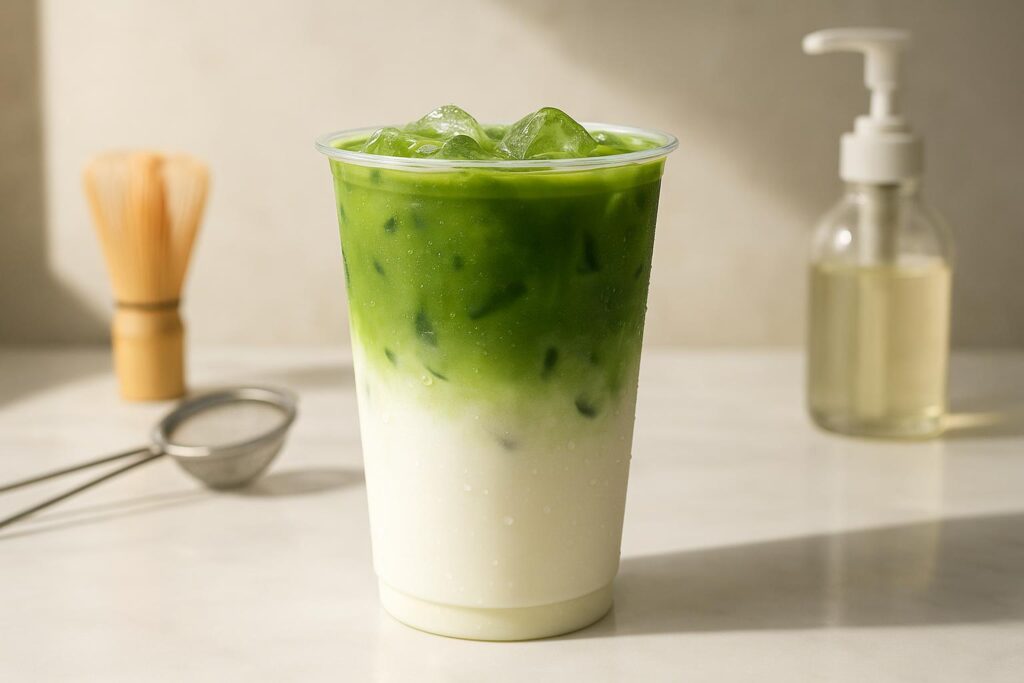
The non-negotiable base SOP: a smooth “matcha shot” for iced drinks
If your shop does one thing better after reading this article, make it this: every iced matcha drink starts as a smooth matcha shot/slurry, not dry powder in cold milk.
What you need at the station
- Digital scale (grams matter; teaspoons don’t)
- Fine-mesh sieve (or dedicated matcha sifter)
- Matcha bowl + whisk, or a shaker bottle
- Temperature-controlled kettle (nice-to-have) or a simple cooling routine
Pro Tip: If you don’t have a bamboo whisk at every station, a shaker method is still legit. Sugimoto Tea specifically notes that shaking matcha in a bottle is an option when you don’t have a whisk (see Sugimoto Tea’s matcha whisking guide
).
Step-by-step: the base matcha shot (single drink)
- Sift the matcha dose into your bowl/shaker.
- This is your cheapest quality upgrade.
- Add warm water (not boiling).
- Target the 70–80°C / 160–175°F range.
- Hibiki-An explains the core principle: lower temperatures extract more of the mellow theanine and less of the bitter catechins/caffeine (see Hibiki-An’s temperature guidance).
- Whisk or shake hard until glossy + foam-topped.
- If whisking, use fast back-and-forth (not circles) to suspend the powder.
- Sweeten while warm (if using syrup).
- Syrup dissolves best in the matcha shot before it hits cold milk + ice.
Done-check (train this)
Your matcha shot is done when:
- No dry pockets are visible on the sides/bottom
- Texture is smooth (no grit)
- Color is even (no muddy streaks)
If you’re building an SOP sheet for staff, BubbleTeaSuppliers.com has an operator baseline you can borrow from their iced matcha latte SOP for cafés
.
Matcha latte ratio by cup size (12 oz / 16 oz / 20 oz)
Use this as a starting point, then dial it in based on your matcha quality and milk choice. (Oat milk often needs slightly less syrup because it reads sweeter.)
Baseline reference ratios (from tea brands)
A credible gram-based reference point comes from Ippodo Tea’s iced recipe, which uses 3 g matcha + 100 mL water at ~80°C, then pairs it with 100 mL cold milk and ice (see Ippodo Tea’s iced matcha latte recipe
).
For shop service, you’ll usually tighten the water volume (stronger shot) so it holds up as ice melts.
Shop-friendly starting table (iced)
Use this as your first round of menu testing, then lock your final spec.
| Cup size | Matcha (g) | Warm water (mL) | 1:1 simple syrup (mL)* | Milk fill (typical) |
|---|---|---|---|---|
| 12 oz | 3–4 | 30–60 | 10–20 | Fill to line over ice |
| 16 oz | 4–6 | 40–80 | 15–30 | Fill to line over ice |
| 20 oz | 6–8 | 60–100 | 20–40 | Fill to line over ice |
*Start at your “standard” sweetness level, then offer controlled options (below).
These ranges align with the operator-style guidance used in the BubbleTeaSuppliers iced matcha latte SOP.
Standardize sweetness (so customers trust you)
Pick a system your team can execute under rush conditions. Two common patterns:
- Percent system: 0% / 30% / 50% / 70% / 100%
- Light / Standard / Sweet (3-level system)
What matters is that each level equals a measured amount (mL or pumps). Example:
- 0% = 0 mL
- 50% = 15 mL
- 100% = 30 mL
Once you set your spec, add it to the POS modifier so baristas don’t freestyle.
7 refreshing summer matcha drinks (controlled matcha latte recipes)
Every variation below uses the same base workflow:
- make matcha shot → 2) add syrup/flavor layer → 3) add milk + ice → 4) pour matcha shot (layered) or shake (fully mixed)
That’s how you get summer matcha drinks without “new drink chaos.”
1) Classic Iced Matcha Latte (your house standard)
Why it sells: It’s the benchmark. If this isn’t dialed in, the rest won’t matter.
How to run it:
- Use your 16 oz spec as the standard order size.
- Set one default milk (whole or oat) and list alternatives as upgrades.
Failure mode: watery, pale green drink after 5 minutes → fix by tightening the water in the matcha shot or increasing matcha grams slightly.
2) Vanilla Cream Iced Matcha
Why it sells: Vanilla rounds bitterness and reads “dessert” without being heavy.
Build notes:
- Replace simple syrup with vanilla syrup (same sweetness levels).
- For a premium tier, add a small amount of cream to the milk base.
Failure mode: tastes like vanilla milk with a green tint → you’re under-dosing matcha.
3) Strawberry Matcha Latte (layered)
Why it sells: Color contrast + fruit-forward summer vibe.
How to run it (shop-friendly):
- Strawberry syrup or strawberry puree layer first.
- Add milk + ice.
- Pour matcha shot last for the layered look.
Failure mode: looks great, tastes disconnected → shake lightly for 1–2 seconds after layering so the top integrates on first sip.
4) Coconut Matcha Latte
Why it sells: Coconut reads “vacation” and pairs well with matcha’s grassy notes.
Build notes:
- Use coconut milk blend (or part coconut + part oat).
- Keep sweetness slightly lower than your standard if the coconut base is already sweet.
Failure mode: separation → ensure your coconut base is well-mixed and keep the matcha shot strong.
5) Mango Matcha Latte
Why it sells: Mango is a top-performing summer flavor and makes matcha feel more approachable.
Build notes:
- Mango syrup or mango puree works.
- If using puree, standardize grams/mL per cup size so you don’t blow COGS.
Failure mode: muddled flavor → pick one mango source (syrup or puree) and standardize.
6) Lavender Matcha Latte (LTO)
Why it sells: Feels premium and seasonal; higher price tolerance.
Build notes:
- Lavender should be subtle. Use a measured spec and don’t let baristas “splash.”
Failure mode: soapy aftertaste → lavender is overdosed.
7) Dirty Matcha Latte (espresso add-on)
Why it sells: Captures both matcha customers and coffee customers.
How to run it:
- Use your standard iced matcha build.
- Add espresso last for a layered visual.
If you want a shop-ready spec and QC checks, BubbleTeaSuppliers has a full dirty matcha latte SOP
.
Matcha latte for cafes: speed + consistency systems (so it doesn’t slow your line)
Matcha can be fast if you treat it like a system.
1) Decide: whisk station vs shaker station
- Whisk station: best texture; slower; more training.
- Shaker station: faster; consistent; easier to train.
Many boba shops land on a shaker workflow because it’s repeatable and already matches how staff build other drinks.
2) Keep matcha dry (this prevents clumps)
Humidity and condensation ruin service.
- Store bulk matcha airtight, away from steam.
- If you refrigerate/freezer-store bulk matcha, let it come to room temp before opening so condensation doesn’t hit the powder.
3) Batch only what you can sell fast
You can batch matcha concentrate, but keep it conservative:
- Make small batches
- Keep cold
- Shake before each use
- Discard if color/aroma degrades
If batching starts causing separation and remakes, you’re losing the time you think you’re saving.
Troubleshooting: bitterness, clumps, and “watery green milk”
Problem: bitter matcha
Likely causes:
- Water too hot
- Low-quality matcha for milk drinks
- Too much matcha for the milk ratio
Fix:
- Keep whisking water around 70–80°C / 160–175°F.
- Re-test matcha in cold milk + ice (not just hot water) using the BubbleTeaSuppliers selection checklist (linked earlier).
Problem: clumpy or gritty texture
Likely causes:
- Not sifting
- Not making a shot/slurry first
- Mixing directly into cold milk
Fix:
- Make sifting non-optional.
- Use shaker method if whisk skill varies.
- Train the done-check: no dry pockets.
⚠️ Warning: If you’re getting repeated clumps, don’t “fix it” by adding more syrup. It hides bitterness but doesn’t solve texture.
Problem: drink looks good but goes watery fast
Likely causes:
- Shot is too diluted
- Ice-to-liquid ratio is inconsistent
Fix:
- Tighten water in the matcha shot.
- Standardize ice fill level (e.g., 60–70% of cup).
FAQ (for shop owners)
What’s a good default water temperature for matcha lattes?
Many matcha guides recommend staying under boiling and commonly around 70–80°C / 160–175°F to reduce harsh bitterness.
Should we use “ceremonial grade” matcha for lattes?
Ignore the label as your only decision tool—it’s not a regulated standard. Buy for performance in milk drinks: color, aroma, bitterness-in-milk, and mixability.
How do we stop matcha from slowing down service?
Standardize one base method (shot + shake), one default cup size, and a limited set of LTO variations that reuse the same build.
What if customers say matcha is “too bitter”? Should we switch to hojicha?
Sometimes, yes. If your customers want roasted, smoother flavor, hojicha can be an easier win. Use BubbleTeaSuppliers’ comparison to position both without cannibalizing: matcha vs hojicha
.
Next steps
If you want to tighten your program fast, pick one size (usually 16 oz), run a 3-point test (light/standard/bold matcha grams), lock your syrup levels, and train the done-check.
For deeper SOP resources and sourcing checklists, start at BubbleTeaSuppliers.com. *