
Matcha and taro are both top-tier crowd-pleasers on a bubble tea menu—but they’re rarely treated like they belong in the same cup.
They do.
When you build it right, matcha taro milk tea gives you:
a high-contrast, photo-friendly “two-tone” look
a flavor profile that’s creamy and dessert-like (taro) but still clean and tea-forward (matcha)
an easy story to sell: “earthy matcha + sweet taro”
When you build it wrong, you get the opposite: clumpy matcha, a muddy green-purple swirl, and staff making “their version” every shift.
This post is an awareness-stage intro (why it works and when to add it), but it ends with a shop-ready SOP + batch prep system you can hand to staff.
What “matcha taro milk tea” should taste and look like
A good taro matcha milk tea hits three targets at once:
1) Flavor balance
Taro brings creamy, vanilla-nutty sweetness.
Matcha adds grassy/umami depth and a clean finish.
If the drink tastes “flat,” your tea side is too weak. If it tastes “sharp,” your matcha is too hot, too strong, or too low-grade.
2) Texture
Your target texture is smooth and milkshake-adjacent, not chalky, gritty, or separating after two minutes.
3) Visual consistency
For a two-tone build, you want:
a stable taro base (no watery separation)
a matcha layer that’s smooth enough to pour, but thick enough to sit on top
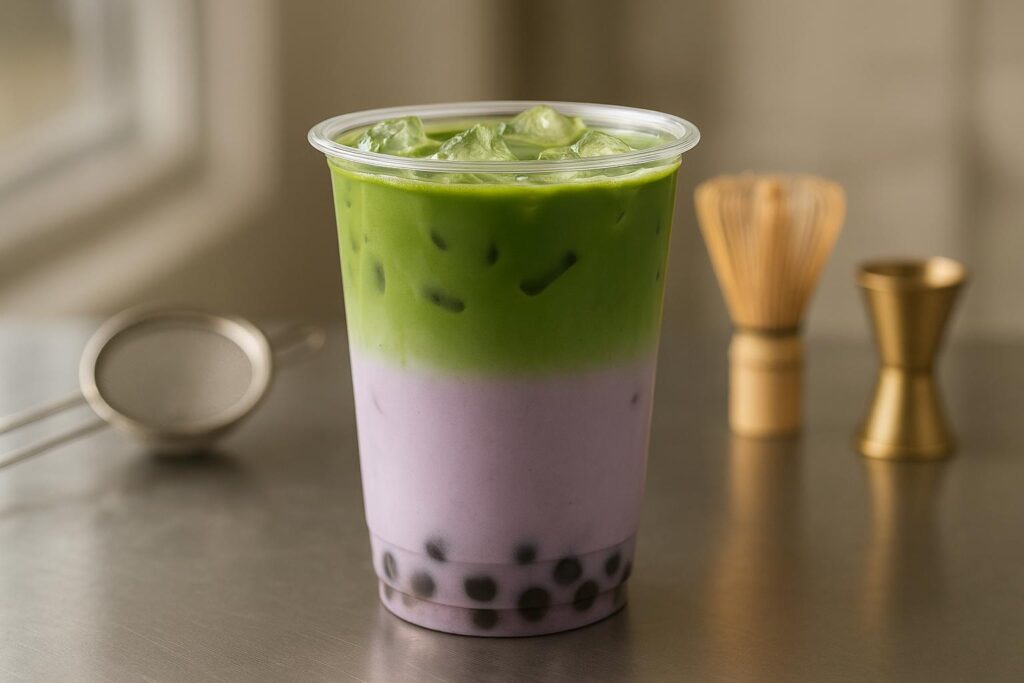
Pro Tip: Treat this drink like a layered latte, not a shaken milk tea. The build order matters more than people think.
Ingredient decisions that make or break the SOP
You can’t SOP your way out of weak ingredients. But you can SOP your way to consistent output.
Matcha: pick a grade your staff can’t “accidentally ruin”
If your matcha is bitter or clumpy, it’s usually one of three things:
the powder is low-grade (meant for baking)
the water is too hot
the mixing method is wrong
The matcha side of this drink should use a repeatable method that prevents clumps—because matcha’s ultra-fine powder can clump easily without prep. Best Matcha’s matcha troubleshooting guide (2025) breaks down how grade + water temperature + technique drive bitterness and texture.
SOP rule: If you’re serving matcha as a beverage (not baking), choose a “latte-grade” or better, then standardize the paste method (below).
Taro: powder vs paste (and the clean-label reality)
Most shops use taro powder because it’s fast and consistent. Bobo Tea Shop’s taro boba milk tea guide (2025) outlines powder and fresh-taro methods, including holding notes.
But here’s the key for your constraint: no artificial colors/flavors.
Many “classic purple” taro powders get that look from added coloring and flavoring. If your brand promise includes clean label, your SOP must include a purchasing checklist.
Clean-label taro checklist (practical, not preachy):
Ask for the full ingredient list/spec sheet from the supplier.
Avoid “artificial flavor,” “artificial color,” and ambiguous “color added.”
Confirm how sweetness is delivered (pre-sweetened powder vs unsweetened base).
Run a 3-cup test before launch: standard ice, standard milk, 0% / 50% / 100% sweetness.
If you want a naturally purple look, test a small amount of purple sweet potato as a color booster and document the grams in your SOP. (It’s a common trick in fresh-taro recipes like Hungry Huy’s taro milk tea recipe (2020).)
The build strategy: two components, then one clean pour
Think of this as two mini-SOPs:
a matcha concentrate that is smooth and pourable
a taro base that is creamy and stable
Then you combine them with a build order that keeps the layers clean.
SOP Part 1: Matcha concentrate (matcha without clumps)
This is the “paste method,” built for speed.
Matcha concentrate — per 16 oz drink (starting ratio)
Use this as a baseline, then adjust sweetness and matcha strength to your customer profile.
Matcha: 1 tsp (or pre-weighed dose)
Warm water: 50 ml (hot but not boiling)
Sweetener: ~15 ml (adjust)
If you want to call this a “matcha milk tea recipe” internally, label this section as the non-negotiable core spec: dose + water temp + mixing method.
Step-by-step: matcha concentrate
Sift the matcha into a small bowl/cup.
Add warm water and sweetener.
Froth/whisk until fully smooth.
For high-volume service, use a batching system (sieves, opaque containers, documented ratios and refresh intervals). Matcha Program’s guide to batching matcha for cafes (2025) is a strong starting point.
⚠️ Warning: Don’t mix matcha directly into cold milk with ice and call it a day. That’s how you get clumps that sink, then bitterness in the last third of the cup.
SOP Part 2: Taro base (stable, creamy, clean-label friendly)
Option A: Taro powder base (fastest to standardize)
This is the go-to for most shops.
Starting spec (per 16 oz drink):
Taro powder: follow your supplier’s recommended grams, then lock it in
Warm water: enough to dissolve into a smooth paste
Milk (or dairy-free milk): to volume
Tea: optional (small amount) for a cleaner finish
Shop upgrade: Don’t let staff scoop “by vibes.” Pre-portion taro powder doses in labeled containers.
Option B: Taro paste base (premium, but more labor)
Fresh taro gives a more natural flavor, but it adds prep time and variability.
If you do it, treat the paste as a batch item with:
measured cooked taro weight
standardized blending time
a quick straining step if grit shows up
Hungry Huy’s taro recipe also flags an operator-relevant issue: too much taro can make the drink pasty, so your SOP should cap paste grams per cup.
Final SOP: Matcha taro milk tea (two-tone, 16 oz)
This is the staff-facing build.
Ingredients (default)
Cup: 16 oz
Ice: standard scoop
Boba: optional standard scoop (if used)
Taro base: prepared (powder or paste option)
Matcha concentrate: prepared
Build order (layering-friendly)
Add boba (if using) to the cup.
Add ice.
Pour the taro base first (this is your heavier layer).
Slow-pour the matcha concentrate over the back of a bar spoon (or down the side of the cup) to keep a clean layer.
Lid, serve with instruction: “Stir if you want it blended; sip layered for two-tone.”
Done-when checkpoints (training friendly)
Color: distinct green top + taro bottom (not muddy)
Texture: no visible matcha specks, no taro chalkiness
Taste: taro leads; matcha finishes clean (not bitter)
Batch prep + holding (so the drink survives rush hour)
What you can batch
Taro base: batch in a labeled pitcher; shake before use.
Matcha concentrate: batch in small volumes if you can keep it cold, opaque, and well mixed.
What you shouldn’t batch
Cooked boba: boba quality drops fast. Your SOP should include a “discard time” and a holding method.
Dairy-free matcha taro milk tea (creamy without “planty” aftertaste)
A dairy-free option is easy—if you pick the right base.
Practical approach:
Use a barista-style oat/almond/coconut option that’s designed to foam and hold.
Keep the same SOP steps (matcha paste method + taro base dissolved first).
Adjust sweetness slightly upward if your plant milk is unsweetened.
If your shop serves gluten-sensitive guests, note that oat milk can have cross-contact risk unless it’s certified gluten-free (this varies by brand).
Gluten-free note (and what you can responsibly promise)
Tea, milk, and tapioca pearls are often gluten-free by ingredient—but bubble tea becomes risky when you add powders, syrups, and shared equipment.
The National Celiac Association says in its Q&A on whether boba tea is gluten-free (2025) that plain boba tea can be gluten-free, but ingredients and preparation vary.
What to put in your SOP:
Verify every powder/syrup/topping ingredient list.
Use dedicated scoops (or sanitize between allergens).
Add a “GF request” workflow: clean shaker/blender, clean spoon, fresh gloves.
⚠️ Warning: “Gluten-free ingredients” isn’t the same as “gluten-free drink” if you’re using shared blenders or scoops.
FAQs (quick answers your staff will get)
Does matcha taro milk tea need a tea base?
Not always. Many versions work as a milk-based drink. But adding a small amount of tea (or using tea on the taro side) can keep the finish cleaner and less candy-like.
Why does my matcha layer sink or swirl?
Usually because it’s too thin (too much water) or the taro base is too light. Thicken the matcha concentrate slightly and slow-pour over a spoon.
Why does the drink look gray instead of purple?
If you’re avoiding artificial colors, natural taro can skew muted. If you want a more vivid look without dyes, test a small amount of purple sweet potato and document the grams in your SOP.
Can I store taro base overnight?
You can store the base chilled, but you’ll need a shake/stir protocol before every pour. Always run a quick “first cup” taste check at open.
Next steps
If you’re building out a consistent new-drink pipeline, browse BubbleTeaSuppliers.com’s New Drinks collection and keep your SOP format consistent across every launch so staff training gets easier each time.
For deeper SOP building blocks, these internal guides can help:
BubbleTeaSuppliers.com’s shop-ready milk tea ingredient SOP
Their matcha recipes page: Matcha Bubble Tea
Menu positioning context: Matcha milk tea compared to classic flavors
Taro variations and naming ideas: Taro pearl milk tea series