
Vanilla milk tea is one of those “safe bets” drinks that can quietly do a lot for your menu.
It’s familiar enough for first-timers (it tastes like comfort), but it still fits the bubble tea experience—chewy pearls, customizable sweetness, and that creamy tea base people come back for.
If you’ve ever tried adding a vanilla option and ended up with something that tastes watery, bitter, or weirdly perfume-y, you’re not alone. Vanilla is simple, but it’s also unforgiving: small changes in tea strength, dilution, and flavoring format show up fast.
This guide breaks vanilla milk tea down in shop terms: what it is, what makes it taste “right,” and a step-by-step SOP you can train to.
What is vanilla milk tea?
At its core, vanilla milk tea is black tea + milk (or creamer) + vanilla flavor + sweetener, served iced or hot and often finished with tapioca pearls.
Two quick clarifications help operators avoid confusion:
Vanilla flavor isn’t one thing. “Vanilla” can mean extract, syrup, powder, paste, or even a vanilla-forward creamer.
Milk tea is a ratio problem. If the tea base is weak or the drink is over-diluted with ice, vanilla can’t save it.
If you already serve classic milk tea, vanilla milk tea is essentially a variation: you’re keeping the same structure, adding a vanilla note, and tuning the balance so it stays tea-forward instead of turning into “vanilla milk.”
Why vanilla milk tea works on US bubble tea menus
For a lot of US customers, vanilla is a familiar flavor anchor. It lowers the barrier to trying “tea-based” drinks—especially for people who are more used to coffeehouse beverages than brewed tea.
From an operator standpoint, vanilla milk tea can be a smart addition because it:
Pairs with your existing build (tea base + dairy/non-dairy + sweetener + pearls)
Plays well with customization (oat milk, less sugar, different toppings)
Can be positioned as “classic, but softer” than straight black milk tea
The main risk is that vanilla can mask problems until it can’t. A drink that’s slightly bitter or slightly thin might pass as “okay” when it’s unflavored, but vanilla tends to spotlight those issues.
The 3 decisions that control vanilla milk tea quality
Before you write an SOP, make three decisions. If you skip this and jump straight to a recipe, you’ll get inconsistency across staff and shifts.
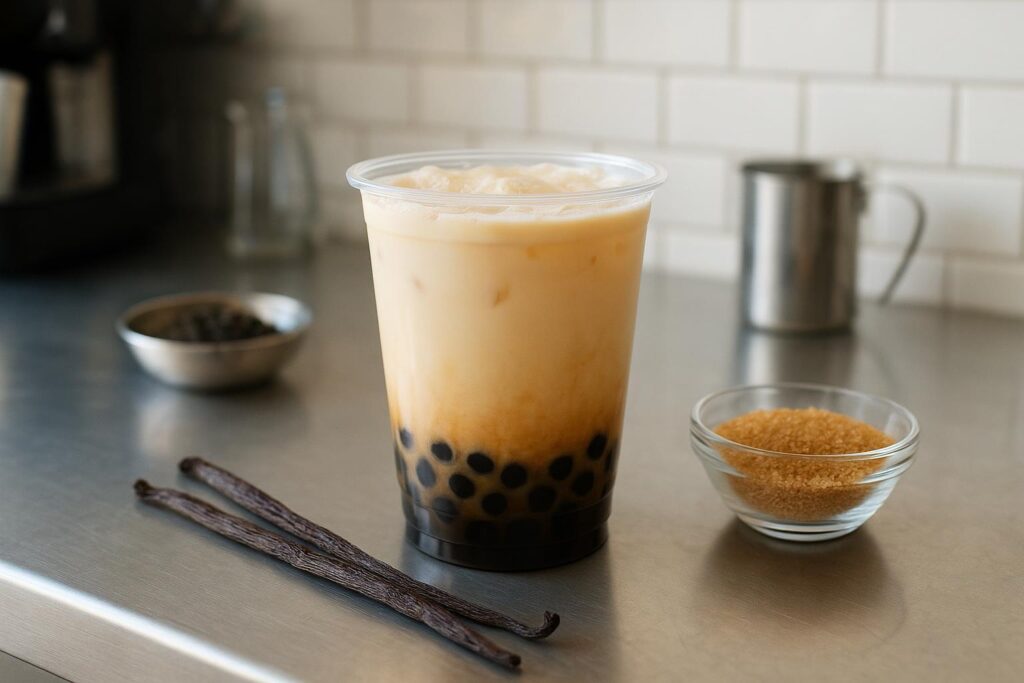
1) What black tea are you using?
Most shops use a black tea that can stand up to milk: Assam, Ceylon, English Breakfast blends, or similar.
Your goal is not “the most delicate tea.” Your goal is a base that still tastes like tea after you add:
milk or creamer
vanilla flavoring
sweetener
ice
toppings
Pro Tip: If your tea base tastes perfect on its own but disappears once you build the drink, the fix is usually a stronger tea base—not extra vanilla.
2) What milk system are you using?
You can build vanilla milk tea with:
fresh dairy milk (clean, familiar)
plant milk (oat tends to read “creamy” without tasting nutty)
non-dairy creamer (consistent, shelf-stable, common in many milk tea builds)
Milk choice changes mouthfeel and how vanilla reads. If you want a deeper dive on options operators use, reference BubbleTeaSuppliers.com’s guide to milk for boba tea shops.
3) What vanilla format fits your workflow?
This is the decision that most affects speed and consistency.
Here are the common options:
Vanilla syrup (fastest in service)
Best for: speed-of-service, consistent flavor, easy training
Tradeoff: syrup adds sweetness, so it changes your sugar math
Vanilla extract (clean flavor control)
Best for: a clean vanilla note without extra sweetness
Tradeoff: staff must measure accurately; too much can taste sharp or “boozy”
Vanilla powder (strong, shelf-stable)
Best for: high-volume batching, no added liquid
Tradeoff: needs proper dispersion (especially in cold liquids). Powder is typically more concentrated than extract; D’Adora Vanilla notes powder vs extract use-case differences in their guide (2025).
Vanilla paste / vanilla bean
Best for: premium positioning (“real vanilla bean”)
Tradeoff: cost, prep time, and sourcing consistency
For most shops, the practical choice is vanilla syrup for speed or vanilla extract for control.
How to brew black tea for milk tea (without bitterness)
Vanilla milk tea lives or dies on the tea base. If the base is harsh, vanilla turns “candley.” If the base is weak, vanilla turns “watery.”
The core rule: build strength with tea quantity, not steep time
A lot of bitterness comes from over-steeping. A better approach is:
keep steep time in a safe range
increase the amount of tea (or use a stronger blend)
That same idea is emphasized in The Flavor Bender’s black tea & milk tea guide (2025): control steep time to reduce bitterness, and adjust strength with more tea.
Starter steeping targets (for shop testing)
Use these as starting points, then dial in based on your tea and your desired “tea-forward” level:
Water temp: near-boiling for most black teas
Steep time: typically 3–5 minutes
Taste test: the base should taste slightly stronger than you’d serve as plain iced tea
⚠️ Warning: Don’t “fix” weak milk tea by steeping longer and longer. That usually creates a bitter base that staff will then over-sweeten to hide.
Start with a tea-to-milk ratio, then tune it
Most shop problems with vanilla milk tea aren’t “wrong ingredients.” They’re ratio drift.
A simple, workable starting point is a 2:1 tea-to-milk ratio, then adjust for your desired creaminess and tea strength. That’s the baseline recommended in BubbleTeaSuppliers.com’s tea-to-milk ratio guide (2025).
In other words, treat it like a milk tea tea-to-milk ratio system you can train, measure, and repeat (instead of a “recipe” each barista interprets differently).
Here’s how to tune from there:
Too thin / watery → use a stronger tea base, reduce ice slightly, or increase milk modestly (depending on what “thin” means to your customers)
Too bitter / astringent → shorten steep time or change tea, then re-test; don’t just add more sugar
Vanilla is weak → increase vanilla slightly after you confirm the tea base is strong enough
Vanilla milk tea SOP (classic: black tea + vanilla)
This SOP is designed for consistency and training. It gives you a starting recipe you can scale, plus the “adjustment knobs” so your staff knows what to do when the drink is off.
SOP overview
Build type: classic vanilla milk tea (black tea + vanilla)
Format: works as made-to-order or as a batch base
Best use: iced vanilla milk tea with tapioca pearls
Step 0: Set your standards (do this once)
Decide and document:
your cup size (e.g., 500 ml / 700 ml)
your ice standard (full / normal / less)
your sweetness levels (0 / 25 / 50 / 75 / 100%)
your default milk system (dairy, oat, creamer)
your vanilla format (syrup or extract)
If you don’t standardize these, every “recipe” becomes a moving target.
Step 1: Brew a strong black tea base
Brew black tea using your chosen tea and a controlled steep time.
Strain or remove bags immediately when the timer ends.
Cool the tea base if you’re building iced drinks (hot tea + cold milk can create a cooked flavor).
QC check: Tea base should taste a little stronger than you’d want to drink plain.
Step 2: Choose one vanilla method and stick to it
Pick one as your house standard.
Option A: Vanilla syrup (service speed)
Add syrup as part of your sweetener system.
Keep it consistent (one syrup, one pump size, one standard).
Option B: Vanilla extract (flavor control)
Measure carefully.
Start lower than you think and increase in small steps during recipe testing.
If you want a reference point for a vanilla-forward home recipe, The Fig Jar’s vanilla milk tea recipe (2024) uses both vanilla bean and extract. For shops, that’s more of a “premium inspiration” than a default.
Step 3: Build the drink (iced)
Add cooked tapioca pearls to the cup.
Add sweetener + vanilla (syrup or measured extract).
Add tea base.
Add milk.
Add ice to your standard fill line.
Shake or stir until fully mixed.
QC check: Color should be consistently creamy (no visible separation), and the first sip should read “tea first, vanilla second,” not the other way around.
Make it consistent in a bubble tea shop (batching + training)
If you’re running volume, the goal is to remove “eyeballing” from the system. That’s where bubble tea shop milk tea batching earns its keep: you standardize the base, then only customize at the last step.
Here are two practical patterns:
Batch the tea base only: brew and chill a strong tea base, then add milk + vanilla + sweetener per order.
Batch a sweetened tea base: make two versions (0% and 100% sweet) and blend to hit 25/50/75% without re-measuring sugar every time.
A common shop approach is to brew tea in bulk, mix in sweetener while warm so it dissolves, then chill and use throughout service; see Bossen Store’s shop milk tea workflow (2017).
Batching tip: If you batch anything, label it with brew time/date and train one “discard rule.” Consistency isn’t just taste—it’s process.
Pro Tip: If you batch anything, label it with brew time/date and train one “discard rule.” Consistency isn’t just taste—it’s process.
Troubleshooting: what goes wrong (and how to fix it)
“It tastes watery.”
Common causes:
tea base is too weak
ice dilution is too high
too much milk for the tea strength
Fix:
strengthen the tea base (more tea, same steep time)
confirm the ice fill line is consistent
re-test the ratio (start from 2:1 tea-to-milk)
“It tastes bitter.”
Common causes:
over-steeping
tea sitting too long at high temp
Fix:
reduce steep time and re-test
brew smaller, fresher batches during peak hours
“Vanilla tastes like perfume/candle.”
Common causes:
overdosing extract
adding vanilla to a harsh/bitter base
Fix:
lower vanilla dose first
then fix the tea base (bitterness often amplifies the wrong side of vanilla)
“The flavor isn’t consistent across shifts.”
Common causes:
staff eyeballing measurements
different ice habits
different “sugar level” interpretations
Fix:
standardize measuring tools (pumps, jiggers, scoops)
lock ice lines
write a one-page build card and train to it
Simple menu positioning ideas
If you’re introducing vanilla milk tea, keep the description simple and familiar:
“Classic black milk tea with a smooth vanilla finish.”
“Creamy vanilla milk tea (choose dairy or oat milk).”
You can also offer it as a “gateway” drink:
“If you like vanilla lattes, start here.”
FAQ (quick operator answers)
Is vanilla milk tea just milk tea with vanilla?
Yes—functionally it’s classic milk tea with a vanilla flavor layer. The operational difference is you need a consistent vanilla format and a tea base strong enough to carry the flavor.
What’s the easiest vanilla format for a bubble tea shop?
For most shops, vanilla syrup is the easiest during service because it’s fast and consistent. Extract can work well too, but it requires tighter measuring.
Can I make it dairy-free?
Yes. Oat milk is often the closest to “classic creamy,” but you can also use soy, almond, or coconut depending on your customer base and flavor goals.
How do I stop it from tasting watered down?
Start by strengthening the tea base (more tea, not more steep time), then verify your ice line and tea-to-milk ratio.
Next steps
If you’re building out your milk tea lineup, BubbleTeaSuppliers.com has a few operator-friendly resources worth bookmarking—start with their tea-to-milk ratio guide and their classic vs brown sugar vs Thai milk tea comparison linked earlier in this article.