
Every summer it happens the same way. Your fruit tea lineup that carried you through spring starts reading as tired by mid-June, customers scroll past it, and you know a seasonal item is the cheapest piece of new-product development you have. The problem is picking one that sells in a three-month window, runs fast enough at peak, and does not leave you with a case of something nobody ordered.
Watermelon jasmine tea is one of the few summer builds that answers all three. It uses a base you already brew, a fruit component you can dose by the gram, and toppings that are probably already on your bar. This is not a single recipe — it is a menu direction, with the variations, specs, and trade-offs you need to decide whether it deserves a slot.
Why Watermelon Jasmine Tea Is Worth a Slot This Summer
Fruit flavors are not a niche inside bubble tea anymore. They are the largest single flavor segment, and one 2025 flavor ranking put the fruit category’s annual growth at roughly 8.2% across flavors including watermelon. That growth is coming from customers who want something lighter than a milk tea, which is exactly the space a jasmine base occupies.
The second reason is seasonal mechanics. Watermelon behaves less like a permanent menu flavor and more like a limited-time offer that creates urgency and pulls repeat visits during a defined window, according to customer segmentation research on boba shop demand patterns. That is the useful part: a seasonal watermelon drink gives you a marketing event without a permanent menu commitment.
Wholesale order data backs the demand side. Reviewing Q1–Q2 2026 orders, the top summer flavors ranked mango, strawberry, watermelon, passion fruit, peach, and lychee, and for summer-limited items June through August accounts for more than 70% of annual shipments. Demand is real, but it is compressed — which is the argument for building the drink around speed and pre-portioning rather than a slow, hand-built prep.
One more signal worth noting. Trade reporting through 2026 shows customers stepping back from extreme sweetness toward lighter, less cloying drinks, a shift framing cleaner and lower-burden beverage formulations as the 2026 direction. A jasmine green base with a moderate fruit dose lands right on that preference. A heavy milk-and-syrup build does not.
What Watermelon Jasmine Tea Actually Is
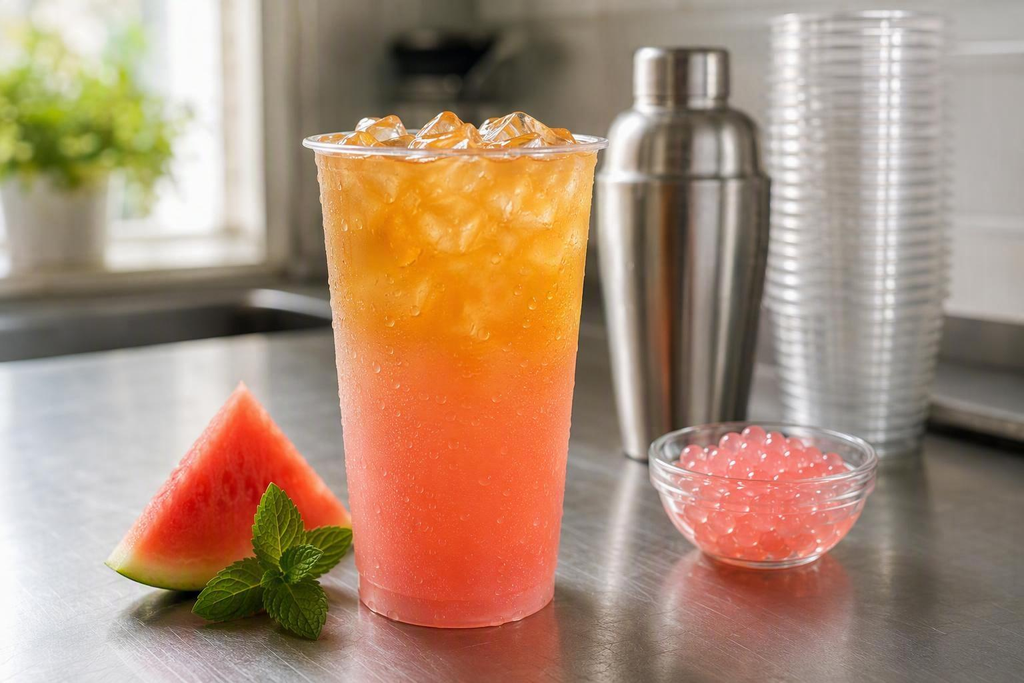
Watermelon jasmine tea is a chilled fruit tea built from three parts: a watermelon component that supplies the fruit, a lightly brewed jasmine green tea that supplies the aroma and structure, and ice, which supplies both the chill and a controlled amount of dilution. It is not a milk tea. When dairy enters the picture at all, it usually arrives as a foam layer on top rather than as the body of the drink.
That distinction matters operationally. A jasmine green base is floral, delicate, and volatile — it will not hold up against a heavy creamer the way a black tea base does, and it does not need to. The tea’s job here is to give the watermelon a spine, so the drink tastes like tea with fruit in it rather than fruit juice with a tea label.
Pro Tip: Brew the jasmine base stronger than you would serve it hot, then chill it completely before building any drink. Ice, fruit, and toppings all dilute the finished cup, and a hot base will flatten the melon aroma instead of lifting it.
Start With the Jasmine Base
The base is where most watermelon drinks quietly fail. Jasmine green leaf is more sensitive than black tea to both temperature and time, and the standard parameters are narrow: roughly 175–185°F, a steep of two to three minutes, and around 2 grams of leaf per 240 ml of water for a drinking-strength cup.
In a shop setting you are brewing for volume, not for a single cup, and a commercial batch baseline of about 1 gram of leaf to 40 ml of water by weight keeps your pour cost predictable while still leaving room for fruit and ice. If the finished drink tastes thin, the fix is more leaf, not a longer steep. Over-steeping brings tannin bitterness well before it brings more jasmine, and bitterness does not pair well with melon.
Hold the brewed tea chilled in a sealed container and rotate it within the same day. Jasmine aroma fades faster than most people expect, and a day-old base will make even a well-dosed drink taste flat. If you are comparing base options for the rest of the lineup, this jasmine milk tea ingredient guide walks through how tea, sweetener, and dairy components interact on the same base.
Pick Your Watermelon Component Before You Pick a Recipe
This is the decision most menu planners skip, and it determines your bar speed, your waste, and your margin more than any flavor choice does. Watermelon arrives in four usable formats, and they behave very differently.
| Format | Consistency | Prep per drink | Storage / shelf life | Cost tier | Best for |
|---|---|---|---|---|---|
| Powder | High, when dissolved correctly | Fast once dissolved into a batch base | Long, dry storage | Low | High-volume bars, batched bases |
| Concentrate / syrup | High | Fastest — pour and measure | Long, ambient or chilled per spec | Low to moderate | Chains, consistent repeat builds |
| Puree | Moderate — can settle | Moderate, needs measuring by weight | Frozen or chilled, limited window | Moderate to high | Fruit-forward, premium positioning |
| Fresh fruit | Low — varies by ripeness | Slowest, plus prep and waste | Short, daily prep | Highest with labor and waste | Limited premium builds and garnish |
The useful rule is that format choice is a labor decision disguised as a flavor decision. Powder and concentrate let you pre-build a sweetened base once per shift and pour drinks in seconds. Puree buys you a more natural fruit profile and charges you in upfront measurement time. Fresh fruit buys you visual credibility and charges you in daily prep, seasonal variance, and waste.
If you are weighing the top two options against each other, this comparison of fresh fruit versus concentrate for fruit tea covers the shelf-life and labor trade-offs in detail, using mango as the worked example — the logic transfers directly to watermelon.
⚠️ Warning: Dosing fruit by the spoon is the single most common cause of a watermelon drink that tastes great on your test bar and watery on a Tuesday night shift. Fruit goes in by weight, on a scale, every time.
The Master Build Spec
Once the format is fixed, write the build down and stop improvising. The table below is a starting point for a standard fruit tea, not a mandate — adjust the sweetener tier to match the rest of your menu so the drink sits in the same sweetness family as everything else you sell.
| Component | 16 oz | 22 oz | 24 oz | Notes |
|---|---|---|---|---|
| Watermelon puree | 35–50 g | 50–70 g | 55–75 g | Reduce added sugar when using puree |
| Watermelon syrup / concentrate | 30–40 ml | 40–55 ml | 45–60 ml | Already sweetened — drop the sugar tier |
| Chilled jasmine green tea | 150–220 ml | 200–280 ml | 230–300 ml | Brewed strong, fully chilled |
| Sugar (house tier) | 0 / 30 / 50 / 70 / 100% | same tiers | same tiers | Start at 50% with puree, lower with syrup |
| Ice | To the marked shaker line | To the line | To the line | Over-icing is the main dilution risk |
| Shake | 10–15 seconds, hard | same | same | Until the shaker body frosts |
For a concentrate-based build, one published dosage ladder from a shop-supply source runs 20–25 ml for a 350 ml cup, 30–40 ml for 500 ml, and 40–50 ml for 700 ml — useful as a cross-check that your own spec scales sensibly with cup size rather than roughly by eyeball.
Lock the Build Order
Build order is not aesthetic. It determines whether the fruit integrates or settles, whether the sugar dissolves, and whether two staff members produce the same cup. The sequence below is the working standard across commercial fruit tea SOPs.
- Fruit component first. Watermelon puree or syrup goes into the shaker before anything else, so it has the most contact time with the liquid.
- Sweetener second, if your house recipe calls for it. Skip or reduce this step when the fruit component is pre-sweetened.
- Chilled jasmine tea third. Pour it in and let it begin lifting the fruit off the bottom of the shaker.
- Ice to the marked line last. Ice before liquid is how drinks end up accidentally light.
- Shake hard for a counted 10–15 seconds, until the outside of the shaker frosts.
- Pour and top. Add toppings only if the format you chose calls for them.
The same sequence governs a sibling drink in the jasmine family, and you can see the order discipline applied to a jasmine-based fruit tea with guava and lychee as the worked examples. If your team can hold that pattern for one drink, they can hold it for the whole fruit tea category.
Six Watermelon Jasmine Tea Variations Worth Running
These are grouped by how they behave on a real menu rather than by flavor. Each one names the trade-off, because a variation that sells well and takes 40 seconds is a different business decision from one that sells well and takes 90.
1. The Straight Build — Fastest, Lowest Risk
Watermelon component, jasmine tea, sugar tier, ice. Nothing else. This is the variation you should launch first, because it sets your baseline cost and your baseline speed, and because every other idea on this list is a modification of it. Batching the fruit component into a sweetened base once per shift cuts build time to under 20 seconds.
Trade-off: it is not visually remarkable. If your customers photograph their drinks, this build depends on the cup and the garnish, not on the liquid.
2. Watermelon Strawberry — The Volume Play
Strawberry is the most commonly co-listed pairing with watermelon on US fruit tea menus, and it is easy to see why: strawberry brings tartness that a ripe watermelon lacks, so the drink reads as more complex without needing more sugar. Run watermelon as the base component and strawberry as roughly a third of the fruit dose, then pull the sugar tier down a step.
Trade-off: two fruit components means two pre-portion lines. If your bar is tight on space, pre-blend the two into a single batch base instead of dosing twice.
3. Watermelon Lychee — The Floral Multiplier
Lychee and watermelon appear together often on fruit tea menus, and on a jasmine base the combination compounds rather than competes — the lychee’s floral notes sit alongside the tea’s rather than fighting it. Use watermelon as the volume component and lychee syrup as an aromatic accent at roughly half the watermelon dose.
Trade-off: lychee syrup is sweet, so this build sits noticeably sweeter than the straight version at the same sugar tier. Test it one tier lower.
4. Watermelon Lime — The Brightener
A little acid fixes the most common complaint about watermelon drinks, which is that they taste watery. Lime or lemon at 10–15 ml per cup sharpens the melon and makes the drink read as more refreshing at the same fruit dose. This is also the build that holds up best when the fruit component itself is on the weak side.
Trade-off: citrus is the one addition that can make a jasmine base taste thin if overdone. Measure it, do not squeeze it in.
5. Watermelon Citrus Fizz — The No-Tea-Equipment Build
A published sparkling build pairs 40 ml watermelon concentrate with 15 ml fresh lemon juice and 200 ml sparkling water over konjac or aloe cubes. On a jasmine menu, the natural move is a split base: half jasmine tea, half sparkling water, which keeps the tea identity while adding the fizz.
Trade-off: carbonation needs a different cup, lid, and a faster serve window. This is a dine-in or immediate-consumption drink, not a delivery one.
6. Watermelon Cheese Foam — The Premium Tier
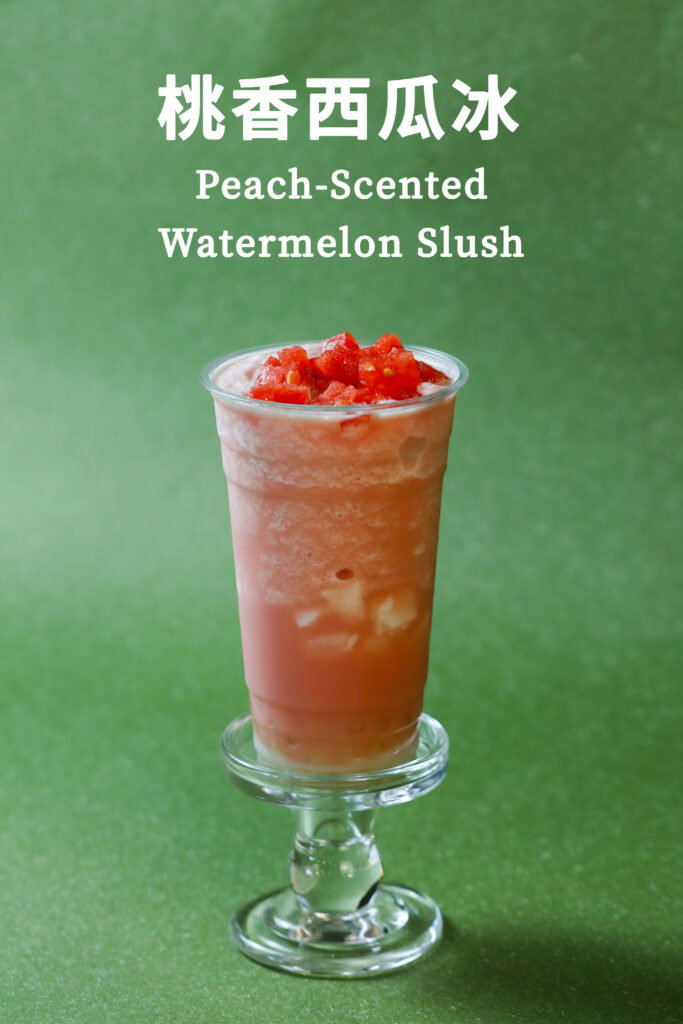
Cheese foam turns a light fruit tea into a two-texture drink and supports a higher price point. Watermelon fruit tea with a cheese foam cap is an established menu concept in the category, not an experiment. Build the tea slightly lower in the cup so the foam sits above the liquid line.
Trade-off: cheese foam adds a prep station and a perishable component to a drink that was previously shelf-stable. Only run it if you already keep foam on the bar for other drinks.
Toppings That Fit Watermelon Jasmine
Topping choice matters more for fruit tea than for milk tea, because the classic tapioca pearl does not hold its texture well in a light, chilled, low-sugar drink.
| Topping | Fit with watermelon jasmine | Operational note |
|---|---|---|
| Popping boba | Strong — watermelon popping boba is explicitly marketed as a match for watermelon or mango fruit tea | Long hold, no texture decay window, high perceived value |
| Cheese foam | Strong — established as a watermelon fruit tea build in the category | Adds a prep station and a perishable component |
| Milk foam | Moderate — appears on US menus as a topping on watermelon green tea drinks | Lighter than cheese foam, cheaper, less distinctive |
| Crystal boba / konjac | Moderate — fits the light fruit tea profile; published builds use around 40 g per 500 ml cup | Long hold, neutral flavor, adds chew without heaviness |
| Basil seeds | Moderate — paired with watermelon and mint in combination guides | Very low cost, but a texture some customers dislike |
| Classic tapioca pearls | Weak for this drink | Chewiness drops faster than the drink’s hold time |
For more pairing logic across the fruit category, including which tea bases match which fruit weights, this fruit bubble tea combinations guide is a useful companion to the six builds above.
Make It Repeatable Before You Make It Popular
The gap between a drink that works on your test bar and a drink that works across three shifts is entirely process. Four habits close it, and none of them require equipment you do not already own.
- Pre-portion the fruit component. Squeeze bottles with a measured pump, or pre-dosed cups lined up at the start of the shift. This removes the single largest source of cup-to-cup variance.
- Use a scale, not a ladle. Weigh the fruit component and the sweetener. Volume measures drift with viscosity, especially with purees.
- Fix the ice line. Mark the shaker. A consistent ice line produces a consistent finished volume after dilution, which is what actually determines how the drink tastes.
- Count the shake. Ten to fifteen seconds, out loud if you have to. Shake time changes both chill and aeration, and both change perceived sweetness.
These are the same habits that keep a milk tea program stable across a multi-person bar, and the consistency habits for a boba tea shop in that SOP give the full version of the workflow if you want to standardize the whole menu, not just this drink.
What Goes Wrong, and What to Do About It
| Problem | Root cause | Fix |
|---|---|---|
| Drink tastes watery, especially in the last third | Over-icing at build, plus a long hold before pickup | Fill to the marked ice line; if the drink is going out the door, shake with ice and strain before sealing |
| Melon flavor never shows up | Underripe or over-chilled fruit, or too little fruit for the ice load | Dose fruit by weight; move to a concentrate or powder for repeatable intensity; keep fruit at room temperature until build |
| Drink looks separated | Fruit density is higher than the tea; a layered build separates by design | Shake to integrate for standard service; reserve layering for photographed or dine-in builds only |
| Bitter, drying finish | Jasmine green over-steeped or over-dosed | Cap the steep at two to three minutes; keep water at 175–185°F; add aroma with leaf dose, not steep time |
| Two staff members make two different drinks | Spooned syrup, eyeballed puree, variable shake | Pre-portion, weigh, mark the ice line, count the shake |
| Topping loses its texture | Classic tapioca pearls held past their window | Switch to popping boba, crystal boba, or another long-hold topping for fruit tea |
| Flavor swings week to week | Fresh watermelon ripeness and sugar content vary | Keep the repeatable spec on a stable fruit format and use fresh fruit as a garnish or premium build only |
What to Charge, and What Actually Drives the Cost
Fruit tea is not a milk tea with a different flavor shot. It carries a structurally different cost profile, and pricing it like a milk tea is how a seasonal launch ends up with thinner margin than the drink it replaced.
US shops price standard fruit tea broadly in the range of about $3.50 to $5.00, with metro and premium-positioned shops running roughly $5.50 to $7.50 depending on size and add-ons, based on 2026 US price-band data across shops. Seasonal fruit launches are frequently positioned above the everyday menu — a 2026 NYC roundup documented a premium summer watermelon series priced consistently at $7.49 across the line — because the seasonality itself justifies the tier.
On the cost side, the structure matters more than any single number:
| Component | Share of cup cost | How a watermelon build moves it |
|---|---|---|
| Jasmine tea base | Lowest line item | The base is not where your money goes |
| Fruit component | Largest and most volatile | Puree and fresh fruit cost materially more than powder or concentrate |
| Sweetener | Small | Falls when the fruit component is pre-sweetened |
| Toppings | Moderate, highly variable | Popping boba and cheese foam add cost and add perceived value |
| Cup, lid, straw, seal | Small but fixed | Any topping requires a wide straw |
Pro Tip: Run your own numbers before you set the menu price. Published per-cup cost figures vary widely by supplier and order volume, and most leave their assumptions out. Treat them as a structure to fill in with your own invoice, not a benchmark to copy.
Two practical levers follow from that structure. First, share the toppings: every option on the list above is probably already on your bar for other drinks, so the variation set costs you no new inventory. Second, match the format to the price tier — a concentrate build at a standard fruit tea price protects margin, while a fresh-fruit build belongs at a premium tier where the labor and variance are paid for.
The Editor’s Take
If you are adding exactly one item this summer, run the straight build with popping boba and put your energy into making it fast and identical every time. It has the lowest ingredient cost, the shortest build time, and the widest customer appeal, and it gives you a baseline to compare every other variation against.
If you have room for two, add the watermelon strawberry version. It is the most commonly co-listed pairing in the category, it corrects watermelon’s main weakness — insufficient acidity — and it photographs well enough to carry a social post without extra work.
Save the cheese foam and the sparkling version for a second season. Both are good drinks, and both add prep stations or serve-window constraints that a first-year summer launch does not need.
FAQ
What does watermelon jasmine tea taste like? It tastes like a light, floral iced tea with fresh melon on top — the jasmine supplies aroma and a slightly dry finish, and the watermelon supplies sweetness and body. It is noticeably lighter than a milk tea and sits in the same refreshment space as a strawberry or lychee green tea.
Is watermelon jasmine tea a milk tea? No. It is a fruit tea. Jasmine green tea is the base and the watermelon is the flavor, with no dairy in the body of the drink. If you want a creamy version, add a milk foam or cheese foam cap rather than a full milk build, which overwhelms a delicate green base.
How much watermelon should go into a 16 oz cup? As a starting point, 35–50 grams of puree or 30–40 milliliters of syrup or concentrate, alongside 150–220 milliliters of chilled jasmine green tea. Purees are less sweet than syrups, so keep the added sugar tier higher with puree and lower with syrup.
Why does my watermelon drink taste watery? Two causes, usually together. Too much ice at build dilutes the drink as it melts, and too little fruit component for the ice load means the ratio never had enough fruit to begin with. Mark an ice line on your shaker, dose fruit by weight, and cut the ice rather than adding more syrup.
What topping works best with watermelon jasmine tea? Popping boba is the strongest fit, and watermelon popping boba is specifically marketed for watermelon fruit tea. Crystal boba and cheese foam also work well. Classic tapioca pearls are the weakest choice, because their chewiness declines faster than the drink’s serve window.
Can I use fresh watermelon instead of a concentrate? Yes, and it produces the most natural flavor. It also adds daily prep, seasonal variance between batches, and waste, which makes it a better fit for a limited premium build or a garnish than for a high-volume everyday drink. Many shops run a stable fruit format for the base spec and save fresh fruit for the visual layer.
Is watermelon jasmine tea a summer drink only? In practice, yes — it is built and marketed as a warm-weather fruit tea, and the strongest demand sits in a June-through-August window. The build itself works year-round, but the menu case for it is seasonal, which is why an operator can test it as a limited-time offer before committing to a permanent slot.
Next Steps
Decide the format first, because it sets your labor, your waste, and your price tier before a single drink gets made. Then write the spec down, mark your ice line, and pre-portion the fruit component.
Before you lock next season’s spec, review the brand’s technical guides on the jasmine base and on fruit component formats — they cover the ingredient-level trade-offs behind every choice in this post, and they will save you a test-and-throw-away cycle.