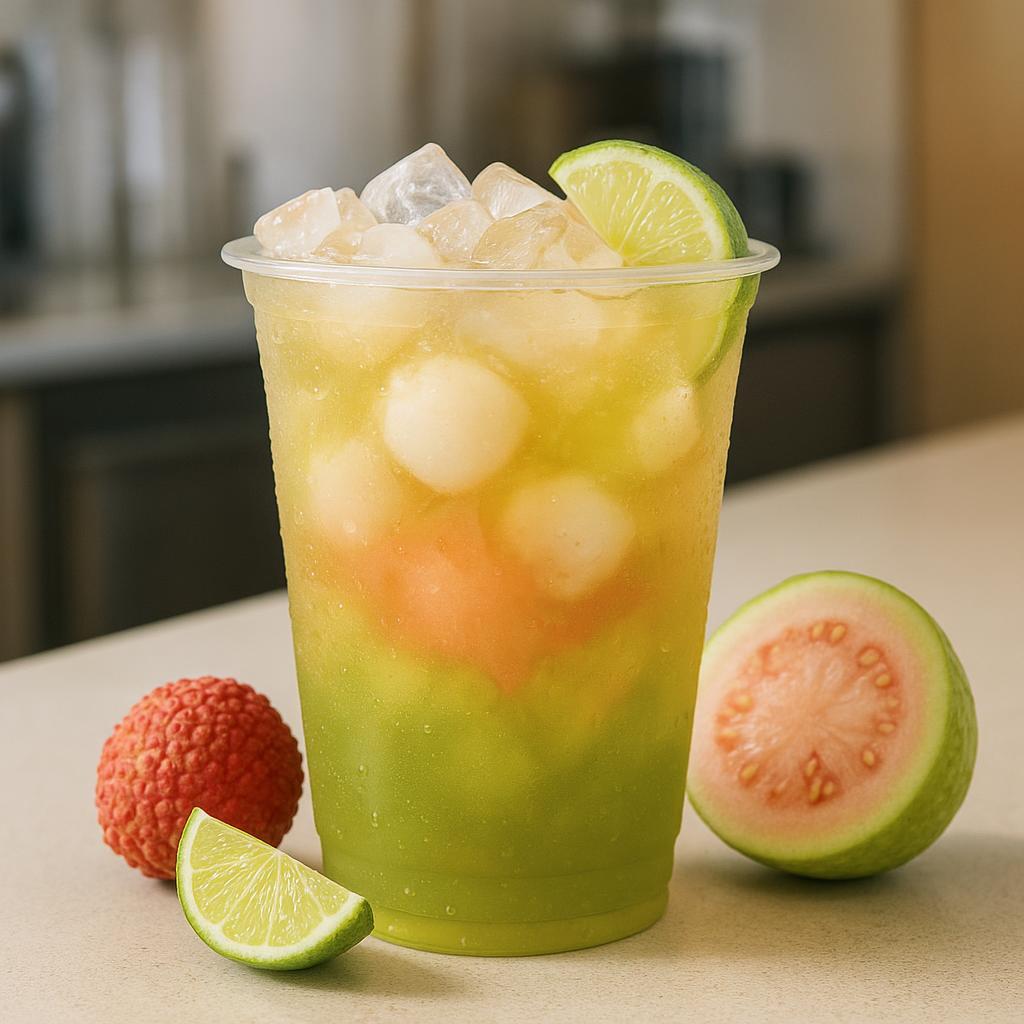
Lychee brings a clean, floral sweetness. Guava brings body and a tropical “roundness.” A bright green tea base keeps the whole drink crisp instead of candy-sweet.
If you’re building a summer fruit tea menu, iced lychee guava green tea is an easy seller because it tastes familiar (tropical fruit) but still feels “tea-forward” and refreshing.
This guide is written as a shop SOP: ingredient options, batch prep, a standardized build for 16 oz and 24 oz cups, plus QC checks so it tastes the same across staff and shifts.
What makes iced lychee guava green tea work (and how shops mess it up)
Most versions fail for one of three reasons:
Weak tea base → the drink tastes like melted fruit syrup water once the ice melts.
No sweetness system → staff free-pours, customers get inconsistent drinks, reviews get weird.
No batch-prep rules → the first drink is great and the last drink tastes flat or “off.”
The fix is simple: brew a stronger green tea base, control dilution with an ice line + shake time, and standardize fruit components by weight or measured pumps.
Ingredients + options (choose what fits your prep speed and margin)
Below is the operator-friendly breakdown. Use what your shop can execute consistently.
Tea base
Green tea or jasmine green tea (recommended for floral lift)
Filtered water
Ice
If you want a jasmine-style profile, consider using a jasmine green tea like Jasmine Snow Bud Tea
as your base.
Pro Tip: Fruit tea lives or dies on the base. If your tea is already a little bitter hot, it will taste more bitter once chilled and shaken. Dial tea quality first.
Lychee component (pick one)
Lychee syrup (fastest, most consistent)
Canned lychee + a little of the can syrup (more texture, a “real fruit” cue)
Lychee jelly (adds chew; turns the drink into a topping-forward menu item)
Operational note: Canned lychee is great, but it requires a strict open-date label and a clean fruit station workflow. If your staff is stretched, syrup is the safer SOP.
Guava component (pick one)
Guava syrup (fast, consistent, brighter)
Guava puree (more body, more “smoothie-like” mouthfeel)
If you use puree, you’ll usually need less total sweetener because puree often brings its own sugar and thicker texture.
Sweetener (if your fruit components aren’t already sweet enough)
Simple syrup (1:1)
Fructose
Cane sugar syrup
Optional add-ons (sell-up without changing the core recipe)
Lychee popping boba
Coconut jelly
Aloe
Basil seeds (only if your customer base already likes the texture)
SOP: Brew a dilution-proof green tea base
A fruit tea base should be brewed stronger than a typical “drink it straight” cup of tea because the final build gets diluted by ice and fruit components.
Step 1 — Brew your green tea correctly
Inputs
Green tea leaves
Water at ~175–185°F (80–85°C)
Action
Brew green tea with hot (not boiling) water. Green tea is commonly brewed cooler than black tea to avoid harsh bitterness; for boba-style drinks, a typical guidance range is around 80–85°C (175–185°F) per Edible Brooklyn’s guide to boba tea (green tea temperature range).
Output
Strong green tea base with clean aroma (not astringent).
Done when…
The tea tastes slightly stronger than you’d drink plain, but not bitter.
Step 2 — Chill fast and hold safely
Action
Cool tea quickly (ice bath or shallow pans) and move to cold storage.
Label with: tea type, brew time, discard time, staff initials.
Done when…
Tea is fully chilled before service builds.
Food safety note: Follow the FDA guidance on the “two-hour rule”
for foods/beverages that require temperature control—don’t leave brewed tea sitting at room temperature for extended periods. For additional tea handling and sanitation reminders, see Iowa State University Extension guidance on brewing tea safely
This is where “tastes great” becomes “tastes the same every time.”
Option A (fastest): Syrup-only batch
Best for: high volume, small prep team, tight consistency needs
Keep lychee syrup and guava syrup in labeled bottles
Use measured pumps or a jigger (no free pour)
Done when…
A new staff member can build it correctly on the first try.
Option B (premium cue): Canned lychee batch
Best for: shops selling “real fruit” cues
Inputs
Canned lychee
Sanitized container
Action
Drain lychee, saving a portion of the can syrup separately.
Portion lychee pieces into a labeled container.
Outputs
Ready-to-scoop lychee pieces
Measured lychee syrup portion for controlled sweetness
Done when…
Lychee pieces are consistently sized, stored cold, and dated.
⚠️ Warning: Fruit stations are where cross-contamination happens. Use clean utensils, don’t double-dip, and date everything. When in doubt, discard.
Option C (body-forward): Guava puree
Best for: a richer “nectar” mouthfeel
Keep puree refrigerated and use a dedicated ladle or measured pump
Stir or shake puree before service if separation occurs (follow manufacturer directions)
The build: iced lychee guava green tea (16 oz + 24 oz)
This is the core SOP section. Train staff on these builds, then let customers adjust sweetness using a percentage system.
Standardize your sweetness system first
Many boba shops use a 0% / 25% / 50% / 75% / 100% sweetness system to standardize recipes and customization (see Tasting Table on bubble tea sweetness levels
).
For operations, that system works best if you define one baseline: your “100%” syrup amount. Then everything else is a straight scale-down.
Suggested SOP baseline (adjust after taste test):
16 oz: 100% sweetness = 40 mL total sweetener (including fruit syrups and/or simple syrup)
24 oz: 100% sweetness = 55–60 mL total sweetener
If your lychee/guava components are already sweet (common), your “100%” may be entirely fruit-based with zero additional simple syrup.
16 oz SOP (fruit tea version)
Inputs
16 oz cup
Ice
Chilled green tea base
Lychee component (syrup or fruit)
Guava component (syrup or puree)
Optional topping
Action (numbered build)
Add fruit base to shaker:
Lychee syrup: 15–20 mL
Guava syrup: 15–20 mL (If using guava puree, start at 25–35 mL and reduce syrup.)
Add ice: fill shaker to standard ice line (train this visually)Done when… the ice line is consistent across staff.
Shake hard: 10–15 secondsDone when… the outside of the shaker frosts and the drink is fully chilled.
Add topping (optional) to cup:
1 scoop lychee popping boba or coconut jelly
Pour and serve
QC check
Color is bright (not watery-clear)
Aroma is tea + tropical fruit (not just sugar)
First sip has tea structure, finish is lychee/guava
24 oz SOP
Use the same build logic—don’t “wing it bigger.” Scale liquid + fruit components and keep the shake time consistent.
Starting point:
Lychee syrup: 20–25 mL
Guava syrup: 20–25 mL
Chilled tea: 320–380 mL
Ice: to the same relative ice line
Shake: 10–15 seconds
Troubleshooting (fix the issue without remaking everything)
Problem: Too watery after 5 minutes
Likely causes
Tea base too weak
Ice line too high
Hot/warm tea used (fast melt)
Fix
Chill tea before service builds
Brew a slightly stronger base (but avoid bitterness)
Set a visual ice line and enforce it
Problem: Bitter or drying finish
Likely causes
Green tea brewed too hot or too long
Tea held too long
Fix
Keep brew water in the 175–185°F range per Edible Brooklyn’s guide to boba tea (green tea temperature range)
Refresh tea more frequently and follow safe holding guidance like Iowa State University Extension guidance on brewing tea safely
Problem: Too sweet / “candy”
Likely causes
Fruit syrup + simple syrup both added at full amounts
Fix
Define 100% sweetness as a total sweetener cap
Offer 25/50/75% as defaults for fruit teas
Problem: Flat flavor (no “pop”)
Likely causes
Not enough acid
Fix
Add a tiny amount of citrus (lemon juice) only if it matches your menu style
Or switch to a more aromatic jasmine green tea base
Variations and LTO ideas (without retraining the whole team)
Once the SOP is stable, rotate one element at a time:
Lychee Guava Green Tea + Coconut Jelly (texture-forward)
Lychee Guava Jasmine Green Tea (more floral)
Lychee Guava Green Tea + Aloe (fresh, spa-like)
Sparkling Lychee Guava Green Tea (replace part of tea with sparkling water; shake gently)
If you’re collecting seasonal inspiration, browse the New Drinks
page and adapt ideas using the same SOP framework (standard ice line + measured fruit base + consistent shake).
Costing + prep-time notes (quick framework)
For MOFU readers, a simple costing framework helps decide whether to run this as a core menu item or a limited-time offer:
Count your “variable” ingredients (tea leaves, syrups/purees, toppings, cup/lid/straw).
Estimate per-drink usage from the SOP (mL of syrup, grams of tea, one scoop topping).
Add a waste buffer if you’re using canned fruit or puree (spoilage is real).
Decide your default sweetness (50% often reduces syrup usage and still tastes great).
Key Takeaway: The cheapest drink is the one you can execute consistently. A slightly higher-cost recipe that reduces remakes and bad reviews usually wins.
FAQ
Can I use black tea instead of green tea?
Yes—but it will read warmer, heavier, and less floral. If your goal is a bright, tropical fruit tea, green or jasmine green tea usually fits better.
Should I use guava syrup or guava puree?
If you want speed and a cleaner finish, choose syrup. If you want body and a thicker fruit presence, choose puree—then reduce other sweeteners accordingly.
How do I keep this consistent across staff?
Use three controls: a measured fruit base (mL or pumps), a visual ice line, and a fixed shake time. Add a quick QC sip check at the start of each shift.
How long can brewed tea sit out?
For food safety, avoid leaving brewed tea at room temperature for extended periods; follow the FDA guidance on the “two-hour rule” and shop-safe tea handling guidance like Iowa State University Extension guidance on brewing tea safely.
Next steps
If you want to turn this SOP into a consistent menu item, make one decision this week: syrup-only (fastest) or canned-lychee + syrup (premium cue)—then train the whole team on the same ice line and sweetness system.
When you’re ready to stock a jasmine-green-tea base or gather seasonal drink ideas, you can start with Jasmine Snow Bud Tea and the shop’s New Drinks collection for inspiration.