
If you’ve ever watched a bubble tea line stall because one item takes “just a minute longer,” you already know the real risk of adding desserts. The concept isn’t the hard part. The workflow is.
This SOP is built for US boba shop operators who want to run bubble waffles (Hong Kong egg waffles) inside a boba tea shop without wrecking ticket times, consistency, or staff sanity.
What “boba waffle” usually means in a boba shop
In most US shops, “boba waffle” is shorthand for a bubble waffle/egg waffle served as:
a warm, hand-held dessert (often folded into a cone)a plated dessert with toppingsor a drink-adjacent add-on you can bundle with milk tea
Operationally, bubble waffles are different from pre-baked pastries: the texture is best when they’re fresh, and they don’t forgive long holding. A crisp shell turns soft fast if you trap steam.
Prerequisites (what you need before you sell the first waffle)
Think of this like opening a mini hot line inside your drink bar. If you can’t staff or stage it, the waffle will become a bottleneck.
Equipment: choose for consistency, not novelty
Minimum equipment
Commercial bubble waffle iron (electric recommended for repeatability)Wire cooling rack(s)Portioning tool: spouted pitcher, ladle, or squeeze bottle (whatever makes your pours consistent)Timer system (built-in timer or external)Heat-safe release tools (tongs/spatula) and a heat-safe glove
Why this matters: Most “bad waffles” are process problems: inconsistent pours, inconsistent heat, and guesswork timing. A fixed timer and stable preheat removes a lot of that variability.
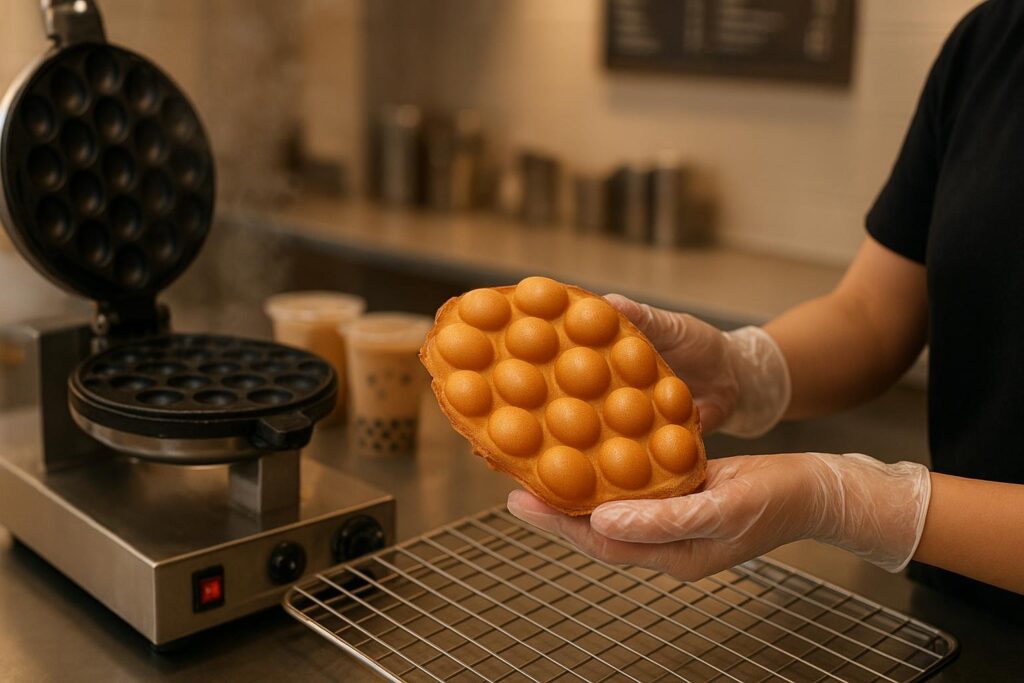
Station layout: keep raw batter away from finished desserts
You’re dealing with raw batter and a ready-to-eat dessert on the same counter. Set the station so staff don’t cross paths.
Cold zone (raw): batter container, portioning toolsHot zone: iron + heat-safe toolsDry zone (post-cook): wire rack for crispingFinish/pack zone: toppings, sauces, boxes, napkins
Done when: staff can complete a waffle without reaching over a finished product with a batter ladle.
Packaging: plan for steam
If you package a hot waffle in a sealed container, it will steam itself into softness.
Use packaging that vents, or stage the waffle on a rack briefly before boxing.Avoid stacking waffles directly on plates or in clamshells right off the iron.
Done when: a waffle stays acceptably crisp for the time it takes to hand it to the customer.
Bubble waffle SOP for a boba waffle in a boba tea shop (step-by-step)
This SOP is designed for training and shift consistency. Each step has an input, an action, and a verifiable output.
Step 1: Set your daily targets (throughput first)
Input: your expected peak orders per 15 minutes.
Action: decide how many irons you need and whether waffles are “made-to-order” or “short-hold.” Output: a clear service rule you can train.
A simple starting point:
One iron running continuously can become your dessert bottleneck.If you can’t commit to running the iron during rush, treat waffles as an off-peak item or limit availability.
Done when: you have a written rule like “waffles available 2–8pm” or “waffles pause during peak 6–7pm.”
Step 2: Mix batter in a way that stays consistent
Input: your house bubble waffle batter recipe.
Action: standardize mixing (same bowl, same whisk time, same batch size).
Output: batter that pours smoothly and cooks predictably.
Process controls that show up repeatedly in bubble waffle guidance:
Resting the batter can improve consistency; several egg waffle recipes advise refrigerating batter for about an hour before use (machine and recipe dependent), such as in Christine’s Hong Kong-style egg waffle notes.Bubble waffle issues are often driven by consistency, temperature, and dosage, as summarized in GoFrex’s guide to common bubble waffle mistakes (2025).
Practical shop rule:
If you batch batter ahead, label it with a “made at” time and a “discard by” time.If it separates in the fridge, quick-whisk to recombine before service.
Done when: two different staff members can cook the same batter batch and get the same color and crispness.
Step 3: Hold batter cold, stage a small working container
Input: batter batch in the walk-in/reach-in.
Action: keep the main batch refrigerated; pour a smaller working amount for the station.
Output: batter stays safe and consistent during service.
Why: batter is a high-risk cross-contact item and it warms up quickly on a counter.
Done when: the station has a small container that can be swapped out, not a huge tub that sits out all shift.
Step 4: Preheat and stabilize the iron (don’t start early)
Input: clean iron + power on.
Action: preheat until temperature is stable. Some commercial guidance recommends a full preheat period so plates stop “climbing” in temperature; many operators treat the first waffle as a calibration waffle.
Output: first sellable waffle is already at quality.
A useful reality check: correct temperature varies by machine. One bubble waffle mistake is treating one setting as universal. Use test waffles to lock your setting.
Done when: a test waffle comes out evenly browned without burning, and the timer matches the result.
Step 5: Oil lightly, consistently (especially after cleaning)
Input: preheated iron.
Action: apply a light, even oil layer according to your iron’s coating and manufacturer guidance.
Output: waffle releases cleanly without tearing.
Done when: the waffle releases with a controlled lift, not scraping.
Step 6: Portion batter by a fixed dose (no eyeballing)
Input: batter at workable temperature/consistency.
Action: pour the same amount every time.
Output: bubbles form evenly, no leaks, no thin spots.
Common failure modes:
Overfill = leaks, mess, inconsistent bubbles.Underfill = thin waffle that tears easily.
Done when: your staff can point to a line on the pitcher or a fixed ladle size.
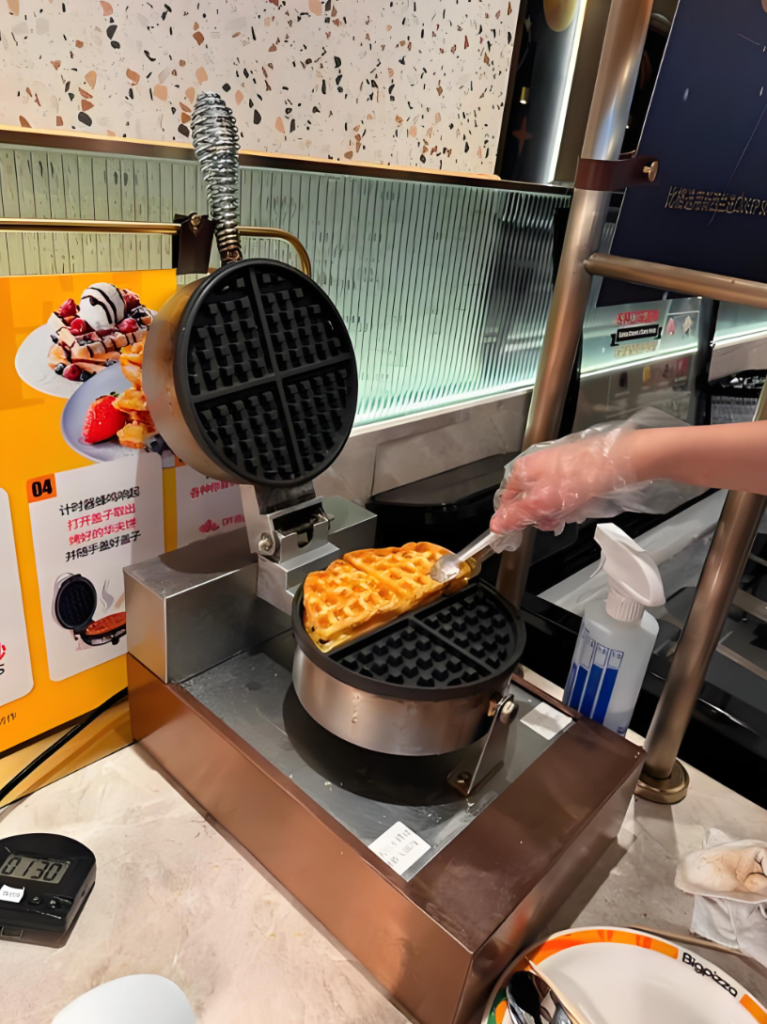
Step 7: Close, flip (if your iron requires it), and start the timer
Input: batter on plates.
Action: close firmly; flip/rotate as your iron design requires; start timer immediately.
Output: even bubble formation and consistent browning.
Cook windows vary, but many sources cluster around a few minutes. Use your own calibration.
Done when: staff do not “peek” early. The timer runs the station.
Step 8: Open at the right time, then release cleanly
Input: timer complete.
Action: open and release with heat-safe tools.
Output: fully cooked waffle with intact bubble structure.
GoFrex summarizes that wrong temperature and time are among the most common drivers of poor results, which is why the timer matters more than vibes (GoFrex 2025).
Done when: there’s no wet batter left on the plates and the waffle doesn’t collapse.
Step 9: Crisp-set on a wire rack (this is not optional)
Input: cooked waffle.
Action: move it to a wire rack so steam escapes.
Output: shell sets crisp instead of steaming soft.
Commercial crispness guidance consistently points to airflow and dry heat, and recommends serving waffles right after cooking; for service holding, it suggests dry heat options such as convection rather than sealed warming (commercial guidance on keeping waffles crispy during service).
Done when: waffles are never stacked straight off the iron.
Step 10: Finish fast, then serve (or short-hold with rules)
Input: waffle on rack.
Action: finish with toppings/sauces quickly, then hand off.
Output: the guest gets the texture you’re selling.
Short-hold rule of thumb:
If you must hold briefly during rush, hold on a rack in open air.Avoid sealed containers that trap steam.
Done when: your team knows the difference between “made-to-order” and “short-hold” and uses the same rule every shift.
Rush workflow (how to keep drink tickets moving)
If the iron and toppings are run by the same person who is also sealing drinks, your rush will break.
Two-person model (recommended)
Iron operator: batter, timer, release, rackFinisher/expo: toppings, boxing, handoff
Done when: the iron operator never leaves the iron unattended during a rush.
One-person model (only if volume is low)
If you must run it with one person:
limit waffle options (fewer toppings)throttle availability during peakprioritize drinks if the line spikes
Done when: you have a rule for pausing waffles rather than letting drink tickets pile up.
Quality gates (train these like drink specs)
These are the checkpoints that prevent “one bad staff day” from becoming your permanent reviews.
Heat gate: iron fully preheated and stable before the first sellable waffle.
Dose gate: fixed batter dose every time.
Time gate: timer-driven cooking; no early peeks.
Steam gate: rack crisp-set before finishing/boxing.
Cleanliness gate: no batter splatter in the finish zone.
Troubleshooting matrix (fast fixes during a shift)
Use this section as a staff reference. Fix the process, not the recipe, first.
Problem: waffle is pale, soft, or soggy
Likely causes:
iron not hot enough or not fully preheatedbatter too coldcook time too shortwaffle held/covered (steam trapped)
Fixes:
run a calibration waffle and adjust time/tempstage batter so it isn’t ice-coldenforce rack holding and avoid sealed containers
Problem: outside burns but inside seems undercooked
Likely causes:
heat too high for your machinebatter dose too large
Fixes:
lower temp, extend time slightly, re-calibratere-check the dose gate
Problem: waffle sticks or tears on release
Likely causes:
insufficient oilingremoving too earlyresidue build-up on plates
Fixes:
oil lightly and consistentlyextend cook time slightly and stop peekingclean according to your unit’s guidance and keep plates cared for (see Waffle Pantry’s waffle iron care tips)
Problem: uneven bubbles or uneven browning
Likely causes:
uneven pour distributionbatter separation (not whisked after sitting)inconsistent flipping/rotation
Fixes:
standardize pour patternquick-whisk batter before servicestandardize the flip timing and stick to the timer
Food safety and allergen notes (operator-safe, not legal advice)
You’re running a hot appliance plus raw batter. Keep the basics tight.
Separate raw batter from ready-to-eat finishing
Treat the batter side like a raw-prep station. Keep utensils and surfaces separate from finishing tools.
Done when: staff never touches topping tools with batter gloves.
Cross-contact: be careful with “gluten-free” promises
Waffle irons have grooves that are hard to clean perfectly. If you ever offer gluten-free waffles, cross-contact risk is a serious operational decision. Beyond Celiac notes that cross-contact can occur easily and that appliances like waffle irons can be difficult to clean thoroughly enough to remove gluten residue (see Beyond Celiac’s explanation of gluten cross-contact risks).
Done when: if you claim gluten-free, you have a dedicated process or equipment.
Stay aligned with local requirements
Food rules vary by state/county. If you’re opening a new food line or changing prep, start with the basics and your local inspector’s expectations. The FDA provides a baseline overview for new food businesses in the FDA overview on starting a food business (2026).
Done when: you can explain your batter storage and cleaning routine clearly.
How to integrate bubble waffles into your boba menu without chaos
Keep this part short. The ops is the main event.
Limit your topping menu at launch
Start with 3–5 finish options that share ingredients you already stock. If you want topping ideas that increase average order value, use this as a starting point: Best boba toppings to boost your average order value.
Borrow SOP discipline from your drink bar
If your team already runs cold holding and batch discipline for toppings like foam, model your waffle station the same way. This SOP is a good reference for how to train holding and service without overcomplicating it: Mochi foam SOP for prep, holding, and service.
Treat desserts like a “menu line,” not a one-off
If waffles become popular, they behave like a menu line (like smoothies/slushes) with throughput limits and equipment constraints. For the mindset, see: Slush vs smoothie menu profitability guide and Fruit smoothies vs milk smoothies: which sells better.
FAQ (operator questions)
How long can we hold bubble waffles?
As an operator, the honest answer is: keep holding minimal. The shell softens as steam gets trapped. Use a wire rack and serve quickly. If you must hold, prefer dry heat with airflow rather than sealed containers, consistent with commercial guidance on keeping waffles crispy during service.
Should we pre-cook waffles during prep and reheat?
You can, but it changes the product. If the whole point is fresh crispness, reheating becomes a compromise and adds another process to train. If you do it, document it as a different menu item (“reheated”) so your team doesn’t mix service standards.
Do we need one iron or two?
Start with one iron only if your waffle volume is low or you’re limiting availability. If you plan to sell waffles during peak, one iron can become the choke point.
What’s the fastest way to improve consistency?
Lock three things: preheat, dose, and timer. Most quality problems trace back to one of those.
Next steps
If you want to turn this into something you can hand to staff, copy the Quality gates and Troubleshooting matrix into a one-page training sheet, then run a short calibration session before launch.
And if you’re building out a broader profitable menu line, the ops frameworks in BubbleTeaSuppliers.com’s SOP library (like the mochi foam SOP) can help you keep new items from turning into “special knowledge” only one person knows.