
If “fruit milk tea” is on your menu (or you’re trying to add it), one ingredient choice quietly decides how the drink will taste and how smoothly your line runs:
- Do you flavor it with fruit puree?
- fruit syrup?
- or fruit powder?
There’s no universal “best.” What matters is matching the format to your shop’s priorities: speed, consistency, storage space, training level, and the kind of texture you want in the cup.
Below is a practical framework you can use to choose—and to explain the choice to your staff so the drink stays consistent even when it’s slammed.
Quick definitions (so your staff uses the same words)
Fruit puree: A fruit-forward, thicker ingredient that tends to add body and a more “real fruit” vibe. Depending on the product, it may be aseptic (shelf-stable) before opening, but it’s still a higher-attention ingredient once it’s in active use.
Fruit syrup: A concentrated liquid flavor (often sweetened) that mixes fast and is easy to portion. In bubble tea workflows, syrups are often the simplest way to standardize drinks and keep service moving.
Fruit powder: A dry mix that you portion by weight or scoop. In boba shops, powders are commonly used when you want a creamier profile, dry storage convenience, and repeatable batching—assuming your mixing process is tight.
Pro Tip: Pick the format first, then build the recipe. If you start from “we want strawberry,” you’ll end up mixing formats randomly (puree + syrup + powder) and chasing consistency forever.
Fruit milk tea ingredients: puree vs syrup vs powder decision criteria
When you’re choosing fruit puree vs syrup vs powder for a fruit milk tea build, you’re really choosing what you want to optimize: flavor style, texture, speed, storage, consistency, or cost.
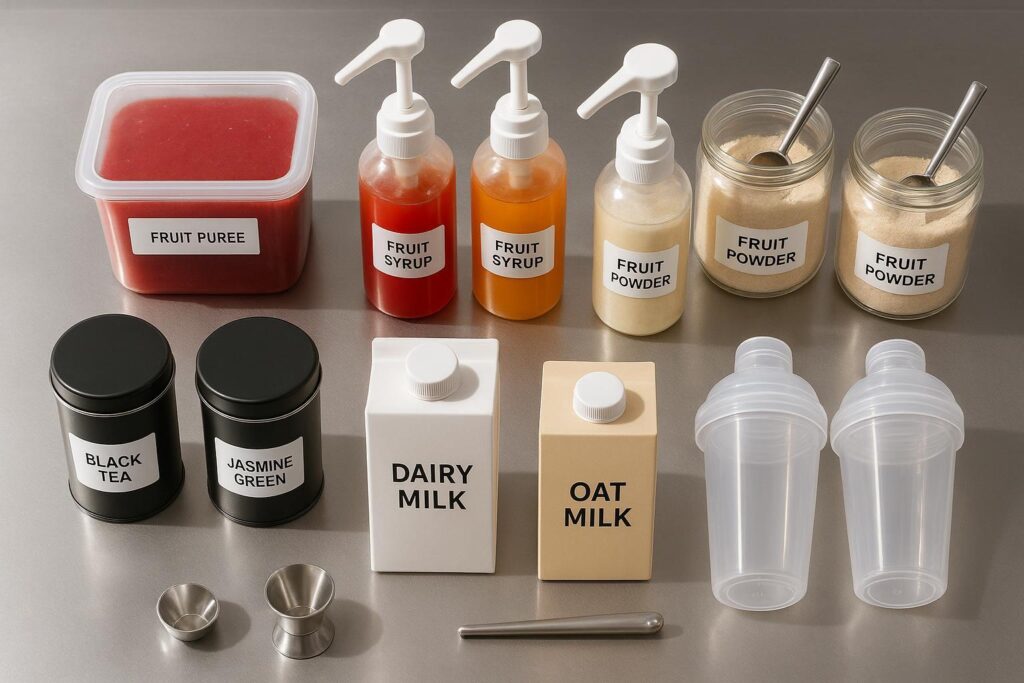
The 6 criteria that actually matter in a boba shop
When you compare puree vs syrup vs powder, keep it simple. For fruit milk tea, these are the criteria that show up as real operational wins (or real problems):
1) Flavor style
Do you want fresh/fruit-like, bright and candy-leaning, or creamy and dessert-like?
2) Texture and mouthfeel
Is this drink supposed to be light, silky, or thick?
3) Speed of service
How many seconds can you afford for mixing and rework?
4) Storage and handling
Do you have reliable cold space? Do you have humidity issues? Can you keep pumps and scoops clean?
5) Consistency across shifts
Can a new staff member hit the same flavor as your opener? Or does the drink require “feel” and constant tasting?
6) Cost control
Not just ingredient cost—waste risk, portioning drift, and labor.
With that lens, here’s how each format behaves.
Fruit puree in fruit milk tea: when it’s worth it
Fruit puree is the easiest way to get a rounder fruit body—the kind of flavor that feels less like “fruit flavoring” and more like fruit.
Where puree wins
You want a thicker, fruit-forward cup. Puree naturally adds body. That’s great for dessert-style milk teas or any drink where “juicy” isn’t the goal.
You’re selling a premium experience. If your menu leans premium, puree can justify the price because the drink tastes more substantial.
You’re okay with more handling discipline. Puree is often less forgiving if your team is loose with open dating, fridge habits, or utensil hygiene.
Where puree bites operators
It can be harder to standardize. Fruit-heavy ingredients vary across brands and lots. Even within one brand, thickness can vary enough to change pour behavior.
It raises your handling bar. When the ingredient is wet and fruit-rich, you need better habits: clean tools, tight lids, and clear “opened on / discard on” labeling.
It can fight clarity. If you want a clean, transparent drink, puree is usually the wrong tool.
Best-fit menu uses for puree
- “Real fruit” style fruit milk teas
- Yogurt-style or smoothie-adjacent boba drinks
- Thick, dessert-like builds (especially when paired with non-dairy creamer)
If you want a practical operator example, BubbleTeaSuppliers.com’s mango milk tea dairy-free SOP
shows how a puree-forward build can still be staff-trainable.
Fruit syrup in fruit milk tea: the consistency machine
If your top priority is speed + repeatability, syrup is usually the easiest format to operationalize.
Where syrup wins
Fast mixing. Syrups are designed to dissolve quickly—often even in cold drinks.
Tight portion control. Pumps (when maintained) and measured pours make it easier to keep flavors consistent across shifts.
Bright flavor. Syrups typically read as vivid, punchy fruit. In fruit tea they shine; in fruit milk tea they can still work, but you’ll want to manage sweetness and not let the drink turn into “milk + fruit candy.”
A simple framing that matches how many boba shops operate: syrups tend to be favored for fast, consistent builds, while powders skew creamier. See Taipec’s breakdown in Flavoured Syrups versus Flavoured Powders in Bubble Tea (2025)
.
Where syrup causes problems
Sweetness can crowd out fruit nuance. If you’re layering syrup with sweetened creamer or sweetened non-dairy milk, the drink can get “flat sweet” fast.
Pump hygiene becomes a real variable. Syrups are easy—until the pump becomes the weak link.
Not ideal for thick, premium texture. If your brand is known for rich, spoon-coating drinks, syrup alone usually won’t get you there.
Best-fit menu uses for syrup
- High-volume shops prioritizing speed
- Lighter, more refreshing “milk tea meets fruit” profiles
- LTOs where you want fast training and consistent execution
If you want a shop-ready internal comparison that speaks the language of workflow, BubbleTeaSuppliers.com includes a practical puree/syrup/powder discussion in its shop-ready mango SOP
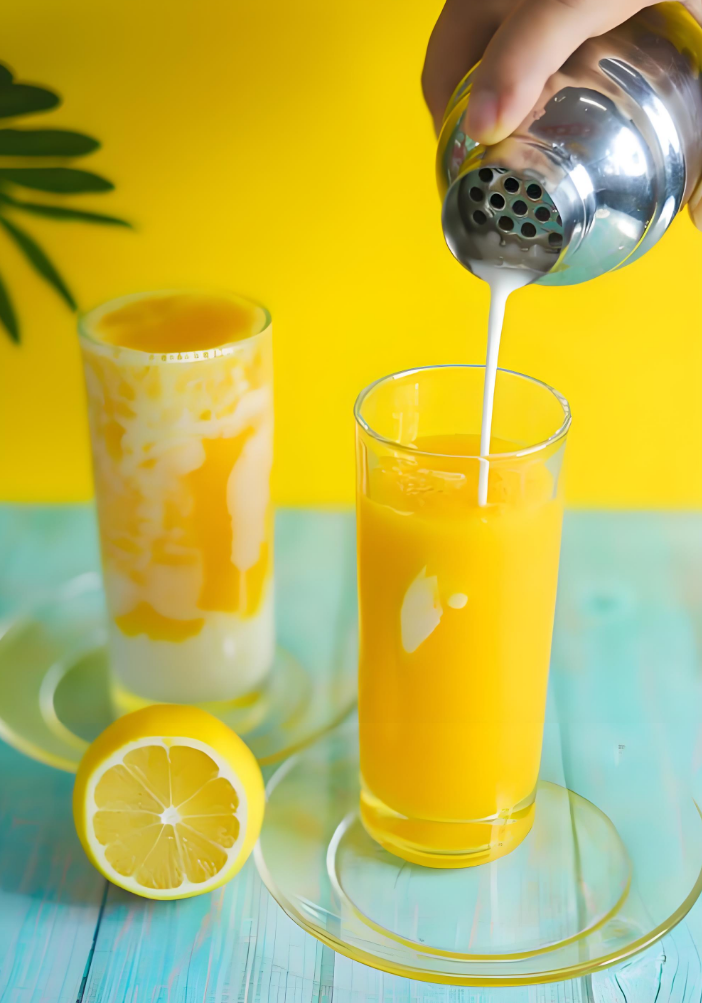
Fruit powder in fruit milk tea: creamy, controlled, and storage-friendly
Powder becomes the hero when you care about creaminess, dry storage, and repeatable batching.
Where powder wins
Creamier mouthfeel. In bubble tea systems, powders commonly map to a thicker, richer result—especially in milk-based drinks. BubbleBobaWorld summarizes this tradeoff in Syrups vs. Powders for bubble tea (2024)
.
Dry inventory. Powders are compact, easier to store, and generally easier to manage in tight back rooms—if you keep them dry.
Consistent results (if you weigh or standardize). When you portion precisely and mix correctly, powders can be extremely repeatable.
Where powder can go wrong
Clumping and poor dissolution. If you dump powder into cold liquid without a plan, you’ll fight graininess. Many shops solve this with a controlled mixing step (e.g., a small hot base or a dedicated mixing routine).
Humidity is the silent killer. If your powder containers live near steam, ice bins, or dish areas, you’ll get caking and inconsistent scoops.
“Powdery” flavor risk. Some powders taste artificial if the formulation is weak. You’ll know fast during staff tastings.
Best-fit menu uses for powder
- Creamy fruit milk teas (especially when you want a dessert-like finish)
- Shops with limited refrigeration space
- Stores that want a fast training path (standard scoop/weight + standard mix)
If you’re dialing in texture, BubbleTeaSuppliers.com’s creamy milk tea texture guide
is a useful internal reference for what creates “thin vs rich” results.
Tea base for fruit milk tea: black vs green (and how to avoid a weird finish)
Tea base matters more in fruit milk tea than many shops expect—because fruit + dairy/non-dairy changes how bitterness and aroma show up.
Black tea: strong backbone, but watch astringency
Black tea gives a deeper base and holds up to creamy builds. The downside is that over-steeped black tea can read astringent (that dry, rough finish) once you add fruit.
Practical rule:
- If you’re using black tea, consider a slightly lighter brew strength for fruit milk tea than you’d use for a classic milk tea.
Green tea: cleaner, brighter, but easier to “wash out”
Green tea tends to play well with bright fruit flavors. In fruit milk tea, it can feel lighter and more aromatic.
Practical rule:
- If your fruit flavor is subtle (or you’re using a lower-impact syrup), green tea can disappear. Test with your exact ingredient.
Dairy vs non-dairy in fruit milk tea (non-dairy milk tea options)
Fruit milk tea is where you find out fast whether your shop’s “non-dairy” system is solid.
Milk options you’ll see in shops
Dairy milk (whole/2%): clean, familiar, and easy to balance. It can mute some bright fruit notes.
Plant milks (oat/soy/almond/coconut): useful for non-dairy positioning, but each behaves differently. Some are more prone to separation when paired with acidic fruit flavors.
Non-dairy creamer: common in boba shops because it’s consistent, shelf-stable (before opening), and gives a very “milk tea” texture.
If you want an internal refresher on what operators use and why, see BubbleTeaSuppliers.com’s guide on what kind of milk to use in your boba tea shop
.
Why separation happens (simple explanation)
Two common triggers:
- Acid + proteins: Some fruit ingredients are more acidic. Acid can destabilize certain proteins, which can show up as curdling or “grainy” texture.
- Bad mixing order: If you hit milk with fruit concentrate in the wrong sequence, you can create localized high-acid pockets.
Operator fixes that usually work
- Standardize mixing order: tea/water → dissolve flavor (syrup or properly mixed powder) → add milk/creamer → add ice last.
- Avoid over-concentrating fruit in a tiny milk volume: disperse flavor into the base first.
- Pick the right format for the drink style: if separation keeps happening with a certain fruit ingredient, syrup or powder may be more stable than puree in your system (or vice versa), depending on the specific product.
⚠️ Warning: Don’t promise “shelf-stable” or “no separation” as a blanket statement. Stability depends on the exact product formulation. Test your exact SKUs and follow the manufacturer label.
Storage and handling: the SOP basics that prevent expensive mistakes
I’m not going to give you fake “exact shelf life” numbers here—because those vary by brand and packaging. What you can standardize is the handling system.
The baseline system
1) Open-date everything. Every bottle, bag, or jug gets: product name + opened on + discard on.
2) FIFO always. First in, first out. No topping off old product with new.
3) Keep tools format-specific.
- Dedicated pumps for syrups.
- Dedicated dry scoops for powders.
- Dedicated portion tools for purees.
4) Protect powders from moisture. Store away from steam and keep containers sealed immediately after use.
5) Keep syrup pumps clean. Pumps/spouts are where contamination tends to enter.
For a shop-focused overview of storing common boba ingredients, BubbleTeaSuppliers.com has a practical internal guide on storage information and shelf life for bubble tea supplies
.
A quick note on “after opening” guidance
Manufacturers vary. For example, Monin notes specific conditions and windows for after-opening storage in Monin’s FAQ on storage conditions and after-opening shelf life
. Use that as a model for how to think: conditions + window + cap/pump hygiene, not a one-size-fits-all rule.
And if you’re training your team on why puree handling matters, it helps to explain that fruit purees are often treated as more sensitive from a manufacturing standpoint, with specifications tied to good manufacturing practices—see the USDA AMS document PUREES, FRUIT, FROZEN (2018)
.
The quick chooser: what to use when
If you want a fast rule set to align your team, use this:
Choose fruit syrup when…
- Speed and repeatability are top priority
- You want a brighter, cleaner fruit flavor
- Your staff training needs to be simple
Choose fruit powder when…
- You want a creamy, dessert-like fruit milk tea
- You need dry storage efficiency
- You can standardize mixing to prevent clumps
Choose fruit puree when…
- You’re optimizing for “real fruit” character and body
- You’re willing to enforce tighter handling discipline
- The drink concept is smoothie-adjacent or premium-thick
Next steps (if you’re building or cleaning up your fruit milk tea program)
If you’re trying to standardize fruit drinks across shifts, start by choosing one format per drink and writing it down as a one-page SOP.
For more shop-ready guides and recipes you can adapt, browse BubbleTeaSuppliers.com and pull the resources that match your menu style.