
If a customer sees “ice cream milk tea” on your menu, they’re expecting a milk tea that drinks like dessert. Creamier, sweeter, and more indulgent than your standard black milk tea. Done right, it’s a high-margin upgrade that feels special without adding a lot of new SKUs.
(You may also see this called milk tea with ice cream on some menus.)
This guide is written for bubble tea shop operators. You’ll get two production-ready builds (layered float and blended), plus batching, speed, QC, and food safety notes.
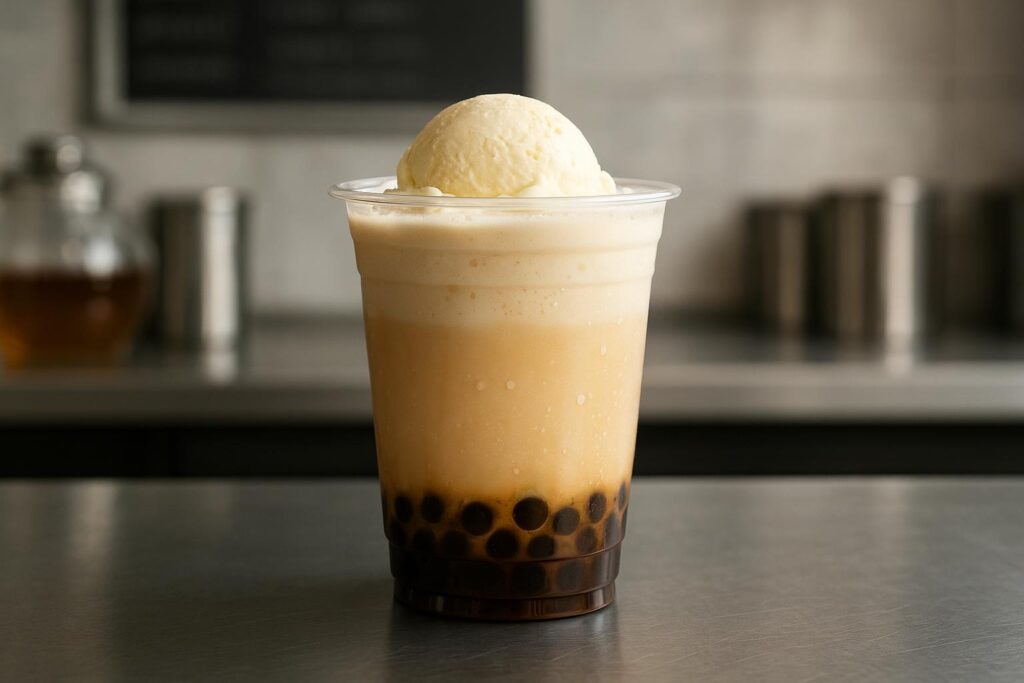
What is ice cream milk tea (aka ice cream bubble tea on some menus)?
In shop terms, ice cream milk tea is a milk tea drink finished with ice cream (usually a scoop on top, or blended in). Some shops label this as ice cream bubble tea when they want the “boba” association to be obvious. It sits in the same “float” family as root beer floats, but your base is milk tea instead of soda.
Some blogs use the phrase to mean milk-tea-flavored ice cream (ice cream infused with black tea) rather than a drink. If you want that definition for your menu planning, Zhang Catherine’s recipe explains milk tea ice cream infused with black tea and the tea-steeping method clearly in her Milk Tea Ice Cream guide (updated 2026).
For most boba menus, though, customers read “ice cream milk tea” as: milk tea + ice cream in the cup.
Choose your format: layered float vs blended
You can sell this two ways. Both work. Pick the one that fits your line speed and presentation goals.
Option A: Layered float (best for presentation)
What it looks like: pearls at the bottom, milk tea in the middle, ice cream on top.
Why it sells: customers see it. It looks like an upgrade.
Tradeoff: ice cream melts during holding, so you want to build it close to handoff.
Option B: Blended (best for consistency)
What it looks like: a thick, milkshake-style drink with milk tea flavor.
Why it sells: same taste every time. Less “melt drama.”
Tradeoff: blender is a bottleneck if your station is already slammed.
Pro Tip: If you’re testing this as a limited-time offer, run the layered float first for photos and social proof. If it becomes a top seller, add the blended version for peak hours.
Ingredients: what you need to stock (and what you can skip)
You can build a strong version with items you already carry.
Core ingredients
Black tea (Assam, Ceylon, or a house black blend). This drink needs a tea base that can stand up to dairy and sweetness.
Milk component: whole milk, half-and-half, non-dairy creamer, or your standard shop milk base.
Sweetener: cane syrup, brown sugar syrup, or condensed milk.
Ice cream: vanilla is the safest baseline. It pairs with black tea and lets the tea flavor show.
Optional add-ons (high ROI)
Brown sugar boba (or your standard pearls)
Whipped cream (for the blended version)
A drizzle: brown sugar, caramel, or honey (use lightly)
If you want a broader milk decision framework, start with milk options for boba shops and standardize one “default” milk for this drink.
SOP build #1: Layered ice cream milk tea float (one-cup recipe)
This is the version that looks premium in photos.
Target portion (suggested)
Cup size: 16 oz (works well for a float)
Pearls: 60–80 g cooked tapioca pearls (or your normal single serving)
Milk tea: ~330–360 g / ml finished milk tea (depends on ice cream scoop size)
Ice cream: 1 scoop (about 70–90 g)
Key Takeaway: For floats, consistency is less about “exact grams” and more about controlling tea strength + sweetness + time-to-handoff. Melt is the silent ingredient.
Step-by-step (with checks)
Step 1: Prep the cup
Input: cooked pearls, clean cup
Action: Add pearls to the bottom of the cup.
Output: pearls settled in the base.
Done when: pearls cover the bottom in a single layer (not a giant mound).
Step 2: Build your milk tea base
Input: chilled strong-brewed tea, milk component, sweetener
Action: Mix a stronger-than-normal milk tea base (because ice cream will dilute it as it melts). If you already have a standardized method, follow it. If you don’t, use your existing “classic milk tea” recipe and increase tea concentration by roughly 10–20%.
For broader standardization, reference your shop’s milk tea base approach and QC mindset from this shop-ready milk tea SOP.
Output: a chilled milk tea base that tastes slightly stronger than your normal serving.
Done when: the tea flavor is obvious even after you taste it cold.
Step 3: Add milk tea to the cup
Input: pearls-in-cup + chilled milk tea base
Action: Pour milk tea over pearls, leaving space for the scoop.
Output: cup is filled to about 80–85%.
Done when: you can add ice cream without overflow.
Step 4: Finish with ice cream (last)
Input: ice cream, sanitized scoop
Action: Add one scoop on top.
Output: visible scoop sitting above the tea line.
Done when: scoop is centered and not already collapsing.
Step 5: Handoff timing
Action: Serve immediately.
Done when: the drink is in the customer’s hand within a couple of minutes of scooping.
Service notes
If your shop does sealed cups, consider a domed lid for the float version.
Don’t pre-scoop into cups for later. You’ll lose texture and create a messy melt line.
SOP build #2: Blended ice cream milk tea (milkshake-style)
This is your “peak hour” version.
Wells Foodservice has a straightforward float-style recipe that blends ice cream + milk + iced tea concentrate, then pours it over boba; their Bubble (Boba) Tea Float build is a useful baseline for proportions.
Target portion (suggested)
Cup size: 16 oz
Ice cream: 2–3 small scoops (about 140–200 g total)
Milk: 90–120 ml
Strong tea or tea concentrate: 60–120 ml (adjust to hit “milk tea first,” not “vanilla milkshake”)
Sweetener: add only if needed (ice cream brings sweetness)
Pearls: optional in cup (or as a topping)
Step-by-step (with checks)
Step 1: Load blender
Input: ice cream, milk, chilled strong tea
Action: Add to blender.
Output: ready to blend.
Done when: liquids are in first (helps blades catch), ice cream is on top.
Step 2: Blend to a short, thick pour
Action: Blend until smooth.
Output: thick, uniform texture.
Done when: no visible ice cream chunks remain, and the drink pours in a slow ribbon.
Step 3: Build the cup
Action: Add pearls to cup (optional), pour blended drink, top with whipped cream or drizzle if desired.
Done when: the surface is smooth and the straw will pull without clogging.
Batching + station setup (to keep this from wrecking your line)
Batch what you can
Tea concentrate / strong brew: batch for the day, keep chilled.
Sweetener syrup: pre-portion pump counts.
Don’t batch what you shouldn’t
Don’t batch anything with ice cream mixed in. Texture breaks fast.
Station setup
Keep ice cream in a freezer that holds temp reliably.
Keep your scoop and rinse setup organized so it’s easy to sanitize and rotate tools.
QC checkpoints + troubleshooting
Problem: it tastes watery
Likely causes: tea base too weak, too much ice, slow handoff melt.
Fixes:
Strengthen tea concentration 10–20% for the float build.
Reduce ice in the base (the ice cream is already doing the chilling).
Tighten the “scoop-to-handoff” window.
Problem: it tastes like vanilla, not milk tea
Likely causes: not enough tea, tea isn’t strong enough, or the ice cream is overpowering.
Fixes:
Increase tea concentrate volume in the blended build.
Choose a bolder black tea.
Use vanilla ice cream with a clean flavor (avoid heavy “birthday cake” styles).
Problem: slow line / blender bottleneck
Fixes:
Offer layered float as default, blended as an add-on during off-peak.
Pre-chill tea concentrate so blend time is short.
Food safety and allergen notes (operator basics)
Ice cream is a dairy product. Treat it like one.
Use pasteurized dairy products.
Avoid repeated thaw/refreeze cycles.
Train staff on clean handling and personal hygiene.
For a general overview of risks and why temperature control matters, see Colorado State University’s Ice Cream food safety overview.
Allergen note: milk is a major allergen. Your menu description should clearly signal dairy for this drink, and your team should know how to prevent cross-contact when making dairy-free drinks on the same line.
Pricing + menu description templates
Pricing logic (simple)
Ice cream milk tea is a premium add-on drink. Price it so it covers:
added COGS (ice cream)
slower build time
waste risk (melt, freezer burn, scooping errors)
Many shops position this as a +$1.00 to +$2.50 upgrade over classic milk tea, depending on scoop size and local market.
Menu description templates
Layered float
“Creamy black milk tea topped with a scoop of vanilla ice cream and boba.”
Blended
“Milk tea blended with vanilla ice cream for a thick, dessert-style boba drink.”
Brown sugar version
“Brown sugar boba + rich milk tea + vanilla ice cream float.”
Next steps
If you’re refining your milk tea base, start with bubble tea basics and keep your core recipe consistent using the shop-ready milk tea SOP you already have linked above.
If you want more visual menu ideas (layering and flavor pairings), use this internal guide on ice cream with bubble tea menu ideas.