
Mango milk tea sells for the same reason every “tropical + creamy” drink sells: it’s familiar enough to order fast, but different enough to feel like a treat. The problem is consistency.
In a busy shop, mango milk tea can swing from bright and fruity to flat and watery—or worse, split and look curdled if the tea is hot or the fruit base is too acidic.
This guide gives you two things:
A repeatable, staff-trainable mango milk tea SOP using mango puree and no dairy (non-dairy creamer and/or oat milk).
A decision framework so you can choose the right tea base, mango base texture (puree vs jam/fruit bits), and dairy-free method for your shop’s speed, cost, and “no separation” tolerance.
What a “shop-ready” mango milk tea SOP needs
A home recipe can be “good enough.” A shop SOP needs to be boringly reliable.
Here’s the checklist most owners actually care about:
Portionable: staff can measure it the same way every time (scoop, pump, grams, or ml).
Fast: minimal blender time and minimal “special handling” during rush.
Stable: doesn’t separate right away and doesn’t look curdled.
Scalable: the same build works for one drink or a batch strategy.
Trainable: steps have clear “done when…” checks.
Pro Tip: If your SOP can’t be explained in 60 seconds and verified in 10 seconds, it won’t survive Saturday night.
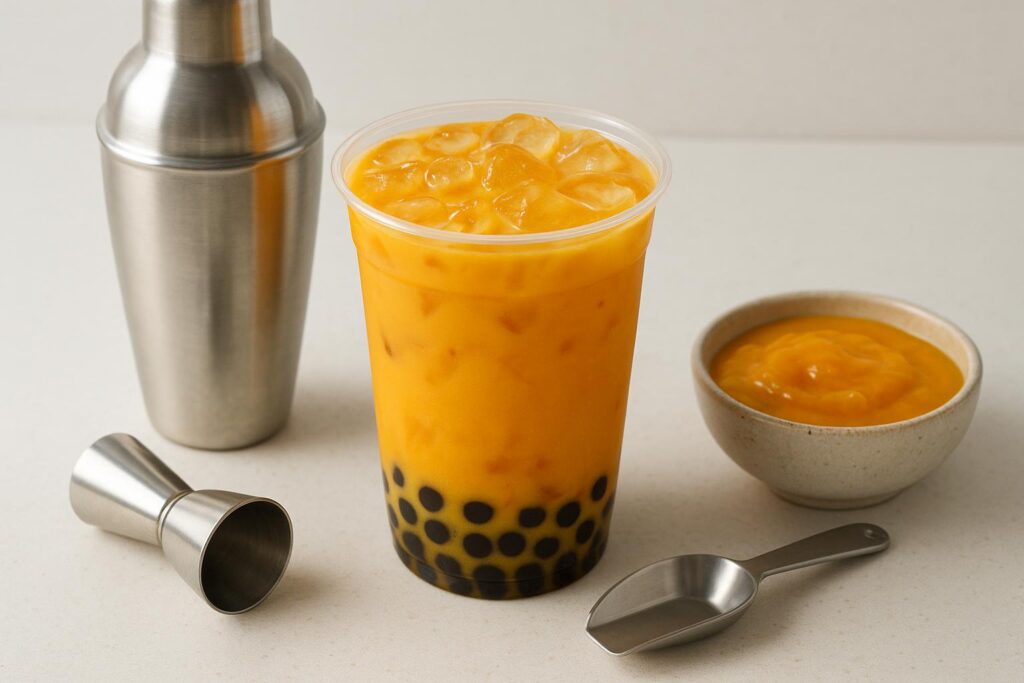
Ingredient decision guide (so you don’t fight your own recipe)
Before we get into the numbered SOP, decide the three levers that control 90% of your results: tea base, mango base, and dairy-free method.
1) Choose your tea base: jasmine green vs Assam black
Jasmine green tea
Best when you want mango to feel bright and aromatic.
Usually reads “lighter” and more refreshing.
Assam black tea
Best when you want mango to feel richer and more “milk tea.”
Gives you more backbone if your mango puree is sweet.
If you’re building a dairy-free mango milk tea that has to hold up in a sealed cup, a strong black tea base can help the drink taste full even if you keep the dairy-free component moderate.
BubbleTeaSuppliers notes mango milk tea commonly uses black or green tea and can be made with puree/concentrate/syrup (which is useful for planning your menu options), see their overview on mango milk tea with puree or concentrate. For search intent, this is essentially a mango milk tea recipe for bubble tea shops—your edge is turning it into a repeatable SOP instead of a home-kitchen recipe.
2) Choose your mango base: puree vs mango jam/fruit bits (and when to use both)
You selected mango puree as your primary base, which is the right call for a milk tea texture.
Now decide texture:
Puree-only = smooth, consistent mouthfeel, easiest to portion.
Puree + mango jam/fruit bits = more “real fruit” texture, premium feel, but higher separation risk and more training.
If you’re using a thick mango concentrate/jam, BubbleTeaSuppliers highlights why ops teams like it: consistency, year-round availability, and storage; their comparison of mango concentrate vs fresh mango also cites a starting point of about 1 tablespoon per cup (then adjust).
Recommendation (most shops):
Start with puree-only as the default SOP.
Add mango jam/fruit bits as an optional upgrade (menu add-on or premium version) so you don’t sabotage consistency for every order.
3) Choose your dairy-free method: non-dairy creamer vs oat milk
Both work. They behave differently.
Non-dairy creamer (powder or liquid)
Pros: consistent, “classic milk tea” body, often more stable.
Cons: can taste heavy if overused; some brands are sweeter than expected.
Oat milk (barista blend preferred)
Pros: customer-friendly ingredient label; smooth when it works.
Cons: can separate more easily with fruit + tea, especially with heat shock.
If you want maximum operational stability, build your baseline SOP with non-dairy creamer and offer oat milk as a swap (priced accordingly). That also helps you keep one standardized non-dairy creamer milk tea build in training, then treat oat milk as a controlled variation.
The core SOP: mango milk tea with mango puree (single-cup build)
This SOP is written so it can be executed with either non-dairy creamer or oat milk. Choose one path and train it hard.
Standard tools (pick your shop standard)
Jigger (ml) or scale (grams)
Standard scoop (label the size in your SOP)
Shaker tin
Bar spoon
Timer
Standard cup size
Written for a 16 oz cup.
To scale to 22 oz: increase tea + dairy-free component first, then mango base to taste.
Ingredients (16 oz target)
Strong brewed tea (jasmine green or Assam black), cooled
Mango puree (your chosen brand)
Sweetener (fructose, simple syrup, or house syrup)
Option A: non-dairy creamer (recommended baseline)
Option B: oat milk (barista blend preferred)
Ice
Optional: mango jam/fruit bits
Optional toppings: boba, mango jelly, coconut jelly
⚠️ Warning: Don’t combine hot tea + fruit base + dairy-free milk in the cup. Heat shock is one of the fastest ways to get a split/curdled look.
Step 0 — Prep the tea base (do this before service)
Brew a strong tea concentrate.
Cool it fully (room temp or refrigerated).
Done when: tea is no longer hot to the touch and doesn’t steam.
Step 1 — Portion mango base
Add mango puree to the shaker.
Start with your house standard (example: 45–60 ml).
If you’re using a mango concentrate/jam style base, BubbleTeaSuppliers cites a starting point around one tablespoon per cup—use that as a calibration point, then standardize your number.
Done when: the mango base amount is consistent (same jigger mark or same weight) every time.
Step 2 — Add sweetener (set your “default sweetness”)
Add sweetener to the shaker.
Choose one standard sweetener so staff doesn’t improvise.
Set “default sweetness” (e.g., 50% or “regular”) and document the pump count.
Done when: the sweetness level is written in the SOP and staff can repeat it without asking.
Step 3 — Add tea (for structure and aroma)
Add cooled tea to the shaker.
Done when: the shaker volume hits your pre-marked line for 16 oz build.
Step 4 — Add dairy-free component (choose one path)
Option A (baseline): non-dairy creamer
Add your non-dairy creamer amount.
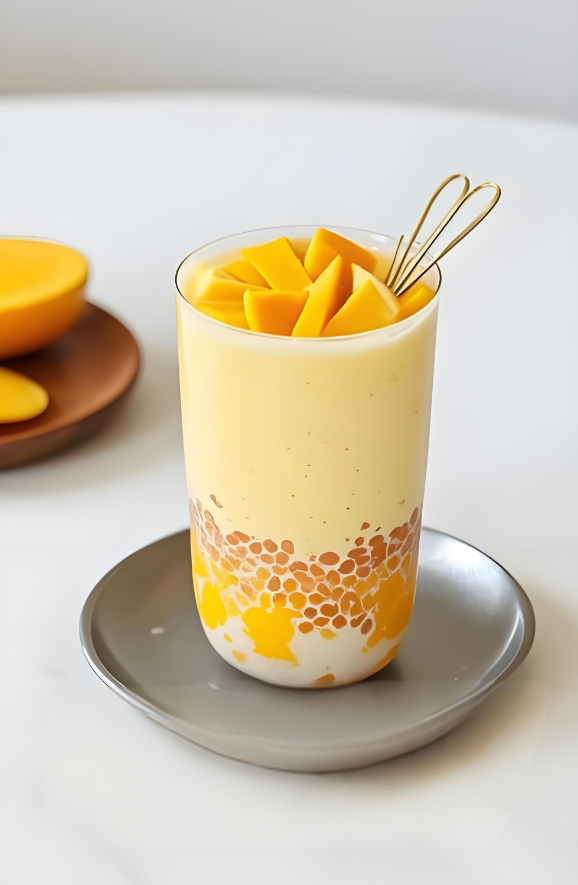
If you’re using powder-based creamer in any part of your program, it’s worth training a “dissolve-first” method. BubbleTeaExpert’s powder recipe emphasizes the operational step to dissolve powders with hot water first to prevent lumps.
Done when: no visible powder clumps remain and the liquid looks uniform.
Option B: oat milk
Add oat milk after tea is cooled and mango + sweetener are already in the shaker.
Add it gradually and stir once before icing.
Done when: the mixture looks smooth and doesn’t show “floaty” separation streaks.
Step 5 — Ice and shake
Add ice (use a consistent scoop).
Shake 10–15 seconds until the shaker is frosty.
Done when: shaker is cold, and the drink looks evenly mixed.
Step 6 — Build the cup
Add toppings (if any) to the cup.
Pour the drink into the cup.
Seal and serve.
Done when: color is consistent from top to bottom and the drink looks stable for customer handoff.
Optional upgrade SOP: mango jam bubble tea version (fruit bits without ruining stability)
If you want that “real fruit” hit, do it in a way that doesn’t require staff to re-engineer the drink.
Two reliable approaches:
Approach 1: Bottom layer (recommended)
Add 1 spoon of mango jam/fruit bits to the bottom of the cup.
Add drink on top.
Label it as a texture feature (“mango bits at the bottom”).
Why it works: you keep the base drink stable, and the fruit is an intentional layer.
Approach 2: Light mix-in (for premium version)
Add a small measured amount of jam/fruit bits into the shaker after mango puree and sweetener.
Shake gently (shorter shake) to avoid turning it into pulp.
Why it’s riskier: fruit pieces can accelerate separation and make “inconsistency” look like a defect.
Batching and holding (rush-hour friendly)
Batching can help, but only if you control three things: tea strength, mango base viscosity, and time.
What to batch
Tea concentrate: batch daily, label brew time, store cold.
Mango base portions: pre-portion mango puree into cups (service-ready) if your food safety setup allows it.
What not to batch (usually)
Fully mixed mango + oat milk + tea blends, unless you’ve tested separation and you’re comfortable with shaking before use.
A practical compromise:
Batch tea.
Pre-portion mango puree.
Mix per drink in shaker (fast and consistent).
Troubleshooting guide (train this like a mini-SOP)
Problem: drink looks split / curdled
Most common causes:
Tea was too hot.
The fruit base is more acidic than normal.
Milk/creamer added too fast.
Fixes to train:
Cool tea before adding dairy-free milk/creamer.
Avoid extra acidic add-ins.
Add milk/creamer gradually and mix well. Guidance for preventing curdling with creamer often emphasizes avoiding acidic teas and reducing temperature shock—see Santos-Krimer’s notes on how to prevent creamer from curdling in tea.
For a plain-language explanation of why this happens (acid + milk interaction), Plum Deluxe explains what makes milk curdle in tea.
Problem: mango flavor is weak
Causes:
Mango puree dose too low.
Tea too strong for the mango level.
Fix:
Raise mango puree in small increments and lock the new number into the SOP.
Problem: drink is watery
Causes:
Too much tea relative to mango + creamer.
Over-shaking with too much ice.
Fix:
Reduce tea slightly or increase creamer slightly. Standardize ice scoop.
Problem: “chalky” mouthfeel
Cause:
Powder creamer or powder mango not fully dissolved.
Fix:
Train dissolve-first (small hot-water dissolve step), similar to BubbleTeaExpert’s method to dissolve powders with hot water first.
SOP-friendly variations (without rewriting your whole recipe)
Variation 1: Jasmine mango milk tea
Use jasmine green tea base.
Keep creamer slightly lower for a lighter, floral profile.
Variation 2: Assam “rich mango” milk tea
Use Assam black tea base.
Keep mango puree dose steady; increase tea strength only if mango still cuts through.
Variation 3: Mango + coconut vibe (dairy-free)
Use oat milk or coconut-forward non-dairy creamer.
Add coconut jelly topping.
Next steps
If you want to lock this SOP fast, do a 30-minute internal tasting with three controlled tests:
Jasmine vs Assam tea base
Non-dairy creamer vs oat milk
Puree-only vs puree + fruit bits (bottom layer)
Then document the winning ratios and train against the troubleshooting section.
If you’re building a full milk-tea program, BubbleTeaSuppliers has a shop-operator overview of milk tea ingredients and SOP structure that can help you standardize beyond this one drink.