
If you’re trying to make an ube taro milk tea that looks premium and holds up during a real rush, the winning move is to keep the drink simple:
Base: a consistent taro milk tea (smooth, not chalky)
Signature: a vivid ube foam cap + a small ube drizzle for aroma and color
This isn’t an at-home recipe. It’s a shop SOP you can train, scale, and cost—built to function as a taro milk tea recipe for bubble tea shop teams (fast, repeatable, and easy to QC).
Ube taro milk tea specs to standardize before you touch ingredients
Most “inconsistent taro” problems aren’t about taro at all—they’re about specs drifting across staff.
Lock these in first:
Cup size: 16 oz (this SOP is written for 16 oz; scale from there)
Ice: full cup of ice to your standard line (don’t guess—mark the cup)
Sweetness: choose one default (e.g., 100% = your standard)
Tea strength: decide whether you’re using a strong tea concentrate or a regular brew (be consistent)
Pro Tip: Decide whether your shop is “taro-forward” (more taro, thicker body) or “tea-forward” (lighter body, clearer tea aroma). You can make either version excellent—but you can’t make both with one recipe.
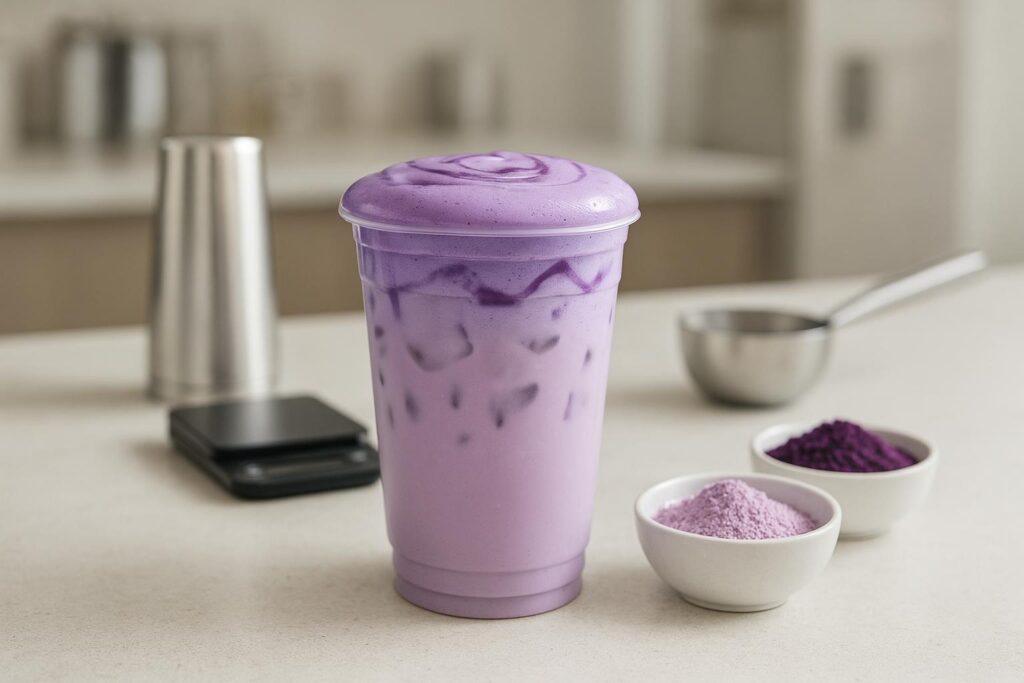
Ingredients and tools (operator list)
Core ingredients
Taro powder or taro paste (choose one primary SKU for consistency)
Tea base (black or jasmine are common backbones)
Milk / half-and-half or non-dairy creamer (use whatever matches your shop standard)
Sweetener (simple syrup, fructose, or your house sweetener)
Ice
For a practical operator overview of the ingredient categories you’re controlling, see BubbleTeaSuppliers.com’s guide to core bubble tea ingredients.
Ube foam + drizzle ingredients
Heavy cream
Milk (or half-and-half)
Ube extract/flavoring and/or ube powder (pick one as your primary driver)
Sweetener (sugar or condensed milk)
Pinch of salt (tiny, but it matters)
Optional: a small amount of ube halaya/jam for body (use sparingly)
Different ube formats behave differently in drinks (sweetness, color, stability). If you’re choosing SKUs, start with a quick read on ube ingredient types like ube flavoring/extract and the trade-offs in ube flavoring vs ube syrup.
Tools that prevent “operator drift”
Digital scale (grams)
Shaker cup + strainer
Whisk (for powder hydration)
Hand frother or immersion blender (for foam)
Labeled squeeze bottle (for drizzle)
Date dots + batch labels
Step-by-step SOP: taro milk tea base (16 oz)
This SOP assumes you’re using taro powder or a standardized taro base (best for speed + consistency). In training, name the exact grams-per-cup as your taro milk tea powder ratio and audit it weekly—this is the #1 lever for consistency and cost control.
Step 1 — Brew tea (or prep your tea concentrate)
Input: your shop’s black or jasmine tea.
Action: brew to your standard strength.
Output: brewed tea ready to use.
Done when: tea is aromatic and not over-steeped/bitter.
Step 2 — Dissolve taro warm to prevent clumps
Input: taro powder + a small amount of warm tea or warm water.
Action: whisk until completely smooth before adding cold milk.
Output: a smooth taro slurry (no dry pockets).
Done when: you can drag a spoon through it and see no powder streaks or grit.
⚠️ Warning: If you dump powder directly into cold milk, you’re almost guaranteeing chalkiness and clumps—especially when staff rush.
Step 3 — Build the base in the shaker
Input: taro slurry + brewed tea + milk/creamer + sweetener.
Action: add ingredients in a consistent order, then shake with ice.
Output: a creamy, uniform taro milk tea base.
Done when: color is even, texture is smooth, and the drink tastes balanced (not “flat” and not overly sweet).
If you want a staff-friendly reference card format, BubbleTeaSuppliers.com has shop-friendly milk tea SOP cards that reinforce the same “dissolve first, then shake” idea.
Step 4 — Fill the serving cup with fresh ice and pour
Input: finished taro milk tea base.
Action: fill cup to your ice line, then pour to your fill line.
Output: consistent headspace for foam.
Done when: you still have room for a foam cap without overflow.
Step-by-step SOP: ube foam cap (operator version)
If you’ve been searching for an ube foam for milk tea that doesn’t collapse mid-shift, focus less on fancy ingredients and more on cold temperature, correct viscosity, and a consistent frothing endpoint.
Ube foam is where most shops get burned—because they treat it like a “cute topping” instead of a controlled recipe.
There are two operator-safe approaches:
Extract-led foam: best consistency, easiest batching, strongest color control
Powder-led foam: great flavor, but requires hydration to avoid grain
Option A — Extract-led ube foam (most consistent)
This is adapted from simple ube cold-foam ratios like the one in Bites by Bianca’s ube latte with ube cold foam, scaled up for shop handling.
Target texture: thick-pourable, sits on top for service, spoonable.
Step 1 — Combine base Input: heavy cream + milk + sweetener + ube extract + pinch of salt.
Action: mix cold ingredients, then froth.
Output: lavender foam.
Done when: foam holds soft peaks and looks uniform (no streaks).
Step 2 — Taste + adjust Input: finished foam.
Action: adjust sweetness and ube extract in small increments.
Output: balanced ube aroma and color.
Done when: you can smell ube before you taste sugar.
Option B — Powder-led ube foam (more “ube” character)
Whole Latte Love’s ube cold foam recipe includes a small but important operator trick: hydrate the powder first. It’s also a useful reference point if you’re adapting a bubble tea foam topping recipe to ube—same mechanics, different flavor system.
Step 1 — Pre-hydrate ube powder Input: ube powder + a tiny amount of water.
Action: stir into a smooth violet paste.
Output: hydrated ube concentrate.
Done when: no dry powder specks remain.
Step 2 — Add dairy + sweetener, then froth Input: hydrated ube + heavy cream + milk + sweetener (condensed milk works) + salt.
Action: froth to thick-pourable.
Output: vivid violet ube foam.
Done when: foam is thick and glossy, not bubbly and thin.
Step-by-step SOP: ube drizzle (the “visual signature”)
Your drizzle should do three things:
Add a hit of ube aroma at the top of the sip
Reinforce color
Stay controlled (not turn the drink into syrup soup)
Step 1 — Choose your drizzle base
Pick one primary drizzle strategy:
Ube syrup (easy, consistent)
Ube halaya thinned into sauce (richer, but more variables)
If you’re using halaya, treat it like a sauce component and remember it’s essentially purple yam jam—see a standard reference like Hungry Huy’s ube halaya (purple yam jam) to sanity-check what’s typically inside.
Step 2 — Portion into a squeeze bottle and label
Input: your ube drizzle.
Action: bottle + date label.
Output: ready-to-use drizzle.
Done when: drizzle flows cleanly through a standard nozzle without clogging.
Step 3 — Apply with a fixed pattern
Input: finished drink (with foam cap already on).
Action: 1–2 quick passes across the top (or one spiral).
Output: consistent visual, controlled sweetness.
Done when: drizzle is visible but doesn’t sink immediately.
Assembly and presentation standards (what staff should do every time)
Build order (repeatable)
Ice + taro milk tea base
Ube foam cap (consistent thickness)
Ube drizzle (fixed pattern)
Visual QC (10-second check)
Foam layer is intact (not sliding off the rim)
Color contrast: pale taro base + vivid violet top
Drizzle is visible (but not pooling)
Batching + holding (what to prep vs what to do at service)
You’ll make this drink more consistent by batching the right things.
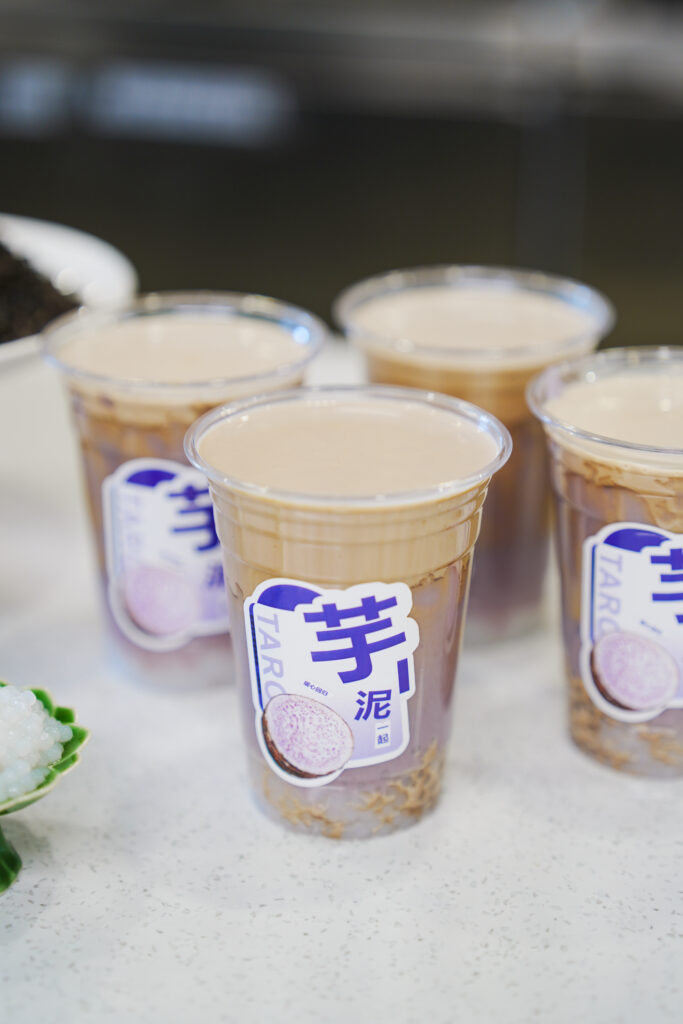
Batch these
Brewed tea / tea concentrate (labeled, refrigerated)
Pre-measured dry kits (taro powder per cup in portion bags) if you’re high-volume
Ube drizzle (in squeeze bottles)
Batch carefully (small batches only)
Ube foam base: foam is best fresh. If you must prep ahead, keep the liquid base cold and froth closer to service.
Do NOT batch
Finished taro milk tea with ice (dilutes, flavor fades)
Foam already fully whipped for long periods (texture degrades)
Pearls inside the drink (texture loss)
A practical reminder from Boboteashop is that taro milk tea tastes best fresh—for shop ops, that translates to: batch components, assemble to order.
QC checklist + troubleshooting (operator quick fixes)
QC checklist (each batch)
Texture: smooth, creamy, no grit
Aroma: tea + taro present (not just sugar)
Color: uniform base; foam evenly violet
Foam: thick-pourable, no obvious separation
For ingredient consistency and repeatability habits, BubbleTeaSuppliers.com’s notes on ingredients that stay consistent are aligned with this SOP.
Troubleshooting guide
Problem: Chalky / gritty taro base
Likely cause: powder not fully dissolved
Fix: dissolve taro with warm liquid first; whisk longer; strain if needed
Problem: Taro base is too thick/pasty
Likely cause: too much taro powder or too little tea
Fix: reduce taro dose slightly, increase tea portion, re-balance sweetness
Problem: Drink tastes flat (sweet but no backbone)
Likely cause: weak tea, over-dilution, or too much dairy
Fix: strengthen tea; reduce ice melt variability; keep ratios fixed
Problem: Foam slides off / collapses fast
Likely cause: foam too thin or drink too warm
Fix: keep ingredients cold; reduce milk fraction; froth to thicker peaks
Problem: Foam is grainy
Likely cause: ube powder not hydrated
Fix: pre-hydrate powder into paste before adding dairy (powder-led method)
Problem: Drizzle sinks immediately
Likely cause: drizzle too thin
Fix: slightly thicken (less dilution), use a smaller amount, drizzle after foam
Costing (simple, operator-friendly)
You don’t need fancy software to cost this drink—you need consistency.
Step 1 — Define your “bill of materials” per 16 oz
List your exact SKUs and portion weights:
taro powder (g)
tea (oz)
milk/creamer (oz)
sweetener (oz)
ube foam ingredients (g/ml)
ube drizzle (ml)
Step 2 — Convert each ingredient to cost per gram/ml
From your invoice pricing:
cost per gram = (case cost) ÷ (total grams in case)
Step 3 — Multiply and sum
Per-cup cost = Σ (portion size × unit cost)
Cost levers that actually move the needle
Portion control on taro powder and dairy (biggest swing)
Foam waste (make smaller batches more often)
Drizzle over-application (train the pattern)
Quick labor note (why this SOP is faster in real life)
Fewer mid-shift decisions: staff don’t stop to debate “extra taro” or “more ube”—they follow one spec.
Less re-make waste: clumpy taro and broken foam are two of the most common re-make triggers.
Better training outcomes: once you can describe the result (“done when…”) you can coach quickly without hovering.
In other words: this is a marketing-friendly drink, but it’s built like an operator drink.
Next steps
If you’re standardizing multiple milk tea builds (not just taro), BubbleTeaSuppliers.com is a helpful reference hub—use the same “specs first, grams second, QC always” approach across your whole menu.