
Lychee milk tea is one of those flavors that reads “premium” on a menu—floral, fruity, and instantly recognizable. The problem is that a lot of shops treat it like a home recipe: splash of syrup, eyeballed milk, weak tea, then wonder why it tastes thin on busy days.
This SOP is built for US bubble tea shops that care about two things:
- Consistency (same flavor, same body, same sweetness—no matter who’s on bar)
- Cost control (you can price it confidently because you know the cost per cup)
You’ll get a 16 oz build spec, a batch tea base method, a syrup-vs-puree-vs-powder decision framework, and a simple costing template.
What makes lychee milk tea tricky in a shop
Lychee is aromatic and sweet, but it’s not “loud” like mango. That means small execution mistakes show up fast:
- Weak tea → the drink tastes like sweet milk with perfume.
- Watery body → the fruit note gets lost as ice melts.
- Over-sweetness → lychee turns candy-like and customers don’t finish the drink.
- Separation / curdling → rare with lychee compared to citrus, but still possible if the fruit base is very acidic or you’re using thin milk.
So the SOP leans on controls: tea strength, measured lychee dose, and a repeatable milk choice.
Ingredient choices: lychee syrup vs puree vs powder
This section covers the core lychee milk tea ingredients decision: pick one “default” for daily service, then keep the others for premium builds or LTOs.
Option A: Lychee syrup (fastest, easiest to portion)
Use syrup when you need:
- fast training and fast build time
- consistent sweetness
- the cleanest workflow (no blending)
This is also the easiest path to scaling volume service. Many lychee milk tea builds on the web rely on syrup or canned-lychee syrup as the flavor base, which tells you how common this approach is.
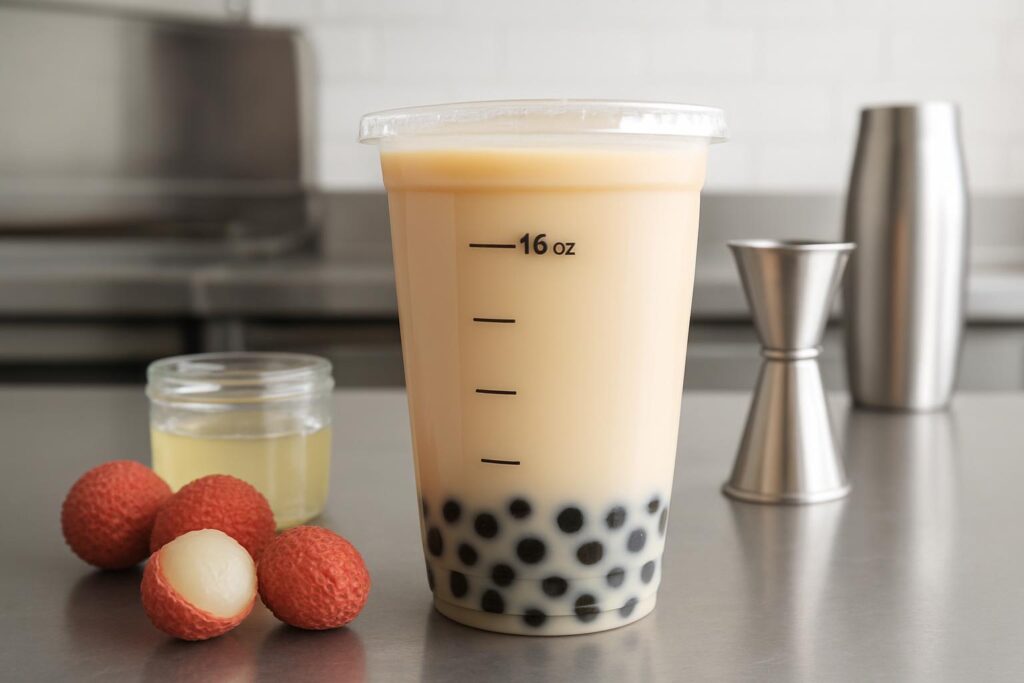
Option B: Lychee puree (best “real fruit” perception, more variability)
Use puree when you want:
- a premium story (“real fruit”)
- a thicker mouthfeel
Tradeoffs:
- more prep labor
- more separation risk (especially if puree is thin)
- more waste if you don’t have steady demand
Option C: Lychee powder (most standardized, easiest to keep identical)
Use powder when you want:
- repeatable flavor even with new staff
- a stable inventory item
- a thicker, more uniform body (many commercial powders include creamer)
Powder-style recipes often blend powder directly into milk for a consistent base, which mirrors how many shops standardize flavored milk teas.
Pro Tip: If your shop is struggling with “watery” fruit milk teas, start by tightening your milk solids (milk choice + measured milk volume) and your tea strength before you add more syrup.
16 oz (US) lychee boba milk tea build spec
This section gives you a starting spec you can calibrate with a sugar scale (0/25/50/75/100%).
Target profile
- Flavor: floral lychee up front, tea structure in the back
- Sweetness: medium (good default for US shops)
- Body: creamy, not heavy
Base ratio (what you’re aiming for)
A practical starting range for fruit milk tea is roughly:
- 60–70% tea base
- 20–30% milk
- 10–20% lychee syrup/puree
That ratio is broad on purpose—your tea strength and your lychee product sweetness will determine where you land.
Shop-default recipe (16 oz iced)
Ingredients (per 16 oz / 473 ml cup)
- 5.5 oz (165 ml) strong brewed tea base (black tea or jasmine green tea), chilled
- 2.5 oz (75 ml) milk (see milk notes below)
- 1.0–1.5 oz (30–45 ml) lychee syrup or 1.5–2.0 oz (45–60 ml) lychee puree
- Ice: fill cup to the top
- Optional topping (choose one): tapioca pearls, lychee jelly, or popping boba
Build steps (service)
- Add topping to cup (if used).
- Done when: topping sits evenly at the bottom and isn’t clumped.
- Add measured lychee syrup/puree.
- Done when: your jigger hits the line—no free-pouring.
- Add milk.
- Done when: milk volume is consistent across builds.
- Add chilled tea base.
- Done when: tea reaches the target line before ice.
- Fill with ice, seal, and shake 8–10 seconds.
- Done when: cup exterior is frosty and the drink color looks uniform.
⚠️ Warning: Don’t build with warm tea. It melts ice instantly and your recipe “drifts” cup-to-cup.
Milk options (choose based on your menu and cost target)
If you want a deeper breakdown of milk choices and how they affect body and cost, see BubbleTeaSuppliers.com’s guide on what kind of milk works best in a boba shop
.
Practical operator guidance:
- Whole milk: easy default, good body.
- Oat milk (barista blend): popular non-dairy option; body is usually better than almond.
- Half-and-half: use for a “rich” premium build, but watch cost.
If your lychee milk tea tastes thin, use the texture controls in Creamy Milk Tea Recipe: how to get a richer, smoother cup
to diagnose whether you’re missing fat, protein, solids, or mixing.
Tea base SOP (batch prep for consistency)
Your tea base should be stronger than “drinking tea” because you’re diluting it with milk, lychee, and ice.
Tea choice
- Black tea: classic backbone; holds up under sweetness.
- Jasmine green tea: lighter and floral—pairs naturally with lychee.
For a broader pairing mindset (which tea works best with which fruits), BubbleTeaSuppliers.com’s fruit bubble tea combinations guide
is a good internal reference.
Batch brew steps
- Brew tea at your chosen strength (keep it consistent—same grams, same time, same water temp).
- Done when: brewed tea hits your target color and aroma every batch.
- Strain (if using loose leaf).
- Done when: no leaf sediment remains.
- Cool quickly.
- Done when: tea is cool enough to refrigerate without warming the fridge.
- Refrigerate and label.
- Done when: container is dated, time-stamped, and stored covered.
For cooling guidance, the National Restaurant Association highlights common Food Code cooling targets (cooling from 135°F to 70°F within 2 hours, then 70°F to 41°F within 4 hours) in its safe food procedure guidance
.
Holding times, cold storage, and food safety (operator baseline)
This is not legal advice and local health department rules vary, but you should build your SOP around conservative, standard baselines.
Temperature control
Keep perishable beverage ingredients cold. A common baseline is 41°F (5°C) or below—see StateFoodSafety’s refrigerator storage guidance
.
Practical holding rules for lychee milk tea service
- Hold tea base cold, covered, and labeled.
- Hold milk cold and return it to refrigeration fast during service.
- Hold lychee syrup/puree cold once opened (unless it’s explicitly shelf-stable after opening).
- Do not pre-mix milk + fruit + tea in bulk unless you have a tested process. Build to order for best quality.
Pro Tip: Most “separation” complaints are quality issues caused by warm ingredients + slow service. Keep everything cold and shake right before handoff.
Costing: how to price lychee milk tea (and your milk tea cost per cup) with confidence
You don’t need perfect numbers—you need a repeatable method and a standard portion spec.
Step 1: Track your portion costs
For each ingredient, record:
- cost per unit (per oz, per gram, or per ml)
- portion used per 16 oz cup
Typical COGS drivers:
- tea (leaf cost + batch yield)
- milk (dairy vs oat vs half-and-half)
- lychee flavor format (syrup vs puree vs powder)
- topping (pearls/jelly/popping boba)
- cup/lid/straw
Step 2: Use a simple per-cup formula
COGS per cup = tea + milk + lychee + topping + packaging + wastage allowance
Add a wastage allowance (for example, 3–8%) if you’re introducing a new syrup/puree and you expect some spoilage or training waste.
Step 3: Set sweetness defaults (so costs don’t drift)
If your team free-pours sweeteners, your costs will drift. Most boba shops use a sugar scale (0/25/50/75/100%). One US shop guide quantifies a ~500 ml cup at roughly 50–60 g sugar at 100%, and about 25–30 g at 50% in its breakdown of typical boba shop sugar levels and what they mean in grams
.
You don’t have to copy those exact grams—but you should pick a standard and train to it.
Troubleshooting (the 5 problems that kill consistency)
1) “It tastes weak”
Likely causes
- tea base brewed too light
- too much ice melt (warm ingredients)
- lychee dose overpowering the tea backbone
Fix
- strengthen tea base and always chill before service
- tighten the tea-to-milk ratio before adding more syrup
2) “It’s watery”
Likely causes
- low milk solids (thin milk)
- under-shaking
- too much dilution from ice
Fix
- upgrade milk choice or adjust milk volume (without increasing sweetness)
- follow the body checklist in the creamy milk tea texture guide (linked earlier)
3) “It’s too sweet”
Likely causes
- syrup is doing double-duty as flavor + sweetener
- staff are adding extra sugar “just in case”
Fix
- drop your default lychee syrup dose by 0.25 oz (7–8 ml) and retest
- standardize sugar levels and stop free-pouring
4) “It separates after a few minutes”
Likely causes
- warm tea into cold milk + ice (fast dilution)
- thin non-dairy milk
- high-acid fruit base
Fix
- chill tea base
- use barista-style non-dairy milk
- shake and serve immediately
5) “Customers want more lychee aroma, but I don’t want more sugar”
Fix options
- use a more aromatic lychee syrup at the same dose
- switch to a small amount of puree for aroma (and lower added sugar elsewhere)
- keep sweetness at 50–75% and let aroma do the work
Staff training checklist for a bubble tea shop SOP
- Use jiggers for lychee and milk (no eyeballing)
- Use a labeled tea base with a set brew recipe
- Chill tea base before service
- Choose one default milk and one default lychee format for daily service
- Taste-test every new batch at the start of shift
- Keep cold ingredients cold (target 41°F / 5°C or below)
Next steps (resources + related guides)
If you’re building a shop SOP library, the milk tea ingredients hub
is a useful place to pull standardized ingredient and workflow references—and it’s a clean way to keep your training docs consistent across recipes.