
Mango + passionfruit is one of those “easy sellers” that can quietly become a top-5 order—if you standardize it. The flavor combo is forgiving (sweet mango + bright, tart passionfruit), but the execution isn’t: tea strength drifts, ice varies, and staff eyeballing turns a great drink into “mango sugar water.”
This guide is built for US bubble tea shop owners and managers who want two things at the same time:
- a consistent mango passionfruit fruit tea that tastes the same at 11am and 7pm,
- a menu that feels big (8–15 variations) without buying 15 new SKUs.
The simplest way to build a mango passionfruit menu: 4 modules
A clean mango passionfruit fruit tea program is easier when you treat it like LEGO:
- Tea base (the structure)
- Mango core (your main flavor driver)
- Passionfruit modifier (the “top note” that makes it pop)
- Toppings (texture + upsell)
This matches the operator-style 4-module mango fruit tea menu framework laid out by BubbleTeaSuppliers.com.
Pro Tip: Treat passionfruit as a modifier, not a second equal flavor. That keeps the drink mango-forward (what customers expect) while still giving it that bright tropical snap.
A high-volume “starter kit” that still feels like a full menu
If you want a small inventory footprint, use a starter kit approach:
- Tea bases: jasmine green tea + black tea
- Mango core: pick one primary format (syrup or puree or concentrate)
- Modifiers: passionfruit + lemon (or lemonade)
- Toppings: mango popping boba + lychee jelly (+ classic boba if you already run pearls well)
That exact “starter kit” logic is also recommended in BubbleTeaSuppliers.com’s mango menu ideas post.
Pick your tea base: jasmine green vs black vs oolong
Your tea base decides whether the drink reads as refreshing or heavy, and whether it tastes clean after ice dilution.
Option A: Jasmine green tea (default for fruit tea)
Jasmine green tea is usually the best default for mango passionfruit fruit tea because it stays light and lets fruit lead. A bubble-tea education guide from Bobatopia notes that green tea blends especially well with fruit-based bubble teas like mango and passionfruit because of its brightness and lighter body (Bobatopia: “Tea Education”
).
Use jasmine green tea when:
- you want a clean, bright, “refreshing” menu description
- your customer base prefers lighter, non-dairy drinks
- you plan to add citrus (lemon/lemonade) as an upsell modifier
Option B: Black tea (for a bolder, more tannic backbone)
Black tea can work if your fruit tea customers like stronger tea character (or if your mango format is very sweet and needs structure). But black tea can also read more astringent when the drink is heavily iced.
Use black tea when:
- your shop’s fruit teas are often ordered at higher sweetness levels
- you want a more “tea-forward” finish
- you’re selling this as a bridge for milk-tea regulars
Option C: Oolong (premium feel, but keep it consistent)
Oolong can create a more premium aromatic profile. The tradeoff is operational: a more complex tea is more noticeable when the tea base drifts (over-steep, under-steep, old tea in the dispenser).
Use oolong when:
- you already run an oolong program with solid tea standards
- you want a “grown-up” mango passionfruit green tea alternative
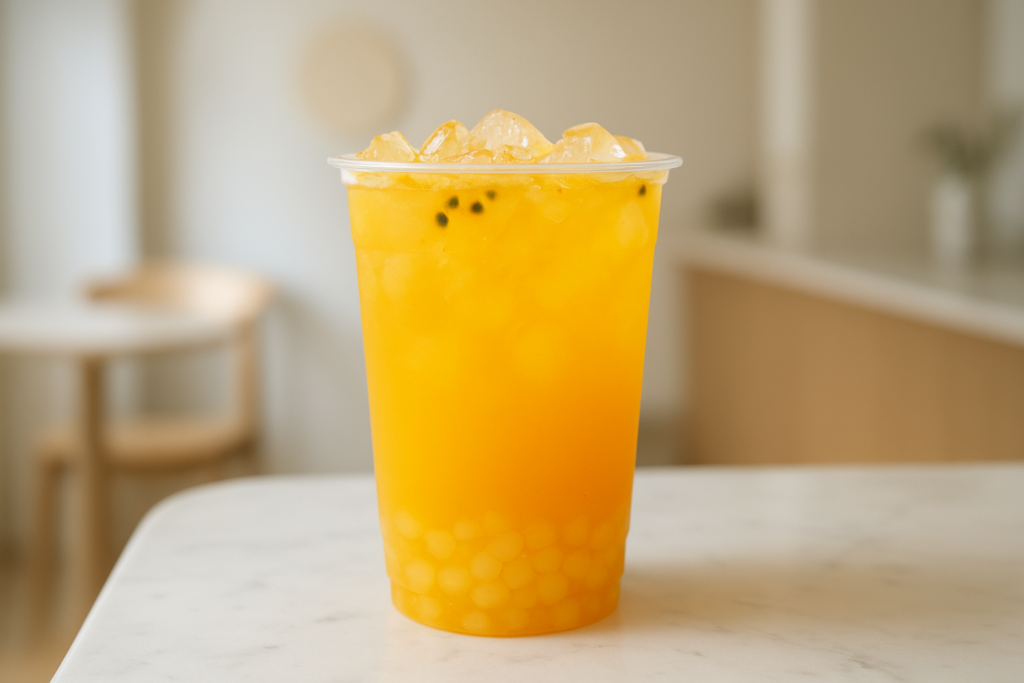
Choose your fruit tea ingredients: puree vs syrup vs powder
Most shops struggle here because they pick mango based on taste alone—and then wonder why it’s chaos in production.
A good operator decision framework is laid out in BubbleTeaSuppliers.com’s “puree vs syrup vs powder” guide (linked below). Even though it’s written through a fruit milk tea lens, the operational tradeoffs map well to fruit tea.
If you’ve been searching for fruit tea ingredients puree vs syrup vs powder, the short version is: syrup = speed and repeatability, puree = premium fruit character, powder = creamy profiles + dry storage.
This is the same logic behind mango fruit tea menu ideas: your format choice changes speed, consistency, storage needs, and even how “premium” the drink feels.
Mango syrup (best for speed + consistency)
What it gives you: fast builds, predictable sweetness, easy training.
Best when:
- you’re high volume
- you have newer staff
- you want the drink to stay visually clean (no settling)
Failure mode: too sweet + “candy mango” if you dose heavy.
Mango puree (best for premium “real fruit” character)
What it gives you: thicker mouthfeel, more fruit authenticity.
Best when:
- you can turn the product fast (reduce waste)
- you can enforce clean tools, lids, labeling, and cold holding discipline
Failure mode: separation and inconsistency if staff under-mix or if puree thickness varies.
Mango powder (best for creamy profiles, not clear fruit tea)
Powder is a better fit for milk tea and smoothies than for a clear fruit tea. If you do use powder for a fruit-tea-adjacent drink, you’ll need disciplined mixing to avoid clumps.
Failure mode: grainy texture and uneven flavor.
Treat passionfruit like a modifier: how to dose it without making the drink sour
Passionfruit is strong. It brings sharp acidity and aroma, which is why it pairs so well with mango.
A practical way to think about it:
- Mango is your base flavor (sweet, round, familiar)
- Passionfruit is your top note (bright, aromatic, tart)
If you want deeper product-ingredient thinking, The Perfect Purée explains that concentrates are thinner and can be 200–250% stronger than puree equivalents, while purees add body (The Perfect Purée: “What’s the Difference?”
). That matters because passionfruit concentrate can easily overtake the drink.
A simple dosing rule for ops
- Start with a mango fruit tea that tastes “right.”
- Then add passionfruit just until the finish is brighter and slightly tangy.
If your staff can’t taste-test routinely during rush, build your passionfruit as a measured pump/jigger and lock it.
⚠️ Warning: Passionfruit + over-steeped green tea is a common “too sharp” combo. If customers complain it’s sour, check tea bitterness and passionfruit dose before you add more sugar.
Your standard mango passionfruit fruit tea SOP (16–18 oz)
This is the “shop reality” build: consistent, fast, and easy to train.
BubbleTeaSuppliers.com’s shop-ready mango fruit tea SOP
emphasizes that the best recipe is a formula with QC checks, not a one-time ingredient list.
Step 1: Standardize your tea base (don’t skip this)
If your tea base isn’t consistent, your mango passionfruit fruit tea will never be consistent.
A bubble-tea brewing guide from MasterCarefully recommends a typical hot-brew tea-to-water ratio of 1:40 by weight, with a rapid-cool option of 1:35:5 (tea:water:ice), plus tea-type water temperatures and steep times (MasterCarefully: “Three Methods for Brewing Tea in Bubble Tea Shops”
).
Operator translation: write your tea recipe on the wall, weigh tea, use a timer, and label the batch time.
Step 2: Pre-portion the mango core
Do not eyeball mango—ever.
- Pumps (fastest) or jiggers (most accurate)
- One standard amount for 16 oz and one for 18 oz
Step 3: Mix in the right order (this prevents streaks and weak flavor)
- Add mango core to shaker
- Add chilled tea
- Mix until fully uniform (scrape bottom if using puree)
- Add passionfruit modifier (measured)
- Add ice to your standard line and shake hard until frosty
Step 4: QC in 10 seconds (your “rush-hour test”)
Train staff to check:
- Mango intensity: does it read as mango immediately?
- Tea backbone: does it still taste like tea, not juice?
- Finish: is passionfruit bright, not sour?
If it fails, troubleshoot in this order:
- tea strength and batch age, 2) ice standard, 3) under-mixing, 4) mango dose, 5) passionfruit dose.
How to create 10+ menu variations without adding 10+ new SKUs
Here’s the point of the module system: you can sell “new” drinks by changing just one module.
Variation set A: change the tea base (3 options)
- Mango Passionfruit Jasmine Green Tea (default refresh)
- Mango Passionfruit Black Tea (bolder, tea-forward)
- Mango Passionfruit Oolong Tea (premium aromatic)
Variation set B: change the citrus lift (3 options)
- Mango Passionfruit + Lemon squeeze (small brightness)
- Mango Passionfruit Lemonade-style (bigger citrus profile)
- Mango Passionfruit + calamansi-style (if you already stock it)
Variation set C: change the texture topping (at least 6 options)
The mango passionfruit pairing entry
recommends green/jasmine tea and toppings like tapioca pearls or lychee jelly.
Build a topping ladder (fastest to slowest):
- Mango popping boba (on-theme, easy upsell)
- Lychee jelly (chewy, floral-friendly)
- Aloe vera (clean, “fresh” perception)
- Coconut jelly (tropical, low-risk)
- Tapioca pearls (classic, but only if your pearl quality is strong)
- Mixed jelly (only if it doesn’t slow service)
Add-ons that increase AOV without breaking the drink
Most add-ons fail because they’re either too many flavors at once, or they slow down ticket time.
Best add-ons for mango passionfruit fruit tea
- Extra topping (double jelly / add popping boba)
- Citrus upgrade (lemonade-style)
- Tea base upgrade (jasmine → oolong “premium”)
Add-ons to be careful with
- Dairy add-ons (can dull the brightness and complicate ops)
- Too many fruit modifiers (turns into a muddled “tropical punch”)
BubbleTeaSuppliers.com suggests labeling mango fruit tea as “refreshing, non-dairy” by default and making dairy optional to reduce order confusion (see their mango menu ideas post).
Operational notes: batching, holding, and avoiding separation
Batch tea daily, but don’t batch finished fruit tea
Batching tea is good. Batching finished mango passionfruit fruit tea usually isn’t—ice dilution and fruit intensity drift.
If you must pre-mix for catering, keep fruit separate until the last possible moment.
Control ice like it’s an ingredient (because it is)
If one staff member uses “one scoop” and another uses “whatever,” your drink is a different product.
Pick:
- one scoop size
- one fill line
- one shake time
Prevent separation in puree builds
If you run mango puree (or passionfruit puree):
- Use a consistent shake time
- Scrape the bottom of the shaker (puree clings)
- Reduce hold time (serve fresh)
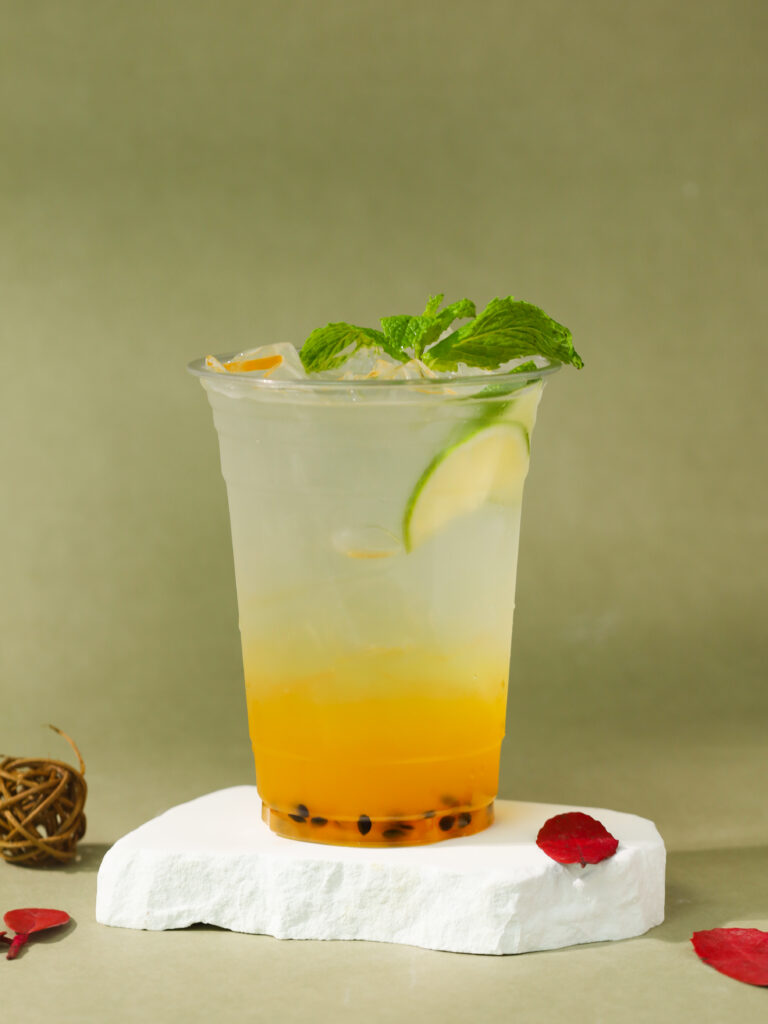
FAQ: Mango & passionfruit fruit tea in a boba tea shop
Is mango passionfruit fruit tea better with green tea or black tea?
For most shops, jasmine green tea is the best default because it keeps the drink light and fruit-forward. Black tea can work if you want a bolder, more tannic finish or if your customer base prefers stronger tea character.
Should I use puree or syrup for mango passionfruit fruit tea?
If you’re optimizing for speed and repeatability, use syrup. If you want a premium fruit-forward version (and you can manage storage and mixing discipline), use puree.
How do I stop my fruit tea from tasting watery?
Fix the basics first: tea strength, tea freshness, and ice standard. The BubbleTeaSuppliers.com SOP recommends adjusting tea and ice consistency before increasing syrup.
What toppings sell best with mango passionfruit?
Fast sellers tend to be mango popping boba and lychee jelly because they match the tropical profile and don’t slow down service.
Next step
If you want a simple way to standardize this drink across shifts, start with the 4-module framework and the shop-ready SOP from BubbleTeaSuppliers.com
and lock in three standards: tea recipe, ice line, and fruit dosing.