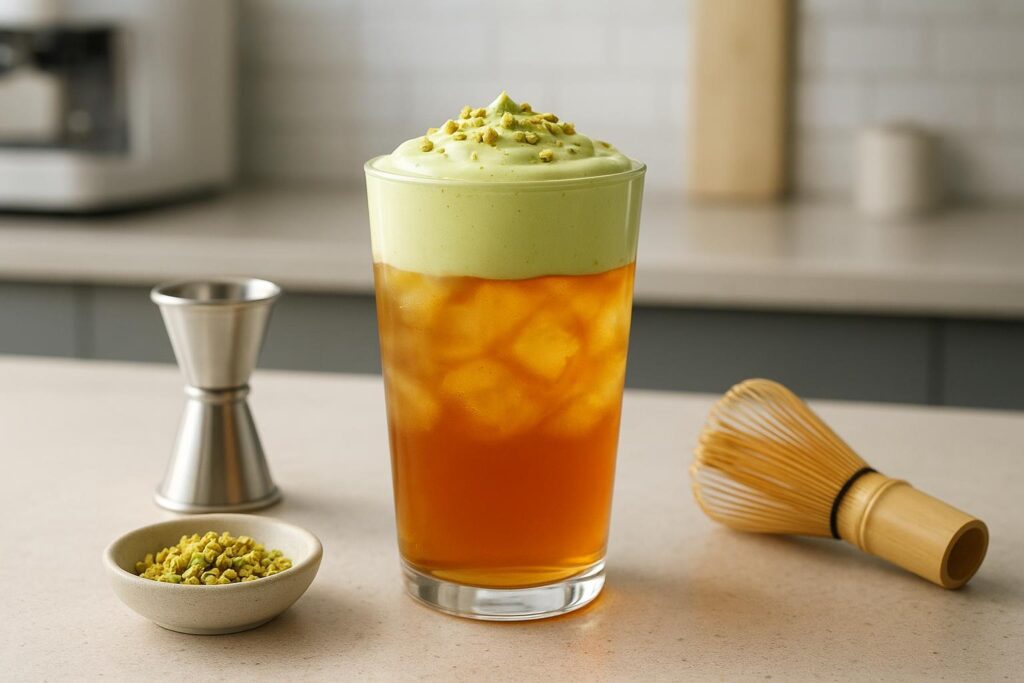
But pistachio cheese foam is one of those toppings that can either feel like a premium signature… or like a remake factory that slows your line down.
If you’re testing it for a boba tea shop menu, the first decision isn’t “what’s the recipe?”
It’s which type of pistachio foam you’re actually trying to run—because each one wins on different criteria: speed, holding, cost, and how forgiving it is with new staff.
This guide compares the three operator-realistic options, and shows you how to choose the right one for your shop.
The 3 pistachio foam options operators actually mean
Different shops use different names (milk cap, cheese cap, cheese foam). For decision-making, it helps to standardize the options:
Best when you want: faster production and a topping that plays nicer with more drinks.
Biggest risk: it can taste like “sweet cream with pistachio,” not “pistachio cheese.”
Option 3: Powder-assisted pistachio foam (built for speed)
This is the operationally easiest approach: use a stabilizing base (shop creamer/foam base, dairy powder, or a commercial foam mix), then add pistachio flavor.
Best when you want: consistency across staff, predictable cost, and fast builds.
Biggest risk: if the base tastes “processed,” it can read as lower-end unless your flavor balance is tight.
Key Takeaway: If you want a true “cheese foam” sensory profile, Option 1 is the only one that reliably gets you there. Options 2 and 3 win on speed and consistency.
The decision criteria that matter in real service
When shops test toppings, they often fixate on taste and forget ops. Here are the criteria that usually decide whether pistachio cheese foam survives past the trial week.
1) Speed of service
Ask: Can a new hire build it during a 10–20 drink rush without slowing the line?
Option 1 is slower (more steps + higher failure risk).
Option 2 is faster.
Option 3 is fastest.
2) Holding behavior (what happens after 30–60 minutes)
Foams are unstable by nature. Even high-quality versions change texture as they sit.
As Serious Eats notes, cheese foam is meant to be served immediately; it’s not a “leave it on the counter” topping, and the texture target is flowable—not stiff like whipped cream (Serious Eats’ cheese foam tea recipe
).
Practical operator takeaway: plan for cold holding, small batches, and a defined re-whisk rule.
3) Remake risk
Pistachio + dairy has two common remake triggers:
the foam turns grainy/lumpy
the foam becomes too runny (won’t sit, pours into the drink)
4) Menu compatibility
Your topping needs “safe homes” on the menu.
Pistachio tends to play well with: oolong, jasmine green, black tea, and matcha-style profiles.
It tends to fight with: very acidic fruit teas (acid increases curdling/separation risk for dairy foams).
5) Cost per serving + waste
The most expensive topping isn’t the one with the priciest ingredients.
It’s the one you dump.
A slightly cheaper foam with predictable holding and fewer remakes often wins on margin.
6) Training and QC simplicity
If your foam requires “feel” instead of checkpoints, it will drift over time.
You want a standard texture target your team can recognize.
One useful texture cue: thick-but-pourable, like a slow ribbon off a spoon—a cue emphasized in shop-focused SOP writing like BubbleTeaSuppliers’ shop-ready hojicha cheese foam SOP
.
Head-to-head: which option wins by criteria
Here’s the comparison in plain terms.
If your priority is premium taste + “cheesecake” identity
Choose Option 1 (true pistachio cheese foam).
Why it wins:
unmistakable cream-cheese richness
sweet-salty finish reads premium
easiest to market as “pistachio cheese foam” honestly
What must be true operationally:
you can standardize your process (soften → smooth base → whip to target)
you can control holding and re-whisking
If your priority is speed + broad menu fit
Choose Option 2 (pistachio cream foam).
Why it wins:
faster build
fewer “split” events
works across more drinks (including coffee-style specials if you run them)
Tradeoff:
it’s not truly “cheese foam,” so name it accurately (pistachio cream foam / pistachio cold foam).
If your priority is consistency across staff + predictable cost
Choose Option 3 (powder-assisted pistachio foam).
Why it wins:
most forgiving
easiest to scale
simplest to portion and forecast
Tradeoff:
you need to nail flavor balance so it still tastes premium.
How to choose your pistachio flavor format (powder vs syrup vs paste)
Your pistachio ingredient choice affects both flavor and stability.
Pistachio powder
Best for:
bubble tea style builds
consistency
fast blending and predictable sweetness
Operational upside:
stable
easy to portion
Pistachio syrup
Best for:
quick integration
drinks where pistachio is an accent rather than a hero
Operational upside:
dissolves easily
fastest “add flavor” method
Pistachio paste
Best for:
premium hero drinks
richest pistachio aroma and mouthfeel
Operational watch-outs:
can separate (oil)
tends to cost more
needs tighter storage/handling
If you need a neutral baseline for what pistachio paste is and how it’s typically made, see American Pistachio Growers’ pistachio paste recipe
.
Pro Tip: For Option 1 (true cheese foam), start with powder or syrup for your first test week. Paste can be incredible, but it adds another variable (oil separation) while you’re still training consistency.
The failure modes that kill pistachio cheese foam (and how to fix them)
Problem: Grainy or lumpy foam
Most common causes:
cream cheese wasn’t softened
sugar didn’t dissolve
Fix pattern:
smooth the base fully before you add more liquid and whip
A shop-oriented troubleshooting reference that calls out this “smooth base first” standardization is the shop-ready hojicha cheese foam SOP mentioned above.
Problem: Split / separated foam
Most common causes:
over-whipping
temperature swings
Fix pattern:
chill briefly, then re-mix gently
avoid whipping to stiff peaks
Problem: Foam is too runny
Most common causes:
too much milk/liquid
ingredients too warm
Fix pattern:
chill to firm
tighten ratios on the next batch
For a simple ingredient baseline (useful for training new staff on what “normal” looks like), China Sichuan Food’s cheese foam ingredient baseline
is a quick reference.
Problem: Tastes too salty for pistachio
Most common causes:
salt is calibrated for classic tea, but pistachio reads “dessert”
Fix pattern:
reduce salt slightly and increase pistachio aroma (not just sweetness)
keep the finish lightly savory, not briny
A practical “pick this if…” recommendation
Use this to decide quickly.
Pick Option 1 (true pistachio cheese foam) if…
you want a signature premium topping you can market hard
you can enforce a tight SOP and QC checks
you’re comfortable batching small and refreshing often
Pick Option 2 (pistachio cream foam) if…
your shop is high-volume and line speed matters most