
Purple yam milk tea can be a quiet menu winner: it’s visually striking, it feels “dessert-like” without being heavy, and it gives customers a reason to try something other than the usual brown sugar or classic milk tea.
The problem is consistency. If you’ve ever tested a purple yam drink that turned out grainy, separated in the cup, or tasted like “sweet purple” instead of an actual ingredient, you already know why this needs a real SOP.
This guide is written for US bubble tea shop owners and managers. It starts by clearing up the naming (because it matters for customer expectations), then gives you a shop-ready build with batch options, QC checks, and troubleshooting.
What “purple yam” means in a US bubble tea menu
When customers see “purple yam,” they may assume a few different things:
Ube (a true purple yam)
Purple sweet potato (different ingredient)
A drink that’s mostly color + extract
Because these are often confused, your menu name should be explicit. If you’re using ube, call it “Ube (Purple Yam) Milk Tea.” If you’re using purple sweet potato, say that clearly.
For a quick ingredient-level distinction (and why the flavor/texture can differ), WebstaurantStore’s explainer on the key differences between ube (purple yam) and purple sweet potato is a useful reference.
Why purple yam milk tea sells (even if you’re not a “dessert drink” shop)
This flavor works in a lot of stores because it hits three things customers buy with their eyes and memory:
Color payoff: purple drinks stop the scroll and look premium in photos.
Comfort profile: yam-like sweetness reads “warm and cozy,” even served iced.
Easy pairing: it plays well with boba, pudding, and light foams.
Operator-wise, it also gives you a lever for limited-time variations (foam, toasted notes, a second layer, a topping swap) without rewriting your whole bar.
The two failure modes to design around: grittiness and separation
Purple yam drinks go wrong in predictable ways.
Grittiness (sandiness, tiny lumps)
Most often, this happens when the yam base isn’t fully hydrated/cooked, or it isn’t blended smooth enough before it hits milk and ice.
Separation (layers, settling, “purple sludge” at the bottom)
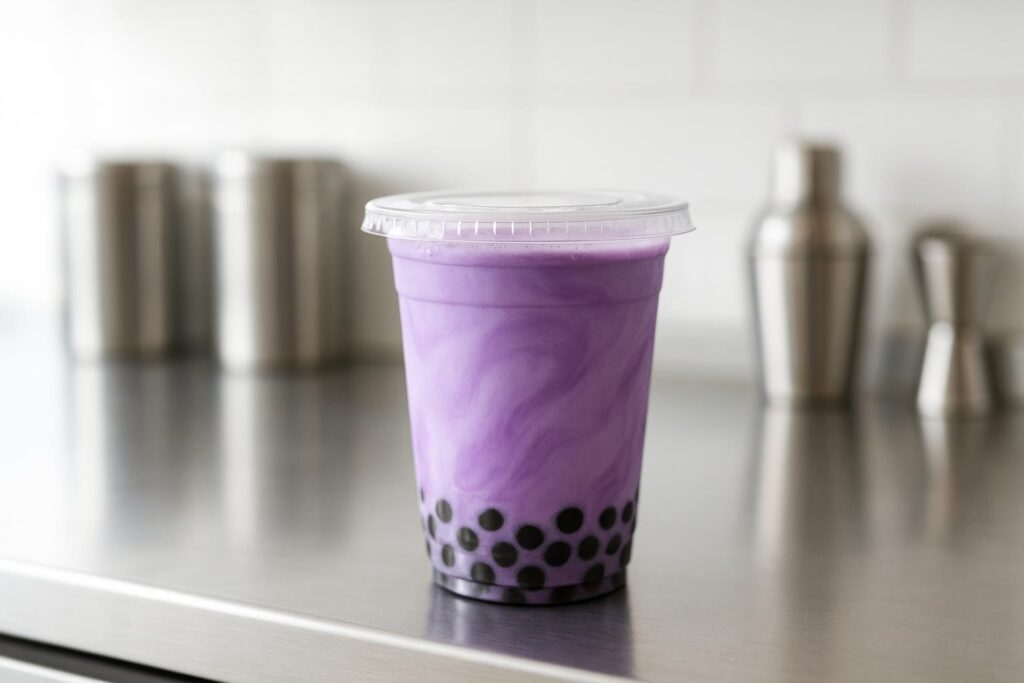
A starchy base will settle if it’s under-emulsified or if the drink sits too long before serving. Your SOP should assume:
The base needs a defined hold time, and
Staff should shake thoroughly right before serving.
Pro Tip: If you can make the base smooth enough to pass through a fine strainer before service, you’ll solve most “something’s off” complaints.
Purple yam milk tea SOP (shop-ready build)
This SOP is built for consistency first. If you want a baseline to standardize all your milk tea builds across flavors, BubbleTeaSuppliers.com’s shop-ready milk tea SOP framework is a solid reference.
Equipment checklist
Digital scale (grams)
Sauce pot + whisk
Immersion blender (or high-power blender)
Fine mesh strainer
2–4L food-safe container
Label tape + marker (date/time)
Ingredients (core build)
You’ll dial these based on your shop’s sweetness and dairy standard, but keep the structure consistent.
Brewed tea (black tea is a common start)
Milk base (dairy or non-dairy)
Purple yam base (see options below)
Sweetener (choose one primary path)
Ice
Optional topping: tapioca pearls
For milk selection (especially if you’re deciding between whole milk, non-dairy, or creamer systems), BubbleTeaSuppliers.com’s guide on how to choose milk for boba shop drinks can help you standardize across the menu.
Step 1: Pick the right “real yam base” for your labor model
You said you want actual purple yam as the base. In practice, shops land in one of these lanes.
Option A: Fresh or frozen purple yam (highest ingredient integrity, highest labor)
Best for: shops that want “real ingredient” storytelling and can afford prep time.
Workflow (high level):
Cook yam until fork-tender.
Blend smooth with a small amount of liquid.
Cook it down into a spoonable concentrate.
Your goal isn’t mashed yam. Your goal is a smooth concentrate that portions consistently.
Option B: Purple yam paste / halaya-style base (practical, still reads as real yam)
Best for: shops that need speed and repeatability while keeping an honest ingredient story.
A technique that translates well to beverage bases is: fully hydrate/cook the yam component first, then add dairy/sweeteners. Hungry Huy describes a method for hydrating ube powder, cooking it down to a thick applesauce texture, then adding dairy to avoid raw/gritty texture.
Even if you’re not using powder, the principle still holds: smooth and cook the yam base first; don’t rely on shaking-in-cup to fix texture.
Why this matters for your menu language
If you’re used to seeing “ube milk tea” online, most of those recipes are referencing ube flavor broadly (sometimes powder, sometimes extract). Your positioning is stronger: you’re making purple yam milk tea with a real yam base, and your SOP should make that obvious.
Step 2: Make a purple yam base concentrate (batch)
This is the part that makes the drink consistent.
Target spec (what “done” looks like)
Texture: smooth enough to pour slowly; no perceptible grains
Color: uniform purple (no streaks)
Taste: clear yam sweetness; not “purple vanilla” only
Starter batch workflow (operator-friendly)
Cook your purple yam input until fully soft/hydrated.
Blend warm (carefully) until smooth.
Strain through a fine mesh strainer.
Cook down on low heat until spoonable.
Cool fast, then store cold.
⚠️ Warning: If you skip the blend + strain step, you’re betting your whole drink on “shake harder.” That rarely ends well in a rush.
Batch yield and portion control (simple math)
Your concentrate should be portioned the same way every time. Two practical approaches:
By weight per drink: easiest for training. One number per cup size.
By pumps/scoops: faster in rush, but only if your base viscosity is stable.
If you go the pump/scoop route, set a “done when” rule: the base must pour in a consistent ribbon and not break into chunks.
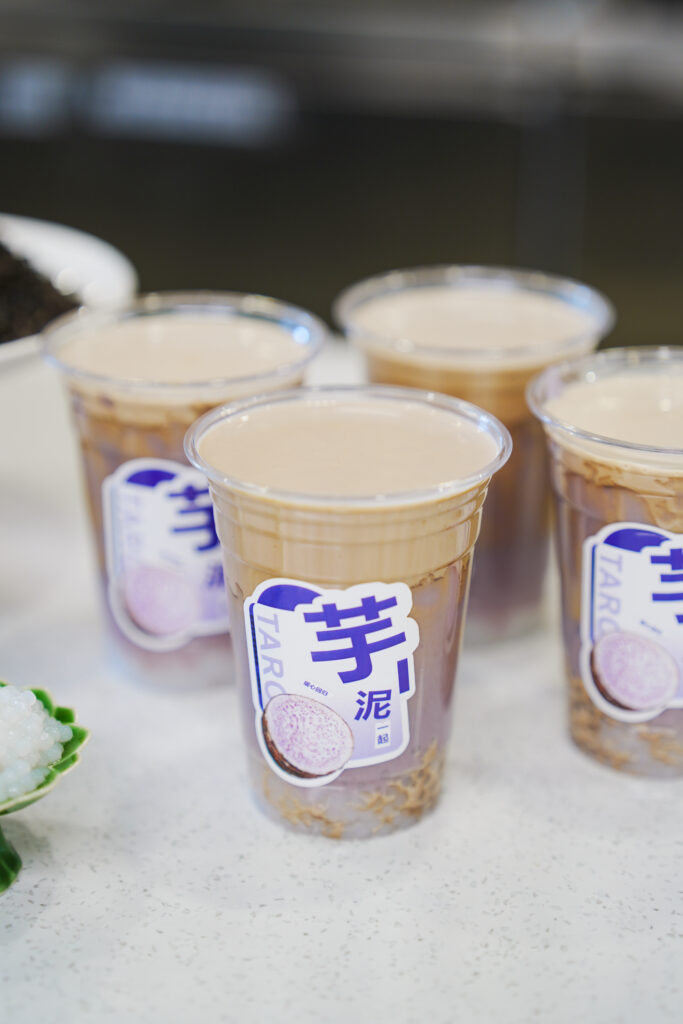
Label + hold time rule
Create one rule your team can follow without thinking:
Label each batch with made time and a use-by time based on your food safety program.
If the base is older than your allowed hold window, discard.
(Exact hold times depend on your ingredients and local requirements—set these with your manager/food safety lead and stay conservative.)
Step 3: Service build (per drink)
This is a reliable starting build. Adjust sweetness and tea strength to your menu, but keep the sequence the same.
Add purple yam base concentrate to shaker.
Add sweetener.
Add milk base.
Add brewed tea.
Add ice.
Shake hard until the cup is cold and the drink looks uniform.
Add boba (optional) and pour.
If a customer asks “how to make ube milk tea at home,” the answer is basically the same shape—smooth base first, then milk/tea/ice—just with smaller equipment.
Tea base selection
If you’re debating black vs oolong vs jasmine for your shop’s milk tea lineup, BubbleTeaSuppliers.com’s overview of tea base options commonly used in boba shops is a good starting point.
QC checkpoints your staff can actually use
You don’t need a lab. You need three checks that catch mistakes early.
1) Visual check (10 seconds)
Uniform purple, not streaky
No visible specks or fibers
If it’s layered, shake again before serving
2) Sip check (one straw pull)
Smooth mouthfeel (no “sand”)
Balanced sweetness
Yam flavor is present even when cold
3) Rush-proof check
If a new staff member can’t build it reliably during peak:
Your base is too thin (separates)
Or your base is too thick (clogs, inconsistent portioning)
Fix the base—don’t “train harder” as the only solution.
Troubleshooting: the fixes that usually work
If it’s gritty
Increase blend time.
Strain the base.
Cook the base longer on low heat.
Don’t add cold milk early if your base still has raw starch texture.
If it separates fast
Increase concentration (thicker base holds better).
Shake harder/longer.
Reduce sit time: build closer to handoff.
If the color looks dull
Check base concentration.
Make sure you’re not over-diluting with too much tea.
Confirm you didn’t accidentally switch ingredients (ube vs purple sweet potato vs extract-only).
Menu naming and customer expectations (small detail, big payoff)
If you’re using actual purple yam, you can be straightforward:
Ube (Purple Yam) Milk Tea
Purple Yam Milk Tea (with a short descriptor like “real yam base” if your market needs it)
This reduces refunds and “this doesn’t taste like what I expected” complaints.
A simple topping note
Purple yam milk tea does well with classic boba, but only if the boba texture is on point. If you’re standardizing pearls, BubbleTeaSuppliers.com’s explainer on chewy boba texture basics is a helpful quick refresher for training.
FAQ
Is purple yam the same as purple sweet potato?
No. They’re different ingredients with different texture and flavor behavior. If you’re using ube, label it as ube (purple yam). If you’re using purple sweet potato, name it clearly so customers know what they’re getting.
Can I make this without tea?
You can, but then you’re selling a flavored milk drink, not a milk tea. If your customers expect “tea,” keep a tea base (even mild) so the name matches the experience.
Is this basically an “ube halaya drink”?
It can be, depending on your base. If your purple yam concentrate is similar to halaya (a cooked-down yam paste), you’re essentially using a halaya-style base as the flavor and texture engine—then thinning it into a milk tea.
What’s the fastest way to make it smoother?
Treat smoothness as a base problem, not a shaker problem: blend the warm base thoroughly and strain it before you dilute it into the drink.
Next step (low-friction)
If you’re building more flavors and want your whole menu to feel consistent, standardize your tea base, milk choice, and QC checks across every milk tea you serve—and keep BubbleTeaSuppliers.com’s milk tea SOP resources as your reference point.