
If you’re opening a bubble tea shop in the US, Southeast Asia can be a smart place to source core ingredients—if you buy with the right specs and paperwork.
The mistake most new shops make is treating “boba ingredients” like commodity groceries. They’re not. Tapioca pearls, syrups, powders, and tea live or die on batch consistency, shelf stability, and whether your shipment clears import checks without drama.
This guide is written for the consideration stage: you’re comparing options (US distributors vs. importing), trying to understand trade-offs, and building a supplier shortlist you can actually trust.
Key Takeaway: Before you compare suppliers, compare your own requirements (menu, volume, storage, timeline). That’s what determines whether importing from Southeast Asia is a win or a headache.
Boba ingredients wholesale: what you’re really buying
When you buy boba ingredients wholesale from overseas, you’re not just buying flavor. You’re buying repeatability (each lot tastes the same), documentation (each shipment clears), and survivability (the product arrives in good condition after heat + humidity + transit).
That’s why the right question isn’t ‘Who has the cheapest pearls?’ It’s ‘Who can meet my spec sheet and prove it with lot-level paperwork?’
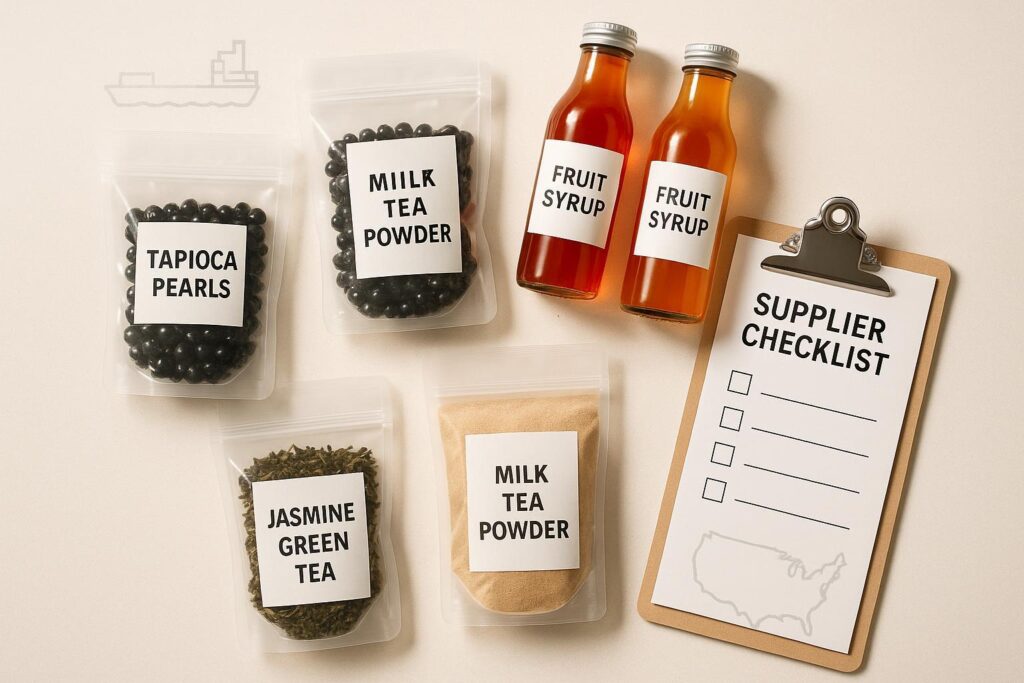
First, decide what “good sourcing” means for your shop
A supplier that’s “great” for a high-volume chain can be a terrible fit for a new shop.
Here’s the quick needs assessment to run before you request quotes.
Your launch menu (and what it implies)
- If your hero drinks are classic milk teas, your highest-impact inputs are: tea base + creamer/powder + pearls.
- If your hero drinks are fruit teas, your highest-impact inputs are: tea base + fruit syrups/purees + sweetener system.
- If you’re doing both, you’ll usually get better results by standardizing: one or two tea bases, one pearl spec, and a small set of syrups.
Your expected weekly volume (rough is fine)
Volume drives:
- MOQ reality (can you meet minimum order quantities without tying up cash?)
- shipping mode (air vs. LCL ocean) and reorder cadence
- how many lots you need to test (more volume = more risk if a bulk lot is bad)
Your storage constraints
Be honest about storage. Hot, humid back rooms and tight shelves punish:
- powders (clumping, flavor drift)
- tea (staling)
- syrups (leaks, crystallization depending on formula)
If you don’t have stable storage, you may be better off sourcing domestically until operations are smooth.
Your evaluation criteria: how to compare Southeast Asia suppliers (without guessing)
When you’re comparing suppliers, start with criteria that protect you from the two most expensive failures:
- product quality that looks fine in a sample but fails in service
- shipments that get delayed because documentation doesn’t match reality
1) Documentation quality (non-negotiable)
For food imports, the US expects imported foods to be safe and truthfully labeled. The FDA’s overview on Importing Human Foods (updated 2026)
is a good baseline for what “import-ready” means.
Minimum documents to request before you place a bulk order:
- product specification sheet
- full ingredient statement
- allergen statement
- lot-level COA (certificate of analysis) for the batch you’ll receive
- shelf life + storage conditions
- packaging spec (inner + outer carton details)
If a supplier won’t share these until after you pay, treat that as a warning sign.
2) Food safety system and traceability
You don’t need to become a food safety auditor, but you do need to verify the supplier can trace lots and provide records.
For many imported foods, the US importer has responsibilities under FSMA’s Foreign Supplier Verification Program (FSVP). If you want the “what does the importer have to do?” overview, this FSMA Foreign Supplier Verification Program guide (updated 2026) is a clear starting point.
What you want from a supplier:
- lot codes on cartons and inner packaging
- consistent production dates and expiration/best-by format
- a commitment to notify you of formula changes (especially for powders and syrups)
3) Batch consistency (the real make-or-break)
A single great sample means nothing if the next lot tastes different.
Ask for:
- multi-lot sampling (at least 2 lots) before you commit to a large reorder
- clear tolerance ranges (color, sweetness, viscosity, pearl size, cook time)
- a “what happens if the bulk doesn’t match the approved sample?” policy
4) Packaging that survives heat, humidity, and long transit
Southeast Asia → US transit can expose products to heat and humidity for weeks.
Packaging questions to ask:
- Are powders packed with moisture barriers and proper inner liners?
- Are syrup caps and seals designed for ocean transit (leak prevention)?
- Do cartons stack well without crushing?
⚠️ Warning: Even a “good” ingredient can become a bad one if it arrives moisture-damaged. If the supplier can’t explain their packaging design, assume they haven’t had to solve this problem.
Ingredient-by-ingredient: what to request (and what to test)
This is the part most new shops skip. Don’t.
Instead of asking “Do you sell tapioca pearls?”, ask “Can you meet this spec?”
Tapioca pearls wholesale: your spec sheet essentials
Tapioca pearls are your highest-risk “feel” ingredient. Customers forgive a slightly weaker syrup. They don’t forgive mushy boba.
Request these specs:
- pearl diameter and size tolerance
- cook time window (e.g., 25–35 minutes) and holding time texture target
- breakage rate / broken pearl allowance
- moisture content and shelf life
- packaging barrier (how it prevents moisture ingress)
Tests to run in your shop:
- cook test at standard time + 5 minutes under + 5 minutes over
- hold test at 30/60/90 minutes (your real service window)
- sweetener absorption test (if you use brown sugar or honey soak)
Tea sourcing: what matters beyond “black vs green”
Tea is what makes your menu taste “clean” instead of muddy.
Request:
- grade and origin info
- moisture level and storage requirements
- infusion performance targets (color, aroma strength, bitterness tolerance)
- residue testing support if relevant (this varies by product and supplier)
Operational tip:
- decide whether you’re a strong tea shop (punchier, more aroma) or a smooth tea shop (less bitterness). That preference should be in your RFQ.
If you’re building a shortlist, it can help to browse categories first (so you’re not sourcing blind). Start with BubbleTeaSuppliers.com’s bubble tea ingredient categories
.
Bubble tea syrup wholesale: what to check (and what breaks in transit)
Syrups look straightforward, but they hide problems:
- inconsistent sweetness (Brix drift)
- unstable flavor concentration
- packaging leaks
Request:
- target Brix range (sweetness)
- viscosity range (pourability)
- pH range and preservation approach
- packaging seal details
- storage temperature range
Tests to run:
- dilution test (your standard recipe ratio)
- cold storage vs room temp stability over a week
- cap/leak test (shake and invert)
Milk tea powder wholesale: the “label risk” category
Powders are usually the fastest way to get a consistent baseline milk tea—especially for new shops.
But powders also carry higher risk around:
- allergens and ingredient transparency
- clumping and solubility
- flavor drift across batches
Request:
- full ingredient list and allergen declaration
- solubility notes (hot vs cold mixing)
- anti-caking approach and packaging barrier
- lot COA and micro specs if applicable
If you’re thinking about when to use powder vs fresh milk (cost, flavor, consistency), this powder vs. fresh milk comparison
is a useful reference point.
Importing from Southeast Asia vs buying from a US distributor
This is the trade-off in one sentence:
- Importing can lower unit costs and expand options, but increases your burden around lead time, documentation, and risk.
- US distributors cost more per unit but reduce complexity and help you move faster.
For new shops, the most practical hybrid model is:
- import the 1–2 ingredients that truly differentiate you (often tea or pearls)
- source the rest domestically until your reorder cadence stabilizes
A practical US import compliance checklist (keep it simple)
If you’re Googling how to import bubble tea ingredients to the USA, this is the checklist you want to build before you send money overseas.
You don’t need a law degree, but you do need a system.
Baseline import expectations:
- Imported foods must be safe and truthfully labeled, per the FDA’s Importing Food Products into the United States (updated 2026).
- For many foods, the importer is responsible for supplier verification under FSMA/FSVP (see the FSVP overview (updated 2026)).
Your internal checklist for each new ingredient:
- Do we have the spec sheet + ingredient list + allergen statement?
- Do we have a lot-level COA for the shipment we’re receiving?
- Do shipping documents match product names and lot codes?
- Do we have a “hold until verified” receiving rule?
Logistics and terms: how to avoid getting stuck with the wrong deal
LCL vs FCL vs air: what’s realistic for a new shop
- Courier is best for samples.
- Air freight can make sense for small first orders if timing matters.
- LCL ocean is often the sweet spot once you’ve validated the product.
Incoterms: a simple rule of thumb
If you’re new, avoid deals where you have no visibility.
In many cases, FOB (Free on Board) is the most practical middle ground: the supplier handles export side to the port, and you control freight + import clearance through your forwarder.
Be cautious with “we’ll deliver to your door” promises if you can’t confirm how compliance steps are handled.
MOQs: negotiate like a new shop (because you are one)
Ask:
- what’s the MOQ for stock products vs custom formulations?
- can they do a starter mix across multiple SKUs to reach MOQ?
- can they commit to a consistent spec with smaller repeat orders?
A simple 5-step workflow to shortlist suppliers
This is the decision framework to use when you’re comparing multiple Southeast Asia suppliers.
- Start with your spec sheet (pearls, tea, syrups, powders) and send the same document to every supplier.
- Reject on documentation first (ingredient list, allergens, COA, traceability).
- Run multi-lot sampling (don’t fall for one perfect sample).
- Test in real service conditions (holding time for pearls, storage for powders, dilution for syrups).
- Place a small first commercial order with a clear “match approved sample” expectation.
If you want a fast way to build your initial shortlist, browse bubble tea wholesale resources
and pull 3–5 candidate ingredient lines that match your launch menu.
Where Southeast Asia fits (and what to source there first)
Southeast Asia is a big region, and suppliers vary widely. You don’t need to memorize which country makes what—you just need to match the region’s strengths to your launch priorities.
A practical way to think about it:
- If your shop’s signature is chewy, consistent boba, prioritize validating pearls early (cook + hold tests, packaging integrity, and lot consistency).
- If your shop’s signature is tea aroma, prioritize tea base sourcing and dial in your brew SOP before you over-invest in syrups.
- If your shop’s signature is loud flavors and fast training, powders and syrups can work well—but only if labeling, allergens, and solubility are locked down.
For new shops, your first import shouldn’t be 12 SKUs. It should be one category you can test deeply, then expand once your receiving + storage routine is stable.
Pro Tip: Ask every supplier the same two questions: “What are your top 3 causes of customer complaints?” and “What do you do when a bulk lot doesn’t match an approved sample?” A good supplier answers quickly and specifically.
FAQ: Southeast Asia sourcing for new US boba shops
Do I need to import directly, or can I start with a US distributor?
If you’re opening your first shop, starting with a US distributor is often the fastest way to reduce risk. You can still import later once your sales volume and reorder cadence are predictable.
What’s the safest first ingredient to import?
Usually the safest first move is whichever ingredient you can test clearly and store easily—often tea or pearls. Fruit products and some syrups can be more sensitive to handling and storage conditions.
How many samples should I test before placing a bulk order?
Aim for at least two lots (not just two bags). Lot-to-lot variation is the most common “surprise” when you scale from a perfect sample to a real shipment.
What’s one red flag that isn’t obvious?
Vague paperwork. If product names, ingredient lists, and lot codes don’t match cleanly across the spec sheet, invoice, and cartons, expect delays and headaches later.
Next steps
If you’re opening soon, your best move is to make your first sourcing decision boring and reliable:
- lock a tea base
- lock a pearl spec
- lock 3–5 syrups/powders you’ll actually sell
Then optimize.
If you want a place to start organizing options, grab a category overview and downloadable materials from the BubbleTeaSuppliers.com catalog
and use this article’s criteria to narrow down what’s worth sampling.