
If your customers keep asking for “the purple one,” you’ve probably felt the taro-vs-ube confusion firsthand. On the surface, both drinks look like close cousins. In reality, taro vs ube milk tea plays out differently in a shop menu—especially when you factor in prep speed, consistency across shifts, and what customers expect when they order.
This guide is built for US shop operators who want a clean decision: Which flavor should be a core SKU, which should be a premium/LTO, and what ingredient format won’t wreck your workflow?
Quick comparison: taro vs ube milk tea (operator view)
| Criteria | Taro milk tea | Ube milk tea (purple yam milk tea) |
|---|---|---|
| Flavor | Mild, starchy, lightly nutty/vanilla-adjacent | Sweeter, dessert-like, often vanilla/coconut-nutty leaning |
| Color expectations | Customers expect purple, but real taro can be muted | Naturally deep purple is easier to deliver consistently |
| Easiest ingredient format | Powder for speed and repeatability | Powder or paste/base for repeatability |
| Best menu role | Reliable classic “comfort” milk tea flavor | Premium “treat” flavor; great for photo-friendly promos |
| Biggest risk | Customers think bright purple = “real taro” (expectation gap) | Mislabeling (ube vs purple sweet potato) → complaints |
Pro Tip: The real decision usually isn’t “taro or ube?” It’s powder vs puree/base vs real cooked tuber—because that determines labor, waste, and consistency.
What taro and ube actually are (fast, so you can label them correctly)
Taro and ube are different plants and they taste different. That matters because customers bring strong expectations to “purple milk tea.”
A clear consumer explainer is The Flavor Bender’s “Ube Milk Tea (Ube Bubble Tea)” (updated 2026)
, which highlights how often people confuse the two.
Shop translation:
- Taro milk tea is usually built from taro flavor (often powder/mix in shops) plus milk and sometimes a tea base.
- Ube milk tea is built from ube (purple yam) flavor (powder or base) plus milk and sometimes a tea base.
If your menu says “ube,” keep it “ube.” If it’s a different purple base, don’t borrow the word.
Color expectations: the fastest way to lose repeat orders
In the US, many customers expect taro to be bright purple. But real taro can be gray-lavender rather than neon. When that expectation gap shows up, it shows up as:
- “This doesn’t taste like taro.”
- “Why isn’t it purple?”
- “I thought this was ube.”
Ube has an advantage here: it’s typically easier to deliver a deep purple appearance consistently.
Operator takeaway: color is part of the product. Treat it like a spec.
If you sell purple yam milk tea, the internal SOP on bubbleteasuppliers.com includes a strong reminder to label clearly and QC for uniform color and texture: Purple Yam Milk Tea: a shop SOP for a smooth, consistent purple drink
.
Flavor profile: which one sells to which customer?
When you look at ube milk tea vs taro, you’re really choosing between two dessert lanes:
Taro milk tea tends to sell like a classic
- Works well as a daily drink flavor.
- Fits a traditional “milk tea” identity (even when it’s made with powder).
- Usually plays well with standard sweetness levels.
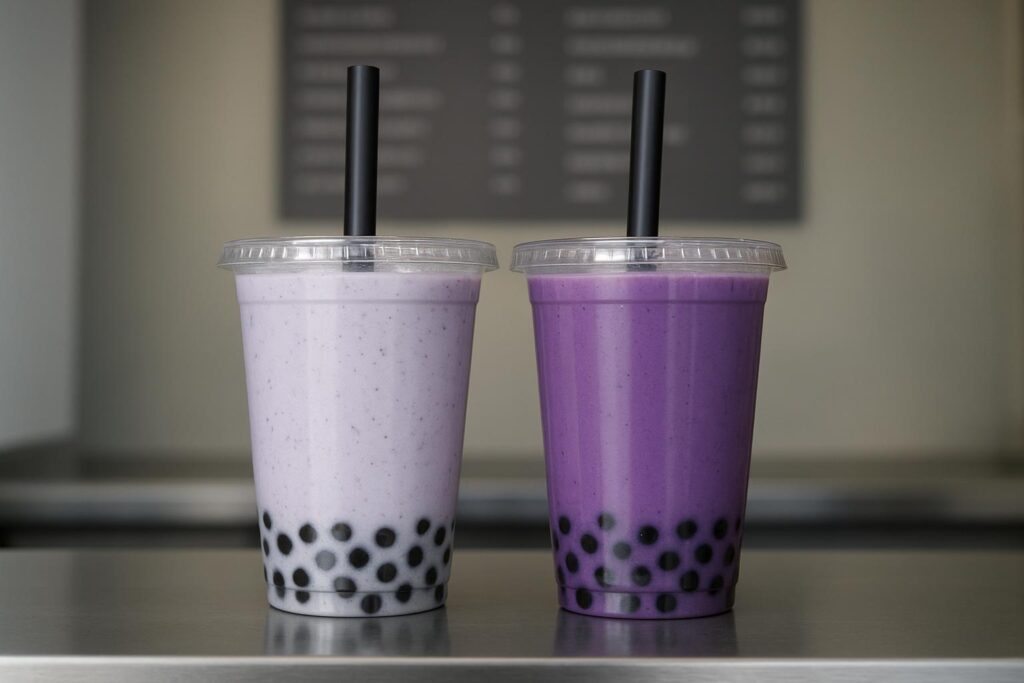
Ube milk tea tends to sell like a treat
- More dessert-forward.
- Strong visual appeal makes it an easy “try it because it looks cool” order.
- Often a good candidate for premium pricing, LTOs, or signature builds.
Ingredient formats: powder vs puree/base vs real tuber (the decision that actually matters)
Most of your operational outcomes (speed, waste, consistency) come from format choice.
Powder: best for speed and consistency
If you need a repeatable SOP, powder is the easiest path.
Best when:
- You want reliable flavor across staff and locations.
- You’re building recipes around grams/ounces, not “a scoop-ish.”
Watch-outs:
- Some powders are more “flavored mix” than true ingredient, which can affect how you describe the drink.
This is the section where “taro milk tea powder vs ube powder” gets practical: taro powder usually supports a classic profile, while ube powder often leans more dessert-like and visually intense.
Puree / paste / base: best middle ground
A paste/base can give richer mouthfeel without full scratch cooking.
Best when:
- You want a more premium texture than powder-only.
- You can handle cold storage and tighter shelf-life management.
Real cooked taro/ube: best for “handcrafted” positioning
You can create a premium experience here, but you need batch controls.
Best when:
- You can batch prep with labeling, holding time rules, and staff training.
- You’re okay with slight variation between lots.
For an operator-friendly taro workflow (including blending and straining for smooth texture), use Crafting Taro Bubble Milk Tea Tips
.
Workflow and training: how taro and ube fail in real shops
Both flavors usually fail in predictable ways.
Failure mode 1: clumps and chalky texture (powders)
If staff dump powder straight into cold milk, you’ll get clumps. If they under-mix, you’ll get a chalky, thin drink.
The most reliable fix is: make a slurry first.
Food formulation guidance like Grande CIG’s guide on preventing powder clumping (updated 2026)
recommends pre-mixing powders into a slurry before scaling up.
SOP version (train this):
- Add the powder to the shaker.
- Add a small splash of warm water or warm milk.
- Whisk/stir hard until smooth.
- Then add the rest of your tea/milk/ice and shake.
A practical drink example that says the same thing is Big Moca’s ube latte recipe (warm liquid first, then mix hard).
⚠️ Warning: If you’re using powder and the drink feels “dusty,” the fix is usually mixing order + hydration, not “add more syrup.”
Failure mode 2: separation and gritty base (purees/pastes)
Puree-based drinks can separate if the base sits too long or isn’t fully hydrated.
Your controls:
- Hydrate/cook the base until fully smooth.
- Strain if needed.
- Enforce batch labeling + discard times.
For ube powder hydration technique, Bites by Bianca’s rehydration guide emphasizes full hydration and constant stirring to avoid graininess.
Cost and margin levers (no guesswork)
The biggest levers aren’t the ingredient name—they’re the operational inputs. This is where taro vs ube milk tea becomes a menu-engineering decision.
Build your COGS estimate from four knobs
You don’t need perfect numbers to make a smart call. You need a consistent method.
- Base cost per drink
- Powder-based builds usually make it easier to control cost because dosing can be standardized (grams/ounces).
- Purees/bases can drift if staff “eyeballs” portions.
- Labor minutes per drink
- Real tuber prep adds labor even if the ingredient itself is affordable.
- Powder usually wins on speed.
- Waste + shelf life
- Bases/purees are where margin quietly leaks (expired batch, separation, staff remakes).
- If you can’t enforce batch labeling and discard rules, keep it powder-forward.
- Remake rate (the hidden cost)
- If customers send it back because it’s chalky, watery, or not purple enough, that remake cost can dwarf the ingredient difference.
Practical positioning for US operators
- Taro milk tea tends to work well as a safer core SKU: consistent, familiar, and easy to standardize.
- Ube milk tea tends to work well as a premium SKU: you price for visual impact, dessert vibe, and novelty.
If you run ube as a premium drink, don’t compete on the lowest price. Compete on photo-ready appearance + consistent texture.
Tea base + topping pairings (simple defaults)
You can run both flavors with or without brewed tea. If you do use tea, keep it simple so the ingredient reads clearly.
Tea base defaults
- Taro: black tea for a classic backbone; jasmine green for a lighter finish.
- Ube: black tea if you want “milk tea” identity; milk-only if you want “dessert drink” identity.
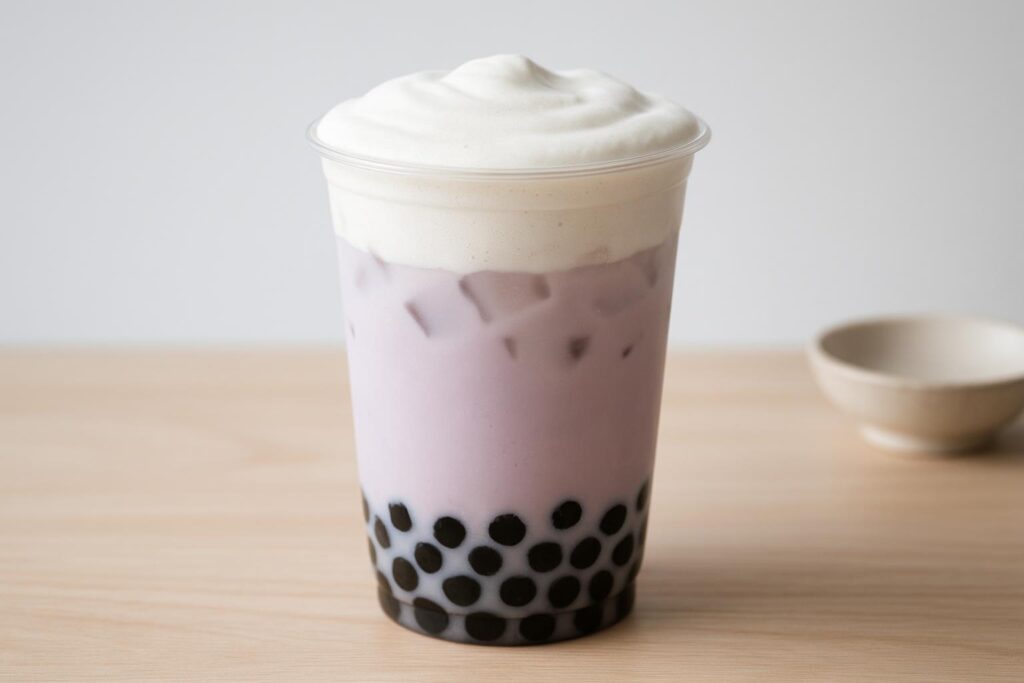
Topping pairings that tend to work
- Taro: classic tapioca pearls, pudding, or a light jelly.
- Ube: tapioca pearls, coconut-style pairings, or a cream topping (if it fits your menu).
Quick SOP checklist for consistent texture (train this)
Use this as a shift-start refresher—most taro/ube quality issues show up here.
- Powder drinks: always slurry first
- Powder + small splash of warm water/milk → whisk smooth → then add the rest.
- Base/puree drinks: hydrate fully
- If the base feels grainy, it’s under-hydrated or under-blended.
- Strain when needed
- If you see fibers/lumps, strain the base once and save yourself remakes.
- Shake discipline
- Separation happens. The fix is consistent shaking and a hold-time rule.
- One spec per drink
- Pick a target color + texture and make it a training standard. That’s how you win the “taro vs ube milk tea” expectation game.
So… which should you choose?
Here’s the shop decision framework.
Choose taro if…
- You want a steady, classic flavor that can stay on the menu year-round.
- You want the easiest path to consistency (powder SOP + standard sweetness).
- Your menu already sells “comfort” milk tea flavors.
Choose ube if…
- You want a premium, visually strong purple drink that pops in photos.
- You can commit to label clarity (ube vs purple sweet potato).
- You’re comfortable pricing it as a treat (not your lowest-price milk tea).
Consider running both if…
- Taro is your core SKU, and ube is your rotating promo.
- You want two “purple lane” options with different customer motivations.
Key Takeaway: If you can only launch one, taro is usually the safer core SKU. If you’re launching a promotion or signature drink, ube often wins on visual impact.
FAQ
Is taro milk tea the same as ube milk tea?
No—different ingredients, different flavor profiles, and different customer expectations.
Which is easier to standardize across shifts?
Powder-based builds are usually the easiest to standardize (regardless of whether it’s taro or ube), as long as you train the slurry/mixing order.
What are “ube milk tea ingredients” vs “taro milk tea ingredients” in practical shop terms?
For both, the core stack is the same: flavor base (powder/paste/puree), milk or non-dairy, optional brewed tea, sweetener, ice, and your chosen toppings. The difference is which flavor base you choose and how you label it.
Next steps
If you want to tighten execution fast, start with SOPs you can train from:
- Taro workflow: Crafting Taro Bubble Milk Tea Tips.
- Purple yam workflow + labeling/QC: Purple Yam Milk Tea SOP.
And if you want consistent build flow across milk teas (not just taro/ube), use the assembly logic from 6 Perfect Milk Tea Recipes for Beginners (Shop-Friendly SOP Cards)
.