
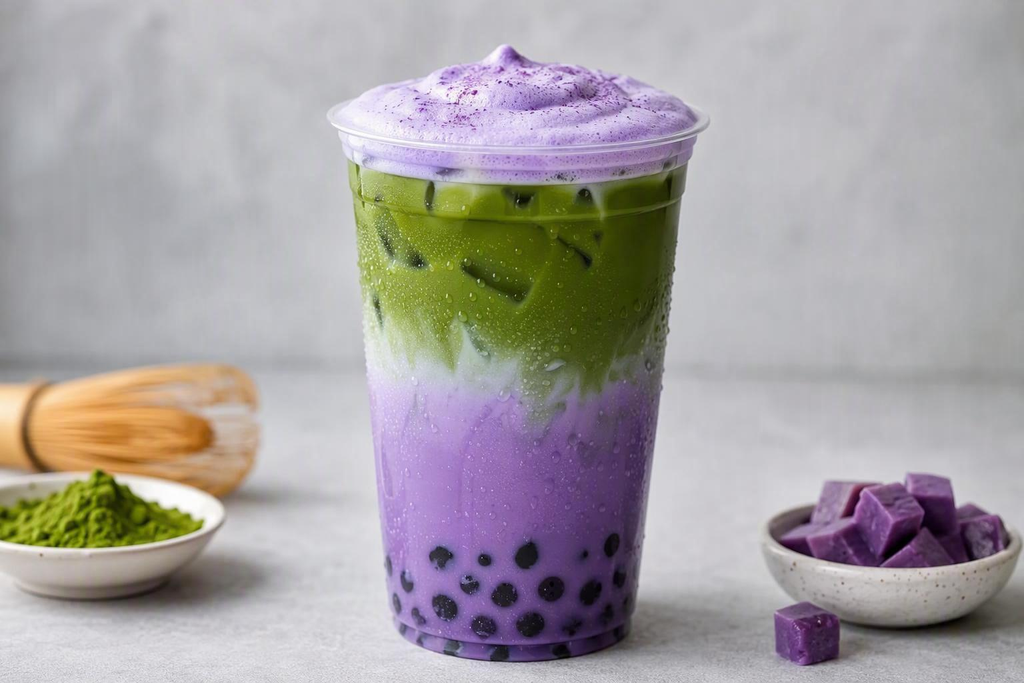
The ube matcha latte — sometimes called a purple yam matcha latte on menus — is one of the strongest additions you can make this season. It stacks two flavors your customers already want — the earthy, antioxidant-rich pull of matcha and the sweet, nutty-vanilla warmth of purple yam (ube) — into one layered, photo-ready cup. And because the demand is real, it can move at volume without blowing up your prep time or your margins.
This post is a commercial build, written for bubble tea shops and cafés. It gives you exact gram and milliliter specs for 16 oz and 22 oz cups, a speed-of-service assembly order, and the two prep techniques that separate a drink that looks great from one that goes muddy and gritty halfway through the day. If you run a home kitchen, you’ll still find the single-serve ratios useful — but the whole thing is built to survive a rush.
Why the Ube Matcha Latte Belongs on a US Menu Right Now
You’re not betting on a niche idea here. Menu-tracking data from Datassential shows purple yam has grown roughly 230% on US restaurant menus over the past four years and now appears on about 1.3% of menus, with that number projected to climb toward 2.4% by 2029. Only about 27% of US consumers know what ube is yet, which is exactly the kind of early-adoption window that lets a shop own a flavor before the big players crowd it out.
Matcha is the more established half of the equation and carries the repeat-purchase behavior. Consumers are already willing to pay $5 to $8.50 for a matcha drink, Forbes reports, and a Yu Tea consumer study found Gen Z drinks about 25% more matcha than the US average. When you pair a high-ticket, trusted flavor (matcha) with a hot, visually striking one (ube), you get a drink that sells on both taste and on the color contrast customers love to photograph.
The format is already proving itself at chain level. Peet’s launched an Iced Ube Matcha Latte with an ube “dream” cream top, and Starbucks has run ube-plus-matcha drinks in limited-time rotations. That mainstream validation means the concept no longer needs explaining — you’re riding a wave that’s already crested in the specialty space and is still open for your menu.
The Two Components That Make or Break the Drink
An ube matcha latte isn’t one recipe. It’s a smooth, sweet ube base layered with a properly whisked matcha shot. Get both components right on their own and the drink builds itself in seconds; get either wrong and no amount of assembly fixes it.
The Ube Base: Hydrate It Like a Pro
Ube comes in a few commercial formats — ube powder, ube premix, ube syrup, and ube halaya. For a bubble tea line, ube powder or a shop ube premix gives you the strongest color and flavor at the lowest cost per cup, and ube syrup is the fastest line option when you want a lighter, quicker build.
The single most common failure with ube powder is clumping and settling. The fix is the same slurry method you’d use for any dry powder: whisk the powder into a paste with a small amount of warm milk or water first, then dilute with the rest of the cold milk. Always add the powder to the liquid, not the reverse, and use warm liquid — cold liquid makes dissolving harder and leaves chalky grit in the cup. Keep your batch stirred before service, because even a well-hydrated ube base will slowly settle on the shelf.
The Matcha Shot: Sift, Whisk, Don’t Boil
Matcha is unforgiving if you rush it. Three rules keep it smooth and bright:
- Sift the matcha through a fine-mesh sieve before any water touches it. Dry clumps that go in dry never fully come out.
- Use hot but not boiling water, around 70–80°C (160–176°F). Boiling water turns matcha bitter and kills its froth.
- Whisk briskly until smooth and frothy — with a chasen, a milk frother, or an immersion blender when you’re batching. This disperses the matcha particles into a stable suspension so you get a creamy sip instead of grit at the bottom of the cup.
Cold milk will not dissolve dry matcha, so you always build a concentrated, whisked shot first and let it meet the cold milk in the cup. Our iced matcha latte SOP for cafés walks through the full shot method if you want the deeper barista detail.
Pro Tip: Build a concentrated matcha shot at 2 g of powder per 50 ml of water, then pour cold milk over ice. A strong shot keeps the flavor from fading as the ice melts.
Commercial Ube Matcha Latte Recipe
The proportions below are tuned for barista-grade matcha (or your house latte matcha) and a standard ube powder or premix. Adjust sweetness to your signature spec, but lock the ratios first so every cup comes out the same.
16 oz Iced Ube Matcha Latte
| Component | Ingredient | Amount |
|---|---|---|
| Ube base | Ube powder / premix | 30 g |
| Ube base | Warm water or milk (to hydrate) | 40 ml |
| Ube base | Simple or brown sugar syrup, to taste | 15–25 ml |
| Milk | Whole, oat, or barista milk | 240 ml |
| Matcha layer | Barista-grade matcha powder | 4 g |
| Matcha layer | Hot water (70–80°C) | 60 ml |
| — | Ice (fill cup to ~80–90%) | to fill |
22 oz Iced Ube Matcha Latte
| Component | Ingredient | Amount |
|---|---|---|
| Ube base | Ube powder / premix | 50 g |
| Ube base | Warm water or milk (to hydrate) | 60 ml |
| Ube base | Simple or brown sugar syrup, to taste | 25–35 ml |
| Milk | Whole, oat, or barista milk | 360 ml |
| Matcha layer | Barista-grade matcha powder | 6 g |
| Matcha layer | Hot water (70–80°C) | 90 ml |
| — | Ice (fill cup to ~80–90%) | to fill |
Assembly Order (Speed of Service)
- Hydrate the ube base. Whisk 30 g (or 50 g for 22 oz) of ube powder with the warm liquid into a smooth paste, then add the syrup and stir until fully combined.
- Portion the ube base into the cup.
- Add ice to about 80–90% full. The ice does double duty: it chills the drink and acts as a physical barrier for the layers.
- Pour the cold milk over the ice.
- Whisk your fresh matcha shot (sift, 70–80°C water, brisk whisk) to order — a shot sits for no more than a few seconds.
- Pour the matcha slowly over the back of a spoon or directly onto the ice so it floats as a clean green top layer.
- Serve immediately. Layers start to equalize within a minute or two, so hand it over fast and let the customer stir when they’re ready.
Key Takeaway: Batch the ube base, not the finished latte. The base holds and stirs back smooth, but a fully assembled cup won’t survive sitting in a pickup queue without the layers bleeding together.
Matcha and Ube Stability: Fixing the Three Things That Go Wrong
“My matcha comes out gritty or settles to the bottom”
This is almost always a prep issue, not an ingredient issue. Sift before you whisk, use water around 70–80°C instead of boiling, and whisk until you see a stable layer of microfoam on top. If you’re batching a large volume, an immersion blender gives you the aeration you need in seconds. Sift the matcha again if you’re using a coarser grade.
“The ube base looks chalky or separates”
Ube powder won’t hydrate properly in cold liquid, and dumping powder straight into milk is the fastest way to a chalky cup. Use the slurry method with warm liquid, and stir your batch just before each service so any settled particles re-disperse. If you want an extra insurance layer, a momentary blend or shake after hydration re-integrates everything into a smooth emulsion.
“The layers turn into one muddy purple-green drink”
Layer integrity comes down to density and temperature. Keep the ube base slightly heavier and creamier than the matcha, fill the cup with ice so the layers physically separate, and pour the matcha onto the ice or over the back of a spoon instead of straight into the milk. Very cold milk also helps — the temperature contrast slows the two layers from blending. For a two-tone latte that stays clean, the same principle shows up in our matcha-milk tea commercial SOP, where the base and the tea layer are built to hold their separation.
Menu Variations: From One Latte to a Small Purple Lineup
The layered purple-yam matcha latte is a strong anchor, but the same two components extend into a small, profitable menu without new prep. A few variations worth testing:
- Ube cold foam cap. Make an ube cold foam — ube powder or extract whisked with cream and a touch of syrup — and float it on top of the matcha layer for a triple-layered, dessert-forward cup. Ube cold foam is one of the fastest-growing topping formats on US cafés right now.
- Boba add-on. Drop a scoop of tapioca pearls into the ube base before the ice. The classic bubble-tea treatment adds texture and average check without touching your prep line.
- Hot version. Skip the ice, steam the ube base into hot milk, and pour the whisked matcha over the top for a slow-sipper suited to cooler months.
- Lighter build. Swap the ube base for ube syrup in the milk for a cleaner, quicker assembly — ideal for a high-volume line where speed matters more than depth of color.
Each variant reuses the same matcha shot, so adding them to the menu costs you almost nothing in training time. The broader bubble-tea flavor lineup gives you a checklist for rolling these out.
What This Drink Costs You Per Cup
The ube matcha latte is a confident-margin drink. Because both the ube base and the matcha portion are powders you can buy in wholesale bulk, unit costs stay low even though the drink sells like a specialty item.
| Line item (16 oz) | Unit cost estimate | Cost per cup |
|---|---|---|
| Ube powder / premix (30 g) | $4.50/lb | ~$0.30 |
| Barista-grade matcha (4 g) | $60/lb | ~$0.53 |
| Milk (240 ml) | $4.00/gallon | ~$0.25 |
| Syrup (20 ml) | $12/gallon | ~$0.06 |
| Cup + lid + straw | — | ~$0.18 |
| Total COGS (approx.) | ~$1.32 |
Sell a 16 oz at $6.50 and you’re looking at roughly a 79% gross margin before labor and overhead — in line with what specialty frozen and layered drinks should hit. The 22 oz version scales to around $1.70 in ingredients and can carry a $7.50–$8.50 price comfortably.
These numbers are ballpark planning figures, not your invoice. Your real COGS depends on your ingredient grade, your supplier pricing, and your cup choice, so build your own sheet off the same line-item structure and set the menu price against your target margin.
Where to Source Ube and Matcha for a Consistent Build
Consistency across the day — and across locations — comes down to buying repeatable ingredients, not chasing the cheapest bag each week. Barista-grade matcha is worth the step up from commodity grade because the sifting, whisking, and suspension quality are built into how it’s milled. You can source your matcha directly from our matcha bubble tea range and barista-grade matcha powder, which keeps color and grind consistent between batches.
For ube, standardize on one format — powder, premix, or syrup — and don’t switch mid-season if you can help it, because formats behave differently in the cup. If you’re expanding your menu around this drink, a few ube menu ideas for your store can help you turn one base into a small lineup of purple drinks.
Pro Tip: Lock a single spec sheet before you train your team. When both the ube dose and the matcha dose are fixed in grams and milliliters, every shift hits the same color, the same sweetness, and the same speed.
Take the Next Step
The ube matcha latte gives you a high-margin, on-trend drink that photographs itself and demands almost no new equipment — just a whisk, a sifter, and two consistent ingredients. Start with the 16 oz spec, validate it in a one-week trial against your existing menu, and scale the 22 oz version once your team hits the speed-of-service rhythm.
If you’d rather compare matcha sourcing and flavor options before you buy, our matcha vs hojicha breakdown helps you decide which tea profile belongs on your menu. Lock in your wholesale matcha and ube ingredients today, and you can have this drink on the board before the weekend rush.