
If you’re training new staff, you don’t need “a million flavors.” You need a small set of recipes that are:
easy to memorize
forgiving during a rush
consistent across different hands
scalable from a slow Tuesday to a Saturday line
This post gives you six milk tea recipes in a consistent SOP card format (batch + yield + scaling notes). It’s written for new shop owners who are in “comparison mode” — choosing ingredients, tools, and methods that actually hold up in service.
If you want a deeper ingredient map and a step-by-step build order for training, start with this shop-ready milk tea SOP on BubbleTeaSuppliers.com.
Your standard milk tea SOP framework (teach this once)
The “3 controls” that prevent 80% of beginner mistakes
Strength control (tea concentration) Milk tea needs a stronger tea base than “normal hot tea,” because milk and ice dilute flavor.
Time control (steeping window) Over-steeping extracts bitter tannins. Under-steeping tastes weak. A general steeping range for black tea is often cited around 4–10 minutes, depending on tea and method; see TeaThority’s steeping times guide (updated 2026) for a practical overview.
Temperature control (water temp by tea type) Green/jasmine teas usually need lower temps than black tea. Your SOP should specify the target range by tea type, and your staff should use a thermometer until they can do it consistently.
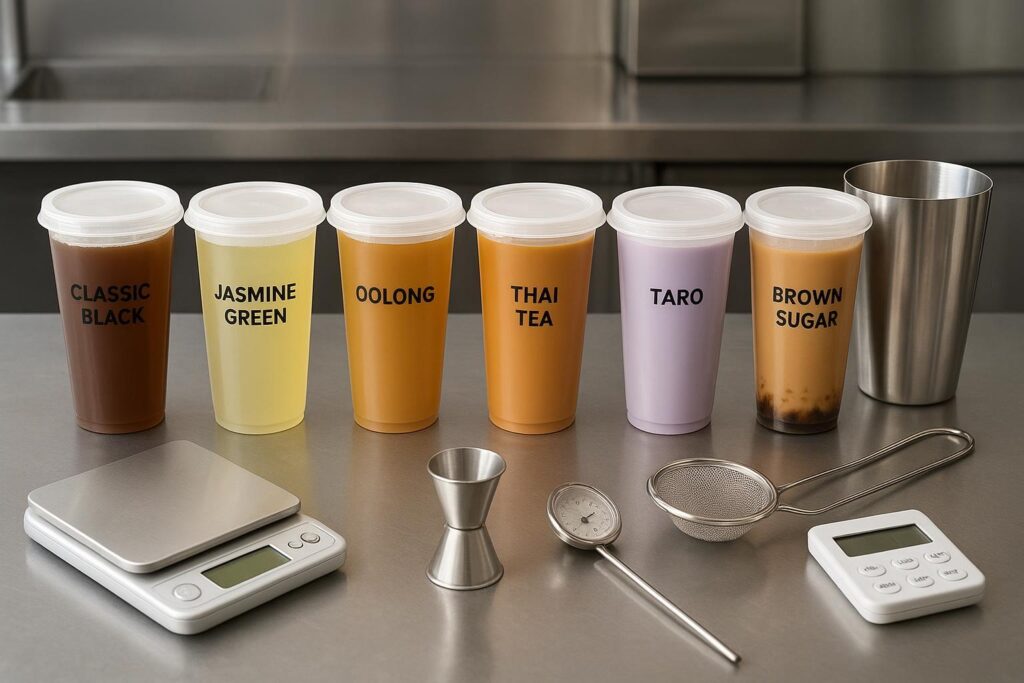
Tools that standardize fast (and pay for themselves)
digital scale (tea + powders)
timer (tea steep)
thermometer (water temp)
jigger / measuring cup (syrups + milk)
fine mesh strainer or tea sock
label tape + marker (batch time + “use by”)
Pro Tip: If your team is still eyeballing, standardize just two things first: tea weight and steep time. Those two variables swing flavor more than almost anything else.
The “starter ratios” (use these to train, then tune)
Different shops run different sweetness and creaminess, but training is easier when you begin with one house baseline.
Use this as a starting point for a 16oz build:
Tea base: 180–220 ml
Milk/creamer: 60–90 ml
Sweetener: 20–35 ml syrup (or your equivalent)
Then tune by your ingredients and customer preference. For a deeper breakdown of how shops think about ratio, keep this internal reference handy: the perfect tea-to-milk ratio for milk tea.
Recipe Card 1: Classic Black Milk Tea (your training baseline)
Teach this first. It’s forgiving, it sets your “house style,” and it becomes the base for half your menu.
Batch yield
Tea base batch: ~4L (about 18–24 x 16oz drinks depending on ice level and your ratio)
Per drink build: 16oz
Ingredients
Black tea (Assam/Ceylon blend is common)
Milk: whole milk (or your house non-dairy)
Sweetener: simple syrup or brown sugar syrup
Ice
Tea base SOP (4L batch)
Heat water to near-boil for black tea.
Brew a strong black tea base (commercial-strength). Some shop-brewing guidance describes black tea brewing around 95°C and using heavier ratios for shop production; see Mastercarefully’s “three methods for brewing tea in bubble tea shops” (updated 2025).
Strain off leaves/tea bag promptly to prevent bitterness.
Cool fast and label: “Black Tea Base — brewed time / use by.”
Per drink build (16oz)
Add syrup to the shaker.
Add chilled tea base.
Add milk.
Fill with ice.
Shake hard 8–12 seconds.
Pour and serve.
QC checks (teach staff what “right” tastes like)
Tea flavor is present through the milk (not “sweet milk”).
No harsh bitterness (over-steep) and no watery finish (under-strength).
Common beginner mistakes
Watery cup: tea base too weak, or too much ice dilution.
Bitter cup: tea steeped too long or sat on leaves.
Recipe Card 2: Jasmine Green Milk Tea (clean + floral)
This recipe trains precision: lower temp, shorter steep, and a lighter hand with milk.
Batch yield
Tea base batch: ~4L
Per drink: 16oz
Ingredients
Jasmine green tea
Milk: lighter than your black milk tea if you want the floral note to stay obvious
Simple syrup
Ice
Tea base SOP
Heat water to your jasmine-green target temp (lower than black tea).
Steep in a shorter window than black tea, then strain.
Chill quickly and label.
Per drink build (starter)
Aim for the high end of tea base and the low end of milk at first, then tune.
QC checks
Jasmine aroma still comes through after shaking.
No grassy bitterness (usually water too hot or steep too long).
Recipe Card 3: Oolong Milk Tea (toasty, smooth, premium-feeling)
Oolong is a great “step up” drink because it feels premium without needing extra add-ons.
Batch yield
Tea base batch: ~4L
Per drink: 16oz
Ingredients
Oolong tea
Milk (whole milk, half & half, or your house creamer system)
Simple syrup
Ice
Tea base SOP
Use a mid-range brew temperature and a controlled steep.
Strain promptly.
QC checks
Smooth and aromatic, not harsh.
Recipe Card 4: Thai Milk Tea (bold + high-attachment)
Thai milk tea is an “expectations drink.” Customers expect it to be bold, creamy, and sweeter than classic milk tea.
Batch yield
Tea base batch: ~4L
Per drink: 16oz
Ingredients
Thai tea blend (or your strongest black tea base)
Evaporated milk and/or whole milk (depending on your house method)
Sugar syrup
Ice
SOP notes
Train staff on your sweetness standard here (Thai milk tea is the one they’ll accidentally under-sweeten).
QC checks
Bold tea flavor + creamy finish, not just sugar.
Training shortcut
For staff who struggle to explain the difference to customers, keep this internal explainer in your training doc: classic vs brown sugar vs Thai milk tea.
Recipe Card 5: Taro Milk Tea (training-friendly if you weigh powder)
Taro is popular because it’s naturally thick and dessert-like. It’s also training-friendly when you standardize powder weight.
Batch yield
Per drink: 16oz
Batch option: pre-mix a taro “slurry base” for faster service (label and rotate)
Ingredients
Taro powder (or real taro puree, if you run that program)
Milk
Sweetener
Ice
SOP steps (per drink)
Add taro powder to shaker (by weight).
Add a small amount of warm water or tea to dissolve (prevents clumps).
Add milk + sweetener.
Add ice and shake.
QC checks
No powder clumps.
Consistent color and thickness across staff.
Deeper internal reference
Use this when tuning your taro program: Crafting taro bubble milk tea tips.
Recipe Card 6: Brown Sugar Milk Tea (your “training test” drink)
Brown sugar milk tea is a consistency test because the syrup level and the look expose mistakes immediately.
Batch yield
Per drink: 16oz
Ingredients
Strong black tea base
Milk
Brown sugar syrup
Ice
SOP steps
Add brown sugar syrup to the cup (optional: swirl for striping).
Build the milk tea in a shaker.
Pour over syrup.
QC checks
Syrup supports the cup but doesn’t erase the tea base.
Visual presentation is consistent across staff.
Milk choices that keep drinks consistent
You don’t have to offer everything on day one. Pick a default and get it consistent.
For classic black milk tea: whole milk or a consistent creamer system is common.
For green/jasmine: a lighter milk choice can keep the tea aroma present.
If you want a simple decision guide by tea type, this internal reference is useful for onboarding: what kind of milk to use in your boba tea shop.
Optional add-on SOP: Boba pearls (quick training version)
If you serve tapioca pearls, train this as a separate station SOP.
A practical cooking method
A common approach is: boil pearls until they float, simmer until mostly translucent, then rest covered before rinsing and soaking in syrup. For a step-by-step walkthrough, see Hungry Huy’s tapioca pearls cooking guide (updated 2026).
Texture rule (the one your staff needs)
Boba texture degrades with time. Your SOP should include a discard rule so staff don’t “save” old boba by oversweetening the drink.
⚠️ Warning: Don’t try to rescue bad boba with extra syrup. If pearls are hard in the center, they’ll ruin the drink and your team will start masking problems with sugar.
A simple shift-lead checklist (print this)
Tea base brewed by weight + timer (no eyeballing)
Batch labeled (brew time + use-by time)
Taste test every new batch before service
Syrups measured with a jigger
Shaker time standardized (8–12 seconds)
One person owns “QC cups” each shift (same palate)
Next steps for new shop owners
Once these six drinks are consistent, you can expand safely: add one seasonal LTO, one premium topping, or one specialty tea base — but only after your team can execute the baseline without “drift.”
If you want more operator-focused training resources, ingredient breakdowns, and SOP references, BubbleTeaSuppliers.com is a practical hub to keep in your training library.
FAQ (beginner shop questions)
Why does my milk tea taste watery?
Usually it’s one of three things: your tea base isn’t concentrated enough, you’re using too much ice relative to liquid, or your staff is free-pouring milk and breaking the ratio. Tighten tea weight + steep time first.
Why does my milk tea taste bitter?
Bitter almost always comes from over-extraction: water too hot for the tea type, steeping too long, or leaving tea sitting on leaves. Strain promptly and treat your steep window as a hard stop.
Why do drinks taste different between employees?
Because the “small” steps aren’t standardized: how full the ice scoop is, how long they shake, and whether they actually measure syrup. Fix your measuring tools and shake time before you rewrite recipes.
Is this a bubble tea milk tea recipe or just “milk tea”?
It’s written as a bubble tea milk tea recipe workflow (tea + milk + sweetener + ice, with optional boba), with the shop training controls that keep it consistent.