
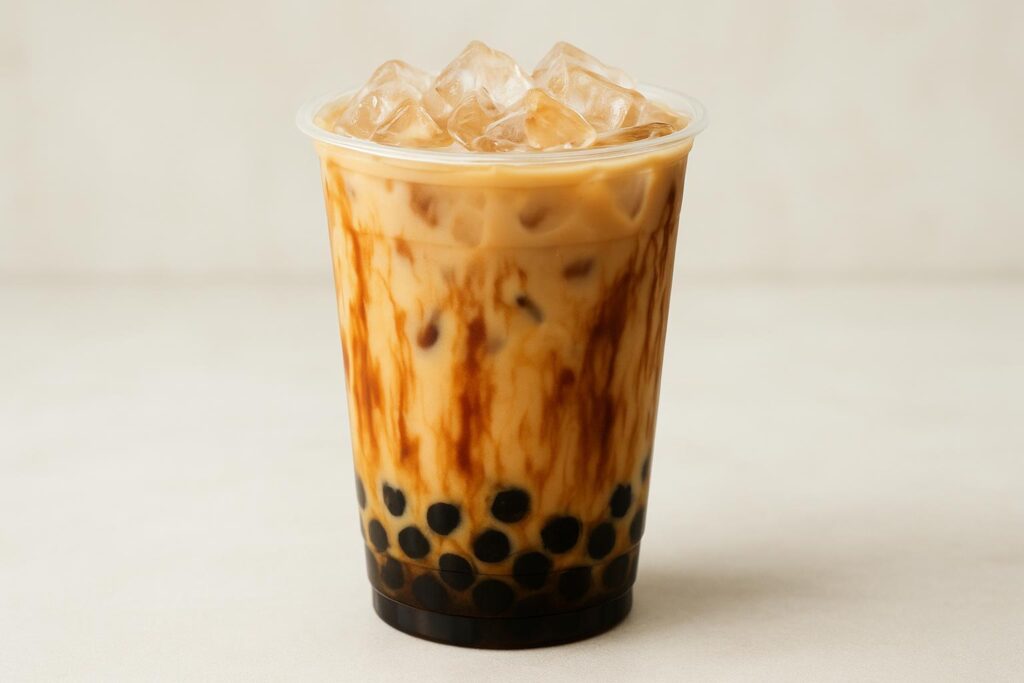
Brown sugar milk tea (often called tiger milk tea or brown sugar boba milk) is a menu staple because it sells itself: dramatic stripes, chewy pearls, and a caramel-molasses finish.
The catch is consistency. In a busy shop, “brown sugar + milk + boba” turns into a dozen small variables:
syrup thickness drifting batch to batch
boba getting hard in the middle (or going mushy)
ice dilution wiping out flavor
staff building in the wrong order and ending up with syrup sludge
This SOP is built for bubble tea shop owners/managers who need a repeatable, trainable process. It’s written for a 16 oz iced drink.
Brown sugar milk tea recipe: the 3 controls that decide quality
If you standardize only three things, make them these.
1) Syrup control (thickness + temperature)
You want syrup that:
tastes rich (caramel/molasses), not bitter
clings to the cup for visible stripes
still mixes cleanly when the customer stirs
2) Boba control (cook + hold window)
You want pearls that:
have an elastic chew
are cooked through (no chalky core)
stay serviceable across a realistic holding window
3) Dilution control (ice + pour order)
You want a drink that:
tastes strong enough at the first sip
doesn’t turn into sweet milk water after 3 minutes
If you’re building a broader standardization system (tea strength, sweetness ladder, topping holding rules, QC checks), BubbleTeaSuppliers.com has a useful framework in their shop-ready milk tea SOP (it’s worth reading once, then turning into station cards).
What “good” looks like (QC targets staff can understand)
Make these your pass/fail checks.
Syrup target
Color: deep amber-brown
Aroma: caramel + molasses (no burnt edge)
Texture: coats a spoon; slow ribbons when poured
Boba target
Chew: elastic with a cooked center
Surface: glossy from syrup (not dry or cracked)
Finished drink target
Sweetness: brown sugar forward, but not cloying
Mouthfeel: creamy, not thin
Look: stripes still visible after the pour; boba stays at the bottom
Ingredients (per 16 oz iced drink)
You can run this as either:
Brown sugar milk (no tea) — richer, dessert-like, fastest build
Brown sugar milk tea — cleaner finish and more “tea” identity
Core ingredients
Cooked tapioca pearls (boba): 80–120 g cooked boba (about 1/4–1/3 cup)
Brown sugar syrup: 30–45 ml (2–3 Tbsp) standard sweetness
Milk: 240–300 ml (8–10 oz)
Ice: fill to spec (see build steps)
Optional tea (recommended if you want “milk tea” on menu)
Strong black tea (Assam/Ceylon-style): 60–90 ml (2–3 oz), cooled
Milk options (pick one default for the SOP)
Whole milk is the easiest “classic” baseline, but there are valid shop reasons to choose other options. BubbleTeaSuppliers.com breaks down tradeoffs in their guide on what kind of milk to use for your boba tea shop (helpful if you’re standardizing across multiple staff).
A practical shortcut:
Whole milk: best classic mouthfeel
Non-dairy creamer: stable + cost-effective, very common in milk-tea builds
Oat milk: closest plant-based texture for this drink
Tools + station setup (make it staff-proof)
Sauce pot
Timer
Fine mesh strainer
Measuring jigger (or a marked cup)
Ladle or portion scoop for boba
Squeeze bottle for syrup
Clear 16 oz cups + wide straws (12–14 mm)
Labels you want in the prep station
“Boba cooked at: ____ / Discard at: ____”
“Syrup made at: ____”
The one rule that prevents half your problems
Don’t let staff free-pour syrup. If you’re offering sweetness levels, standardize the dose with a jigger or pump.
Step 1: Make brown sugar syrup (batch SOP)
Brown sugar syrup SOP (2:1)
Ingredients (small batch)
400 g dark brown sugar
200 g water
Method
Add water and brown sugar to a pot.
Heat on medium until fully dissolved, then bring to a gentle simmer.
Simmer 3–6 minutes, stirring gently, until the syrup coats a spoon.
Turn off heat. Keep warm at the station (or re-warm gently before service).
Why 2:1? A thicker syrup clings to the cup better, which is how you get stripes that still look good after the pour.
⚠️ Warning: Most “burnt” syrup happens because the heat is too high or the syrup is reduced too far. If it smells bitter, toss it. Don’t try to hide it with more milk.
Syrup QC checkpoint (fast)
Dip a spoon and lift: it should coat and drip slowly.
If it runs like water: simmer 1–2 minutes more.
If it pours like taffy: add a small splash of water, warm gently, and re-check.
Step 2: Cook and hold boba (batch SOP)
Different boba SKUs cook differently—your package directions matter.
For a standardized baseline, Chef Bates’ guide on professional boba prep ratios and holding guidance (2025) recommends using enough boiling water (they cite a 1:6 pearl-to-water ratio) and using cooked boba within about a 4-hour room-temperature holding window.
Brown sugar syrup for boba: when to add it
Coat boba while it’s still hot/warm. That’s when the syrup clings best and you get both better flavor and better visuals.
Boba SOP (shop baseline)
Bring a large pot of water to a rolling boil.
Add dry boba slowly while stirring for the first 30–60 seconds.
Cook per your SKU, then rest/steep if your SKU calls for it.
Strain and rinse quickly to remove excess starch.
Toss hot boba with warm brown sugar syrup.
Hold boba in syrup at room temp, labeled with discard time.
Boba QC checkpoint (chew test)
Split a pearl: center should be cooked through.
Bite: you want elastic chew, not gummy paste.
Holding guidance (operator reality)
Best texture is served warm.
Texture declines fast after a few hours.
Don’t refrigerate cooked boba unless you absolutely have to.
Pro Tip: If boba starts to firm up, a quick warm-up in syrup often restores chew better than adding hot water (which can thin your syrup and wash off flavor).
Step 3: Build the drink (16 oz iced) — the tiger-stripe method
Build spec (standard sweetness)
Boba: 80–120 g cooked + syrup-coated
Syrup in cup: 15–25 ml (1–1.5 Tbsp)
Milk: 240–300 ml (8–10 oz)
Optional tea: 60–90 ml (2–3 oz), cooled
Ice: fill to the top, leaving headspace
Assembly steps (train these exactly)
Stripe the cup: Add 15–25 ml syrup to the empty cup. Tilt and rotate so syrup streaks down the sides.
Add boba: Portion boba into the bottom.
Add ice: Fill the cup with ice.
Add tea (optional): Pour cooled black tea over the ice.
Add milk: Pour milk to the 16 oz fill line.
Serve with wide straw. Tell customers to stir before sipping.
Why the order matters
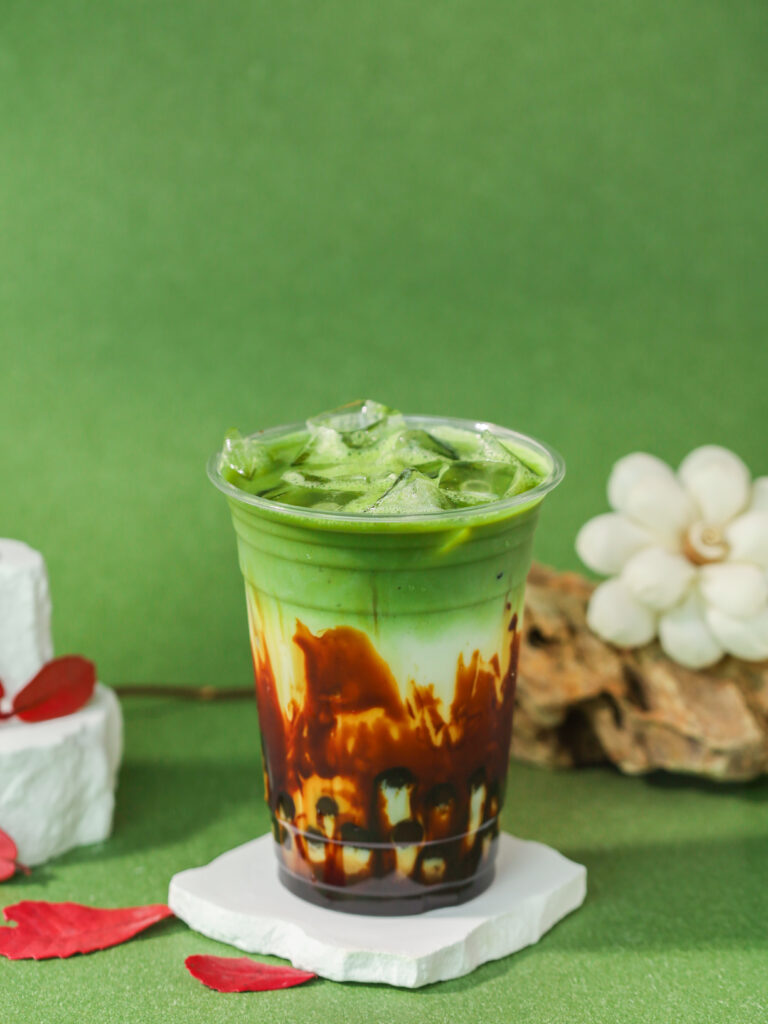
Syrup goes first so it can stick to the cup and create stripes.
Ice goes in before milk so the drink chills fast without “hanging out warm” and tasting flat.
Tea (if you use it) should be cooled so it doesn’t melt ice instantly.
Step 4: Verify the result (30-second check)
Do this before you standardize it across staff.
Stripes still visible after the pour?
First sip tastes like brown sugar (not diluted milk)?
Boba chew is elastic with no chalky center?
Bottom third isn’t syrup sludge?
If one of these fails, don’t “guess and adjust.” Use the troubleshooting section below.
Troubleshooting (common brown sugar boba milk failures)
Problem: Burnt or bitter brown sugar flavor
Likely cause: syrup overheated or reduced too far.
Fix
Lower heat; stop the simmer earlier.
Make smaller batches more often.
Re-warm gently during service (don’t blast it on high heat).
Problem: Drink tastes watery
Likely cause: too much melt/dilution or syrup is too thin.
Fix
Use a thicker syrup (2:1, simmer a bit longer).
Pre-chill milk; build directly over ice.
Standardize your ice fill level (don’t eyeball).
Problem: Flavor tastes flat (sweet but boring)
Likely cause: milk overwhelms; brown sugar lacks depth; tea (if used) is too weak.
Fix
Use dark brown sugar (more molasses character).
Reduce milk slightly and add a small amount of cooled strong black tea.
Keep syrup warm enough to integrate and coat.
Problem: Boba is hard in the middle
Likely cause: undercooked or insufficient resting/steeping.
Fix
Extend rest/steep (if your SKU supports it).
Confirm water is at a rolling boil before adding pearls.
Don’t skip stirring in the first minute.
Problem: Boba turns mushy
Likely cause: overcooked or held too long.
Fix
Reduce cook time.
Cook smaller batches more frequently.
Enforce a discard time (don’t push it into the next rush).
Optional: Standardize sweetness like a real shop
If you sell this at multiple sweetness levels, don’t let staff make it up.
Example ladder (adjust once, then lock it)
100% sweetness: 45 ml syrup (3 Tbsp)
75% sweetness: 35 ml
50% sweetness: 25 ml
25% sweetness: 15 ml
This is also where it helps to have a broader milk tea standardization framework (tea spec + sweetness ladder + QC). If you need one, start with the structure in the BubbleTeaSuppliers milk tea SOP mentioned earlier.
FAQ (shop operator edition)
Does this tiger milk tea recipe need tea?
No. Many shops sell a tea-free version as “brown sugar milk” for a thicker, dessert-like profile. If you want a cleaner finish and clearer milk-tea identity, add a small amount of cooled strong black tea.
How long can we hold brown sugar boba?
Quality drops quickly as pearls firm up or go mushy. Many operators standardize a short room-temperature holding window and discard after a few hours; the Chef Bates guide cited earlier uses about 4 hours as a reference point.
Why do my tiger stripes disappear?
Usually the syrup is too thin, too cold, or you’re pouring too aggressively. Thicken the syrup slightly, keep it warm, and stripe the cup before you add ice.
What straw size should we use?
Use wide straws (12–14 mm) so boba doesn’t clog and customers don’t get a “just milk” sip.
Next steps
If you want to scale this drink cleanly across shifts, write it as a one-page station card:
syrup recipe + viscosity check
boba cook/rest + discard rule
build order + syrup doses
a 5-line troubleshooting box
If you’d like, I can format that station card for print.