
In high-volume bubble tea operations, iced milk tea accounts for up to 65% of daily ticket sales. Yet, serving a perfect cup of cold milk tea remains one of the most frequent operational challenges for store managers. When milk tea is made incorrectly, common failures occur: the tea tastes watered down after ten minutes, the mouthfeel feels thin or grainy, non-dairy creamer separates into oily droplets, or morning batches taste noticeably different from afternoon orders.
These defects rarely stem from poor raw ingredients. Instead, they happen when a shop treats cold milk tea like hot tea poured over ice. Hot brewing extraction chemistry, creamer fat emulsification thresholds, and ice displacement dynamics behave differently under rapid chilling. To maintain brand reputation and cut customer churn, commercial boba shops require a precise Standard Operating Procedure (SOP).
This commercial guide provides a complete commercial cold milk tea recipe and operational SOP. It covers base extraction chemistry, non-dairy creamer temperature windows, ice dilution formulas, cup build spec sheets for 16 oz and 22 oz formats, and unit cost economics (COGS) to safeguard your margins.
Why Cold Milk Tea Fails in Commercial Boba Shops (and How SOPs Fix It)
A cold milk tea served at 4°C (39°F) affects human taste receptors differently than a warm drink served at 60°C (140°F). Cold suppresses sweetness perception by roughly 15% to 20% and masks subtle tea aromatics. At the same time, melting ice continuously adds unflavored water to the cup during consumption.
When baristas improvise measurements or fail to control chilling temperatures, four major quality issues emerge on the bar:
- Severe Melt Dilution: Standard hot tea brewed at a 1:50 tea-to-water ratio collapses when shaken with ice. The melted ice dilutes the tea solids, leaving a watery, weak drink after five minutes.
- Creamer Fat Clumping and Clouding: Non-dairy creamer contains vegetable fats that require a specific heat window to dissolve completely. Stirring creamer into cold tea (<40°C) prevents fat dissolution, creating an oily film on top of the cup. Conversely, dumping creamer into boiling tea (>85°C) scalds milk proteins and causes grainy precipitation.
- Astringent Tannin Over-Extraction: Steeping tea leaves too long to “make it stronger” extracts bitter polyphenols and astringent tannins. When chilled, these excess tannins bind with tea minerals to form insoluble tea cream, making the iced drink look cloudy and taste harsh.
- Shift-to-Shift Inconsistency: Without volumetric or weight-based build sheets, barista speed varies and drink profiles shift throughout the operating day.
Adopting standardized commercial milk tea batch consistency guidelines
eliminates these variables, ensuring every barista builds identical drinks under peak-hour stress.
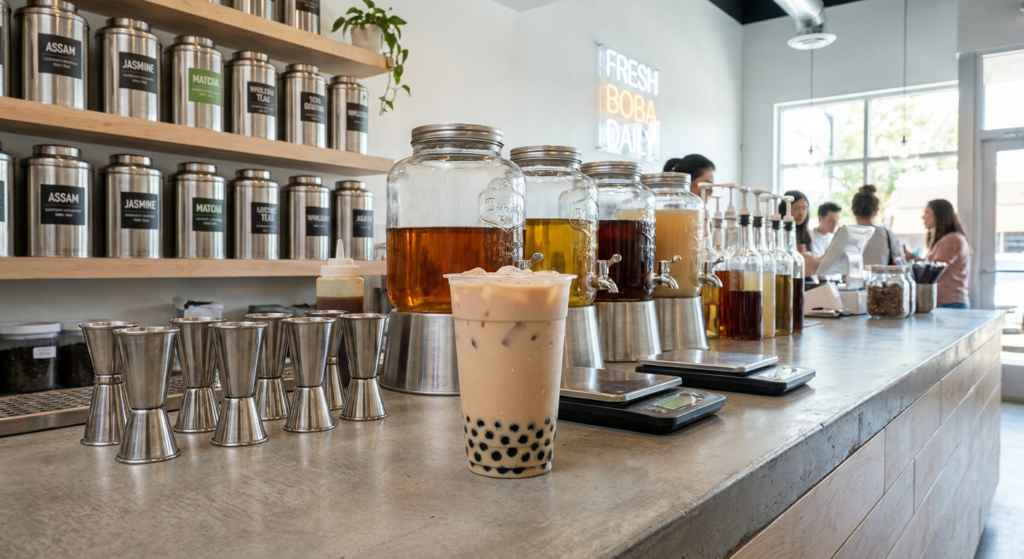
Base Brew Science: Extraction Ratios & Water Chemistry
To build a cold milk tea that retains a bold tea spine through 20 minutes of melting ice, you must extract a concentrated tea liquor. The goal is to maximize soluble tea solids while locking out bitter tannins.
1. Commercial Concentration Ratios
Standard hot tea drinking relies on a 1:50 to 1:60 leaf-to-water ratio. Commercial cold milk tea requires a 1:30 to 1:35 ratio by weight for black tea bases (Assam, Ceylon, or house black tea blends) and a 1:35 to 1:40 ratio for Jasmine green tea bases.
- Assam / Ceylon Black Tea: 1g tea leaves to 30ml filtered water (1:30 ratio).
- Jasmine Green Tea: 1g tea leaves to 35ml filtered water (1:35 ratio).
2. Water Temperature & Steep Times
Water temperature dictates extraction speed and chemical composition. Boiling water (98–100°C) extracts rich color and deep aroma from fully oxidized black teas. However, green tea leaves burn at temperatures above 82°C, destroying floral top notes and releasing bitter catechins.
| Parameter | Assam / Ceylon Black Tea Base | Jasmine Green Tea Base | Roasted Oolong Base |
|---|---|---|---|
| Tea-to-Water Ratio | 1 : 30 by weight | 1 : 35 by weight | 1 : 32 by weight |
| Water Temperature | 98°C – 100°C (208°F – 212°F) | 78°C – 82°C (172°F – 180°F) | 90°C – 92°C (194°F – 198°F) |
| Steeping Time | 8 to 10 minutes | 6 to 7 minutes | 7 to 8 minutes |
| Pot Cover SOP | Covered during steep | Uncovered (prevents stewing) | Covered during steep |
| Agitation | Stir gently at min 0 and min 5 | Stir once at min 0 | Stir gently at min 0 and min 4 |
⚠️ Operational Warning: Never squeeze tea filter bags or press loose tea leaves against the colander strainer during draining. Squeezing forces concentrated tannic acid and microscopic leaf particulates into the batch, causing immediate cloudiness and persistent bitterness in cold drinks.
For a deeper dive into adjusting extraction parameters for green tea versus black tea bases, review our black tea versus jasmine green tea base specs
.
Non-Dairy Creamer Emulsification & Temperature Control
The distinct silky texture of classic boba shop milk tea comes from high-grade non-dairy creamer powder (hydrogenated palm kernel oil and sodium caseinate). Unlike liquid whole milk, which adds up to 88% water to the cup, powdered non-dairy creamer provides rich fat and body without diluting the tea concentrate.
The Dissolution Temperature Window: 60°C to 65°C
Non-dairy creamer powders contain fat globules emulsified with vegetable gums and milk proteins.
- Above 85°C (185°F): High heat denatures sodium caseinate proteins, leading to a grainy texture.
- Below 50°C (122°F): Fat particles fail to melt and integrate, leaving visible oil floating on top of cold drinks.
- Optimal Dissolution Window (60°C – 65°C / 140°F – 149°F): At this exact temperature range, creamer lipids liquefy instantly and form a stable milk-tea emulsion that remains clear and uniform when flash-chilled to 4°C.
Standard Batch Mixing Protocol
- Strain freshly steeped hot tea liquor into an insulated stainless steel tea dispenser. The tea temperature after straining typically measures 82°C to 85°C.
- Allow the tea liquor to rest for 3 to 5 minutes until the batch temperature drops to 62°C – 65°C.
- Add pre-weighed non-dairy creamer powder directly into the dispenser.
- Whisk vigorously in a single direction for 45 to 60 seconds using a long-handled stainless steel whisk until all powder dissolves completely.
- Add liquid cane sugar or fructose syrup while the batch is still warm (50°C–55°C) to ensure rapid sugar dispersion without crystal settling.
For shops comparing dairy alternatives or liquid bases, consult our complete powdered creamer versus fresh dairy performance guide
.
Ice Displacement & Dilution Chemistry: Preventing Watered-Down Drinks
Understanding cup capacity and ice melt thermodynamics is essential for scaling a commercial cold milk tea recipe across different cup sizes.
A standard 16 oz boba cup holds 473 ml of total volume. However, when a barista fills the cup with tapioca pearls (60g / 50ml displacement) and standard ice cubes (150g / ~160ml volume), the remaining liquid capacity shrinks to roughly 260 ml.
During shaking (10–12 seconds) and the first 15 minutes in a customer’s hand, approximately 20% to 25% of the ice mass melts into the drink. This introduces 30 ml to 40 ml of pure water.
Total Cup Volume (16 oz / 473 ml)├── Cooked Tapioca Pearls: 60g (~50 ml displacement)├── Ice Fill (Standard Ice): 150g (~160 ml displacement)├── Melt Dilution Reserve: ~35 ml (melted ice during shaking & serving)└── Active Milk Tea Concentrate Liquid: ~228 mlBy formulating your base milk tea liquor with a 1:30 brew strength and 35g of creamer powder per 200ml of liquid, the resulting beverage accounts for this 35ml of melt water. The finished drink hits its target Brix sweetness (11.5°–12.5° Brix) and flavor balance exactly as the customer takes their first sip.
Standard Operating Procedure: Step-by-Step 16 oz & 22 oz Cup Spec Sheets
Below are the exact barista assembly spec sheets for standard commercial cold milk tea builds. These builds apply to classic iced black milk tea, green milk tea, and oolong milk tea.
1. Master Build Spec Sheet
| Ingredient / Step | 16 oz Cup Build (Standard Ice) | 22 oz Cup Build (Standard Ice) | Low Ice Adjustment (16 oz) | Zero Ice Build (16 oz) |
|---|---|---|---|---|
| Cooked Boba Topping | 60g (1 flat scoop) | 75g (1.25 scoops) | 60g | 60g |
| Concentrated Milk Tea Base | 200 ml | 280 ml | 230 ml | 260 ml |
| Liquid Cane Sugar (100% Sweet) | 25 ml (approx. 1.2 pumps) | 35 ml (approx. 1.7 pumps) | 25 ml | 25 ml |
| Ice Fill Line | Fill shaker 70% (~150g) | Fill shaker 70% (~220g) | Fill shaker 35% (~75g) | No ice in shaker |
| Filtered Chilled Water | 0 ml | 0 ml | 20 ml | 50 ml chilled water |
| Shaking Duration | 10–12 seconds | 12–15 seconds | 10 seconds | 8 seconds |
| Target Serving Temp | 2°C – 4°C (35°F – 39°F) | 2°C – 4°C (35°F – 39°F) | 3°C – 5°C | 4°C – 6°C |
Pro Tip: When customers order Zero Ice (0% Ice), never fill the remaining cup space with pure un-iced warm tea concentrate, as this ruins sweetness balance and makes the drink warm. Instead, top off with pre-chilled filtered water (50ml) and pre-chilled milk tea base from the station refrigerator. This maintains correct sweetness density and serving temperature.
2. Barista Assembly Sequence SOP
To ensure peak efficiency and zero cross-contamination on the assembly line, baristas must follow a strict, standardized build sequence:
- Step 1 (Topping First): Scoop warm cooked tapioca pearls (60g for 16 oz / 75g for 22 oz) into the bottom of the serving cup using a perforated boba spoon.
- Step 2 (Sweetener in Shaker): Dispense liquid cane sugar or fructose syrup into the cocktail shaker cup first.
- Step 3 (Milk Tea Base Addition): Measure and pour pre-chilled milk tea base (200ml for 16 oz / 280ml for 22 oz) over the sweetener in the shaker.
- Step 4 (Ice Fill): Add ice cubes into the shaker up to the designated fill line.
- Step 5 (Shaking): Seal shaker lid tightly. Shake vigorously up and down for 10 to 12 seconds (or run 12 seconds on an automatic shaker machine). Shaking aerates the drink, creating a creamy top micro-foam and lowering drink temperature to 3°C.
- Step 6 (Pour & Seal): Pour iced milk tea contents over the boba in the serving cup. Wipe rim with a clean paper towel if wet, and seal immediately using a cup sealing machine set to 165°C–170°C.
For additional assembly variations and specialty flavor builds, reference our shop-ready milk tea assembly SOPs and ingredient specs
.
Speed-of-Service Batching & Refrigerated Shelf-Life SOP
Preparing individual cups from raw hot tea during a 50-drink peak rush leads to long wait times and ticket backlogs. Commercial boba shops rely on two main batching strategies to maintain speed of service: Pre-Batched Milk Tea Base and Tea Concentrate + On-Demand Milk Dispensing.
Master Batch Brewing Flow (10-Liter Yield)├── 1. Boil 8,000ml Filtered Water to 100°C├── 2. Add 260g Premium Loose Black Tea Leaves├── 3. Steep Covered for 9 Minutes → Strain Tea Liquor (~7,400ml yield at 84°C)├── 4. Cool Tea Liquor to 63°C (approx. 4 minutes)├── 5. Whisk in 1,000g Non-Dairy Creamer Powder until emulsified├── 6. Whisk in 600ml Liquid Cane Sugar / Fructose Syrup└── 7. Add 1,500g Clean Ice → Rapid Stir to Flash-Chill to 15°C → Refrigerate at 3°C1. Master 10-Liter Pre-Batched Milk Tea Recipe
This batch recipe produces ready-to-use cold milk tea base that baristas can pour directly into shakers with ice:
- Filtered Water (Brewing): 8,000 ml
- Loose Black Tea Leaves: 260 g
- Non-Dairy Creamer Powder: 1,000 g
- Liquid Cane Sugar / Fructose: 600 ml
- Clean Ice (Flash-Chilling): 1,500 g
- Finished Cold Batch Yield: ~10 Liters (Yields approx. 50 cups of 16 oz milk tea).
2. Storage & Holding Time Rules
- Insulated Dispenser Holding (Room Temp Bar): Maximum 4 hours at room temperature (below 25°C / 77°F). Label dispenser with a time sticker upon brewing.
- Refrigerated Holding (<4°C / 39°F): Up to 24 hours in sealed food-grade polycarbonate containers. Stir thoroughly with a sanitized whisk before pouring into bar dispensers to re-incorporate settled tea solids.
- Discard Rule: Discard any leftover pre-batched milk tea after 24 hours. Never mix yesterday’s leftover batch into a fresh morning batch.

Commercial COGS Breakdown & Profit Margin Analysis
Maintaining healthy gross profit margins is vital for commercial boba shop survival. Cold milk tea offers some of the highest margins in the beverage industry when ingredients are sourced at wholesale prices and waste is controlled.
Below is a realistic cost-of-goods-sold (COGS) model for a standard 16 oz cold milk tea with boba, based on commercial US wholesale ingredient pricing:
| Cost Component | Quantity per 16 oz Drink | Wholesale Unit Cost | Extended Cost ($ USD) |
|---|---|---|---|
| Wholesale Black Tea Leaves | 5.2g (extracted at 1:30) | $16.00 / 1,000g bag | $0.083 |
| Commercial Non-Dairy Creamer | 20g (powder equivalent) | $4.50 / 1,000g bag | $0.090 |
| Liquid Cane Sugar Syrup | 25 ml | $12.00 / 5,000ml jug | $0.060 |
| Tapioca Pearls (Boba Topping) | 60g cooked yield | $28.00 / 3 kg bag | $0.120 |
| Filtered Water & Ice | 350 ml total | Utilities / Filtration | $0.015 |
| Packaging (16 oz PP Cup, Lid Film, Straw) | 1 set | Wholesale packaging kit | $0.140 |
| Total Unit COGS (per cup) | — | — | $0.508 (~$0.51) |
Margin & Retail Pricing Analysis
- Retail Menu Price (US Market Average): $5.50 (Base drink $4.75 + $0.75 Boba topping).
- Gross Profit Dollar per Cup: $5.50 − $0.51 = $4.99.
- Gross Profit Margin Percentage: ($4.99 / $5.50) × 100 = 90.7% Gross Margin (excluding direct labor and overhead).
With a COGS below $0.51 per cup, cold milk tea serves as a primary profit driver for boba shops, funding store rent, labor, and marketing expenses.
Commercial Cold Milk Tea Troubleshooting & Quality Checklist
When drink quality strays on the bar, use this diagnostic matrix to quickly identify root causes and corrective actions:
┌── Bitter / Astringent? ──► Squeezed filter bag OR water too hot (>98°C) │Cold Milk Tea ────┼── Watery / Weak Body? ───► Ratio diluted (<1:30) OR added ice to hot teaDefect Diagnostics│ ├── Oily Film / Separated?─► Dissolved creamer below 50°C │ └── Cloudy / Sediment? ────► Tea creamed from slow cooling OR squeezed leavesOperational Quality Matrix
| Symptom / Defect | Root Cause | Immediate Corrective Action |
|---|---|---|
| Drink tastes bitter or dry on tongue | Tea steep time exceeded limit OR filter bag was squeezed during straining. | Enforce strict timer alarms; train baristas to drain leaves passively without pressing. |
| Oily droplets or white specks on surface | Creamer added to cold tea (<50°C) or un-dissolved creamer clumps. | Whisk creamer only when tea liquor is in the 60°C–65°C window. |
| Drink loses flavor after 5 minutes | Base tea brewed too weak (>1:40) or warm tea poured over ice. | Switch to 1:30 brew ratio; flash-chill base before adding ice in shaker. |
| Batch turns cloudy and dark in fridge | Polyphenols bonded with calcium/minerals during slow room-temp cooling. | Flash-chill batch rapidly using clean ice before refrigerating below 4°C. |
| Sweetness inconsistent between orders | Fructose syrup settled at bottom of batch container. | Whisk syrup into warm tea base during initial batching; stir before filling bar dispensers. |
Frequently Asked Questions (FAQ) for Boba Shop Operators
1. What is the ideal tea-to-water ratio for commercial cold milk tea?
For commercial cold milk tea, use a 1:30 to 1:35 tea-to-water ratio by weight for black tea bases (Assam or Ceylon) and 1:35 to 1:40 for Jasmine green tea bases. This concentrated brew ensures the tea retains its full body, rich aroma, and deep color even after 20% to 25% ice melt dilution in the customer’s cup.
2. Can I use fresh milk instead of non-dairy creamer powder for cold milk tea?
Yes, fresh milk (such as whole milk, oat milk, or half-and-half) works well, but it requires recipe adjustments. Fresh milk contains roughly 88% water, which can dilute hot-brewed tea. When using fresh milk, brew an extra-concentrated tea base (1:20 to 1:25 ratio) and combine 2 parts cold tea concentrate with 1 part fresh milk to maintain a creamy mouthfeel without watering down the drink.
3. How do I prevent cold milk tea from turning cloudy in the refrigerator?
Tea cloudiness (also called “tea creaming”) occurs when tannins and caffeine precipitate as the tea cools slowly. To prevent cloudiness, flash-chill your freshly steeped tea liquor rapidly from 60°C down to below 15°C using clean ice or an ice-wand heat exchanger before placing it in the refrigerator. Additionally, never squeeze tea leaves during straining, as squeezing releases excess insoluble tannins.
4. How long can pre-batched milk tea be stored in a commercial boba shop?
Pre-batched milk tea can be kept in an insulated counter dispenser at room temperature (<25°C / 77°F) for up to 4 hours. When stored in sealed food-grade containers in a commercial refrigerator at 2°C to 4°C (35°F – 39°F), pre-batched milk tea maintains peak quality for up to 24 hours. Always stir refrigerated batches before service and discard unused tea after 24 hours.
5. What is the exact build for a 16 oz cold milk tea with boba?
For a standard 16 oz cold milk tea: add 60g cooked tapioca pearls into the cup. In a shaker, combine 25ml liquid cane sugar syrup, 200ml pre-chilled milk tea base (made with a 1:30 tea liquor and 35g creamer powder), and 150g ice. Shake vigorously for 10 to 12 seconds, pour into the cup over the boba, and seal.
Looking to upgrade your boba shop’s menu, train your barista staff, or source commercial-grade loose-leaf teas and non-dairy creamer powders? Contact our wholesale beverage specialists at BubbleTeaSuppliers.com for custom ingredient sample kits, spec sheets, and high-volume pricing.