
Your winter menu is your summer menu, and the cold case is doing all the selling in the coldest month of the year. The fix is a hot jasmine milk tea that still smells like jasmine and still drinks creamy at hour four of a shift, not just at the first cup. Jasmine tea is green tea scented with jasmine blossoms, and real jasmine tea is built through repeated scenting cycles, so the leaf carries a floral top note that heat and time strip away faster than most operators expect (Teatulia, page dated 2026-10-06). Holding, in this guide, means keeping a finished drink at a temperature and for a window where it is both safe and still worth selling, which is a different problem from brewing it well once.
The economics make the case for tea over coffee this season. In the Bureau of Labor Statistics CPI for August 2026, coffee prices rose 6.1% year over year while tea edged up 0.4% in the “other beverage materials including tea” category (BLS CPI Table 2, data for August 2026, last modified 2026-09-11). A hot tea line gives you a winter drink whose input cost is not the one moving.
This guide is not a recipe blog rewrite. It covers how to make jasmine milk tea at shop scale: which tea and which milk to buy before you brew anything, a weighed 12 oz and 16 oz build, a holding and discard routine, and the four failures you will actually see on a hot bar.
Get the Jasmine Tea and the Milk Right Before You Brew Anything
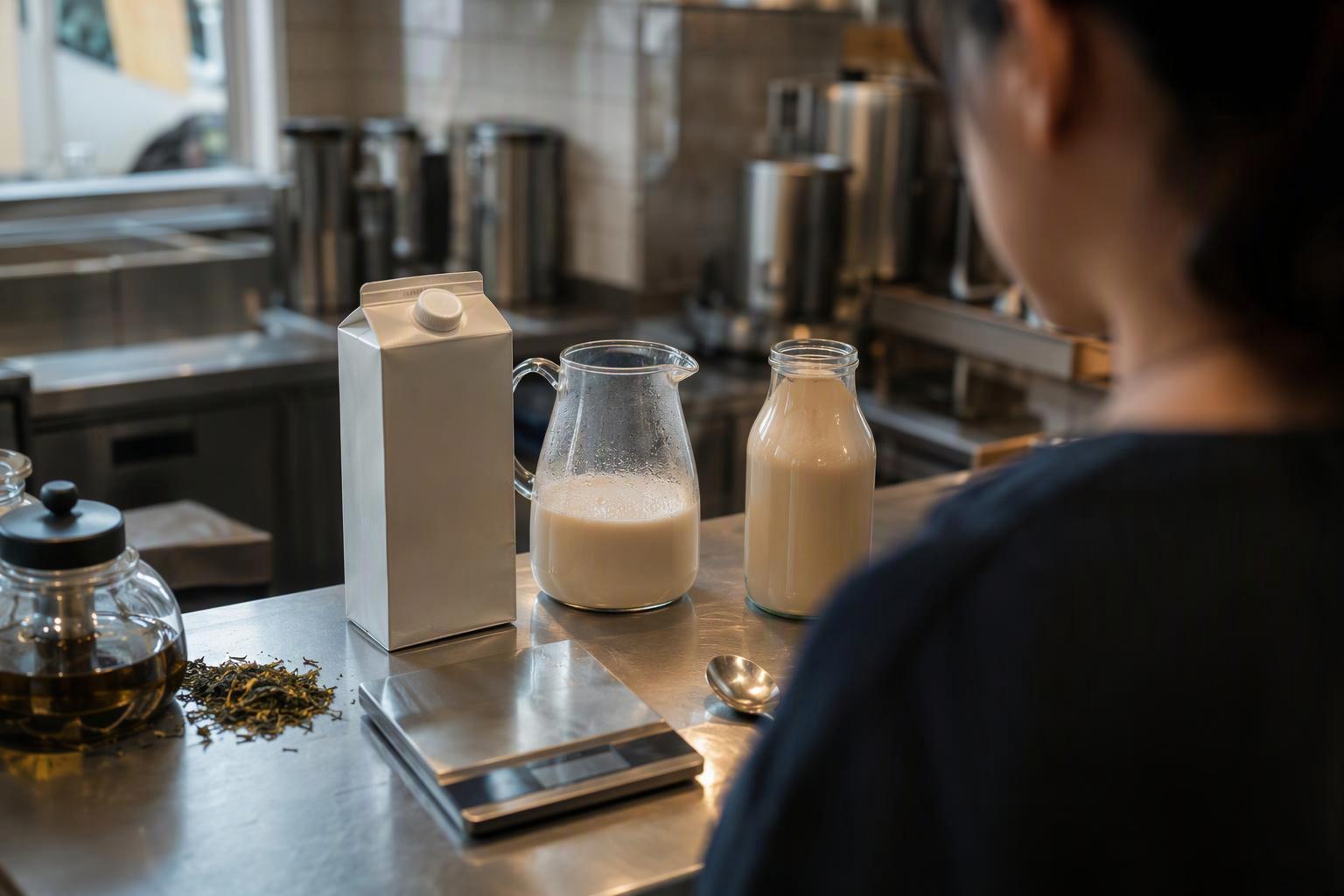
Choose the milk before the tea lot, because the milk decides how long the drink can hold. Jasmine tea is green tea scented with jasmine blossoms, though the base can also be white or black, and all jasmine tea contains caffeine because the base leaf is Camellia sinensis (Teatulia, page dated 2026-10-06). Real jasmine tea is built through repeated scenting cycles, with the trade page putting it at 4 to 7 cycles of contact with fresh flowers, and blended dried-flower or synthetic-flavoured versions sit distinctly lower in quality (Teas.co.uk, 2026-01-17). Buy the scented leaf, not the flavoured powder.
The milk choice is a chemistry decision. Casein destabilises once pH drops near 5, with an isoelectric point around pH 4.6 to 5.2, while fresh milk sits at about pH 6.6 to 6.7 (TeaTrade Milk Guide, 2026-08-24). Brewed tea sits at pH 4.5 to 5.5, close enough to that threshold that a tannic lot can push a dairy drink into visible feathering. UHT milk is heated to 135–150°C for 2 to 5 seconds, which denatures some whey proteins and makes it more resistant to acid- and tannin-induced curdling (TeaTrade Milk Guide, 2026-08-24). For a drink that sits in a holding vessel, that resistance is worth more than the faint cooked note it costs you.
| Base or milk | Heat behaviour | Holding tolerance |
|---|---|---|
| Green jasmine base | Most heat-sensitive; bitterness climbs fastest | Shortest window; brew cool and short |
| White jasmine base | Delicate, low tannin | Moderate; holds aroma poorly |
| Black jasmine base | Most tannin, most stable body | Longest window; watch curdling |
| Whole dairy | Full body, moderate curdling risk | Good, if tea is not very acidic or hot |
| UHT dairy | Partially denatured whey, most stable | Best dairy option for holding |
| Plant milks | Oat and almond separate rather than curdle | Variable; check the formulation |
Pro Tip: choose the milk before the tea lot, because the milk decides the holding window.
Brew the Jasmine Base Cool and Short So It Never Turns Bitter
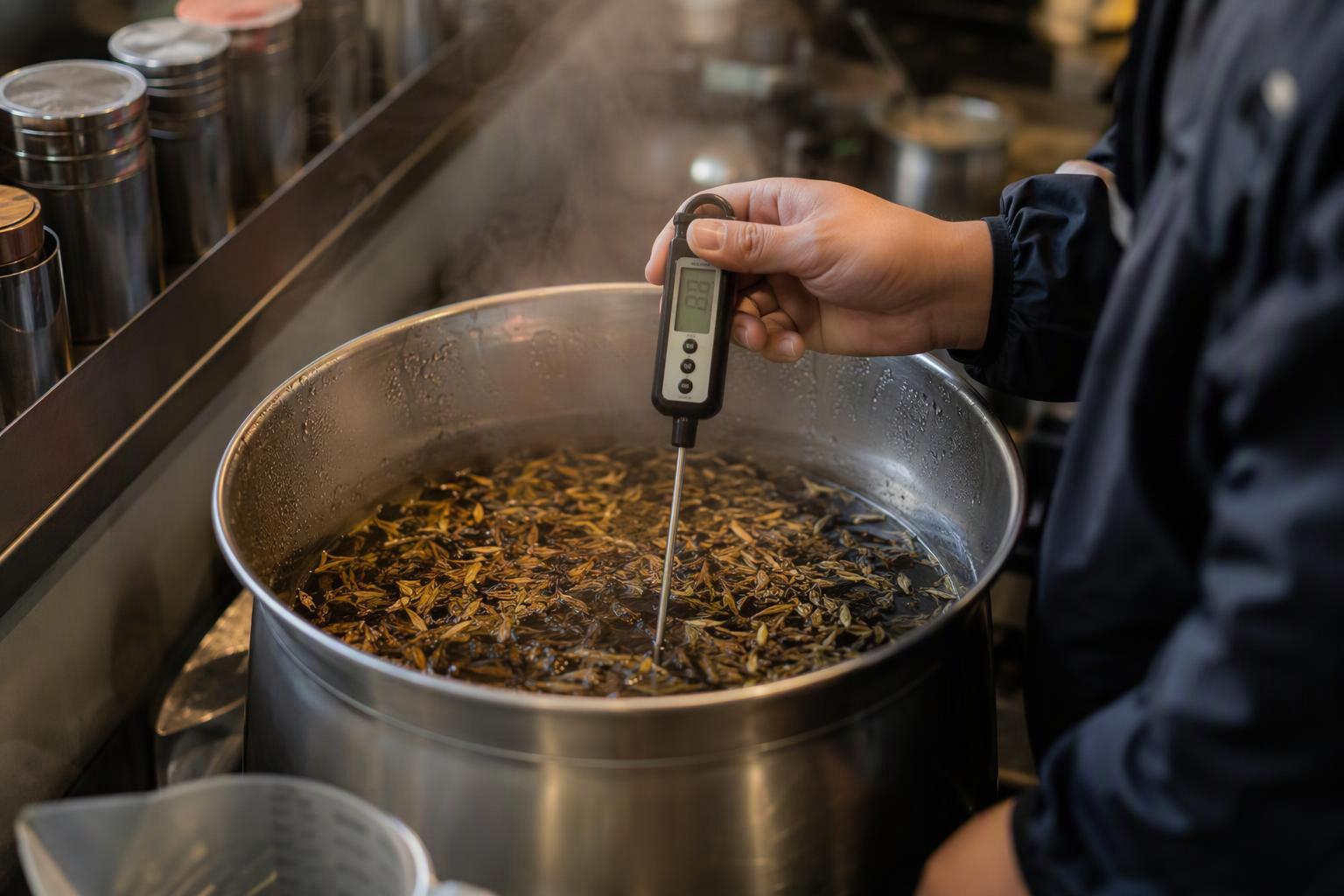
Heat does not extract more jasmine, it extracts more caffeine and catechins, and that is the whole reason a hot bar goes bitter by the second hour. A 2025 brewing-temperature study in Food Chemistry: X brewed Longjing green tea at 70, 80, 90 and 100°C for 4 minutes and found bitterness of the standard grade rose from 3.13 to 5.17 and astringency from 2.07 to 4.13, both significant at p<0.05, while umami-mellow of the premium grade fell from 8.10 to 5.60 (Food Chemistry: X, collection May 2025). Caffeine leaching rose 60.08% across the same range. Longjing is not jasmine, but both are green Camellia sinensis leaf, and the transfer is the temperature dependence of catechin and caffeine extraction, not the specific cultivar.
Bitterness is a balance shift, not simply more flavour. Higher temperature accelerates leaching of flavonols, catechins and caffeine, while the umami amino acids such as L-theanine do not increase enough to compensate, and astringency is a separate mouthfeel caused by polyphenols binding proteins (Food Chemistry: X, collection May 2025). That is why extending the steep makes the problem worse rather than stronger.
The practical band for jasmine green tea brewing temperature is 175–185°F, and the same study’s endpoint data supports pulling the leaves at 2 to 3 minutes rather than steeping longer. A separate green-tea extraction study brewed 24 commercial varieties and found that brewing temperature and time significantly change what you extract, with optimal antioxidant extraction at 5 to 10 minutes and 80 to 100°C (Food Chemistry, issue 2016-02-01). Read the two together and the trade-off is explicit: a cooler, shorter brew gives up some antioxidant yield to protect taste quality, which is the right trade for a drink you are selling by the cup.
⚠️ Warning: do not extend the steep to get more flavour. Add leaf instead.
Build the 12 oz and 16 oz Spec by Weight, Not by Eye
Start at 2 grams per 8 ounces of water, and if the tea tastes weak, add leaf, not steeping time. That ratio and that adjustment rule are the two numbers the brewing cluster agrees on (EatHealthy365
, 2025), and they are the only verified starting points for a jasmine milk tea recipe at shop scale. Everything below them is your own tested build.
Warm the milk gently before it meets the tea. Curdling is driven by heat plus acidity, and the mitigation list is consistent across the sources: cool the tea slightly, pre-warm the milk, stir slowly, and choose lower-acid teas or emulsifier-stabilised creamers (Tasting Table, 2023-10-27). The same mechanism explains why milk proteins start to unravel above about 75°C, so a milk that hits near-boiling tea takes a thermal shock it does not take when it is already warm (TeaTrade, 2026-02-05).
| Component | 12 oz build | 16 oz build | Must reach |
|---|---|---|---|
| Jasmine tea concentrate | 150 g | 200 g | Brewed at 175–185°F, then cooled to about 160°F |
| Milk (UHT dairy or barista plant) | 90 g | 120 g | Pre-warmed to 130–140°F |
| Sweetener syrup | 15 g | 20 g | Room temperature |
| Total | 255 g | 340 g | Serve at 150–160°F |
Key Takeaway: the spec is a starting build, not a cited standard. No source in this packet gives an operator-grade weighted spec, so calibrate these weights to your tea lot and your milk with a taste panel before you put the drink on the menu.
Prep, Hold and Serve It Safely Through a Full Shift
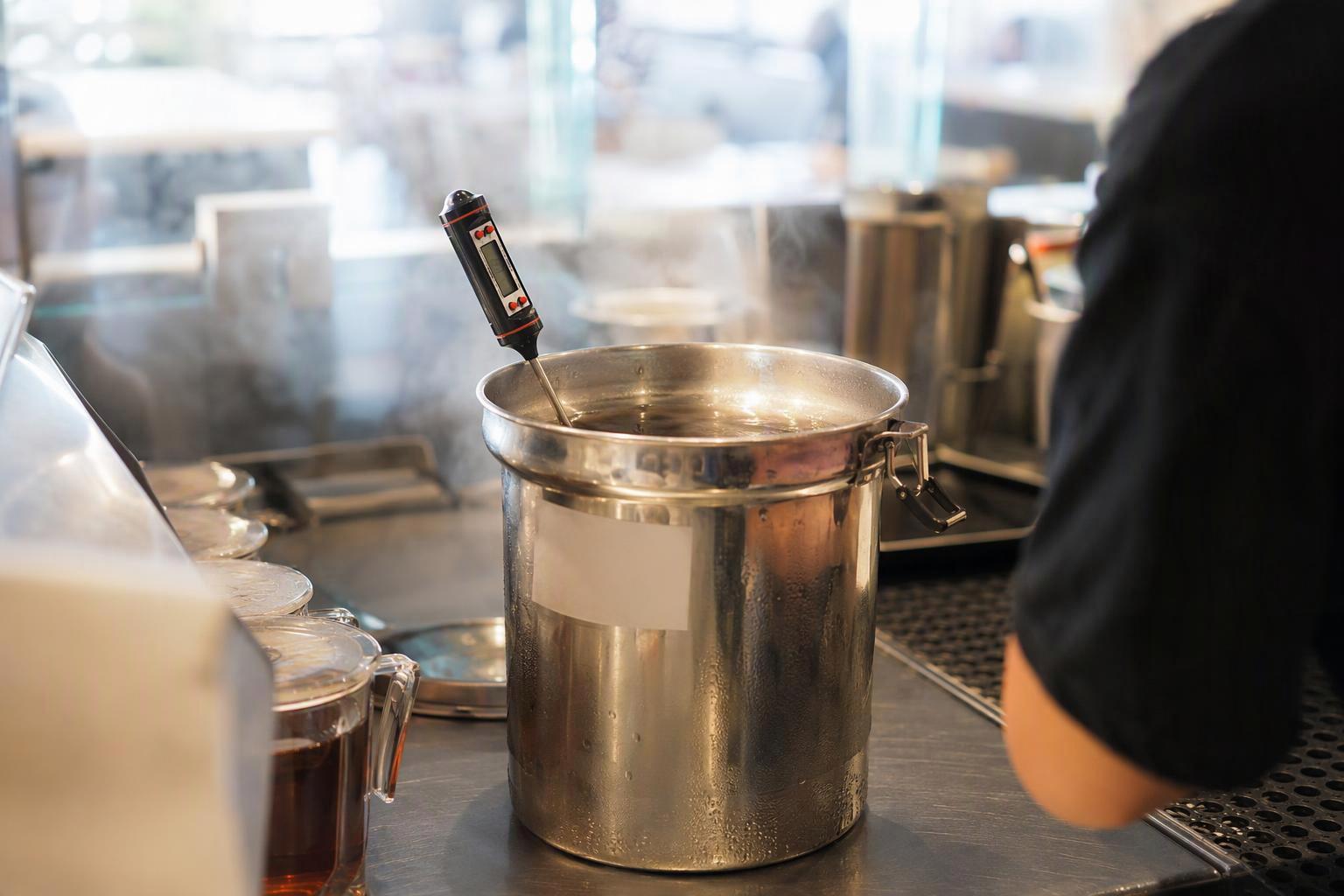
Adding milk is what makes the drink TCS, and that single distinction is what puts a hot milk tea under the hot-holding rule that plain brewed tea escapes. Section 3-501.16 of the Food Code sets hot holding at 57°C (135°F) or above (FDA Food Code Chapter 3, 2022 edition). USDA puts the danger zone at 40°F to 140°F, with bacteria able to double in as little as 20 minutes (USDA FSIS, live page). The two bodies are not contradicting each other: 135°F is the Food Code’s establishment floor, and 140°F is FSIS consumer guidance that says keep hot food at 140°F or warmer (USDA FSIS, live page). Hold at 140°F and you satisfy both.
Your binding number is not the federal one. The FDA Food Code, which the FDA updated to its 2026 edition, is a model code that states, localities and tribes adopt with possible amendments, so your state or local code is what binds your shop (FDA Food Code, page current 09/17/2026). Confirm your local figure before you print a holding temperature on a training card.
If you hold by time instead of temperature, the routine is stricter, not looser. Under time as a public health control, hot food is served or discarded within 4 hours, marked with the 4-hour discard time, and unmarked or over-4-hour product must be thrown out (FDA Food Code Chapter 3, 2022 edition). Any batch that was cooked, cooled and reheated for hot holding must reach 165°F for 15 seconds first (FDA Food Code Chapter 3, 2022 edition). Two instruments, one probe thermometer and one timer, run the whole shift.
Fix the Four Failures You Will Actually See on the Bar
Failure 1: the drink goes bitter by the second hour. Continued extraction and a too-hot hold are the cause. Bitterness and astringency climb with temperature while the umami amino acids that balance them fall, with L-theanine down 25.20% and L-aspartic acid down 43.01% from 70°C to 100°C (Food Chemistry: X, collection May 2025). Brew cooler, pull the leaves on time, and hold the finished drink at the low end of the safe band.
Failure 2: the milk separates when it hits the tea. Heat and acid together are what curdle milk in tea, and the fix is sequence and temperature rather than a different brand (Tasting Table, 2023-10-27). Pre-warm the milk, cool the tea slightly, and stir slowly instead of agitating the cup.
Failure 3: the aroma disappears before the body does. Jasmine aroma is volatile, and the research on jasmine tea beverages shows that encapsulating aroma molecules slows their volatilisation rate (npj Science of Food, published 2026-01-08). You cannot buy that nanocomplex, but the principle tells you what to protect: keep the lid on the holding vessel, keep the hold short, and never reheat a batch twice.
Failure 4: two shifts make two different drinks. This is a measurement failure, not a skill failure. The verified ratio is 2 to 3 grams per 240 ml, and the verified correction is more leaf rather than more time (EatHealthy365, 2025). Put a scale on the bar and the shift-to-shift variance goes away.
Price It and Place It on the Winter Menu
Price the hot jasmine line against your own cost movement, not against a market report. The BLS CPI for August 2026 shows beverage materials including coffee and tea up 4.0% over 12 months, with coffee alone up 6.1% and roasted coffee up 4.9% (BLS CPI Table 2, data for August 2026, last modified 2026-09-11). Tea’s 0.4% movement in the same table is the cost argument for building the winter menu around it.
There is no verified US price band for hot jasmine milk tea in this research, and no verified market-size figure, so set your price from your own plate cost and your local comparables rather than from a published range. What the evidence does support is placement: put the hot jasmine line at the top of the hot section, where a customer who walked in from the cold sees it before the iced list.
The sensory case for the drink is documented even where the price data is not. ISO 3103:2019, the international standard for preparing tea liquor for sensory tests, covers liquor with or without milk and notes that milk-after-pouring is best tasted at 65–80°C (ISO, ISO 3103:2019). That is a tasting-temperature reference, not a serving rule, but it confirms the drink is meant to be evaluated warm rather than scalding, which is also the temperature at which your customers will actually drink it.
Frequently Asked Questions
How do I make jasmine milk tea that tastes clean instead of bitter?
Treat bitterness as an extraction problem, not a recipe problem. Jasmine tea is green tea scented with jasmine blossoms, so the leaf behaves like a green tea: it gives up its harsh compounds fast once the water is too hot or the steep runs long. Keep the water below a boil and cut the steep short, and the floral note survives. If the cup still tastes thin, add leaf next batch rather than adding minutes.
Does hot jasmine milk tea have caffeine?
Yes, always. Jasmine tea is green tea scented with jasmine blossoms, and because the base leaf is Camellia sinensis, no jasmine product is caffeine-free regardless of how floral it smells. According to the IARC Monographs Volume 51 on coffee, tea, mate and methylxanthines, tea leaf runs about 3 to 4 percent caffeine by dry weight, and green and black tea carry similar caffeine, roughly 30 to 50 mg a cup. A 16 oz milk tea built on a double-strength base therefore lands well above a single cup, so quote a range at the counter rather than a number.
Why does the milk separate in my hot jasmine milk tea?
Heat and acid together are what curdle milk in tea. Brewed tea is mildly acidic, and when it meets hot dairy the proteins lose their grip and clump. Plant milks are the harder case: many separate visibly in hot, acidic liquid, while UHT and emulsifier-stabilised versions hold together far better. Pre-warm whatever milk you use, let the tea drop a little below serving temperature before combining, and pour slowly.
Can I re-steep the jasmine leaves for a second batch?
You can, but expect a different drink. Brewing temperature and time significantly change what you extract, so a second pass pulls less aroma and more of the flat, woody notes. Re-steeped liquor is fine as a lower-cost base for flavoured or heavily sweetened builds; it is not a substitute in a drink where the jasmine is meant to lead. Taste the second batch before you commit a shift to it.
What should I do if a step goes wrong mid-service?
Work backwards from the symptom. Bitter or astringent means the steep ran hot or long, so pull the next batch earlier. Thin body means the ratio drifted, so weigh the leaf again instead of eyeballing it. Separated milk means the tea was too hot or too acidic when it met the dairy, so cool slightly and stir gently. Cloudy, sour-smelling, or lukewarm product is not a recipe problem: discard it and start fresh rather than trying to rescue the batch.
A hot jasmine milk tea that holds its aroma and body through a full service comes down to four decisions made in order: buy scented leaf and a heat-stable milk, brew cool and short, build the cup by weight, and hold it at 140°F with a marked 4-hour discard time. The brewing science explains why the first two matter, with bitterness and astringency climbing and umami amino acids falling as temperature rises (Food Chemistry: X, collection May 2025), and the milk chemistry explains why UHT dairy and a pre-warmed pitcher outperform fresh milk poured into near-boiling tea (TeaTrade Milk Guide, 2026-08-24).
The compliance side is simpler than most operators fear once you separate the two instruments. Hold, mark the discard time, reheat, and check your own state or local code, because the FDA Food Code is a model that your jurisdiction adopts with possible amendments (FDA Food Code).
Before the winter rush, run one taste panel against the 12 oz and 16 oz builds in this guide, adjust the leaf weight to your lot, and write the final gram amounts on a card at the bar. The next step is stocking the hot-drink range your winter menu needs, so the first cold week does not catch you with a summer list.