
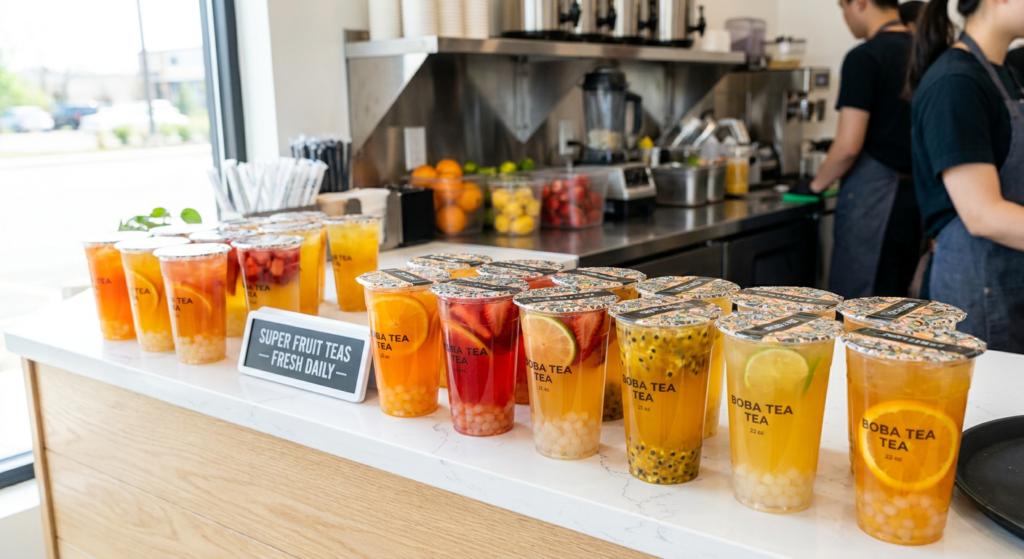
In modern bubble tea shop operations, fruit tea has evolved from a secondary menu option into a primary revenue driver. Specifically, Super Fruit Tea—a high-impact category defined by vibrant fruit purees, fresh fruit garnishes, premium brewed tea bases, and translucent toppings like crystal boba—commands premium retail pricing between $6.50 and $7.50 per cup in the U.S. market.
For commercial boba shop owners and beverage developers, Super Fruit Tea represents an attractive product category with gross profit margins consistently exceeding 80%. However, managing a commercial fruit tea program introduces operational challenges that milk tea lines rarely face: rapid fresh fruit oxidation, ingredient waste, inconsistent Brix levels across shift changes, and back-of-house (BOH) assembly bottlenecks during peak hours.
This operational guide outlines the exact batch brewing protocols, 16 oz and 22 oz build spec sheets, ingredient pairing frameworks, and Cost of Goods Sold (COGS) economics required to execute a high-yield Super Fruit Tea menu line.
Commercial Batch Tea Base Brewing SOPs (3-Liter Scale)
The foundation of every exceptional fruit tea is a precisely brewed, rapid-chilled tea base. Fruit juices and purees require a tea base with sufficient structural acidity and aromatic intensity to cut through cold temperatures and ice dilution without introducing harsh bitterness.
3,000 ml Purified Water @ 175°F → 90 g Jasmine Green Tea / 6 Min Steep → Filter & Add 1,000 g Ice → Store @ 35°F–38°F
Jasmine Green Tea Base (The Industry Standard)
Jasmine Green Tea accounts for over 80% of commercial fruit tea sales. Its clean floral aroma complements tropical and citrus fruits without masking their natural brightness.
Pro Tip: Shock-chilling batch-brewed jasmine green tea with ice immediately after straining locks in delicate volatile floral aromatics and prevents turbidity (clouding) during cold storage.
Commercial Batch Protocol (3 Liters Yield)
- Water Preparation: Heat 3,000 ml of purified reverse-osmosis (RO) water to 175°F–180°F (78°C–82°C).
- Leaf Measurement: Measure 90 g of premium loose-leaf Jasmine Green Tea (maintaining a strict 1:33 leaf-to-water ratio).
- Extraction: Submerge tea leaves in an insulated thermal brewing urn. Steep for exactly 6 minutes. Stir gently twice at the 3-minute mark to ensure uniform extraction.
- Filtration: Strain the brewed tea liquor immediately through a fine-mesh filter bag into a designated chilling vessel.
- Rapid Ice-Shocking: Immediately add 1,000 g of clean ice directly to the hot tea liquor. Stir vigorously until completely melted. This rapid temperature drop preserves floral top notes and prevents tanic bitterness.
- Refrigerated Holding: Store the chilled tea base in food-grade, airtight containers at 35°F–38°F (2°C–3°C).
Four Seasons Oolong & Earl Black Tea Alternatives
While Jasmine Green Tea excels with berries and citrus, secondary tea bases allow operators to create distinct menu tiers:
- Four Seasons Spring Oolong (Si Ji Chun): Offers a buttery, orchid-like floral body with low astringency. Excellent for stone fruits such as white peach, guava, and mango.
- Earl Black Tea / Assam Black Tea: Provides a full-bodied, malty foundation with natural tannic structure. Ideal for heavy citrus builds like ruby grapefruit, navel orange, and passionfruit blends.
BOH Temperature, Holding & Oxidation Controls
Tea bases begin to lose volatile aromatics and develop flat, oxidized flavor profiles after prolonged exposure to air.
⚠️ Warning: Never steep Jasmine Green Tea at boiling temperatures (212°F / 100°C) or extend steeping beyond 7 minutes. Over-extraction pulls harsh catechins and polyphenols that cloyingly clash with fruit purees.
- Maximum Hold Time: Chilled tea bases must be discarded after 4 hours of holding time, even when refrigerated.
- Temperature Target: Maintain tea base dispensing containers below 40°F (4.5°C) at the BOH assembly station.
- Dispensing Protocols: Use insulated stainless steel tea urns fitted with silicone-sealed spigots to minimize ambient air contact.
Super Fruit Flavor Profiles & Ingredient Pairing Matrix
A successful commercial Super Fruit Tea balances three core sensory elements: aromatic tea structure, vibrant fruit acidity/sweetness, and textural mouthfeel.
| Fruit Flavor Profile | Recommended Tea Base | Optimal Fruit Format | Complementary Topping | Brix Target (Finished) |
|---|---|---|---|---|
| Passionfruit Pineapple | Jasmine Green Tea | Puree + Fresh Slices | Crystal Boba / Popping Boba | 13°–14° Brix |
| Guava White Peach | Four Seasons Oolong | Commercial Puree | Coconut Jelly | 12°–13° Brix |
| Ruby Grapefruit Citrus | Jasmine Green Tea / Earl Black | NFC Juice + Slice | Crystal Boba | 11°–12° Brix |
| Mango Dragonfruit | Jasmine Green Tea | Concentrated Puree | Aloe Vera / Mango Jelly | 13°–14° Brix |
| Mixed Super Berry | Earl Black Tea / Hibiscus | Berry Jam / Puree | Popping Boba | 12°–13° Brix |
Fresh Fruit Slices vs. Commercial Puree & Syrup Balance
Relying entirely on fresh raw fruit leads to severe cost variations, short shelf life, labor-intensive slicing, and inconsistent sweetness between batches. Conversely, relying solely on commercial syrups creates a synthetic, low-quality drink that fails to justify a $7.00 price point.
The most efficient commercial solution combines both formats:
- Commercial Fruit Puree / Syrup (In Shaker): Delivers standardized Brix levels, consistent color, and deep flavor profile during the assembly shake.
- Fresh Fruit Slices (In Serving Cup): 2–3 thin slices of fresh lime, orange, or strawberry added directly to the serving glass establish visual freshness and premium perception without overburdening BOH labor.
Topping Pairings: Crystal Boba, Popping Boba & Fruit Jellies
Traditional brown sugar tapioca pearls absorb liquid and lose their chewy texture in cold, acidic fruit tea environments. Super Fruit Teas require specialized cold-stable toppings:
- Crystal Boba (Agar Pearls): Pre-cooked, translucent agar-based pearls with a crisp, bouncy chew. They do not absorb tea color or alter sweetness levels.
- Popping Boba: Liquid-filled juice spheres (passionfruit, mango, strawberry) that burst upon biting, providing interactive flavor release.
- Coconut Jelly (Nata de Coco): Firm, rectangular jelly cubes that absorb subtle fruit notes while adding satisfying chewiness.
Standardized Assembly Builds: 16 oz (500 ml) vs. 22 oz (700 ml) Spec Sheets
Operational consistency requires strict adherence to standardized assembly cards posted at every BOH station. The builds below reflect proven specs for commercial fruit tea recipe SOPs.
| Ingredient Component | 16 oz (500 ml Serving) | 22 oz (700 ml Serving) | BOH Handling Note |
|---|---|---|---|
| Crystal Boba / Topping | 50 g | 70 g | Dispense to bottom of cup first |
| Fresh Fruit Slices (Garnish) | 30 g (2 slices) | 50 g (3 slices) | Place against cup wall for visual impact |
| Chilled Jasmine Tea Base | 200 ml | 280 ml | Dispense from chilled urn into shaker |
| Commercial Fruit Puree / Syrup | 35 ml | 50 ml | Dispense via calibrated syrup pump |
| Liquid Fructose (55%) | 10 ml (100% Sweet) | 15 ml (100% Sweet) | Adjust according to customer selection |
| Fresh Lemon / Lime Juice | 5 ml | 8 ml | Adds natural citric acidity |
| Solid Ice Weight | 180 g | 250 g | Fill shaker to target fill line |
Step 1: Topping & Fresh Slices in Cup → Step 2: Tea + Puree + Fructose + Ice in Shaker → Step 3: Hard Shake 8-10 Sec → Step 4: Pour, Seal & Serve
BOH Assembly Workflow
- Cup Prep: Place 50 g (16 oz) or 70 g (22 oz) of crystal boba into the bottom of the serving cup. Add 2–3 fresh lime or orange slices against the inner cup wall.
- Shaker Build: In a standard polycarbonate shaker, combine chilled Jasmine Green Tea base, commercial fruit puree, liquid fructose, and fresh lime juice.
- Ice Addition: Add solid ice to the shaker fill line (180 g for 16 oz, 250 g for 22 oz).
- Mechanical / Manual Shake: Hard-shake for 8 to 10 seconds (or 15 seconds on an automated shaking machine) to fully chill the liquid, emulsify the puree, and create a light micro-foam cap.
- Pour & Seal: Pour the shaken tea mixture over the prepared toppings and fresh fruit slices. Seal with automated cup sealing film and serve immediately with a jumbo straw.
Super Fruit Tea COGS Breakdown & Profit Margin Analysis
Understanding unit economics enables shop owners to set accurate menu pricing and control food costs. Below is an itemized financial breakdown for a signature 22 oz Passionfruit Guava Super Fruit Tea with Crystal Boba based on current U.S. wholesale ingredient pricing from BubbleTeaSuppliers.
Financial Breakdown (22 oz Serving Size)
| Ingredient / Packaging Component | Portion / Quantity | Wholesale Unit Cost (USD) | Cost per Serving |
|---|---|---|---|
| Jasmine Green Tea Leaves | 6.3 g leaf equivalent (280 ml brewed) | $12.00 / 500 g bag | $0.15 |
| Commercial Passionfruit Guava Puree | 50 ml | $14.50 / 2.5 kg bottle | $0.29 |
| Liquid Fructose (55%) | 15 ml | $18.00 / 7 kg tub | $0.04 |
| Fresh Fruit Slices (Lime & Orange) | 50 g (3 thin slices) | Market price ($0.80 / lb) | $0.18 |
| Crystal Boba Topping | 70 g | $22.00 / 2 kg bag | $0.31 |
| Custom 95mm PP Cup & Sealing Film | 1 cup + 1 seal pattern | $85.00 / 1,000 sets | $0.09 |
| Jumbo Boba Straw & Paper Sleeve | 1 unit | $25.00 / 2,000 units | $0.03 |
| Total Direct COGS | — | — | $1.09 |
Gross Profit Summary
- Suggested Retail Price (SRP): $6.95
- Direct Material COGS: $1.09
- Gross Margin Dollar Return: $5.86 per cup
- Gross Profit Margin Percentage: 84.3%
Maintaining a food cost under 16% allows beverage operators to absorb store labor, commercial rent, utilities, and marketing expense while maintaining net profitability. Reviewing broader commercial fruit tea menu design strategies helps align drink pricing across all beverage lines.
Back-of-House Operational Troubleshooting for Boba Shops
Even with clear spec sheets, daily operational friction can affect beverage quality and ticket times.
Preventing Tea Bitterness & Over-Extraction
- Issue: Customers report astringent, bitter undertones in fruit tea.
- Root Cause: Water temperature exceeded 180°F during brewing, or tea leaves were steeped longer than 6 minutes.
- Solution: Install digital temperature-controlled kettles set to 175°F. Train baristas to use digital countdown timers that ring loudly when steeping ends.
Maintaining Consistent Brix Levels Across Sweetness Tiers
- Issue: Drink tastes watered down at 25% or 50% sweetness selection.
- Root Cause: Removing fructose reduces total beverage volume and sweetness perception, altering flavor balance.
- Solution: Adjust fruit puree dose slightly (+5 ml) when fructose is reduced to maintain fruit aromatics without adding excess refined sugar.
Streamlining Peak-Hour Ticket Times
- Issue: BOH station stalls during rush hours due to fruit slicing and manual measuring.
- Root Cause: Unprepared toppings and uncalibrated syrup pumps.
- Solution: Pre-portion fresh fruit slices during morning prep hours and store them in chilled inserts. Equip syrup bottles with calibrated 10 ml and 15 ml dosage pumps for 2-second dispensing.
Menu Positioning & B2B Wholesale Sourcing Strategy
Super Fruit Teas perform best when positioned prominently on menu boards as “Signature Refresher” or “Zero-Dairy Premium” lines. Highlighting real fruit content, antioxidant appeal, and crystal boba textures appeals directly to health-conscious consumers who avoid traditional dairy or creamer-heavy milk teas.
To maintain high profit margins, sourcing stable, high-yield raw ingredients is critical. Exploring a comprehensive wholesale boba tea ingredient catalog allows shop operators to secure premium tea bases, commercial fruit purees, crystal boba, and specialized equipment directly from verified manufacturing sources.
Get Started with Commercial Ingredients: Elevate your boba shop’s menu performance with barista-grade tea leaves, fruit purees, and crystal boba. Contact our beverage specialists today to request wholesale sample kits and custom recipe development support.