
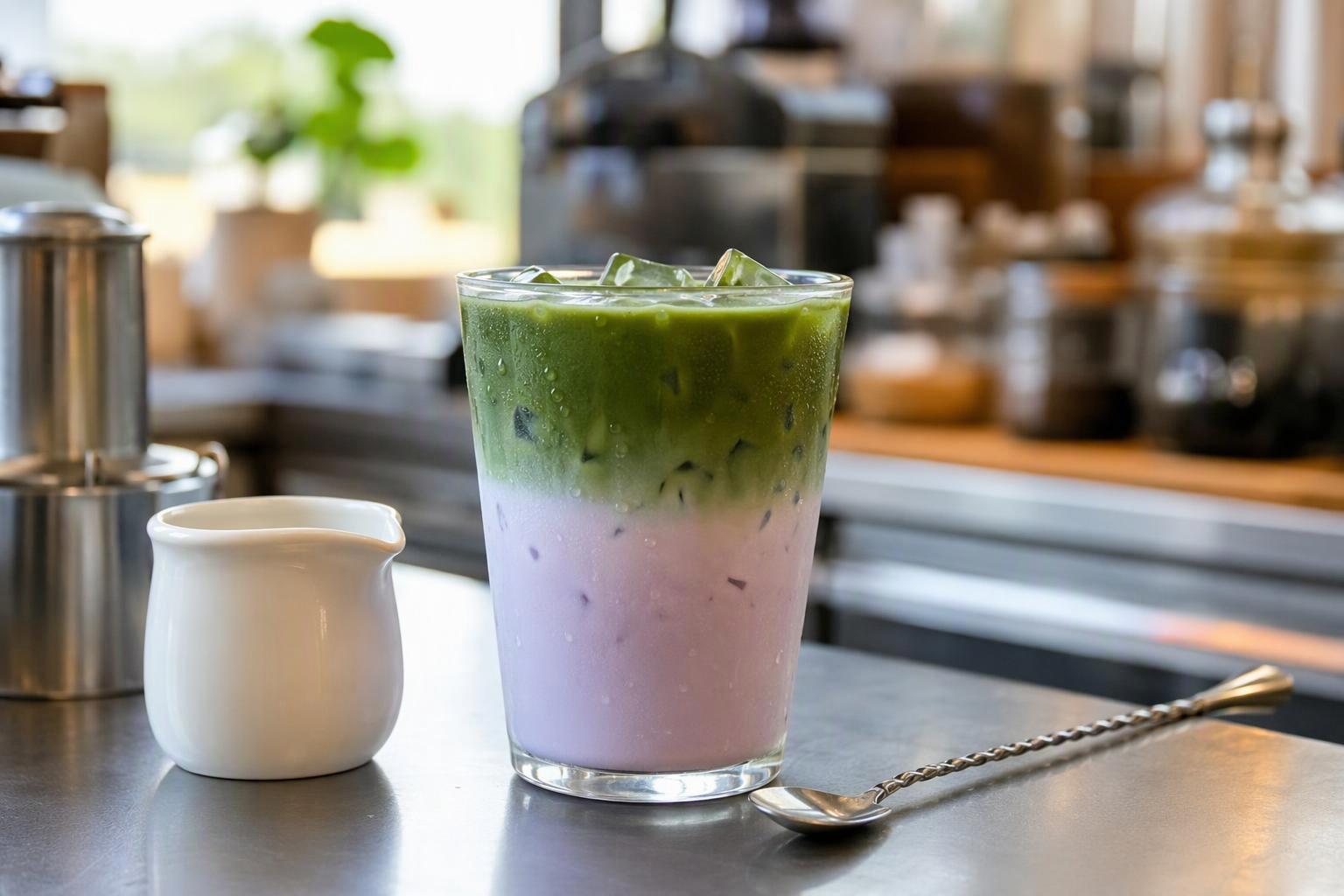
You get one repeatable spec for a 16 oz matcha taro milk tea: grams for the taro base, grams for the matcha, the pour order that keeps the two layers apart under a sealed lid, and the cost math that tells you what to charge. The problem is that the published recipes disagree on the taro dose, and none of them were written for a drink that sits in a delivery bag for 10 to 15 minutes. Every number below traces to a named manufacturer spec or a cited source, and the two places where no source exists are labelled as operating rules rather than presented as measured values. By the end you will be able to pick a matcha grade, choose between taro powder formats, build the cup to the gram, layer it so it survives a lid, run a dairy-free version, price it, and batch it through a Friday rush.
What is matcha taro milk tea and why would a shop add it to the menu?
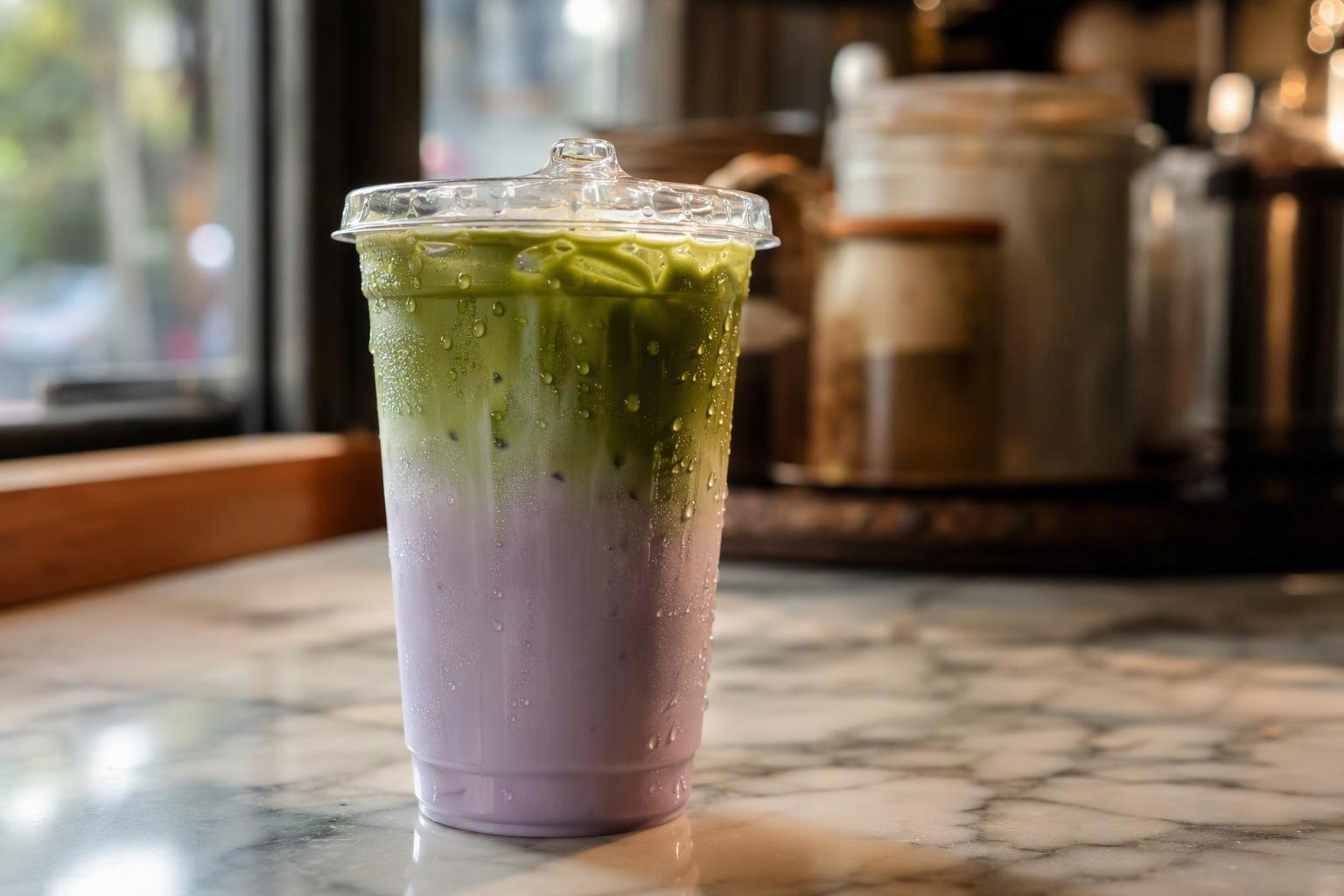
Matcha taro milk tea is two separate flavour systems in one cup: a taro-flavoured powder base built on non-dairy creamer and sugar, and a matcha layer made from ground tencha. They are not the same ingredient and they do not behave the same way, which is why the build order matters more here than in a single-flavour milk tea.
The taro half is a premix. The ingredient line on a standard taro powder reads non-dairy creamer, sugar, glucose, taro powder and FD&C colours, with the colour set typically Red #40, Red #3 and Blue #1 (Bossen, live 2026). That declaration tells you two things an operator needs: the drink is already sweetened and already coloured, so you are buying convenience and consistency, not raw taro.
The matcha half is a different product category. Matcha is tencha ground fine; anything made from other tea is green tea powder (Yamamasa Koyamaen, live 2026). Tencha is shade-grown, steamed and dried without rolling before milling, which is why the powder carries the colour and the non-bitter taste that a plain green tea powder does not.
The commercial case is a flavour-segment bet, not a whole-market bet. Grand View Research puts the global bubble tea market at US$3.3B in 2025 growing at 12.7% a year, with taro as the fastest-growing flavour segment at 13.9% (Grand View Research, 2026). On the demand side, Yelp’s 2026 trend report logged ceremonial matcha searches up 210% year on year and cloud matcha up 429% (Yelp via Delish, 2025). Read those as one vendor’s market scope and one platform’s search data, not as two independent confirmations of the same number.
Pro Tip: Lock the spec before the summer menu prints. Changing the taro dose after staff have learned the cup means retraining every shift.
What matcha grade, taro format and milk should I buy?
Buy matcha on lot data, not on the word on the bag: ceremonial grade is not a protected grade, so the buying decision comes down to harvest, region, colour and lot data (Yamamasa Koyamaen
, live 2026). Ask your supplier for the harvest date, the region and a sample from the actual lot you are buying. The Japanese labelling rules name no quality grades at all, so “ceremonial” and “culinary” are marketing terms rather than regulated tiers.
Expect the matcha quote to move. Forbes reported that Japan’s tea pipeline could not keep pace with US demand, with record heat cutting tencha harvests and shade-grown acreage taking years to ramp (Forbes
, 2026). Machine-picked first-flush tencha went from about 5,400 yen a kilo to about 2.6 times that between 2024 and 2025, according to trade-press pricing (First Agri
, 2026). Treat that as supplier guidance, not a government statistic, and plan for allocation rather than stable list prices.
On the taro side you have three formats, and the trade-off is cost against colour and consistency.
| Taro format | Wholesale cost band | Colour stability | Consistency |
|---|---|---|---|
| Standard premix powder | $8–20/kg | High (FD&C colour set) | High, lot to lot |
| Clean-label taro powder | $20–35/kg | Muted, no synthetic colour | Mid |
| Fresh taro corm | Double to triple powder cost | Natural, fades | Low, cook-dependent |
Cost bands are supplier-listing ranges, not a market index (Mustea, 2025). The colour-stability column is a reasoned ranking from the ingredient declarations, not a measured score. If you want the taro matcha latte recipe to hold its purple under a lid, the premix is the format that does it.
Pro Tip: If you buy clean-label powder, taste it against your milk before you commit. Removing the creamer and colour changes both the body and the look of the finished cup.
What is the exact 16 oz build in grams?
The published doses do not agree, so the build below is a derived band with a stated method, not a copied recipe. Tea Zone’s suggested serving is 100 grams, with 10 servings per 2.2 lb container (Tea Zone, 2024). Bossen’s own recipe card specifies taro powder for a 16 oz drink and a 16 oz smoothie (Bossen, live 2026). That is a 36 g versus 100 g spread on the same drink size, which is the single most useful thing to know before you write a spec.
Here is the build, with the taro dose set by how forward you want the flavour.
| Component | Taro-forward | Balanced | Matcha-forward |
|---|---|---|---|
| Taro powder | 30–35 g | 25–30 g | 20–25 g |
| Matcha | 4 g | 4 g | 4 g |
| Milk or non-dairy creamer | 200 ml | 200 ml | 200 ml |
| Sweetener | to taste | to taste | to taste |
| Ice | to fill line | to fill line | to fill line |
The three taro bands are this article’s build, derived from the two published doses, and are not measured values. The 4 g matcha dose is also the article’s build. The only manufacturer-style matcha dose verified here is Harvard’s roughly one teaspoon of matcha per cup (Harvard Health, 2024).
One limitation to write into your spec sheet: taro powder brands vary in sugar content and colour, so a 30 g dose from one supplier is not a 30 g dose from another. Weigh the first cup from every new lot and adjust before service.
Key Takeaway: The 36 g and 100 g figures are both manufacturer-published, and they describe different products. Start at the balanced band, then move up or down one step based on customer feedback.
How do I layer it so it survives a lid and delivery?
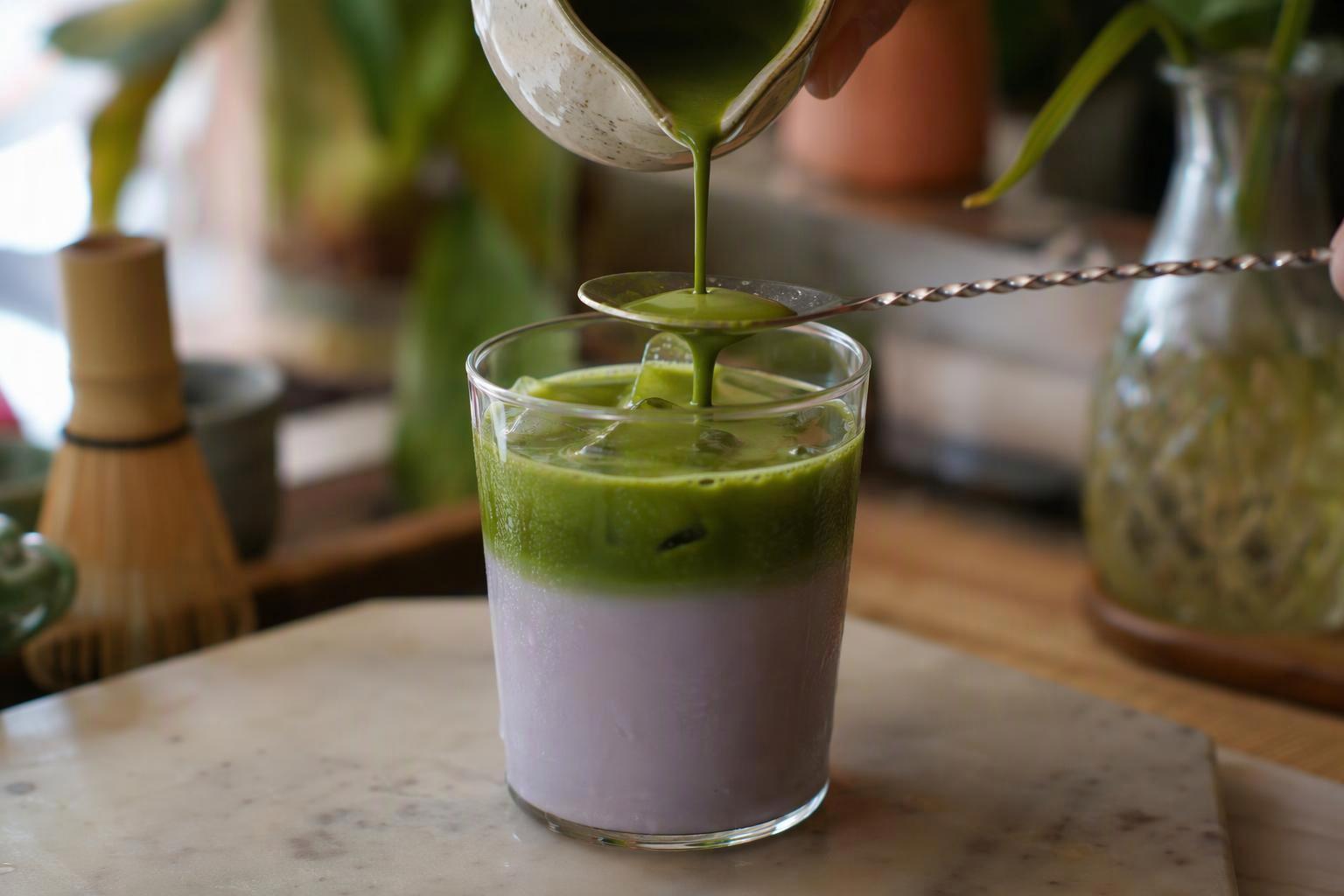
Layer the taro base first, chill it, then pour the matcha over the back of a bar spoon so it floats. The reason is physical: taro pulp settles, which is why high-pressure homogenisation at 30 MPa was used to improve suspension stability in a sedimentation test (Yu et al., Journal of Food Engineering, 2016). A shop blender does not reach 30 MPa, so you cannot homogenise your way to a stable suspension. You manage it with temperature and pour technique instead.
- Build the taro base with cold milk and ice, and stir until the powder is fully dissolved with no dry pockets at the bottom of the cup.
- Chill the base for at least a few minutes. A cold base is denser and holds the matcha layer longer.
- Sift the matcha to break up clumps, then whisk it with a small amount of water into a smooth paste before thinning it.
- Pour the matcha over the back of a bar spoon held just above the taro surface, moving the spoon up as the layer rises.
- Seal and hand off. Do not shake, and do not let the cup sit on the counter before it goes in the bag.
The 10 to 15 minute delivery window and the serve-immediately instruction are operating rules reasoned from the sedimentation mechanism, not cited figures. No published operator hold-time standard for a layered matcha taro drink was found, so treat the window as your own tested limit and verify it with a cup left on the counter.
Warning: Once the layers merge, they do not separate again. A shaken cup is a purple-green drink, not a layered one, and no amount of re-pouring fixes it.
How do I make a dairy-free or clean-label version?
Swap the dairy and the synthetic colour, and keep everything else the same. The nine major allergens are milk, eggs, fish, crustacean shellfish, tree nuts, peanuts, wheat, soybeans and sesame, and taro and tea are not on the list (US FDA, live 2026). That means the allergen risk in this drink comes from the milk or the non-dairy creamer, not from the taro or the matcha.
The declaration rule matters for your menu board. Labels must declare the food source of each major allergen, either in parentheses after the ingredient, as in “whey (milk)”, or in a “Contains” statement (US FDA, live 2026). If your taro powder’s creamer contains casein or sodium caseinate, that is a milk derivative and it belongs on the label.
Do not promise an allergen-free drink. The law does not cover food handed over for immediate consumption, and shared-equipment cross-contact means a shop cannot guarantee allergen-free drinks (US FDA, live 2026). Chain operators already publish this: Sharetea’s nutrition page warns that shared equipment means no drink can be called allergen-free (Sharetea, live 2026). Copy that posture rather than fighting it.
If you want to claim organic, budget for the paperwork. Anything sold as organic has to come from a certified operation, and every certified organic shipment entering the US needs an NOP Import Certificate with a certified importer (USDA AMS, live 2026). That is a real cost line on an imported Japanese matcha, not a label you can add at the counter.
Pro Tip: Test the dairy-free build with the same taro dose. Oat and soy milks carry different body, and a dose that reads balanced in dairy can read thin in oat.
What does it cost per cup and what should I charge?
At a $6.50 menu price, the two flavour components cost roughly $0.53 to $1.08 per cup, and the rest of the build carries the margin. Matcha at 4 g and $60 to $90 per kg works out to $0.24 to $0.36. Taro at 36 g and $8 to $20 per kg works out to $0.29 to $0.72. Those two bands are built from published wholesale ranges and are illustrative, not a measured cost study.
The menu price band comes from chain listings. Premium matcha drinks commonly land between $6.00 and $7.50 for a 12 oz cup, with operator margin guidance in the 70% to 85% gross margin range (Japanomars, 2026). Treat both as supplier guidance rather than an industry standard, because the source sells matcha.
Two line items are missing from that math on purpose. No defensible US wholesale band for tapioca pearls, brown sugar syrup or 16 oz cup, lid and straw sets was found in this research, so plug in your own invoice numbers rather than a borrowed figure. The same applies to fresh taro corm: the only cost estimate available is a Taiwanese supplier’s double-to-triple comparison against powder (Mustea, 2025), with no US primary source behind it.
Pro Tip: Run the math at your worst matcha quote, not your best. If the cup still clears your target margin at the top of the band, the menu price holds through the next allocation cycle.
How do I batch and hold it through peak service?
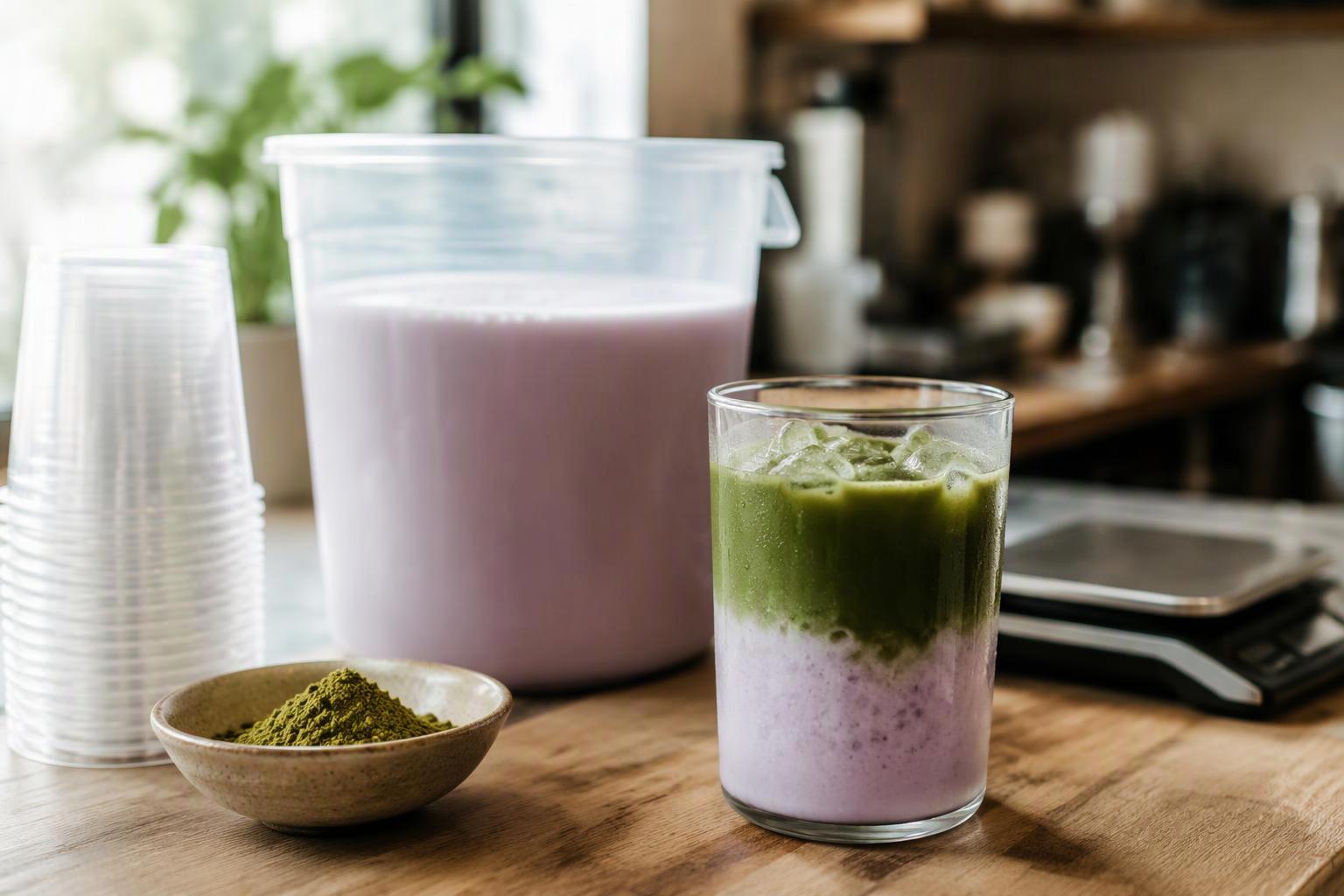
Batch the taro base, hold it cold, and build the matcha to order. The taro base is the slow step, and it is the one that can be made ahead without hurting the drink, because the powder is a stable dry premix and the base is simply powder plus liquid.
Hold time is where the evidence stops. No published operator hold-time standard for a taro base or a layered matcha taro drink was found, so any number you see quoted is someone’s practice rather than a cited figure. Set your own limit by testing: build a quart, hold it at temperature, and taste and inspect it at intervals until the texture or the colour changes. Write that tested limit on the label and treat it as your standard.
Keep the matcha out of the batch. Matcha absorbs moisture and discolours under light, and high temperature and humidity degrade it (Yamamasa Koyamaen, live 2026). Whisking a tray of matcha in advance trades a few seconds per cup for a duller colour and a flatter taste, which is the wrong trade on a drink whose whole selling point is the two-tone look.
For the batch station: a labelled quart of chilled taro base, a digital scale, sifted matcha in a covered container, and a stack of 16 oz cups. The scale is the control point. A scoop is not a unit of measure, and the 36 g versus 100 g spread in the published recipes is exactly what happens when staff dose by eye.
Pro Tip: Put the gram card on the station wall, not in a binder. The spec only holds if it is visible at the moment someone is building the cup.
Frequently Asked Questions
Can I use fresh taro instead of powder?
Yes, with two costs attached. Fresh corm runs double to triple the powder cost per cup in the only available operator estimate, and that figure comes from a powder supplier and has no US primary source behind it (Mustea 2025). Fresh taro also brings cook labour and yield loss, and it will not hold the FD&C colour set that makes the premix layer look consistent. Taro corms are a rich source of starch with granules small enough to suit children and patients (PMC review, 2025), which is why fresh taro thickens and settles differently than a creamer-based premix.
How much caffeine is in one of these drinks?
At the 4 g matcha dose in this build, the drink lands in a calculated range of roughly 76 to 178 mg of caffeine, based on matcha running 18.9 to 44.4 mg of caffeine per gram (Kochman et al., Molecules, 2020). For comparison, an 8 oz cup of matcha tea is 38 to 89 mg, green tea is 23 to 49 mg, and coffee is 100 to 120 mg (Harvard Health,2024). The drink figure is a calculated range from the recipe, not a lab measurement of your cup.
Do I have to disclose the caffeine?
No amount disclosure is required. Restaurants and retail food establishments are not required by law to tell customers how much caffeine is in the products they serve, and the FDA encourages customers to ask (US FDA, 2024). The labelling rule that does apply is for packaged food: caffeine must appear in the ingredient list when it is added as a standalone ingredient, while caffeine inherent to tea need not be listed separately (US FDA, 2024). Nothing in the sources covers a matcha latte specifically, so treat this as the general rule.
How long can I hold the taro base?
There is no published operator hold-time standard for a taro base, so set your own by testing rather than borrowing a number. Build a quart, hold it cold, and check texture and colour at intervals until either changes, then label that limit and train to it. The mechanism behind the change is settling: taro pulp is a particle suspension, and settling is a physical property of the system (Yu et al., Journal of Food Engineering, 2016). Stirring brings the base back, but it does not reverse any colour or flavour change.
Conclusion
The build is settled once you decide three things: the taro dose band, the matcha lot, and the pour order. Start at the balanced band of 25 to 30 g taro with 4 g matcha, chill the base, and pour the matcha over the back of a bar spoon. That gets you a cup that holds its layers through a sealed lid and a 10 to 15 minute delivery window, which is the part the published recipes never solved.
The two places where the evidence runs out are worth writing into your own spec sheet rather than filling with a borrowed number. No source gives a hold time for a taro base, and no source gives a per-16 oz matcha dose from a non-selling party. Test both in your own shop and record what you find, because your tested limit is more useful than a figure from a supplier who does not run your counter.
Before the menu locks, ask a supplier for a sample of the taro format and the matcha lot you are considering, then run the build once at the balanced dose and once at the taro-forward dose. Two cups of testing tells you more about whether this drink belongs on your menu than any published recipe will. *