
Guava is one of those flavors that can quietly become a menu workhorse—bright tropical aroma, easy to pair, and (when you dose it right) it plays well in both tea-forward drinks and creamy builds.
This guide is for operators who want to add guava without adding chaos.
You’ll build a 3-item “mini menu” around one inventory driver: guava syrup:
- a guava milk tea (creamy, dessert-leaning)
- a guava fruit tea (bright, refreshing, easy upsell with toppings)
- a guava smoothie (higher ticket, great for summer)
Everything below is written as a shop-ready starting spec for a 700 ml cup—with the real-world tradeoffs (COGS, speed, consistency) so you can decide if guava belongs on your line.
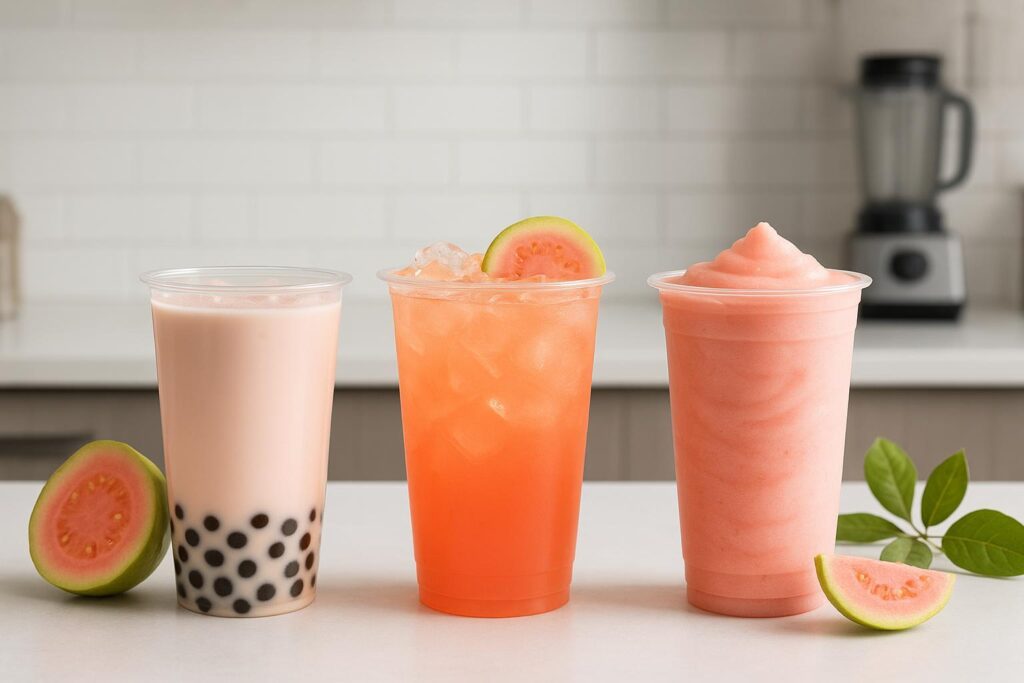
The “one base, three drinks” framework (why it works)
If you’re running a small team, the fastest way to add LTOs is not “three new recipes.” It’s one base + three formats.
With guava syrup, your “base” is essentially two decisions:
- your guava dose (how much syrup per cup)
- your balance tools (acid + tea strength + dairy choice)
Then you change the format:
- milk + tea = milk tea
- tea + water + ice = fruit tea
- blender + fruit/ice/liquid = smoothie
The operator upside
- fewer new SKUs
- faster training
- consistent flavor
- easier forecasting (you’re mostly forecasting guava syrup)
The operator downside (what can go wrong)
- if your guava syrup runs very sweet, it can dominate and turn “candy-like” fast
- if your tea is weak, guava tastes like perfume + sugar water
- if you’re using dairy, guava acidity can expose “split” or chalky texture problems if you shake too aggressively or pick the wrong milk
We’ll solve those as we go.
Before you launch: set your 700 ml build system once
A 700 ml spec only works if the team builds it the same way every time.
Standardize these 4 things
- Ice weight (or fill level)
- If you can: weigh ice (most consistent).
- If you can’t: use a consistent fill line.
- Tea strength Your tea base should be stronger than “drinking tea” because it gets diluted by syrup + ice (and milk, if used).
- Your sweetness scale Pick a default (I recommend 75% as the menu default for fruit-forward drinks). Then standardize how staff changes sweetness.
- Your measuring tool Use a jigger or marked cup. Don’t free-pour guava syrup.
Pro Tip: Add syrup before ice so it mixes cleanly (an “ice-first” build can make syrups harder to dissolve). One standardization guide explicitly calls out syrup-before-ice for better mixing (YenChuan’s notes on drink standardization
).
Your guava syrup “base” (what to test in 10 minutes)
Because you’re using guava syrup, your base isn’t a batch. It’s a dosing rule.
Starting guava dose range (700 ml)
- Fruit tea range: 45–70 ml guava syrup
- Milk tea range: 35–60 ml guava syrup (milk amplifies sweetness perception)
- Smoothie range: 40–70 ml guava syrup (depends on added fruit and dairy)
Why the ranges are wide:
- syrups vary massively in sweetness and thickness
- toppings (pearls/jellies) add carryover sweetness
- some shops run heavy ice (more dilution), some don’t
If you’ve never built fruit teas as “tea + syrup,” Cup 49’s fruit tea guidance is a good sanity check for syrup range thinking (they recommend a syrup dose range per serving and adjust to taste) (Cup 49’s fruit tea build guide
).
Convert any 16 oz SOP into 700 ml (so you’re not guessing)
A lot of shop SOPs online (including your own older recipes) are written for 16 oz / ~473 ml. Here’s the conversion you’ll use again and again:
- 700 ml ÷ 473 ml = 1.48×
So if an SOP says 30 ml syrup in 16 oz, your 700 ml starting point is:
- 30 ml × 1.48 ≈ 45 ml
This is exactly why many 16 oz guava builds that call for 30–45 ml syrup become roughly 45–65 ml at 700 ml.
If you want an SOP example that gives a guava syrup range and a clean build order, BubbleTeaSuppliers has one in their guava SOP library (Matcha guava fruit tea SOP
).
Drink 1: Guava milk tea (700 ml shop spec)
This is the “creamy guava” anchor drink. It should taste like: tropical, soft, slightly floral—not like melted guava candy.
Guava milk tea — 700 ml build (default 75% sweetness)
Ingredients (per 700 ml cup)
- Strong brewed tea base (jasmine green or light oolong), chilled: 220 ml
- Guava syrup: 45 ml
- Milk (choose one): 160 ml
- dairy whole milk for body, or
- barista oat for stability
- Simple syrup / fructose: 0–10 ml (only if needed after tasting)
- Ice: 260 g
- Optional topping: tapioca pearls 60 g (or coconut jelly 60 g)
Build steps (fast service)
- Add topping to cup (if using).
- Add 45 ml guava syrup.
- Add 160 ml milk.
- Add 220 ml chilled tea.
- Add ice (260 g).
- Shake 8–10 seconds; serve.
Done when: drink color is uniform and the cup is frosty.
Why this works
- Milk rounds guava’s edges, so you can keep the guava dose moderate.
- A floral tea base (jasmine/oolong) keeps it from tasting flat.
Common failure modes (and fixes)
- Too sweet / “candy guava” → drop guava syrup by 10 ml next batch; also reduce topping sweetness.
- Weak / perfume-y → strengthen tea base or increase tea volume by 20–30 ml.
- Splitting / grainy dairy feel → switch to barista plant milk, reduce shake intensity, and keep tea fully chilled.
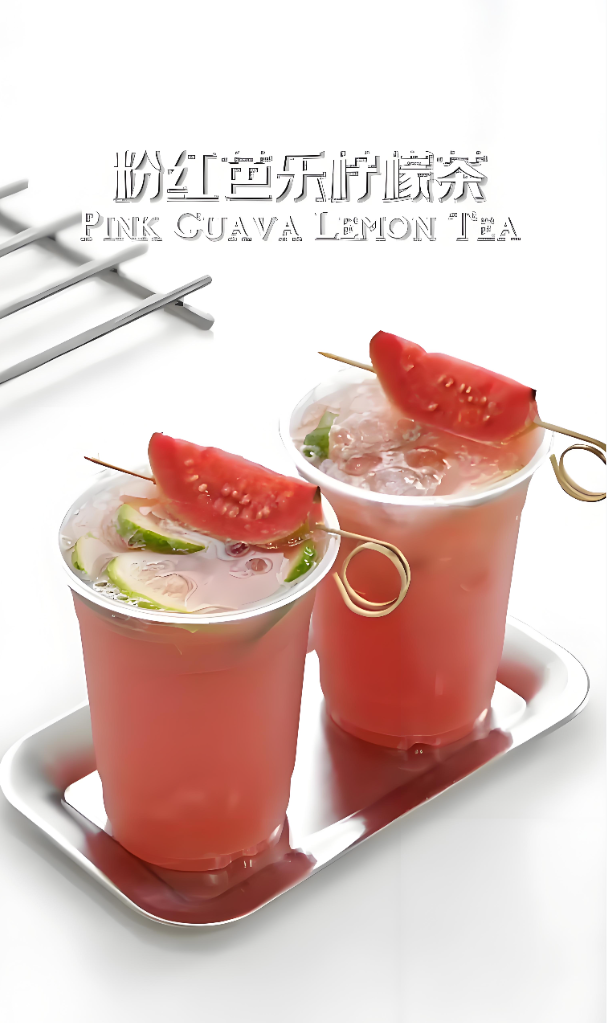
If you want deeper formulation thinking (pH/°Brix, dairy buffering, and why guava can behave weirdly with milk), BubbleTeaSuppliers has a useful operator-level reference here (guava milk tea formulation notes
).
Drink 2: Guava fruit tea (700 ml shop spec)
This is your “high velocity” drink—fast to build, easy to customize, and forgiving on the line.
Guava fruit tea — 700 ml build (default 75% sweetness)
Ingredients (per 700 ml cup)
- Jasmine green tea (or green tea), chilled: 300 ml
- Guava syrup: 60 ml
- Fresh citrus (lime) juice: 10 ml
- Water (or more tea if you want it tea-forward): 70 ml
- Ice: 260 g
- Optional topping: popping boba 60 g or aloe 60 g
Build steps
- Add topping to cup (optional).
- Add 60 ml guava syrup.
- Add 10 ml lime juice.
- Add 300 ml chilled tea + 70 ml water.
- Add ice (260 g).
- Shake 8–10 seconds; serve.
Done when: aroma is bright, not heavy; drink stays flavorful as ice melts.
Why citrus is non-negotiable here
Guava syrup can read “soft” and sweet. A small citrus hit makes it taste fresh instead of syrupy.
For pairing inspiration (and to keep your menu copy coherent across fruit flavors), BubbleTeaSuppliers’ fruit combo guide frames guava as a strong pairing candidate with citrus notes (fruit bubble tea combinations guide
).
Drink 3: Guava smoothie (700 ml shop spec)
This is where you raise ticket size—especially if you position it as “tropical + creamy” rather than a thin slush.
Guava smoothie — 700 ml build (default 75% sweetness)
Ingredients (per 700 ml cup)
- Guava syrup: 55 ml
- Milk (or oat milk): 120 ml
- Water: 60 ml
- Ice: 300 g
- Frozen fruit (choose one): 120 g
- mango (tropical body) or
- strawberry (brighter, more pink)
- Optional: yogurt 60 g (adds body, but test for acidity interactions)
Blend steps
- Add liquids + syrup first: 55 ml guava syrup + 120 ml milk + 60 ml water.
- Add frozen fruit.
- Add ice (300 g).
- Blend 20–25 seconds (or to your station standard).
Done when: no ice chunks; texture is thick enough to hold for 60–90 seconds without separating.
For a smoothie-style guava build example (with measured ingredients and a layered presentation), BubbleTeaSuppliers shows a detailed avocado + guava concept that’s useful for “premium version” thinking (avocado guava smoothie example
).
Sweetness control (make it trainable)
Don’t let staff improvise “50% sweetness.” Give them a rule.
A simple syrup delta system (per 700 ml)
Use your default as 75%.
- 50%: subtract 15 ml guava syrup
- 75%: default spec
- 100%: add 10 ml guava syrup
Why asymmetrical? Because guava syrups are often already sweet; going from 75% to 100% needs a smaller jump to avoid “candy.”
⚠️ Warning: Toppings add sweetness. If you’re adding pearls or sweet jellies, consider dropping guava syrup 5–10 ml on the default build.
Ops: batching, station setup, speed
Even though guava is syrup-based, the ops work is still real—mostly in tea brewing, labeling, and training.
Batch tea (the boring part that makes the drink good)
- Brew tea consistently (same grams, time, water temp).
- Cool fast and keep it cold.
- Cup 49 notes that brewed tea can be refrigerated for short-term use (in their kit context). Your local food code and your own QA should set the real rule, but the operational point stands: brew intentionally, label, and keep it cold.
Station setup (minimum viable)
- 1 squeeze bottle: guava syrup
- 1 squeeze bottle: simple syrup (optional)
- 1 citrus bottle: lime juice
- 2 tea bases in labeled pitchers
- 1 jigger set (30/45/60 ml)
Training checklist (what your staff must nail)
- Measure syrup. No free-pour.
- Syrup before ice.
- Shake time: 8–10 seconds (not 3 seconds during rush).
- Call out toppings (they change sweetness).
COGS and waste: the tradeoffs you should actually think about
The good news
- One syrup drives three drinks.
- Your additional SKUs can be minimal (lime + one frozen fruit).
- The smoothie shares the same syrup, so it’s not a “new station” so much as a new spec.
The real risks
- Over-syrup = margin loss + returns Guava is pleasant when it’s aromatic. It’s exhausting when it’s sticky-sweet. If you’re throwing out remakes, your “easy LTO” isn’t easy.
- Weak tea = you compensate with syrup This is the most common operational mistake: tea isn’t brewed strong enough, so staff adds syrup to “fix flavor.” That’s how drinks get too sweet and still taste flat.
- Too many toppings = sweetness drift Toppings are great for margin, but they make flavor inconsistent if you don’t set a topping default.
A simple cost-control approach
- Pick one default topping for the fruit tea (ex: popping boba or aloe).
- Keep milk tea as “classic pearls” only.
- Keep smoothie as “no topping by default,” then offer one add-on only.
This keeps your staff from turning a 3-drink mini menu into 12 variants you can’t forecast.
Next steps: launch it as a 7-day pilot (and keep the decision reversible)
Here’s a low-risk rollout:
- Pick one tea base (jasmine green is the safest).
- Train the three builds exactly as written.
- Run a 7-day pilot.
- Track three numbers daily:
- units sold per drink
- % orders at 50/75/100 sweetness
- remake count (and why)
If you want more SOP references and guava pairing ideas to expand from, use BubbleTeaSuppliers.com as your resource hub—start with their guava SOP posts and fruit tea combinations.